


By all accounts education wasn’t a top concern among voters in this year’s midterms. It rarely is. To find a national election where the schools were a major campaign issue, you’d have to reach back to the halcyon days of 2000. That year, as George W. Bush and Al Gore debated how to spend a budget surplus and a bipartisan consensus around standards-based education reform was taking hold, roughly one in 10 Americans told Gallup that education was the country’s most important problem. A quarter century later, despite record-low satisfaction with the nation’s public schools, closer to one in 100 Americans said it was their chief concern.
Yet this year’s historic blue wave has the potential to reshape both the politics of education and what remains of the education reform agenda built over the past two decades.
Much has already been written about what November’s results portend for school choice, particularly the future of the new Federal Scholarship Tax Credit. Rather than rehash those high-profile speculations, I focus here on other consequences that have received less attention from the election postmortem commentariat.
A New Education Politics?
For decades, Democrats owned the public’s trust on education as a policy issue. But recent developments have given Republicans reason to think education could be a winning issue for them, too. Since the pandemic, voters have been split when asked which party they trust to do a better job on education. Republicans have a compelling case to make: the “southern surge” in student achievement; their (now largely vindicated) push to reopen schools to mitigate learning loss during the pandemic; and the party’s winning positions on preserving advanced courses in middle and high schools, limiting instruction about sexuality in the early grades, and restricting participation in girls’ sports based on biological sex—positions that put Democrats on the political defensive.
Republicans may have capitalized those post-pandemic cultural fights (to wit, voters in reliably Democratic Colorado and Washington just approved restrictions on transgender participation in high school sports), but they did little to take advantage of their more pragmatic education accomplishments. When the dust settled a few days after election eve, the only Mississippi miracle was Democrat Scott Colom’s historic upset over a GOP incumbent, making him the first Black senator from the deep-red state since Reconstruction.
In other words, rather than touting the real strides made by the party in refocusing on academic excellence—the science of reading, defending meritocracy, etc.—the GOP let its MAGA wing jettison conservative incumbents in places like North Carolina and Louisiana and embrace the unsavory elements of the populist right, who seemed less interested in things like student performance and school choice.
This electoral stupidity was especially glaring in Texas, where Republican candidate Bo French complained about South Asian students celebrating a University of Texas football victory, portraying them as foreigners displacing American students. Instead of celebrating the success of hardworking kids admitted to the state’s flagship university under a largely race-neutral admissions system that Republicans had championed for decades, the party found itself alienating some of the very minority voters it had successfully courted just two years earlier.
Even if these unforced errors made little difference amid the larger anti-incumbent wave that swept Republicans out of office from Maine to Mississippi, they still amounted to political malpractice. That the GOP didn’t have a disciplined and coherent message about academic achievement at a time when southern red states have demonstrated remarkable gains while blue states still struggle to recover speaks volumes about the state of education politics today.
The Left Tries Pragmatic Politics
Republican readers may be wondering why Democrats and their union allies paid no price for running candidates from the party’s far-left Democratic Socialists of America wing.
It’s true that the DSA had a remarkable election season, and we’ve certainly entered an era when the socialist label is no longer the political liability it once was. After all, six DSA-backed candidates won U.S. House seats. With New York City already governed by a socialist mayor and Washington, D.C., and Los Angeles set to follow, it’s tempting to conclude that the 2026 election marked a decisive shift toward the DSA and away from moderates and Democrats for Education Reform types, with teachers unions helping lead the leftward lurch.
There is some evidence for it. As I documented earlier this year, Democratic voters’ net favorability toward teachers unions has surged from barely positive during the Obama years to more than +60 in recent surveys. This summer, an investigative report by Parents Defending Education made the case that DSA activists were successfully infiltrating schools, school boards, and teachers unions to advance a far-left agenda.
But a closer look at the unions’ behavior in the primaries earlier this year paints a more complicated picture of their relationship with the DSA wing of the party. For one thing, there’s a difference between the DSA seeking to harness the unions’ electoral and organizational muscle and the unions actually offering it, especially on a national scale. The best indicator of the teachers unions’ political priorities comes when they are forced to choose between a DSA insurgent and an established incumbent ally in a contested Democratic primary, something this year’s election gave us a direct opportunity to observe.
Start with the six DSA-backed candidates elected to Congress. In the primaries, teachers unions endorsed just one of those six candidates. In the other races, they either backed non-DSA candidates or declined to endorse anyone. The endorsement activity of the New York State United Teachers (NYSUT) offers another case in point. Two DSA-backed candidates won congressional primaries in the Empire State despite not having the support of NYSUT. The union backed incumbent Adriano Espaillat over challenger Darializa Avila Chevalier and Antonio Reynoso, a longtime labor ally, over Claire Valdez in their unsuccessful campaigns.
The unions were similarly ambivalent in statewide races in the heartland. In Michigan, for example, the Michigan Education Association sat out the Democratic Senate primary, endorsing Abdul El-Sayed only after he won the nomination. And in Wisconsin, the unions’ endorsement decision in the gubernatorial primary was arguably more consequential, given their long campaign to repeal Act 10, the 2011 law that gutted collective bargaining for teachers. Last April, the Wisconsin Education Association Council (WEAC) chose not to support DSA darling Francesca Hong. When Milwaukee County Executive David Crowley narrowly defeated her, WEAC subsequently endorsed him in the general election—a pragmatic move that saved them the difficulty of courting Crowley’s support for an Act 10 repeal had they first cast their lot with Hong, his strongest opponent.
A broader look at state legislative primaries across the country tells a similar story. I examined 41 contests, many of them in New York, where both the DSA and a teachers union made an endorsement. Unions endorsed 14 of 16 DSA incumbents but just one of 11 DSA challengers, siding with the sitting legislator in seven contests.
The contrast in approaches to establishment incumbents—the teachers unions toward Democratic candidates on the left and the MAGA wing toward GOP candidates on the right—is telling. While the unions frequently backed more mainline Democrats against challengers from the party’s socialist left, Trump and his allies were willing to push aside reliably conservative Republican incumbents who had simply fallen out of favor with the president. In Louisiana, Senator Bill Cassidy, the senior Republican and chair of the Senate committee overseeing education policy, lost his primary after Trump endorsed a challenger and repeatedly attacked him. Four-term Texas Senator John Cornyn was defeated by Trump-backed Ken Paxton in the Republican primary, and North Carolina Senator Thom Tillis chose retirement rather than face a potential Trump-endorsed primary challenge.
To be sure, the DSA’s ambitions are real, and in large urban districts with extremely progressive rank-and-file members, a symbiotic relationship with unions makes sense. But the rise of democratic socialism does not ensure the capture of the teachers unions. If anything, the 2026 midterms suggest pragmatism is alive and well in union headquarters.

A Mandate for Progressive Education Change?
With that said, if Democrats and their union allies over-read this election as a mandate for a progressive education agenda, they may find themselves back on the outskirts of power in a hurry. This is, after all, the era of “unstable majorities,” as Stanford University political scientist Mo Fiorina is keen to remind us.
Indeed, not all outcomes in November amounted to blue dreams and red nightmares, even in education. Voters passed property-tax limits in several states, including a constitutional amendment in Florida, that will constrain education budgets going forward. Ballot measures restricting participation in high school sports to biological sex categories and an anti-affirmative action campaign in Wisconsin also went in the conservatives’ direction, complicating any claim that this election was a clear progressive mandate for the schools.
Chicago offers a cautionary tale for the unions and the political left. At the urging of the Chicago Teachers Union (CTU), and with the enthusiastic support of Brandon Johnson, formerly a CTU organizer and now the city’s mayor, Springfield abandoned mayoral control in favor of a 21-member elected school board, which held its first full slate of elections this November.
The anti-incumbent backlash that hurt Republicans nationally went squarely against the Democrat Johnson and the CTU, whose close governing alliance had become a liability in a city with public schools facing structural deficits, falling enrollment, and half-empty buildings. Both the mayor and the union are now about as unpopular with Chicago voters as Donald Trump is nationally. Earlier this month, Johnson’s CFO resigned. The union’s failure to win control of the newly elected board was especially striking given how long it had campaigned for one and how well teachers unions tend to perform in school board elections. With the business community’s slate narrowly outpacing the union’s, the nation’s fourth-largest district looks headed for more gridlock ahead of the February 2027 mayoral election. Johnson shows every sign of seeking reelection, but it’s hard to see how the school board election results comport with letting the CTU’s closest ally hold onto the keys to City Hall for another turn at the wheel.
If 2026 offered no mandate for the unions to pursue an unabashedly progressive agenda, school board elections in Florida offered a reminder of how education politics usually work. Here I can offer something more than reading tea leaves. For several years, I’ve been building a dataset that matches the published school board endorsements of the Florida Education Association (the state’s largest teachers union) with election results compiled by the Florida School Boards Association, going back to 2010.
School board elections in Florida are nonpartisan, and many are settled in August primaries, when turnout is exceptionally low. Teachers unions, which are organized and paying attention when almost no one else is, tend to do well in such environments, even in a state that has grown reliably Republican. Between 2010 and 2020, for example, FEA-backed candidates won nearly two-thirds of the seats where the union made an endorsement. Then came 2022. At the height of his political power, Ron DeSantis did something no Florida governor had done in before him: He endorsed a slate of roughly 30 school board candidates. In the 19 races where his picks went head-to-head with the union’s slate, the governor’s won 15. These were seats where FEA-backed candidates had won about three-quarters of the time over the previous decade. That November, DeSantis was reelected by nearly 20 points. At the time, the gambit looked like the future of education politics in red America.
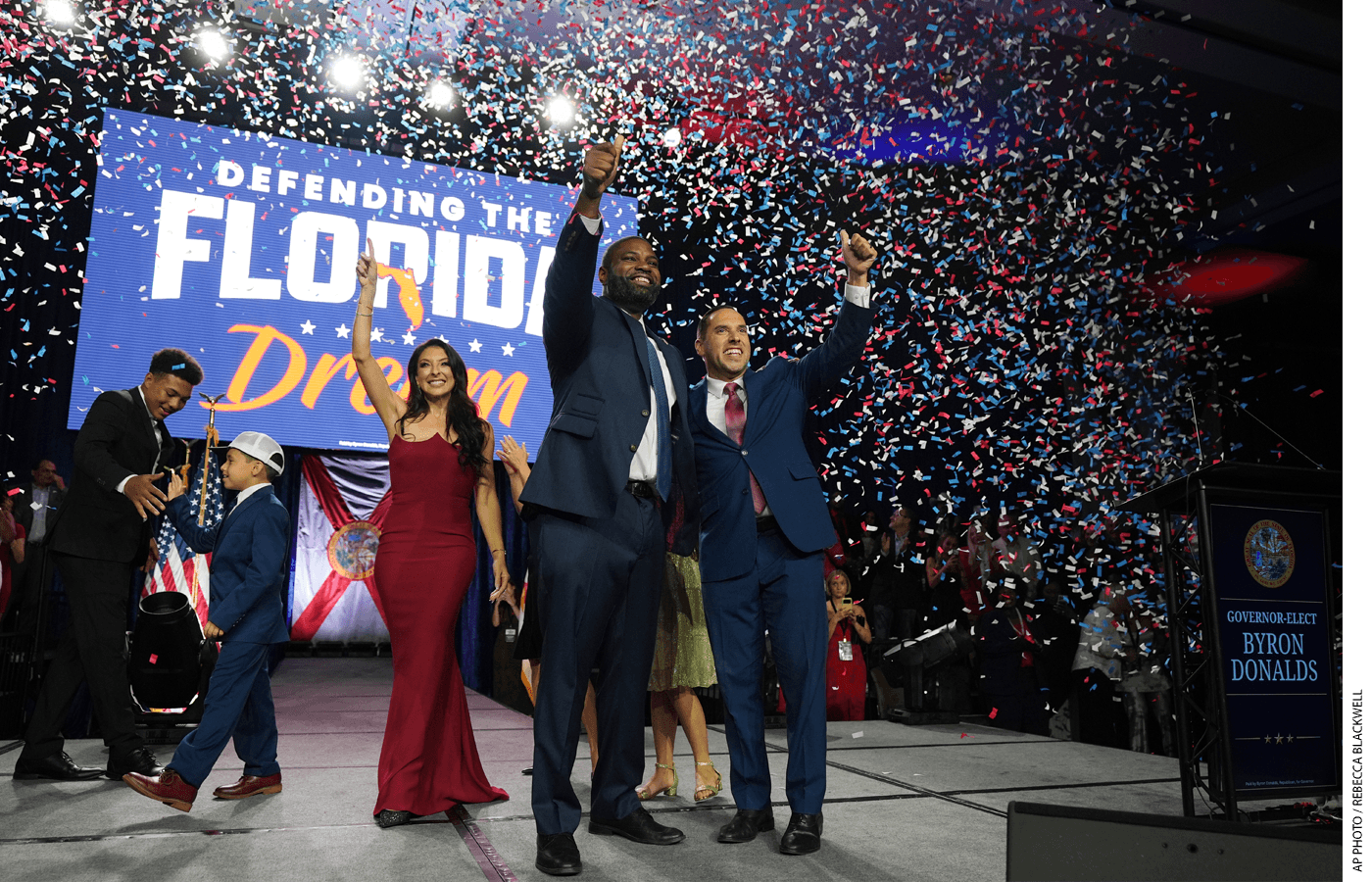
Fast-forward to this year’s election, when the DeSantis counterweight to the teachers unions was gone. The governor, now a lame duck, endorsed no slate of school board candidates, and his Republican successor, Byron Donalds, narrowly held the governor’s mansion. The union, for its part, went right back to doing what it had historically done. By my count, FEA-endorsed candidates won about three of every four seats they contested. To be fair, the FEA endorsed in fewer races than in any midterm year since at least 2010 and steered clear of most of the fights it had lost in 2022. Still, the union regained some of its traditional electoral advantage, even as deep-red Florida grew a little paler overall. Patience, not insisting on ideological purity, is what brought the FEA back in the Sunshine State.
Reform Retrenchment
Perhaps the deepest irony of this year’s midterms is that an election that had almost nothing to do with education policy may nevertheless upend three of the most consequential experiments in school reform since No Child Left Behind. The political reversals of November have made collective bargaining reform in Wisconsin, teacher pay and evaluation reform in Washington, D.C., and state takeover and reform of two major Texas school districts vulnerable to retrenchment.
Wisconsin. Act 10 has given local school districts the flexibility to rein in costs and experiment with teacher pay reform since it became law in 2011. It now faces a high likelihood of reversal. Former Republican governor Scott Walker’s signature reform survived only because the GOP maintained control of the state legislature after Walker’s successor, Democrat Tony Evers, gained power and sought to undo the law. This November, Democrats won both chambers for the first time since 2008, and governor-elect David Crowley, who campaigned on repealing Act 10, will have a unified government to work with in Madison. Meanwhile, a separate legal challenge is expected to reach a state supreme court that now boasts a 5–2 liberal majority. Suddenly, Act 10 is vulnerable on two fronts at once.
The law’s undoing may carry serious costs, both for student achievement and fiscal discipline. Research by Yale University economist Barbara Biasi found that Wisconsin school districts using Act 10’s flexibility to reward effective teachers attracted stronger educators and improved student achievement (see “Wisconsin’s Act 10, Flexible Pay, and the Impact on Teacher Labor Markets,” features, Summer 2023). A 2024 report from the Wisconsin Institute for Law and Liberty estimated that restoring pre-Act 10 collective bargaining arrangements could cost school districts as much as $1.6 billion annually. With enrollments declining, federal pandemic relief exhausted, and school revenue limits still in place, restoring pre-Act 10 collective bargaining rights could impose serious fiscal tradeoffs in the Badger State.
EdNext in your inbox
Sign up for the EdNext Weekly newsletter, and stay up to date with the Daily Digest, delivered straight to your inbox.
Washington, D.C. Another consequential reform experiment that now faces an uncertain future is the watershed teacher evaluation system ensconced in the nation’s capital for nearly two decades. Since 2007, D.C. has been something of a laboratory for urban education reform. Under then-mayor Adrian Fenty and schools chancellor Michelle Rhee, the city embraced mayoral control, expanded accountability, and introduced IMPACT, a teacher evaluation system that tied compensation and job security to performance rather than seniority and credentials. The reforms generated considerable backlash, but they survived Fenty’s defeat in 2010 and remained largely intact under his Democratic successors and subsequent chancellors.
They also worked. DCPS students have posted substantial gains on national assessments, and several evaluations credit Rhee’s personnel reforms for much of that progress. A 2021 Mathematica study showed meaningful improvements in student achievement, particularly in math, and researchers at Stanford and the University of Virginia found that IMPACT raised teacher performance and student achievement, especially when weak teachers were replaced with stronger ones (see “A Lasting Impact,” research, Fall 2017). Results like these won the reforms admirers across the political spectrum.
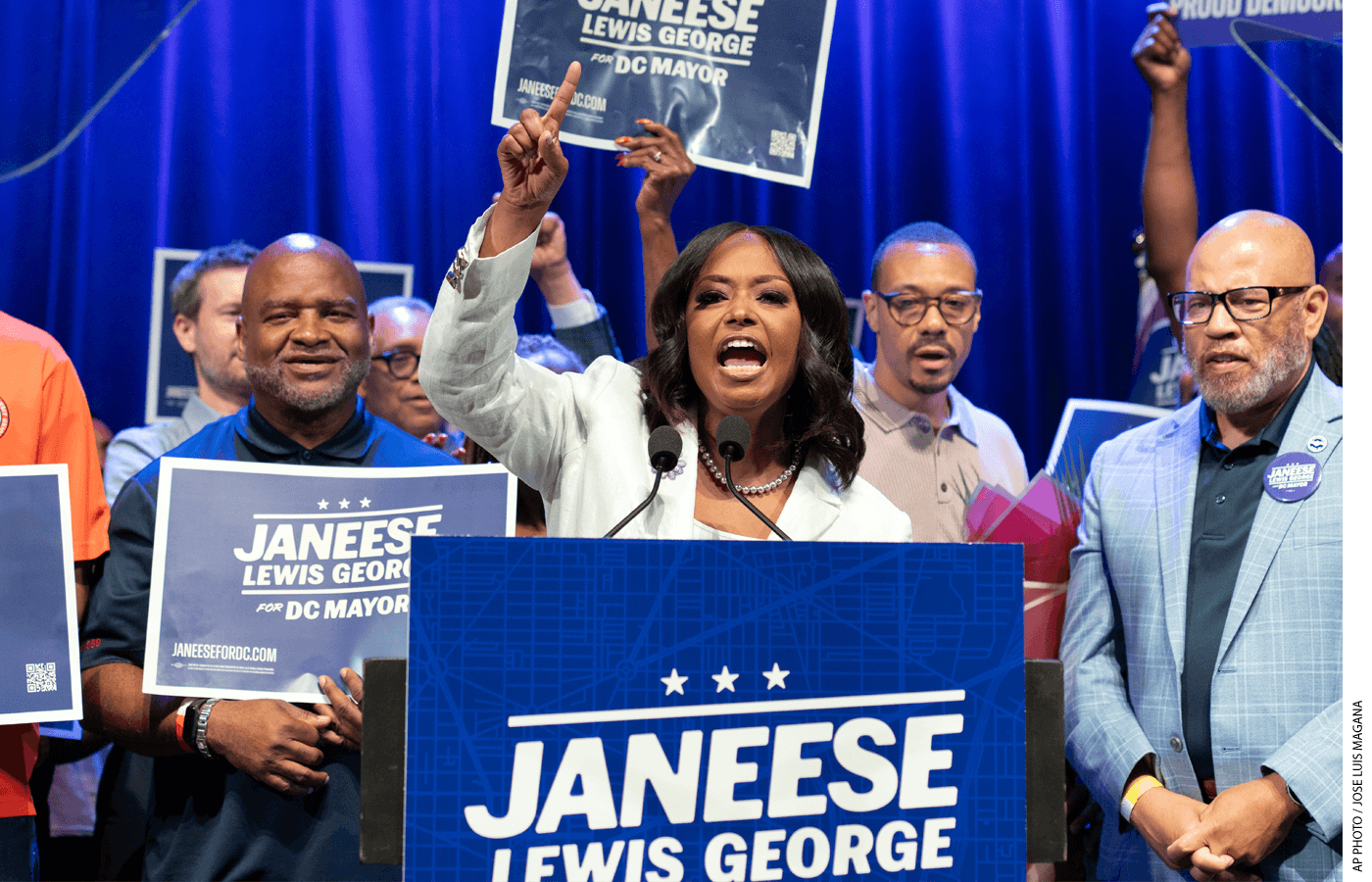
Yet Mayor-elect Janeese Lewis George, a self-described democratic socialist, secured the Washington Teachers Union’s endorsement after pledging to retreat from IMPACT. Whether she follows through may depend on whom she appoints to lead D.C. Public Schools. That choice may determine IMPACT’s fate and will likely indicate whether she governs more like New York’s Zohran Mamdani, who has so far taken a moderate tack on education policy, or Chicago’s Johnson.
Those who fear a return to the bad old days of toothless teacher evaluations should remember that campaign promises do not always translate into governing policy. Just across the Potomac, Virginia Governor Abigail Spanberger, elected in 2025 with organized labor’s backing, surprised many when she vetoed legislation expanding collective bargaining rights for public employees—a measure unions and their Democratic allies had every reason to expect her to sign.
Texas. Finally, school reform via state takeover may be another casualty of this November’s midterms. Gina Hinojosa’s upset of Greg Abbott in the Texas governor’s race almost certainly means the end of Education Commissioner Mike Morath’s tenure and, by extension, that of Houston Superintendent Mike Miles, whom Morath installed following the state’s 2023 takeover of the district.
Miles is one of the few urban superintendents to have successfully challenged the traditional system of teacher compensation, which he first did in Dallas. He introduced performance-based pay and incentives that attracted effective teachers to Dallas ISD’s lowest-performing schools, which later studies showed led to dramatic gains in student achievement (see “The Power of Performance Pay,” research, Spring 2025). In Houston, Miles undertook an even more sweeping set of reforms, overhauling everything from teacher pay and evaluation to curriculum and classroom instruction. The early results have been promising. In just three years, the number of D- and F-rated campuses has fallen from 120 to 13, while the number of schools earning As and Bs has more than doubled.
But elections aren’t a test of whether such reforms improve student achievement; they are a test of what can survive politically. As Paul Hill and Ashley Jochim warn, education reformers who bypass local politics through state intervention or takeover may achieve short-term results without building the political coalitions needed to sustain them. Houston’s takeover may well prove their point. Democratic control of education means reforms rise and fall with elections and changes in the governing coalition; it isn’t about what’s best for students.
* * *
The 2026 midterms look a lot like 1974. That year, Republicans were routed in the post-Watergate backlash that set the stage for a young Democrat from Georgia to ride a wave of anti-Republican sentiment into the White House two years later. The parallels extend to education politics, too. Then, as now, public school enrollments were plunging; today, property-tax revolts are again de rigueur, and the teachers unions and the Democratic Party have never been on better terms. One wonders how Georgian Jon Ossoff, the rising star of today’s Democratic Party, would lead his party on education. Will he don the mantle of his Peach State predecessor Jimmy Carter, who won the NEA’s first-ever presidential endorsement and repaid it by creating a Department of Education, or that of Barack Obama, who pushed his party to embrace purple reforms that the teachers’ unions found unacceptable?
As for the Republicans, can they ever get their Bush-era mojo of NCLB accountability back? Maybe not as long as MAGA remains a political force in the party that counts fealty to Trump as the beginning and end of policy debate. To be sure, establishment conservatives who remain in the party continue the steady work of advancing education policies that concern the majority of families: school choice, school safety, age-appropriate curricula, and religious liberty, to name a few. But who in the party has the political capital and the will to speak to the real gains the GOP has made in education over the last decade?
Can J. D. Vance or Marco Rubio—two of the presumptive candidates for the Republican nomination in 2028—distance themselves enough from MAGA populism to convince America that education is again one of its most important problems (as it truly is)? Or is that more likely to fall to someone like Ron DeSantis, who has already proven his education bona fides in Florida? Then there’s former Virginia governor Glenn Youngkin, a moderate who rode parental frustration with Democrats’ handling of education during the pandemic into office after his competitor famously declared that parents shouldn’t tell schools what to teach. Five years later, Youngkin is again taking aim at his Democratic successor in Richmond, Abigail Spanberger, who most recently blocked the commonwealth’s participation in Trump’s new federal school-choice tax credit. Could this Washington outsider who made education a winning issue in a blue state in 2021 do it again in 2028?
A political party is only as good as its last election, and there’s always another one right around the corner. A lot can happen in two years, but I suspect in 2028, the party of education will be up for grabs.
Michael Hartney is the Bruni Family Fellow at Stanford University’s Hoover Institution, an associate professor of political science at Boston College, and an Educational Liberty Fellow at the Institute for Governance and Civics at Florida State University.
Suggested citation format:
Hartney, M. (2026). “The Education Reset Election: Schools may not have been top of mind for voters in the 2026 midterms, but the results pose threats to reform milestones.” Education Next, 26(4), 24 November 2026.