


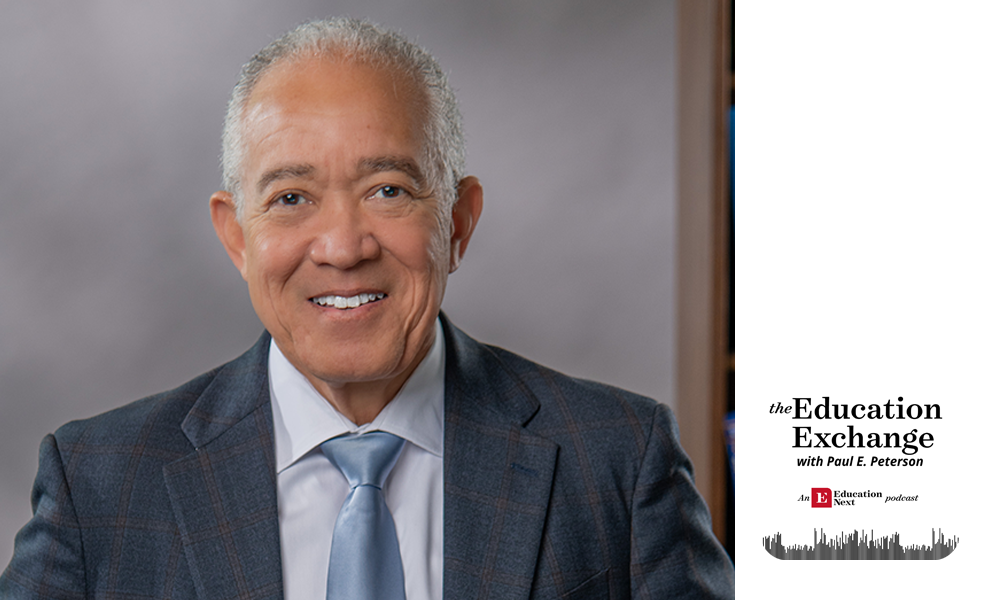
 Mike Miles, the superintendent of Houston Independent School District, joins Paul E. Peterson to discuss Miles’ new book, By Design: How to Transform School Systems.
Follow The Education Exchange on Soundcloud, Apple Podcasts, Spotify, YouTube, or here on Education Next.
— Education Next
Transcript
PAUL PETERSON, HOST:
This is the Education Exchange with Paul Peterson. I am the director of the Harvard Program on Education Policy and Governance. Thank you for joining us. Every month, several new books written by talented teachers explaining their successes in the classroom arrive at my desk. I also get books by principals about school management within a particular building regularly, and I’ve had books from online providers and chief executive officers. But for the first time, I have a book written by a school superintendent of a big city school system while in office. So, the superintendent is Mike Miles. His recently released book is entitled By Design, How to Transform School Systems. And I’m just thrilled to have Superintendent Miles with me on the Education Exchange today. So, thank you, Superintendent, for joining me.
MIKE MILES: Thanks, Paul. Happy to be here.
PETERSON: Superintendent, most people with large responsibilities keep their thoughts to themselves until they retire or move on. What prompted you to write By Design, How to Transform School Systems?
MILES: So, I wrote the book over Thanksgiving, Christmas and spring break. So, most of it was done during that time. So those are the times I had to reflect. And I thought I’d just put down some of the thoughts because we are in the middle of a large system transformation in Houston Independent School District. And I thought I would capture those thoughts. And also, you know, I’m getting older, Paul, and I’m starting to turn a little bit of my attention towards helping the next generation of school superintendents and senior leaders on cabinet to do what I think makes the most sense on how to transform a large school system. We are at a nexus for American public education. I think the future is moving fast, of course, and we haven’t, as a profession, been very successful over the last 20 years in holding to the promise of America, of giving every kid a great education. We haven’t closed the achievement gaps or narrowed them significantly. And our proficiency rates, if you look at NAEP, NWEA, any of these nationally normed assessments, have not risen. So, we need to do both things now. I’ve always been a person interested in serving the public interest and also the underserved part of that public interest. And I think we’ve gotten some answers, not all the answers. We don’t have the answers for every district, but for large urbans, I think what we’re doing in HISD can be helpful to others.
PETERSON: Well, I took special note of the foreword to your book. It’s written by Michelle Rhee, and I’ve known her for many years. She visits my classroom every year. So, she’s a controversial figure, and yet you asked her to write a foreword. Why did you ask Michelle Rhee to…and she says very nice things in the foreword. I’ll say that. But why did you ask her to contribute that to the volume?
MILES: Michelle Rhee is one of those persons in our profession who understood that change has to be systemic and that there has to be these underlying conditions before you can get great implementation. And she may not have had the same framework as I have outlined in By Design, but in what she actually did, and what she actually put in place speaks a lot to By Design principles. I always admired her work, knew how tough it was when you’re changing a whole system in many ways all at once, I call that whole scale systemic reform, you’re going to get the pushback. But as a result of her work, you see that Washington, D.C. has been the beneficiary of that for two decades now, or a decade and a half.
PETERSON: Yeah, the latest evaluations of Washington, D.C. have been very positive, and you’re absolutely on target there. Now, you’ve been in Houston for three years, since June 2023. You’ve done a lot, like you say, a whole system reform. So, what has been the effect on student achievement so far? Have you seen anything that you can point to that says that you’re on the right track?
MILES: Paul, this has been the largest achievement gains in the history of the Texas exams, state exams, and the fastest, just three years. Just to give you some numbers, because we just got our accountability scores yesterday, or a day before yesterday, and we’ve had our STAR exams, the state exam in Texas. Our state exam results, in June and July. So, I can give you a lot of numbers, but I’ll just give you a few. Back in 2023, there were 121 D and F rated campuses out of 274. And Texas has an A through F rating. So that’s 44 percent of the schools were D or F. And a lot of the schools were low C. So, it was a failing system. More than that, there were lots of other problems, a huge minority achievement gap, financial problems, governance issues, all kinds of things. Three years later, we have only 13 D and F campuses. On the other end, we had 93 A and B rated campuses back in 2023. That’s just three years ago. We now have 205 A and B rated campuses. And so that number alone should show you how much we’ve changed. But there’s many other things. The minority achievement gap is the only other one I’ll give you unless you ask. But in middle school math, for example, we had a 38 percent achievement gap between Black students and white students in Houston. 38 percent, which I think is just terrible in telling about how poor the system was serving underserved kids. And our Hispanic students were 30 percent behind their white peers. Now, three years later, we have a 22 percent gap. So, we narrowed it 16 percentage points. That’s still not good enough. But, you know, in three years, narrowing it 16 percentage points is huge, given that the nation achievement gap in the last 15 years closed only two percentage points for Black kids. And then we lost it during…you know, during the Covid years. But that’s the difference. And for our Hispanic kids now, it’s gone from 30 to 15 percent. Give us a couple more years and you’re going to see even more narrowing of that achievement gap, which I don’t think any large urban district can boast. So those are the kind of things that we’ve seen academically.
PETERSON: Well, so that is, those are really compelling numbers. Are you getting as much at the elementary school level as at the middle and high school level, or are you making more progress, which is a little bit backwards. Some of the data I saw looked like your best, your biggest movements were in the middle school. Can you just talk about that?
MILES: Yes, sir. And yes, I mean, if you look at other large urban districts, there’s been some reporting, for example, on New York and Chicago. And the longer you’re in the system, the worse it seems to get. So, your elementary schools are the best schools, I mean, highest performing schools, and then your middle and high schools are lower performing. It’s just the opposite here. The longer you’re in the system, at least the three years, the stronger the scores. And out of the 84 secondary schools we have, so we have 84 middle and high schools; only four have a C rating. No Ds, no Fs. All the rest are A’s and B’s. But of the elementary schools, which are about 180 schools, there are 13 D and Fs. The rest are A, there are 42 C schools or 39 C schools, and then the rest are A’s and B’s.
PETERSON: So how about current absenteeism, Superintendent, this is a huge problem nationally. Kids aren’t coming to school the way they were before Covid. And has Houston been able to address that issue?
MILES: Yes. I mean, we have our absentee. We do have absenteeism. One of the things that the state has done, which helps Houston and all the other districts, is you cannot pass to the next grade level if you don’t have at least 90 percent attendance. So, we have the vast majority of our kids doing that. And then some of them have to go to summer school because you can make up some of the days or the attendance in summer school and you have to pass summer school. So, we have 25 additional days in summer schools that kids have to attend. We don’t have it as bad as many other large urban districts because of that ruling.
PETERSON: Well, Superintendent, one of the main points I take away from your book is that teachers within a school district need to be on the same page. They need to be teaching what the other teachers are teaching so that you teachers in 4th grade know what the 3rd grade teachers are teaching and so on. And the teachers across the 3rd grade are all keeping at the same pace. So, am I right in saying that’s one of your key messages? And if so, why is that so important?
MILES: I think you are right that that’s one of the messages. And I’ll lump that into the bigger message, which is instructional coherence. And let me back up a little bit because there are several big buckets you can look at to how to improve districts quickly. And they have to do with systemic factors, condition, I call them condition setting measures. And then number two, how you operate. And that includes instructional coherence. And number three is a high-performance culture. So those three big things, and they all intersect, of course. It’s a system, but it’s not discrete parts like an engine. So, the most important thing is that what I see my colleagues doing when they ask, what are you doing to get these results? What are you doing? And what can we do? Almost always, they’re looking for some sort of programmatic or secret sauce, right? What sort of curriculum did you put in? What sort of professional development did you do? What program did you buy? Which consulting group did you get in to coach teachers on X? And it’s always programmatic or what I call operational. Those are all important, but none of those are as important or will be implemented well without condition setting measures. So quickly, I outlined six. What is your level of accountability? And how specific is that? Do people know what they’re being held accountable for? And is it real? Is accountability real? Not just, well, if they don’t get the job done, we’ll just give them more professional development. That’s not accountability. What is your level of expectation and how do you maintain it? Is everybody on the same page as to what the expectation is? When you say we expect high-quality instruction, what does it mean? What does it look like? How do you maintain it? How do you get everybody on the same page? Number three is how do you monitor? What is your monitoring regimen? You know, how often do principals get coached? How often do teachers get coached? How often do you monitor whether the curriculum is being used? You know, do you have on-the-job feedback? That’s monitoring regimen. What is your level of autonomy? Is everybody clear about whose decisions or the level of autonomy they have to choose their lesson plan, to write the curriculum, to buy their curriculum? What is your level of autonomy? And by the way, we had 274 autonomous schools, and I took back all autonomy over instruction and then now have slowly started to release it using a defined earned autonomy model. That’s number four.
PETERSON: Superintendent, in the book, you talk about a couple of things that stand out. One of them, you said you don’t like consultants. The school administrative staff needs to be the people who provide the teachers with the direction that they should be going. You shouldn’t bring in a bunch of people from the outside.
MILES: Yes.
PETERSON: What football coach would bring a bunch of outsiders in to help coach his players you say? I find that a very compelling point, but do you have the resources within the system to do it?
MILES: Yes, so just to clarify it’s not that i don’t like consultants, I’ve been a consultant. I probably will be a consultant, and consultants have a role in any big system. You cannot run a 24,000 people operation without consultants, I think. It’s just like you can’t run a football team, a major professional team without some consultants, but not on the field. So, you can have consultants putting together your videos for you, plays. You can have consultants doing your health and running the health tent and your uniforms and how they… what sort of cleats you have, things like that. But I don’t know any elite team that will have a consultant on the field telling the players how to run the plays. The same thing in education. We have all kinds of consultants, but we don’t have consultants on the field. That means we have to be coherent, we have to be aligned, and your leaders have to know instruction. Because if it’s not part of a system…like the evaluation system has to be tied to the instructional feedback system, which should be tied to the compensation system, which should be tied to instructional quality in the classroom. If there’s not that coherence, then you get less effective performance. And so, I don’t want some other consultant coming in and telling the teachers one thing about how to engage kids, another group coming in and telling the principals another thing about how to engage kids. And who says they know more than the principals you hire? If they’re so good, I’ll hire you, consultant, to be the principal to coach the teachers on instruction. So better, and the reason why we’re getting a lot of results is because we have that strong alignment. You come into schools today in Houston, we have 264 now because we closed 10 schools, but you come into schools today and you ask any teacher, 9,600 teachers, they will all tell you what high-quality instruction looks like and what it is, what they’re being evaluated on. Ask any of the 264 principals, 600 APs, 50 executive directors of instructions who coach principals; the chief of schools and the superintendent will all say the same thing. That’s how tight it is. And you won’t get that with 100 consultants running around with every school, you know, various schools doing their own thing.
PETERSON: Well, you say that teachers need to be evaluated, and you have to tie their compensation to that. And you do have a performance pay plan in Houston, which is extraordinarily unusual. I mean, Michelle Rhee had that in D.C. and was very successful with it. But most of the superintendents of big city school systems aren’t able to put that into place. There’s so much resistance out there to pay for performance that it’s just not being done anywhere. How did you get this instituted?
MILES: So, one, I’m sympathetic to some of the large urban districts or large charter networks or large systems that have a strong union. If you have a very strong union, I’m not sure you’re going to be able to get it in place. In Texas, we have unions, but we don’t have master agreements. So, the union’s power is at the ballot box because they’re the ones who have great influence at the ballot box on who gets elected to the school board. And I think you know, Houston ISD was taken over by the state in 2023, and that’s why I’m here. And the board of managers replaced or sidelined; the elected board was sidelined. And now we have a board of managers. We still have an elected board, but they have no power, and they’ve been sidelined. So, we were able to get this through. And you still have to have people who want to come to a system that has paid for performance it has to make sense otherwise you won’t get people coming to the district, or you’d have a lot of confusion. And, so yes, we were able to put it in place and we just had our first payout. So, we evaluated all last year and now we had our first payout and it raises the salaries for most of the teachers. It’s designed in a way that really captures who’s effective, who’s not, and pays the more effective teachers more money. So, we had five vacancies at the start of the school year on Monday, five out of 9,600 teachers. Last year, we only had two. So, the year before my administration, there was 580. So, the pay for performance system is not pushing teachers away. In fact, our retention rate this year is going to be around 87 percent of the teachers have returned. Now, 83 percent are returned to the classroom. And another few percentage points got either promoted or working in central office, things like that. I think that’s a pretty good return rate that suggests that the pay for performance is probably something that invites teachers rather than pushes them away. And our teachers understand that that’s how we do it here. And it’s a benefit to them.
PETERSON: So, you’re saying that once teachers know that that’s what the rule is, they either join the faculty or they don’t join the faculty, depending on whether or not they’re going to accept that reality. And the result is you get better teachers.
MILES: Yes, and Paul, you mentioned, you intimated something else that we do, and that is we have a very clear employee value proposition. That’s actually a document that we have that has, this is how we do it here. We have pay for performance. Your principal’s in your classroom a lot. You’ll get on-the-job feedback. We’re very strict on staff attendance and all these things. On the same document, we say you get the highest salaries in Texas, you get your curriculum provided for you, you get the best instruction development, etc. And then twice in that document we say please choose because the point of buy-in is right there, we don’t…we’re not going to ask a lot for your buy-in after that. We’ll ask input that’s not the same thing we’ll ask for your input; we’ll get feedback. But we’re not going to ask your permission to put in a new curriculum or to have spot observations or to have your principal come in the room. We’re going to ask you to choose wisely, make the best choice for you. But once you choose, yes, you choose us. This is how we do it here. And every elite organization in America, probably in the world, does it that way. You don’t get to change things just because, you know, you feel like you know better.
PETERSON: Well, so one of the big takeaways from your book that we haven’t talked about here is that you expect teachers to teach what children are supposed to learn at that grade level, because there’s the curriculum is designed that in 4th grade, you learn this in 5th grade, you build on that, 6th grade, so on. Now many people say you can’t do that because you have to reach a child where they are. And if they aren’t able to do that work, then you have to give them simpler work or work that’s for younger children. So how is it possible that you can put everybody at this high level of expectation when many students may not have the necessary background?
MILES: Paul, thanks for asking and thanks for reading the book closely. That’s one of the things in there. Yes, teaching at grade level is hugely important. This is, you know, well researched. TNTP did a couple pieces back in 2018. They wrote the opportunity myth. And that was a document or paper they did that showed that 38 percent, almost 40 percent of all of our Black students never in the course of a year received grade level instruction. 40 percent never received grade level instruction. And then they wrote another document, I think in 2021 or 2022, about accelerate is much stronger than remediation, accelerating a student’s starting remediation. Anyway that’s the…those are some of the research basis for saying we’re going to teach at grade level. Now in order to do that you have to have good scaffolding and differentiated, good differentiation so first we teach at grade level the direct teach. And then, and with that direct teach and grade level instruction there’s good scaffolding. And then we have a model where after 45-minutes students take a 10-minute demonstration of learning and then we separate kids. We differentiate the instruction after that into four different groups. The kids who are proficient and accelerated go into a different room and they work on, sometimes together, sometimes individually on the same objective, but with harder material. And the kids who are behind stay with the teacher. Anyway, it can be done. We’re showing that it can be done. And this notion of teaching at grade level is so important because if you don’t, kids never get grade level instruction. They get further behind.
PETERSON: Well, you know, this is quite different from the standard way of doing things in big city school systems, I must say. And so, what’s been the reaction of the teachers to this planning at the central office and then high expectations once you have agreed to participate in this framework? So, is there a bit of resistance to this?
MILES: Yes. At the first year, a lot of resistance. And partly, and I understand, because we did whole-scale systemic reform. We were changing a whole bunch of comprehensive reforms all at one time. And we were directing the instructional progress, the instructional moves, and from the overall majority of the teachers. And so it was a shock. And, you know, I came in in the summer, so the teachers were already on vacation. And so, they get back at the end of the summer, we did quick professional development, and then we just jumped right into it. So yes, there’s a lot of resistance. We had to remove 1,400 teachers at the end of the first year. But as you can see, as teachers learn the system or at least sign the employee value proposition. And those who wanted to be here stayed, and we grew them. Now, most, you know, over 87 percent of the teachers want to stay in HISD. And, you know, there’s normal movement. I don’t know what steady state is probably 10, 15 percent move anyway, every year. That’s, that’s not crazy behavior. I think that there’s more and more buy-in and the willingness to do it the way we do it, and the curriculum that we have outlined for the teachers, even teachers who don’t have to use it are using it. Turns out teachers actually want to spend their time delivering instruction well and want to spend their time planning for high-quality instruction. Teachers don’t want to spend their time after school looking for text material, going on Teachers Pay Teachers, writing their lesson plans. I mean, some teachers do, but most would gladly have you hand them their lesson plans, and then they internalize it so that they deliver it like a professional.
PETERSON: Well, you know, this is going against the grain. And right now, there’s a lot of enthusiasm for school choice. Texas just adopted a big school choice plan. And many other states are doing the same thing. And the federal government’s promoting it. And the idea is everybody should be picking and choosing what they want. And now you’re saying, no, we’re going to actually plan this and then expect people to conform to the plan. Now, how did you ever come to this conclusion that this was the way to go? Can you give us a little bit of the history of your thinking and those around you when you put these ideas together?
MILES: So, this is my third superintendency, and I’ve also been the superintendent of a charter network. I was the superintendent of Dallas Independent School District in 2012 to 2015. And we did a lot of bold things then. We did a pay for performance. At that time, it was the largest in the nation. And now Houston has the largest pay for performance. We also did several other reform elements like placing and incentivizing your highest performing teachers to go to your lowest performing schools, different supports, teacher apprentices things like that that we’re now doing in Houston. So, after Dallas I created Third Future Schools we did a lot of this instructional model that I just talked about the teaching at grade level and so when I came to Houston I already had several of these programs and practices in place. I knew they would be successful because they’ve been successful either in Dallas or in Third Future Schools. But I also came to believe that if you don’t have clear guidance and a way of doing things and you have too much autonomy, there’s wide variability of outcome. In a district the size of Houston with 274 principals, that autonomy, everybody being autonomous, became so onerous to the system. In other words, there was great variability of outcome. Teachers were, the outcomes depended on whether the teacher was effective and also, striving to do, to get better. Not every teacher will do that. Our principal knowing what they’re doing instructionally, and we didn’t have a focus on instruction, so they didn’t know what to do. It was just a wild, wild west kind of thing, and it wasn’t good for kids, hence the 121 D and F campuses. And so, we put into place some really clear guidelines and expectations. And we built a high-performance culture. That’s where we started. And then the instructional coherence came after.
PETERSON: So, you know, when you first came, I believe you said, well, we’re going to work with these D and F schools first, and we’ll let the rest of the system sort of continue because they’re doing pretty well. Now, has this evolved? We talked about this the last time we had our conversation, and I’ve been curious as to whether now you’re doing it system-wide or whether or not it’s still targeted on certain schools.
MILES: So, it turns out, once I got there, it was a lot worse systemically than I thought. Look, and I need to say at this point, Paul, because sometimes people mistake the rigor and expectations for a lack of respect or love for teachers and principals. Every teacher that I know of and principal works really hard across the United States. It is a hard profession. It’s hard to be a teacher and it’s hard to be a principal these days.
PETERSON: It’s a hard job. There’s no question about that. It’s a very hard job.
MILES: Especially if you’re going to an underserved population of kids. You know, kids challenged by poverty or language barriers. So, they will always have my respect. At the same time, if the system is not designed to raise expectations or to hold people accountable, then you have a diminution of skill and capacity and sometimes of will. And that’s a systemic thing. So, if the system is bad, I don’t blame the teacher first. I blame the system. But the expectations have to be raised. And when I got here and it was worse than I expected, very little instructional focus, wide variability of outcome, poor capacity, generally speaking, of course. I’m talking about 11,000 teachers at that time, and some 28,000 employees, that we had to do more than the three-feeder patterns that I talked about, the split screen strategy. And so, when we started with 28 that summer, 57 other principals wanted in. So, we wound up with 85 schools substantially are whole-scale reform. Meanwhile, we also were changing the instructional practices and some of the initiatives throughout the district. And then the second year, we had 130 schools. And this coming year, we will have 134 schools that are whole-scale reform. But the whole system uses pay for performance, uses spot observation. So instructionally, there’s not as much autonomy. But we did have, we started to find autonomy at the end of the first year, and now we have earned autonomy. So, some of our highest performing schools will have more autonomy, have had, and will continue to have more autonomy.
PETERSON: Well, superintendent, A lot of people must be very excited about what you’re accomplishing in Houston. But the Houston Chronicle and other press don’t seem to share that opinion. And you get a lot of criticism. And there’s some local civil rights groups that seem to be active as well, criticizing what you’re doing. Why is there so much opposition when the learning is so clear?
MILES: So, this might, this intersects your first question or your question about Michelle Rhee. If you’re just going to change a textbook or some of the operational procedures or put in a new curriculum, have new procedures around, you know, drop off and pick up or, after school activities, start a new program on tutoring or close a new program tutoring. You get some push back, but not a lot, not a lot of criticism. And people just think that’s, you know, that’s normal change. There’ll be some people who are angry about taking away some amount of money for after school tutoring. But for the most part, it’ll be OK when you change things systemically, when you raise accountability and it’s real. When you say teachers, you have to come to work, and if you don’t, you will be fired. That’s when people start saying, okay, the system is changing, and that’s when the noise comes out. We started with pay for performance for principals. Many schools were used to picking their own principals. Parents were used to picking their principals. I stopped that. Because the principles that they picked were getting D’s and F’s. So, you know, you don’t get to do that anymore. So that is when the pushback really becomes even greater. But the other thing with regard to the Chronicle and some of the news media, there’s a reason why the Chronicle and some other media outlets cannot mention the good things that are going on. For example, the Chronicle has never mentioned in a serious way, they only just started because I wrote this article about what I’m about to say, they’ve never fully mentioned in a serious way the vacancy rate at the start of the school year. They haven’t mentioned the minority achievement gap ever, even though that’s part of the vision statement for this intervention. And it’s such a big win for our kids. They don’t mention the success that Wheatley is having or other schools are having. They’ve never celebrated that. And I know if you want to be objective, you can’t really celebrate, but they get people, anonymous people, a handful of parents to badmouth the district. So, they could get a handful of parents to praise the kids. But the reason why they can’t do that is because to say this is good means that it’s an indictment of the old system. It’s a system I’ve changed. So, if you want to say they’ve really closed the achievement gap, you have to actually mention the achievement gap. You know, you have to say it was 38 percent three years ago for Black and white kids in math. And that’s an indictment of the old system, which they have defended against the intervention. And if they praise that, or they praise the success of the reforms, then how do they get back after the intervention is gone? They want to go back to their old ways, the old interests, the old status quo. They’re not going to be able to do it as easily if the system is working. So, you won’t see a lot of praise in the in the Chronicle. Now, some of my colleagues think it’s race or culture-based, but I think it’s systems-based. I think what I just said about an indictment of the old system, that there was the haves and have-nots, that it was a tale of two districts. To say that the underserved schools, these 121 D and F campuses and a lot of other low C campuses that float in between D and C and F, are improving greatly, they have to note that there was this huge dichotomy and that the system is being changed to help the underserved. For example, the reallocation of resources. They’ve never talked about it. We have reallocated resources. It’s been a huge pain point because the magnet schools and the high-performance schools got the most magnet subsidies, and there wasn’t an equitable funding formula. And I’ve changed that to put more resources into the underserved populations. And we did that without bringing down the resources for the schools. We did that by cutting central office staff. But now the underserved schools have more per pupil funding than the higher performing schools. So that’s been a source of anger. And that’s OK. It makes sense that people would be angry about who’s… and have a discussion about which schools should have more resources. But it’s not been discussed by the Chronicle because they would have to raise these tough questions about transformation in a large urban district where 85 percent of the kids are Black and brown and are challenged by poverty and challenged by language barriers. So, they haven’t done that. That’s why.
PETERSON: Well, thank you very much, Superintendent. Your work in Houston is truly amazing, and your ability to put it down in print so that other superintendents and other practitioners and researchers can learn from that experience in a concrete way is really special. So, thank you for joining me on the Education Exchange.
MILES: Thanks for giving me some time to talk today, Paul.
PETERSON: I’ve been speaking with Mike Miles. He’s the superintendent of the Houston Independent School System and the author of a new book entitled By Design, How to Transform School Systems. I am Paul Peterson. This is the Education Exchange. Please join me for a new Education Exchange podcast released on the Education Next website every Monday at noon Eastern time.