


More than a decade ago, the nation’s schools began to turn away from punishment-based approaches to student discipline and toward restorative justice (RJ), a practice based on mending harm, taking responsibility for one’s actions, and strengthening community. While the approach aimed to build social-emotional skills and create a positive school climate, the unintended consequences of RJ are now coming into focus. A 2025 RAND Corporation survey found that teachers reported significantly higher stress and lower overall wellbeing than other working adults and cited student misbehavior as a primary reason. Many teachers said that classrooms are harder to manage than ever.
“The school system’s discipline policies don’t support the classroom teacher,” one educator commented in a survey headed by the Thomas B. Fordham Institute in 2019. “I have observed students with chronic behavior problems repeat poor behaviors with little consequences. It seems at times that administration’s hands are tied.”
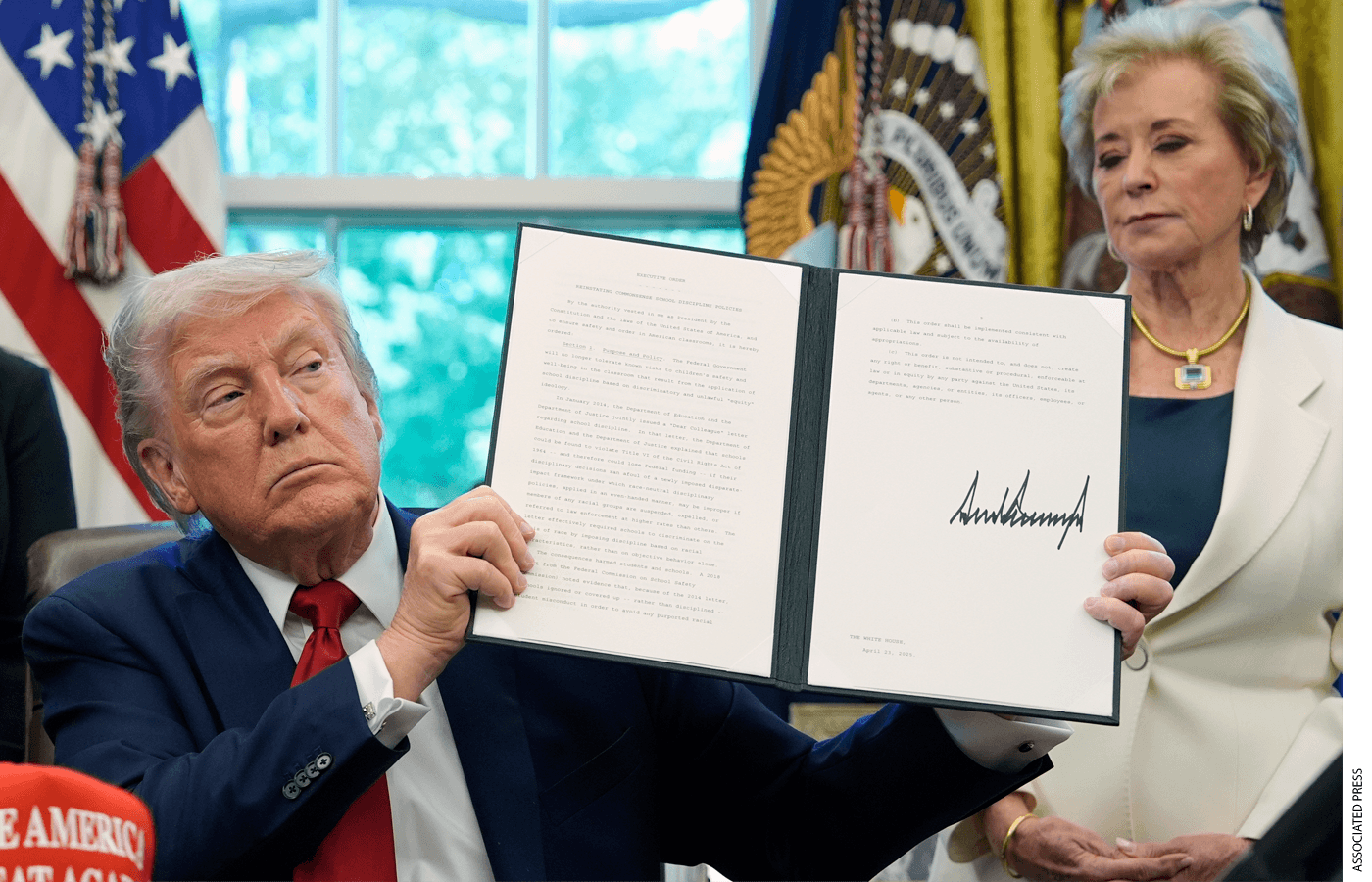
Federal action and state-level debates have pushed the discipline issue to the forefront. In April 2025 President Trump issued an executive order mandating a return to impartial discipline based solely on individual behavior and calling for “school discipline policies that promote common sense, protect the safety and educational environment of students, do not promote unlawful discrimination, and are rooted in American values and traditional virtues.” States are reconsidering their own school discipline laws, as teachers continue to report rising concerns. In Texas, the legislature approved giving schools more flexibility to manage student behavior. In West Virginia, the house passed a bill to give teachers more authority to remove both disruptive and violent students. Across the nation, policymakers are reexamining the decade of RJ and whether it delivered on its promises or left students and teachers feeling unsafe.
The current debate traces back to 2014, when the Obama administration issued a “Dear Colleague Letter” urging schools to reduce suspensions and address racial disparities in discipline. That guidance spurred a national experiment in school discipline. Shortly after, RJ began to move from the juvenile justice system into classrooms across the country. New York City took the lead, followed by Los Angeles, and New York’s reforms became a model for other cities and districts. Smaller districts adopted it, while federal agencies reinforced the approach by labeling RJ a best practice.
On paper, it appeared that the reforms had succeeded. Between the 2011–12 and 2017–18 school years, suspensions rates decreased in 48 states. Some of the largest reductions occurred in California and Illinois, both of which enacted policy reforms to restrict the use of suspensions. Teachers have raised concerns that these declines reflected policy pressure rather than real improvements in student behavior. For example, one teacher noted on the Fordham survey that “the reason suspensions dropped across our very large school district is that the district-level administration refused to let principals suspend students out of school. It had nothing to do with changes in student behavior or ineffective teachers. It had everything to do with them wanting to make the numbers look good on paper.”
A 2023 survey conducted by the EdWeek Research Center reflected the growing concern among educators: In 2022, 77 percent of school staff identified student behavior as a top challenge, and nearly 70 percent of teachers reported that behavior had worsened since before the Covid-19 pandemic. In 2018, the Trump administration rescinded the guidance issued in the 2014 Dear Colleague letter, but most districts nationwide retained their RJ policies. Only recently, with Trump’s April 2025 executive order, has the federal government redirected agencies to reverse equity-driven discipline mandates and return to behavior-based approaches.
RJ gained traction because it offered something different: an emphasis on repairing harm and building relationships. It worked in some settings, and conflict resolution and communication did improve. But on a broader scale, RJ efforts replaced consequences without building the infrastructure needed to maintain order.
What Is Restorative Justice?
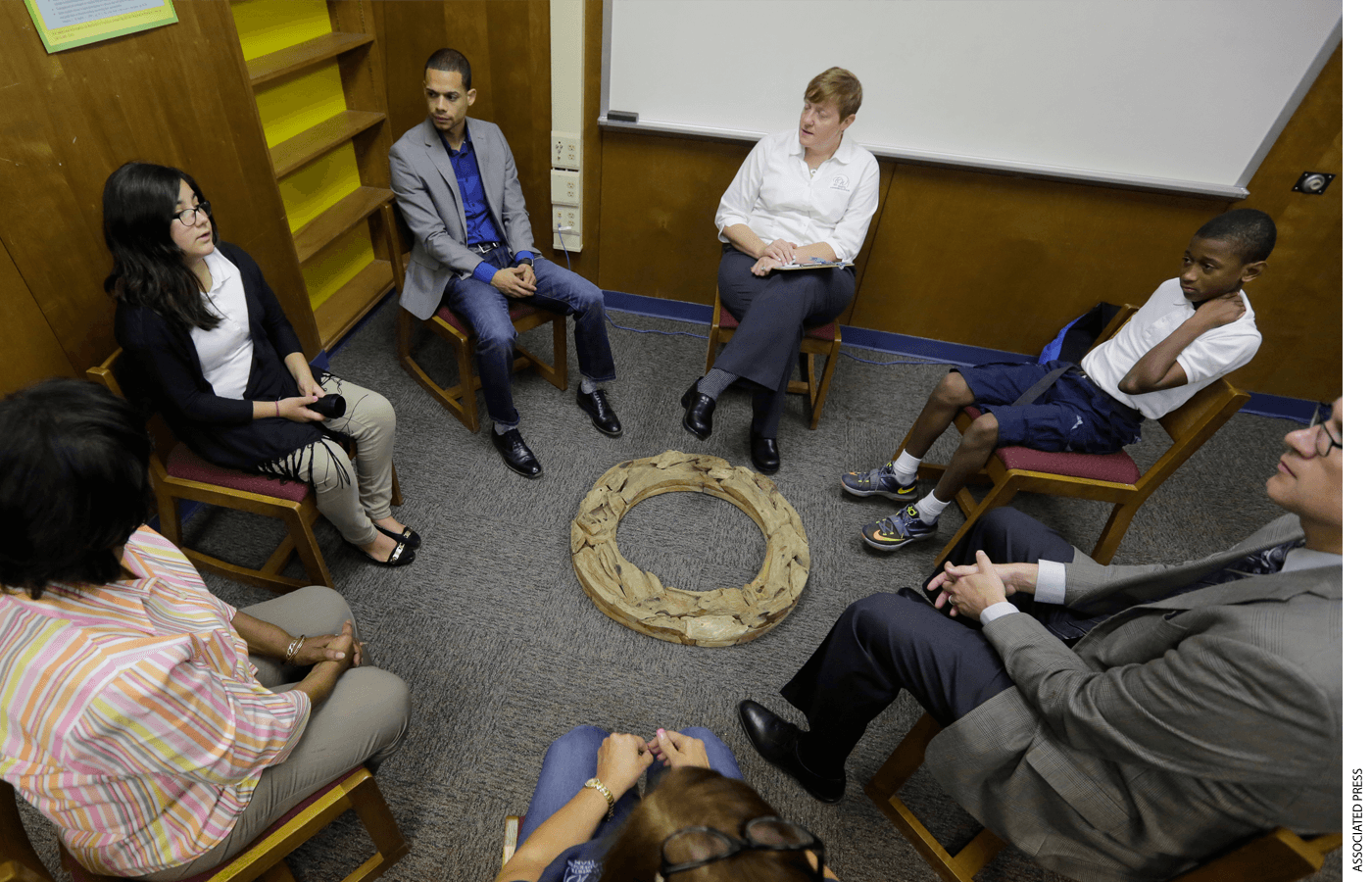
Restorative Justice began in the juvenile justice system as an alternative to jail time. The idea was to sit offenders down with the people they had harmed, talk through the damage, and agree on steps to repair it. The 2014 federal guidance accelerated the trend, urging schools to reduce suspensions and adopt alternatives that emphasized relationships over punishment. In practice, RJ in schools emphasizes the importance of communication and relationship-building. In these settings, RJ usually takes the form of structured conversations after a conflict or incident. Students are asked questions such as “What happened?” or “Who was affected?” Some practices involve the use of community circles or daily check-ins to set the tone for the day, encouraging students to talk about how they feel and use “I” statements when describing the impact of their behavior. A typical scenario might involve two students in conflict meeting with a teacher to discuss the harms caused and agree on steps to repair the relationship. In these cases, the structured conversation becomes the consequence.
Supporters of RJ argued that the approach fosters accountability, empathy, and conflict-resolution skills while reducing racial disparities in suspensions and other disciplinary measures. Many schools have dropped traditional consequences altogether and now only use restorative conversations. Teachers report that RJ has resulted in classrooms where disorder prevails and student accountability is difficult to enforce. As one teacher commented on the Fordham survey, “Our school has focused on restorative justice and student conferences instead of any real consequences, and the students see that as getting away with bad behavior, so they continue.”
New York City Case Study
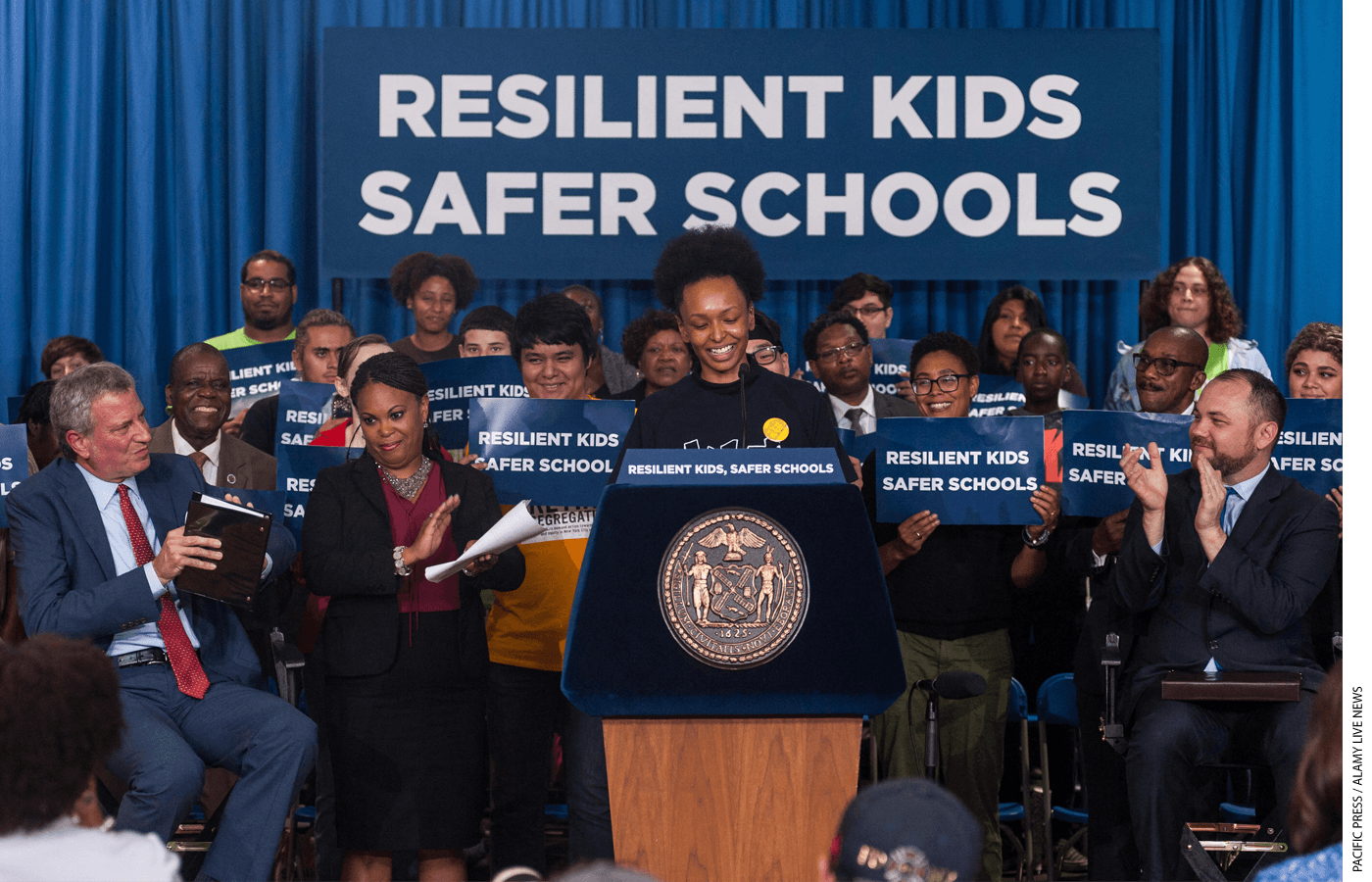
New York illustrates how RJ was implemented at scale, and why it matters nationally. Beginning in 2015, issuing suspensions became difficult, particularly for younger students. Between 2015 and 2024, the city’s Department of Education devoted approximately $97 million to RJ programs. At the same time, the city restricted principals’ ability to suspend students. By 2016, suspensions for grades K–2 were nearly eliminated, and throughout the system suspension lengths were capped. Additionally, administrators were required to obtain central office approval before removing a student from class. In practice, school leaders did not have access to exclusionary discipline.
In 2018, the New York City Department of Education issued guidance to help schools adopt RJ through a step-by-step framework. However, the department provided no teacher training standards, no systems for student and teacher accountability, and no alternative supports for high-need students. As a result, teachers reported losing authority in their classrooms, disruptions increased, and school leaders didn’t have the tools to address misbehavior. A randomized controlled trial by the Center for Justice Innovation (formerly Center for Court Innovation) confirmed that implementation varied widely, training was inconsistent, and outcomes proved difficult to measure. The study found no statistically significant differences in school climate, suspension rates, or academic outcomes between schools that did and did not implement RJ.
Since New York City Public Schools is the nation’s largest school system, its experiment set the tone for other systems. Major districts like Los Angeles, Chicago, and Baltimore adopted similar approaches. The problems seen in New York sprang up across the country.
Procedural and Policy Failures
The shift to RJ in schools did not begin with a bottom-up drive to address student needs, but rather with top-down guidance from the U.S. Department of Education. Across major urban districts, discipline systems that once emphasized structure, clear expectations, and consistent adult authority were dismantled in the name of equity. Some schools had adopted zero-tolerance policies—codes of conduct that set strict rules for infractions and that mete out discipline regardless of any extenuating circumstances. Most schools, however, used suspensions only when serious misbehavior occurred and focused mainly on maintaining order in classrooms and keeping students and staff safe so students could learn. When schools adopted RJ, equity became the overriding goal, even when it meant undermining classroom order and safety.
District discipline codes in cities like New York, Los Angeles, and Chicago made suspensions much more complicated to implement. In New York, principals needed central-office approval to suspend students in grades K–2, effectively eliminating that option by 2016. Similar restrictions appeared across the nation, and many districts treated RJ practices as the default response to serious misconduct in school. For example, in 2014 California became the first state to pass a law, AB 420, eliminating suspensions for “willful defiance,” a broadly defined category for everyday misbehavior. In 2015, Illinois passed SB100, which also limited schools’ ability to suspend students.
Pilot RJ programs expanded into whole-school initiatives and were often packaged with social-emotional learning frameworks intended to guide educators in teaching essential skills for healthy development. These rollouts lacked the necessary infrastructure to succeed. Universal teacher training standards were missing, as were systems for accountability and alternative supports for students with high needs. As a result, schools were left to interpret RJ independently, leading to wide variation and inconsistent results. In many districts, teachers reported that they lost authority and that administrators hesitated to enforce meaningful consequences. One teacher noted on the Fordham survey: “For several years I did not write a single [discipline] referral, as I felt nothing was done when I did. There were no consequences for students. They were simply talked to, if that, and let off the hook. I did not feel supported or backed by my administration. I was told to stay in my lane and that administration had the right to bend rules and enforce however they saw fit.”
By the end of the decade, several states sought to embed RJ in law. In New York, the proposed Solutions Not Suspensions Act would have embedded restorative principles statewide. Similar proposals have circulated in other state legislatures and departments of education, such as in California. Yet even as legislation stalled, district-level mandates remained in place. The problems in New York City revealed by the Center for Justice Innovation study mirror findings in other districts, where RJ often became more about appearances and compliance than about addressing student behavior. What began as a push for equity in school discipline was translated into practices that stripped away accountability in schools and deprived classroom teachers of access to meaningful consequences.
The Cost of Mandates
During the Covid-19 pandemic, schools received substantial amounts of federal relief through the Elementary and Secondary Emergency Relief (ESSER) funds. That money was flexible, and many districts used it to expand school-climate initiatives such as social-emotional learning and restorative justice training. One problem was that RJ programs were rarely identified as a separate line item in budgets. Instead, they were included in larger categories, which means school districts provided no clear and comprehensive accounting of how much they spent on RJ, what the programs looked like, or whether they made a difference.
By 2023, more than 20 states had laws supporting school-based RJ, and nine states went further by requiring it as an alternative to traditional school discipline, often integrating trauma-informed approaches or requiring professional development. But the way funds were allocated created a big problem. Millions of dollars were invested in programs that varied in design and delivery, resulting in some schools receiving coaching and staff support, while others did not. Without a consistent model, school districts had little chance of translating this investment into measurable improvements in school safety or academic learning.
New York illustrates the problem most clearly. Between 2015 and 2024, the city devoted approximately $97 million to RJ initiatives. Yet, as the Center for Justice Innovation study showed, implementation was inconsistent. Some schools received coaching while others had minimal guidance. Teachers reported lacking the time, training, and support to use RJ with fidelity. Despite the significant amount of money spent, the outcomes disappointed.
The real financial failure came in the form of opportunity cost. Funds that districts could have allocated toward evidence-based supports were diverted into programs that promised equity but lacked evidence of effectiveness. Districts are now left with ongoing costs for initiatives that have not resulted in safer classrooms.
Long-Term Consequences
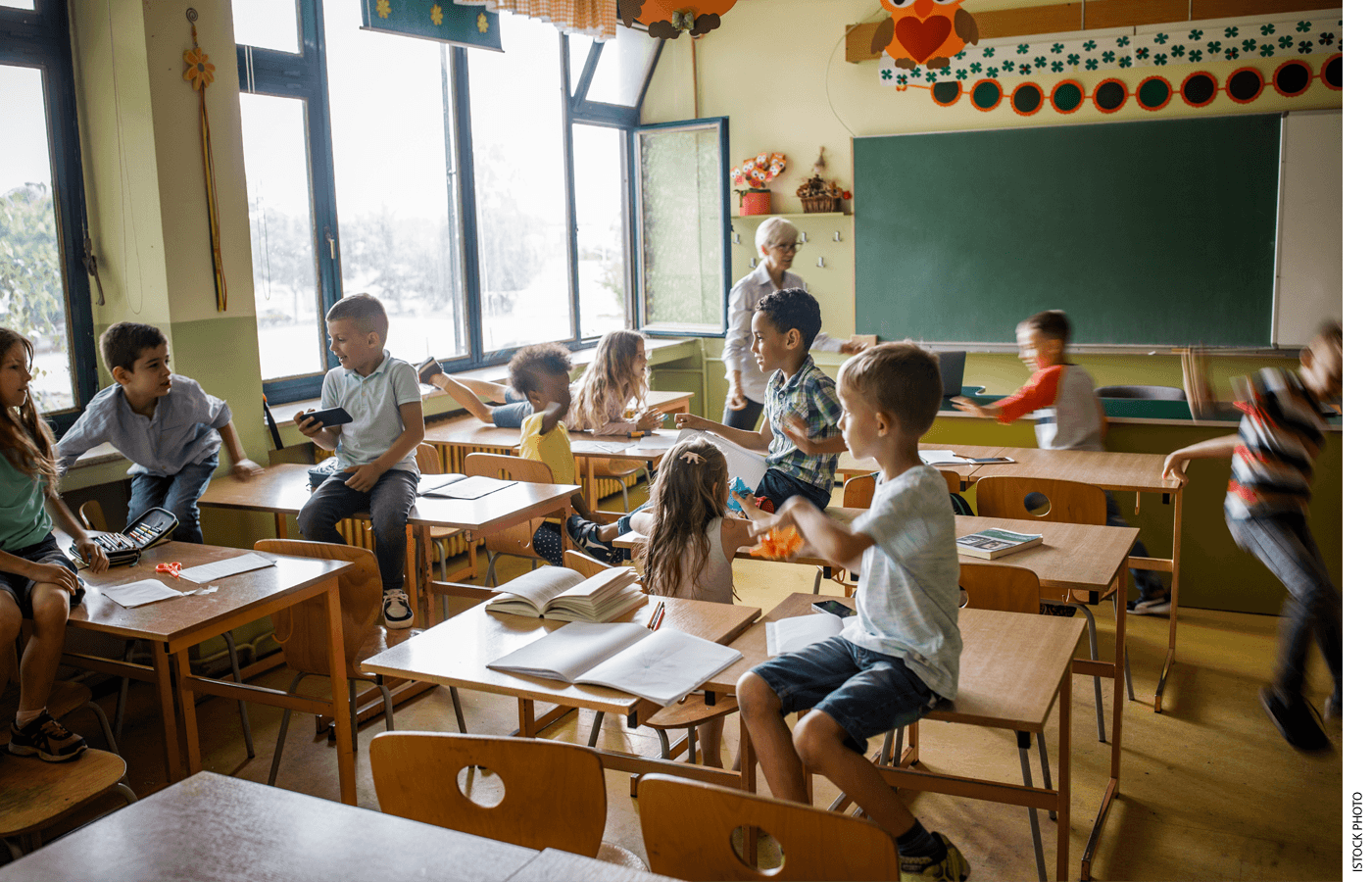
Across the country, the shift to RJ has left classrooms less predictable and harder to manage, with teachers reporting discipline as one of their biggest challenges. In 2023, RAND reported that nearly one in three teachers pointed to student misbehavior as a major stress factor. A 2022 EdWeek Research Center poll reached a similar conclusion—that behavioral concerns now constitute one of the main reasons teachers exit the field. One teacher told the Fordham researchers, “Unruly students are the only factor that makes me feel like leaving the profession.” These pressures have an especially serious impact in high-poverty schools, where structure and predictability are most critical.
Title I schools serving high concentrations of low-income families have suffered the most severe consequences. In these classrooms, instruction time is consumed by redirection and recurring disruptions. As one teacher reported in the Fordham survey, “Last year, my site was held hostage by a small number of students with chronic behavior issues. Many measures were taken to stem the tide, but when you have inconsistent consequences (or no consequences), parents who blame instead of taking responsibility, and a top-down message that suspensions must be brought down, it makes for a challenging situation.” The shift has not advanced equity, but instead created environments where disorder is tolerated. The very students who need the most structure, those already facing challenges and barriers outside of school, are the ones most harmed when that structure is removed.
Research in Pittsburgh, Pennsylvania, and Oakland, California, reinforces this national picture. Both districts documented inconsistent implementation and training and few meaningful consequences for students who repeatedly disrupted learning. In Pittsburgh, a randomized evaluation of RJ found lower math achievement for Black students. In Oakland, district leadership acknowledged that reductions in suspensions and changes in climate occurred only when there was full-time support. Many schools lacked the resources for the extra staffing, and others found the additional support difficult to sustain over time.
EdNext in your inbox
Sign up for the EdNext Weekly newsletter, and stay up to date with the Daily Digest, delivered straight to your inbox.
Some districts are beginning to reverse course. In Clark County, Nevada, and Gwinnett County, Georgia, district leaders scaled back on their use of RJ after seeing increases in school violence and teacher burnout. These shifts highlight a larger national pattern—that even leaders who initially championed restorative practices are recognizing the limits of the approach without accountability. Nationally, data suggest that declining suspension numbers have often reflected policy pressure to underreport rather than real improvements in school climate.
Not all implementations have failed, and not all have failed in every respect. As the researchers at the Center for Justice Innovation noted of their New York City trial, “The qualitative results highlighted numerous areas of impact that were unmeasured in this study, including improved relationships and social-emotional skills, and specific school climate improvements.”
Program design and implementation matter. National data indicate that approximately 72 percent of charter schools use restorative approaches, compared to 58 percent of district schools. The difference lies in how schools use these methods. Many charter schools layer RJ on top of clear school rules and consequences instead of replacing them. That’s the lesson from the past decade: RJ only has a chance to work when schools keep structure and adult authority in place.
What Can Be Done?
Across the country, school districts have invested significant resources in RJ over the past decade. With Trump’s 2025 executive order, school leaders face a choice: continue investing in programs that have not delivered results or reset discipline to restore order and learning.
District leaders can start by restoring authority to educators. Principals and teachers cannot maintain order when central offices second-guess their decisions. Discipline codes should be revised to affirm that suspensions and other exclusionary responses are sometimes necessary, but they don’t have to be the only tools available. Schools need a full continuum of behavior-based responses. Giving educators the discretion to match the responses to the behavior is critical to restoring authority to school staff rather than limiting them to one-size-fits-all disciplinary measures.
Districts also need to rethink how money is spent. Over the past decade, millions of dollars have gone into training sessions, consultants, and programs, with little evidence of impact. Resources should be redirected toward building behavioral expertise inside the schools, training teachers in classroom management, and ensuring leaders are able to respond quickly when students need more support.
Transparency is another critical piece. If states and districts continue to fund RJ programs, those dollars should be tied to clear metrics: reductions in repeat incidents, increases in safety, and more instruction time. Public reporting and independent evaluation would force programs to show whether they deliver the intended results.
Finally, the reset must begin where the consequences have been most severe. In Title 1 schools serving high concentrations of low-income students, the loss of clear rules and consistent consequences has made it harder to maintain classroom structure and expectations for the students who most need them. To establish and maintain order in schools, districts must prioritize staff training, leadership coaching, and stronger oversight. When school leaders fail to address misbehavior promptly, problems escalate, routines collapse, and teachers lose valuable instruction time. True equity means safe classrooms where every student can focus on learning.
A National Lesson
The last decade of school discipline reform shows the risks of building policy on aspiration rather than evidence. RJ was supposed to reduce suspensions, close racial gaps in discipline, and create safer schools. Instead, too many districts ended up with classrooms marked by disruption, teachers stripped of authority, and students left without the reliable structure they need to learn.
These policies have spread quickly, without adequate training, infrastructure, or accountability. Federal relief dollars accelerated the trend, but now that the money is gone, districts are left managing the costs of programs that have not delivered on their promises.
Our national experiment with restorative justice is instructive. Schools need discipline policies that provide educators with real tools, protect instruction time, and hold students accountable while offering support. Districts and states should tie funding to outcomes, require transparent reporting, and reinvest in evidence-based practices that support teachers in teaching and students in learning.
Discipline is not an accessory to education; it is a critical prerequisite. If policymakers want to achieve equity and improve outcomes, they must start by restoring order in classrooms nationwide.
Jennifer Weber is a fellow at the Manhattan Institute. She holds a PhD in behavior analysis.
Suggested citation format:
Weber, J. (2026). “Restorative Justices Didn’t Deliver. Why? Teachers say focusing on students’ social and emotional wellbeing to address discipline has left classrooms harder to manage than ever.” Education Next, 26(1), 12 March 2026.