


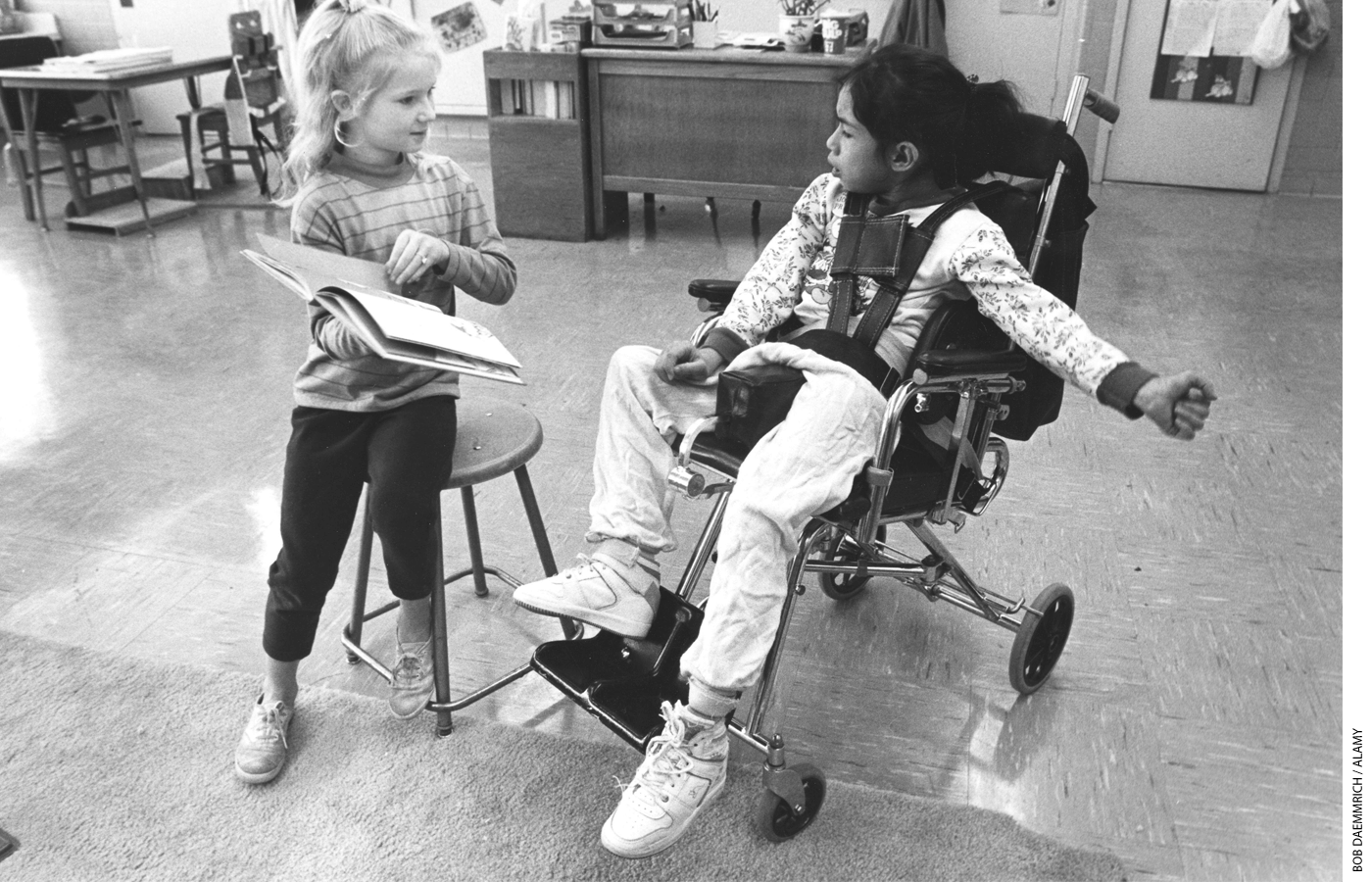
Fifty years ago this month, the federal government transformed education with the passage of the Education for All Handicapped Children Act, now known as the Individuals with Disabilities Education Act, or IDEA. This landmark law established special education and guaranteed qualifying students the right to a free appropriate public education, including specialized instruction, related services, and accommodations tailored to meet their individual needs. It marked a historic shift from exclusion to opportunity for children with disabilities and their families.
The law’s defining feature is individualization, a principle that distinguishes it from other education policies. IDEA establishes a system for eligible students to obtain what they need to succeed in school and life. This individualization is required because of the vast heterogeneity in disability. What one student with a disability needs to succeed may be very different from what another student needs—even among students with the same disability in the same school district.
Under IDEA, each eligible student is entitled to an individualized education program that families hold districts accountable for implementing. This requirement for individualization comes with a significant financial cost. In 2024, the federal government allocated $15.4 billion for special education, only a fraction of the 40 percent of costs Congress stated as its intention to cover in 1975. States and districts pick up the remaining balance, but the true amount of spending on special education remains unknown. The last available estimates, from 2000, placed the total bill for special education services nationwide at nearly $100 billion in today’s dollars.
After five decades, has IDEA fulfilled its promise of individualized education and improved outcomes for all students with disabilities? Examining progress in two areas—access to neighborhood schools and the provision of services that improve student outcomes—and two enduring challenges—staffing shortages and reliance on individual advocacy—reveals the ongoing struggle between policy ideals and implementation realities. It also points to critical directions for strengthening special education systems over the next 50 years.
Two Results to Celebrate (With Caveats)
Access to schools
It is easy to forget that, before the law we now call IDEA was passed, children with disabilities were often excluded from their local public schools. Congress reported at the time that half of students with disabilities were not receiving an appropriate education and that one million children with disabilities were excluded from public education. IDEA sought to change that by guaranteeing every eligible student with a disability the right to a free appropriate public education in the least restrictive environment (LRE), often in their neighborhood school.
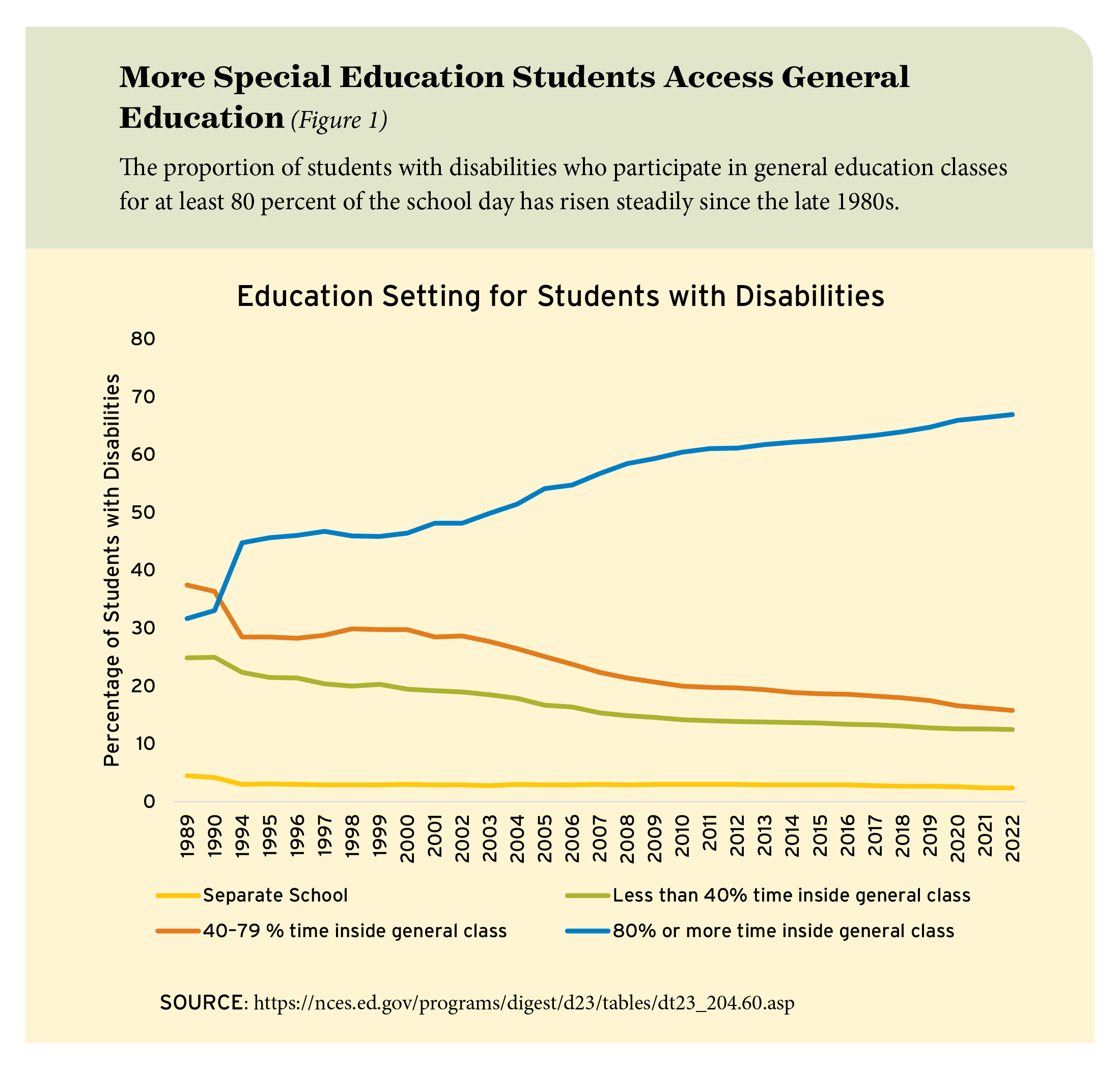
By affirming the rights of students with disabilities to attend public, neighborhood schools, often alongside their peers, IDEA has succeeded in increasing their access to schools and classrooms. There has been steady growth in access to general education and a decline in segregated placements—clear evidence of progress toward the law’s vision of physical inclusion in traditional schools and classrooms (see Figure 1).
Many argue that IDEA nonetheless has fallen short of the goal of providing all students with disabilities access to schools and peers. Some interpret the LRE as general education classrooms for every student, regardless of their individual needs, under the assumption that such placement will improve outcomes for all students with disabilities. These advocates point to the plateauing numbers of students with disabilities who are included in general education for more than 80 percent of their school day, along with the exclusion of students with more significant learning and behavioral support needs, as a failure.
While these concerns may be valid for some students, equating LRE with universal placement misses IDEA’s core principle: individualization. A Deaf student who can only fully access academic and social opportunities through American Sign Language at a school for the Deaf should not be required to go to their neighborhood school where the same level of access is unlikely. Mandating the same setting for all students would contradict IDEA’s requirement that decisions be based on individual needs (see “Has Inclusion Gone Too Far?” features, Fall 2018).
Improved educational outcomes
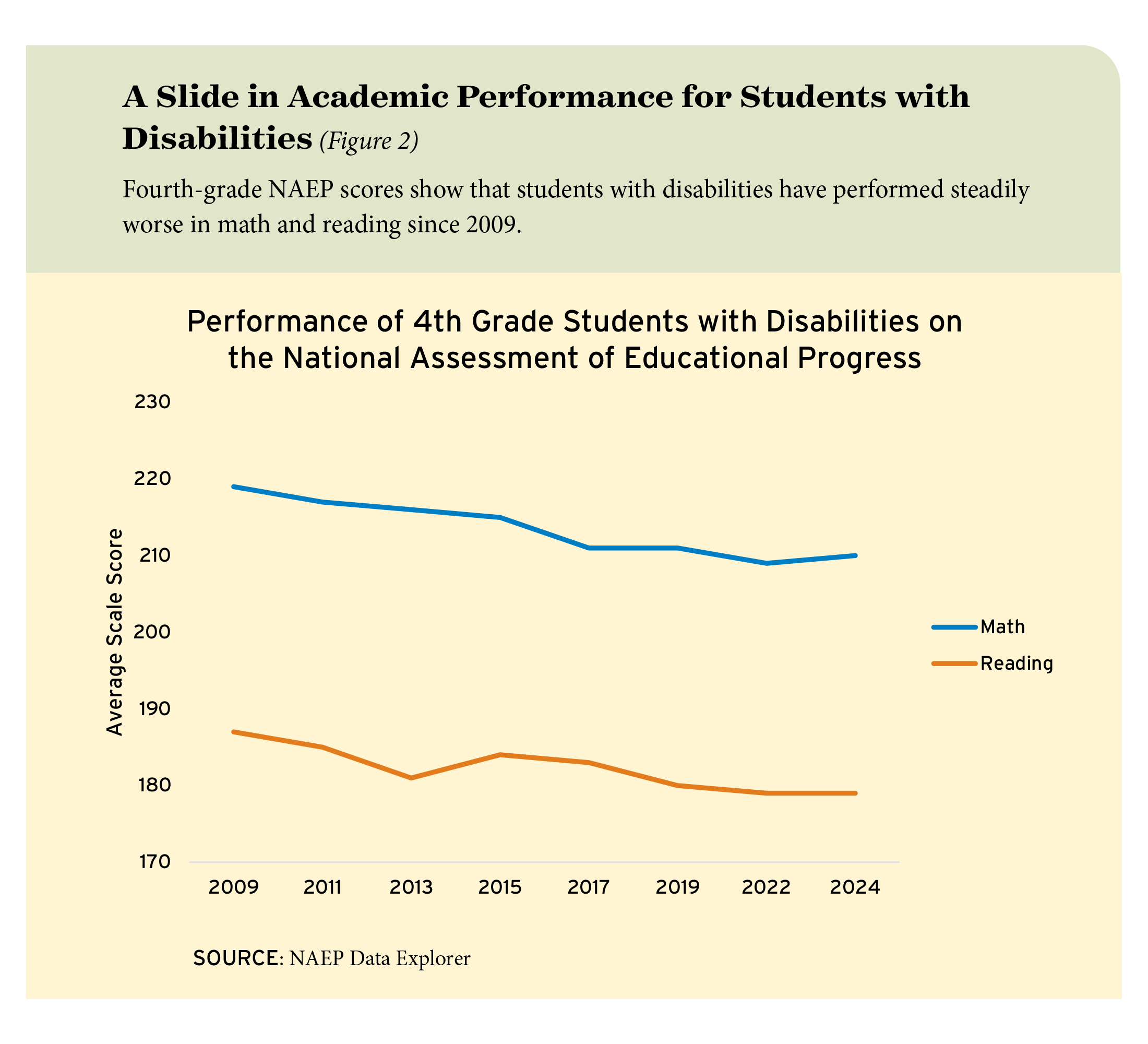
Greater access to schools and classrooms is not enough to deem IDEA’s first 50 years a success. If the law’s ultimate goal is to improve outcomes for students with disabilities, a glance at the National Assessment of Educational Progress (NAEP) might lead one to conclude that IDEA has failed. The mathematics and reading scores of 4th-grade students with disabilities have decreased since 2009, when they were first allowed to participate in NAEP with accommodations (see Figure 2).
However, NAEP scores may not provide a good measure of progress for this group. For one thing, most students receiving special education services were excluded from NAEP prior to 2009 because the assessment did not allow accommodations. Despite increased guidance on including students with disabilities, it remains unclear how schools decide which of these students participate in NAEP—and likely that their decisions have resulted in a larger share of students taking the assessments. At the same time, students with disabilities who have the greatest support needs are often excluded from NAEP testing.
In contrast, the best available research tracking individual students’ learning suggests that special education is effective for many students with disabilities. A recent paper by Kaitlyn O’Hagan and Leanna Stiefel reviewed 15 existing studies that use student-level administrative data to examine if special education is effective. Some of these studies compare the rate of academic growth individual students experienced in years they received special education services to their growth rate in years when they did not. Others exploit policy changes that altered special education identification rates and therefore the probability students receive services. Taken as a whole, the studies confirm that receiving special education is associated with higher math and reading achievement, fewer disciplinary events, and higher high school graduation rates. Experimental research testing the efficacy of intensive or individualized interventions reinforces these findings that special education typically improves outcomes.
Still, important caveats remain. The studies reviewed by O’Hagan and Stiefel do not apply to all students with disabilities, nor do they capture all outcomes of interest. Students with more substantial needs often do not take the regular state test and are less likely to move into and out of receiving special education services. Additionally, students with disabilities have individualized goals with related outcomes that may not be related to performance on the state test, such as participation in community activities or improving on-task behavior. The vast heterogeneity of disability and IDEA’s emphasis on individualization makes broad generalizations about effectiveness inherently challenging. But even with these caveats, the best available evidence suggests many students with disabilities perform better because of special education.
Constraints on IDEA’s Effectiveness at Scale
IDEA has driven significant progress, but its impact could be even greater. Two consistent constraints on IDEA’s success in improving outcomes and experiences of all students with disabilities stand out: (1) chronic special education staffing challenges, and (2) the current system for improving enactment of the law.
Special education staffing challenges
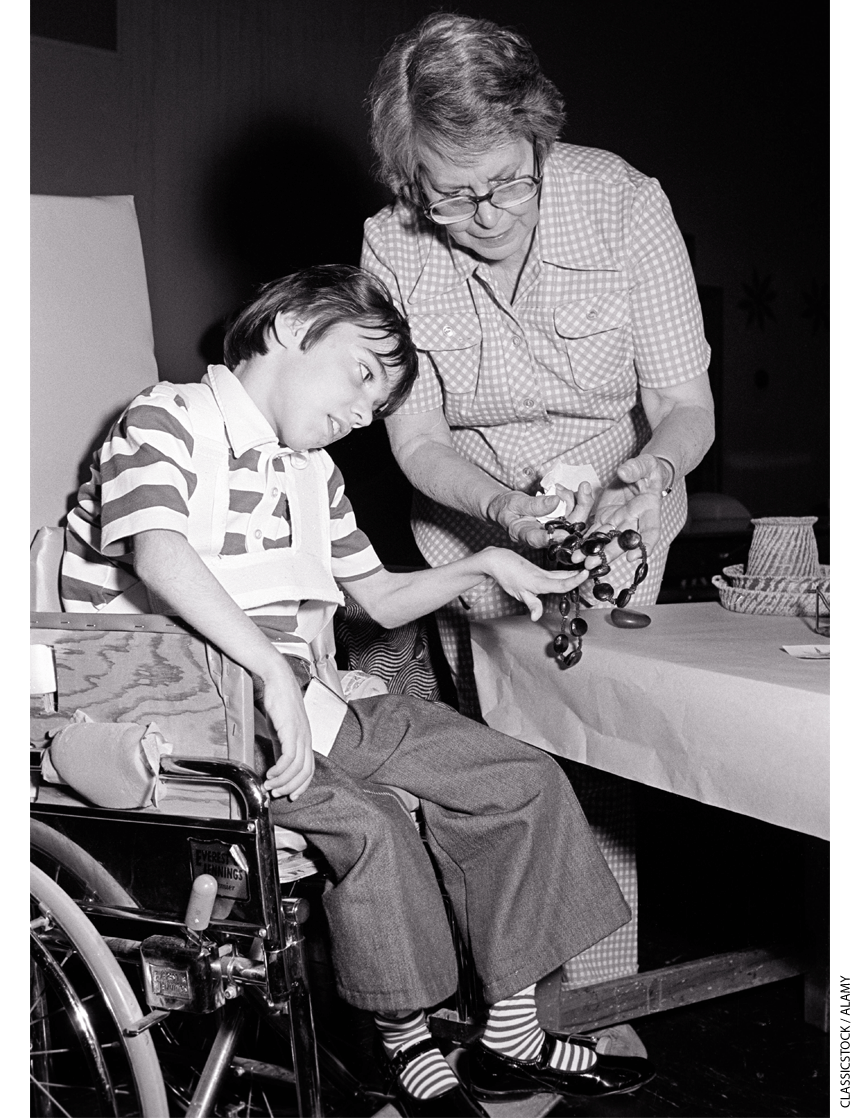
Successful individualization of services for students with disabilities requires qualified teachers, staff, and leaders who can develop and implement individualized education plans that drive access and improved outcomes. From its inception, IDEA faced concerns that a lack of qualified staff would compromise the law’s effectiveness, and districts still struggle today to fill special education teacher and support staff positions. As of 2025, 45 states reported shortages of special education teachers. These shortages are both a supply and a demand problem. High turnover and decreasing numbers of individuals completing special education teacher preparation programs limit the available professionals in the field. At the same time, the demand for special education teachers has increased, a phenomenon driven by higher special education identification rates and staffing models such as co-teaching aimed at supporting inclusion. High paraprofessional and related service provider turnover, coupled with the inability of districts to find related service providers to deliver key services to students, signal systemic staffing challenges across all areas of special education.
IDEA takes multiple approaches to address staffing challenges. It has a provision for personnel development grants. It requires states to establish recruitment and retention policies. And it mandates accountability reporting about the percentage of full-time equivalent special education teachers and staff with the qualifications required to fill their positions. Despite these safeguards, a 2019 survey found that very few districts used strategies beyond mentoring and induction to recruit new special education teachers. While certification is a poor indicator of teacher effectiveness, uncertified special education teachers have substantially higher turnover rates of than those who are certified. Relying on uncertified staff is therefore unlikely to improve outcomes for students with disabilities.
It is doubtful IDEA can realize its goals with the current staffing challenges. Notably, these challenges extend beyond special education teachers and support staff. General education teachers who have students with disabilities in their classrooms for most of the day may have limited training to deliver specialized services and supports, implement accommodations, and differentiate instruction. Similarly, school leaders may be unfamiliar with how to support those teachers. IDEA’s emphasis on special education teachers and staff, while critical, fails to acknowledge that the success of students with disabilities depends on the broader school community. Improving special education requires well-trained and supported special and general education personnel.
Relying on individuals to improve IDEA iteratively
Consistent with its emphasis on individualization, IDEA includes procedures for families of students with disabilities to hold school districts accountable for upholding the law. These procedural safeguards outline dispute-resolution options for when their child’s rights under IDEA are violated. Importantly, the dispute-resolution process is intended both to protect the rights of individuals and to help make special education better for everyone. The theory of change is that parents, by advocating for their child, induce changes in local, state, and potentially even federal policies and practices that improve special education for all students.
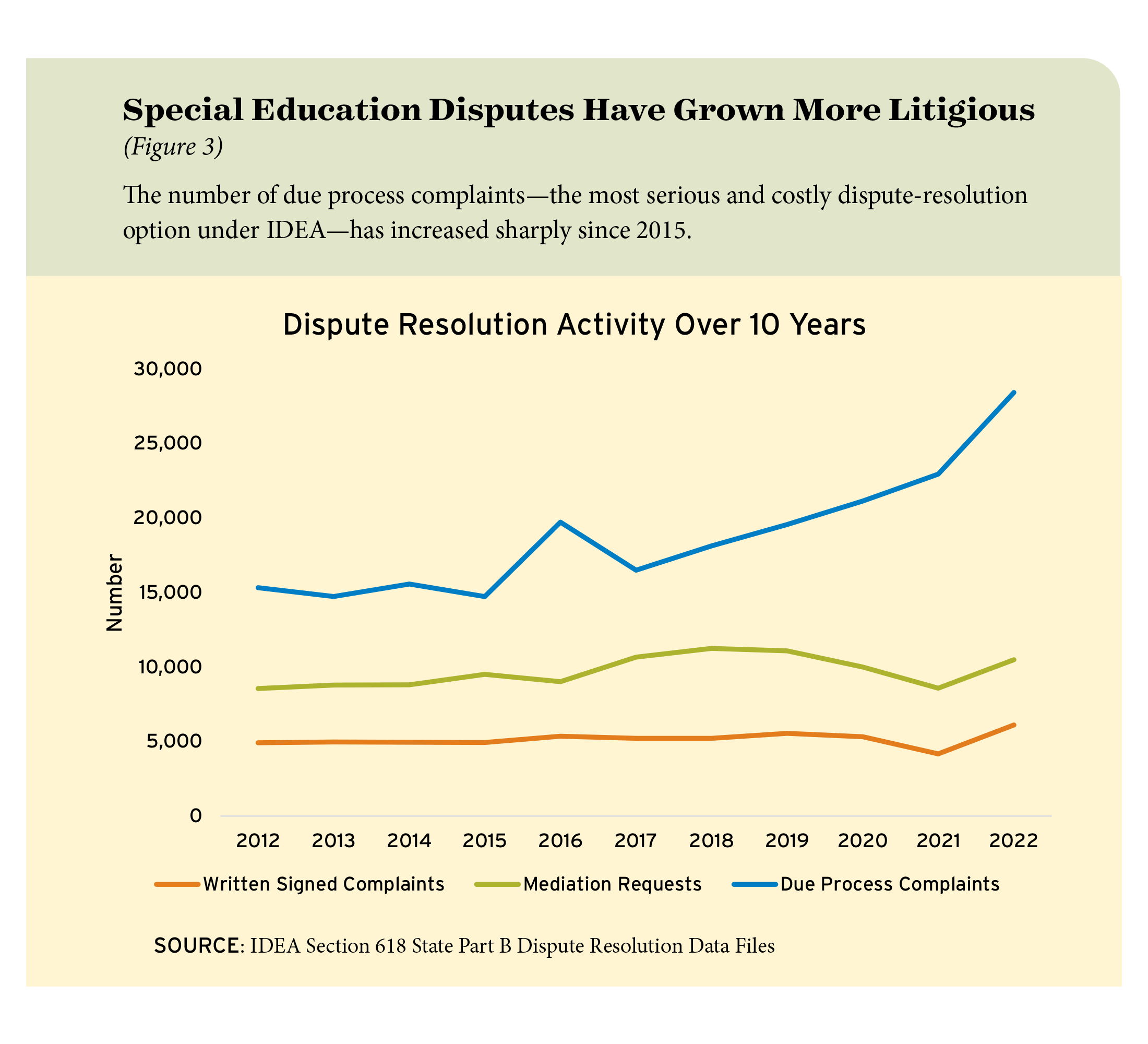
This theory of action has mostly failed in more recent years. (There are some exceptions, like 2017’s Endrew F. v. Douglas County School District.) Due process complaints, the most serious and costly dispute-resolution option because they may result in lawsuits, have risen since 2015 (Figure 3). But these cases are often settled, sometimes with requirements that families not discuss the case or how it was resolved, limiting their potential to drive broader change. The resources poured into legal cases and their expensive resolutions—such as tuition payments to private schools—could be better used proactively within districts to address shortfalls in special education delivery.

Improving IDEA in the Next 50 Years
Even at 50, IDEA remains a relatively young law. It was ambitious, given the historical exclusion of students with disabilities, and remains necessary. Its accomplishments in expanding access to schools and educational opportunities are undeniable. However, a half century of implementation offers a critical moment to consider how IDEA can better fulfill its promises in the decades ahead.
Congress last revised IDEA in 2004, and the near-term prospects for significant changes in the law are dim. Fortunately, there are two potentially fruitful steps policymakers can take within the bounds of the law as it is currently written. One is leveraging its requirements for state monitoring of districts to move beyond compliance and towards a focus on outcomes. The other is making better use of policy evaluation to create effective systems for all students with disabilities.
Shift to monitoring outcomes and essential inputs
Compliance monitoring is a major component of IDEA: the federal government monitors states, and states monitor districts. While compliance is essential, it has prioritized a procedural mindset over an outcome orientation. Even under current monitoring, many districts and states fail to comply with the law. But compliance monitoring, particularly state monitoring of districts, could be leveraged better to improve special education for students.
Delivering effective special education involves collecting data, monitoring progress, and making instructional changes when progress stalls or falters. If applied to schools and districts, this approach could help states focus more on outcomes and essential inputs and less on procedures and paperwork. The resulting data, if presented legibly to families, schools, and districts, could show states what type of support is needed and where it should be directed. Better yet, schools and districts don’t need to wait on the state to intervene. They can leverage the data to identify where their current special education system needs improvement. States could consider loosening oversight for districts with better outcomes for students with disabilities, while maintaining compliance with federal law.
Districts are required under IDEA and other federal laws to report the numbers of students with disabilities, the settings in which these students are educated, the numbers of certified special education teachers and staff, incidents of exclusionary discipline, student test participation, and test outcomes. However, it’s unclear these data get much use—particularly the student outcome data. But many states and districts collect their own data on such factors as educator turnover and student progress that can be used to improve the effectiveness of special education at the local level. These data could be made public to demonstrate how a district is performing relative to others in the state. Data could be further disaggregated by student and setting characteristics to uncover differences in access and outcomes. States could use this information to identify struggling districts and learn from those where students with disabilities perform well.
Take staffing shortages as an example. School personnel challenges for students with disabilities vary by district but are often addressed with broad rather than targeted solutions. A state monitoring system might flag a district for having particularly low outcomes for students with disabilities. Digging into the data might reveal high percentages of special education positions filled by uncertified teachers, which contributes to high turnover rates. A targeted response could involve the district, the state, or federally funded technical assistance provider brokering connections with institutions of higher education to host student teachers, investigating the feasibility of financial incentives for special educators, or promoting the development of new pathways to certification, responsive to local context.
EdNext in your inbox
Sign up for the EdNext Weekly newsletter, and stay up to date with the Daily Digest, delivered straight to your inbox.
An outcome-based approach to accountability in special education presents specific challenges and invites criticisms. Some state tests are insensitive to students’ progress when they are far below grade level. Schools might seek to avoid serving students with the greatest academic and behavioral needs. And traditional outcomes fail to address the many skills students are working to develop that are not aligned with grade-level academics. The progress monitoring data many states and districts already collect, such as academic growth metrics, behavior-related outcomes, and family engagement surveys, can be used to help address these challenges. Connected preschool-through-the-workforce data systems may allow some states to investigate the life outcomes of many students with disabilities who were in their schools—outcomes that address the ultimate purpose of special education.
A system that makes data public and provides districts with targeted support would not be cheap. But cost savings are possible if the system helps districts avoid costly due process proceedings and reduce district spending on out-of-district placements. There are no national estimates of districts’ costs from dispute-resolution activities and out-of-district placements, but existing data suggest that the outlays are substantial. Providence Public School District’s 2024–25 budget earmarked $28 million for out-of-district special education placements. The Philadelphia Inquirer reported this August that area districts spent nearly $6 million in special education settlement costs over three years. Moving from compliance monitoring to an outcomes-based approach and using data to inform changes to special education systems could therefore reduce costs.
Assessing what is working at scale
As with any curriculum or education intervention, special education can be improved by understanding what has been tried and assessing what has worked. While IDEA established broad principles to govern special education in the United States, in reality there are at least 51 different special education systems in the country. Identification rates, participation in general education, staffing, and student outcomes vary widely from state to state and among districts. This variation reflects local context, policy interpretations, and policy enactment.
Historically, evaluations of special education effectiveness at scale have been met with skepticism, both due to data availability and fears related to IDEA compliance. But more recent evaluations have investigated the extent to which decisions by states and districts have improved special education. They have looked at specific learning disability identification rates, the use of special education teacher bonuses, and how eligibility for services impacts short- and long-term outcomes.
Examining the outcomes of existing variation across states and districts represents a ripe opportunity for improving special education. Evaluations could focus on open questions about IDEA such as:
1. What are the true costs of special education and how does spending relate to students’ outcomes?
2. Why have special education identification rates increased?
3. How have practices championed by special education, such as science of reading and multitiered systems of support, been adopted by general education? Have these practices improved the outcomes of all students?
4. Which policies and programs result in special education teachers who remain in their positions?
Evaluation results are essential for states and districts to identify the policies and practices they should enact to address their own special education systems’ limitations. Ongoing evaluation is also a necessity when states relax monitoring requirements for districts that can demonstrate short- and long-term gains for students with disabilities. The same is true at the state level in a context of less federal oversight. Research-practice partnerships and specialized federal research funding competitions, administered through funding mechanisms already included in IDEA Part D, could support these efforts.
 Conclusion
IDEA’s greatest strength—and its greatest challenge—is its focus on the individual needs of students with disabilities. The commitment to individualization makes the law transformative but also difficult to implement at scale. Despite this challenge, the effect that IDEA has had on school systems over the past 50 years is undeniable. Before 1975, many students with disabilities were excluded from public schools entirely. Today, such exclusion is unthinkable. Importantly, IDEA has moved beyond mere access to schools and classrooms, and in doing so it has undoubtedly improved outcomes for millions of students.
It is neither the time to declare IDEA an unqualified success nor to dismiss it as an abject failure. The law has had its share of both and deserves praise and scrutiny. More research is needed to understand the intended and unintended consequences of federal oversight of the education of students with disabilities. While IDEA has accomplished much, many students with disabilities still do not receive the services they need, particularly among families who lack the resources to navigate or leverage the law. As IDEA begins its next 50 years, states and districts face the ongoing challenge of balancing individualization while building systems that deliver strong educational opportunities for all students with disabilities.
Allison Gilmour is a principal researcher at American Institutes for Research.
Suggested citation format:
Gilmour, A. F. (2025). “IDEA at 50: The landmark federal law ensured access for students with disabilities. Now it’s time to focus on outcomes.” Education Next, 25(4), 4 December 2025.