


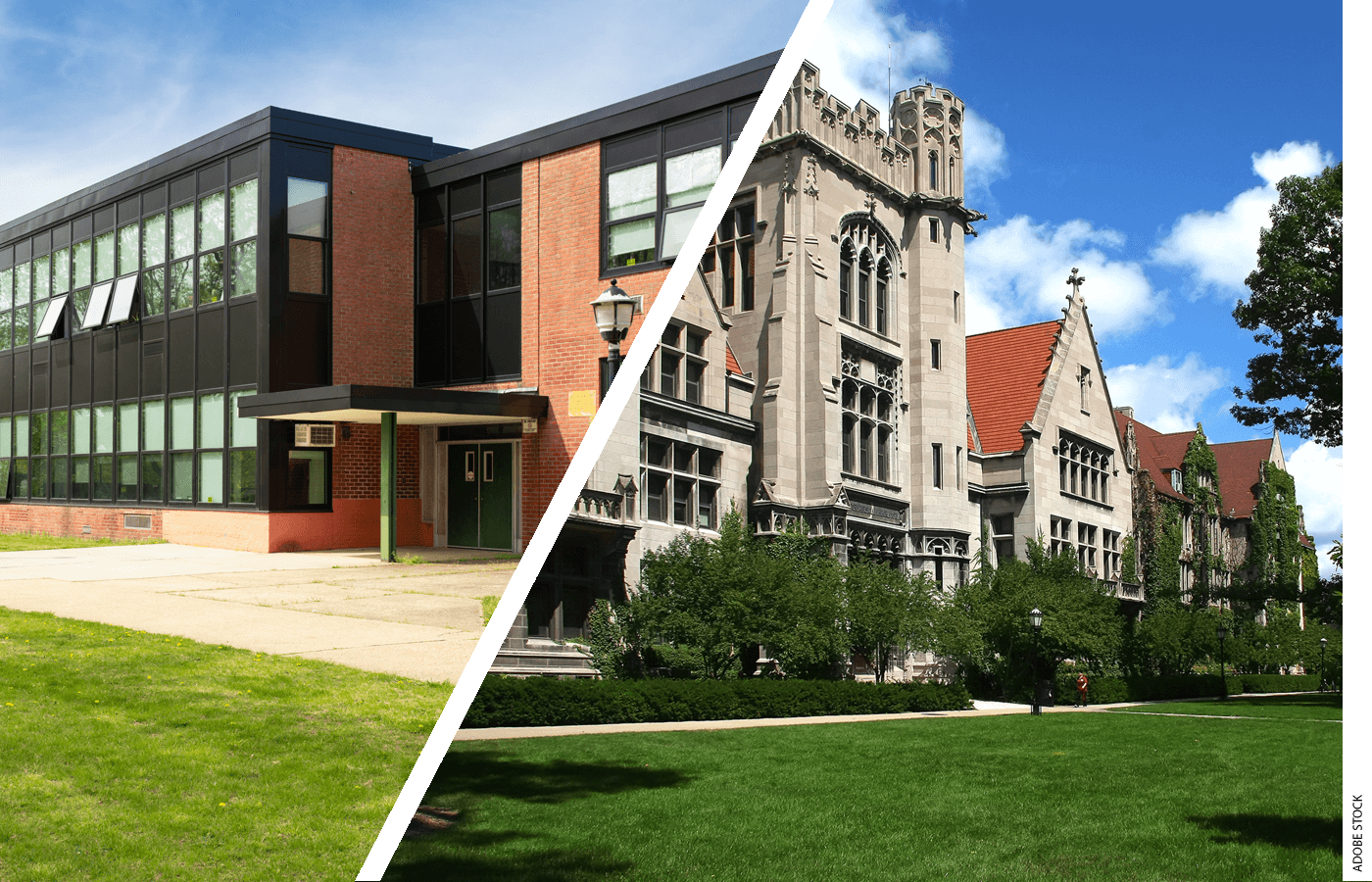
Years ago, when I focused on K–12 schools, I saw higher education as a total mystery. I didn’t understand the institutional arrangements, day-to-day operations, policies, or major issues. Worse, it seemed impossible to get up to speed. Higher ed has different conferences, journals, reporters, trade publications, and experts. I wasn’t alone. Others working in K–12 didn’t know a lick about higher ed either. It just seemed like another world.
Now that I’ve had a good bit of experience in higher ed (having served on two major public higher-ed boards over the last seven years), I see the same is true on the other side. The higher-ed world knows very little about K–12 policy and practice.
It’s not that the two sides don’t want to know about the other. They do: Both care about schools and students. But each side sees the other as an unfamiliar blood relation—that cousin you really should know better but only run into at weddings and funerals and then have nothing to discuss.
How in the world is this possible? How can they be so different?
Based on my experience there are 10 reasons.
1. Pedigree
American K–12 schools and higher-ed institutions simply have very different backgrounds. Our colleges and universities started popping up in the 1600s, all the early ones were private (and most were faith-based), and they were modeled on schools across the pond that were often centuries old. America’s system of K–12 schooling didn’t emerge until the middle of the 19th century. Though we had some private and faith-based schools early on, the major system that developed was primarily “public” and particular to our nation’s unusual character. It was highly Tocquevillian. You might even say it’s quintessentially American.
In other words, these two systems were, from the very start, different species. In fact, they didn’t even evolve from the same institutional ancestry.
2. Subsequent History
The major movements and policy reforms that shaped the K–12 system after its initial emergence are simply different than those that shaped higher education. The K–12 world was formed by the “common schools” movement, the goal of universal literacy, compulsory education laws, the high-school movement, fights over faith in classrooms, Progressive-Era “professionalism,” district and school consolidation, educator licensure rules, etc.
American higher education was largely shaped by the Morrill (land grant) Act, the creation of HBCUs, the growth of academic disciplines, the explosion of federal research dollars, tenure rules, gifts from late-19th century philanthropists, and the GI Bill.
In other words, K–12 and higher ed started in different places and were then led in different directions.
3. All vs. Some
The K–12 education system is designed to serve every student in America. By law, public schools must be available to all kids. This shapes how and where schools are created, how they are funded, and a bevy of rules related to special education, transportation, building accessibility, student accommodations, teacher certification, tracking, the service of immigrant and homeless youth, and much more. Combined, these factors form a “service for all” mindset that permeates policy and practice.
Higher education is obviously different. No school has to try to serve everyone, and the system as a whole has no obligation to serve everyone. This influences where schools are, what they teach, whom they hire, what services they provide, and more.
4. Funding
About 90 percent of K–12 students are in public schools. Public schools are funded almost entirely through public dollars. These funds are generated primarily by state and local taxes. Dollars are distributed to schools based primarily on how many students and which students those schools serve. Funding formulas are a huge part of K–12 policy and a big part of K–12 scholarship. Since all kids are supposed to attend K–12 schools, and since the results are meant to benefit all of society, the public pays the tab.
Public colleges and universities get some operational money from their states, but most schools get most of their money directly from their consumers—students. Private schools get almost all of their operational funds from tuition and fees (though supplemented by private funds, e.g., from donations, their endowments). Foundations and government entities provide research funding, but that primarily goes to the biggest research institutions, and it mostly funds actual research not teaching and learning. Because students pay, America now has a staggeringly large industry of loans and grants, and a huge part of higher-ed policy is now dedicated to loan amounts, loan subsidies, loan forgiveness, etc. But the student-pay model is also at the heart of higher education’s diversity and the ability of students to choose which schools best fit their interests.
Since different groups pay the K–12 and higher-ed pipers, different groups call the K–12 and higher-ed tunes. K–12 and higher ed behave differently in fundamental ways because of their different sources of revenue and different funding systems.
5. Purposes
Most people understand the purpose of K–12 education as preparing young people for future success as family members, community members, workers, and citizens. So K–12 schools teach basic skills (e.g., reading, math), habits and dispositions (civility, cooperation, perseverance, resilience, curiosity), and some higher-level material designed to help students transition into jobs or further education.
Higher education is quite different. At one time, colleges and universities generally provided a broad liberal education—consistent with the view of higher education’s mission. Today, higher-ed institutions have great variety; students have the flexibility to choose majors, specializations, courses, even badges and certificates. And unlike in K–12 education, where state rules dictate a great deal of what is taught and when, professors (and departments) largely get to decide what courses are taught and what the curriculum will be. Many now believe that institutions of higher education (IHEs) reflect the preferences of faculty and employers.
Ask an elementary school principal what student success looks like. Then ask a high school principal. Then ask a college professor or provost. You’ll get different answers. That fact influences how these schools conceive of themselves and where they put their resources.
6. Performance Measurement
Because the public pays so much for K–12 schooling, and since K–12 schooling prioritizes basic skills, there is a lot of performance measurement in K–12. There are standardized tests, statewide reading and math assessments, a host of high school graduation tests, state- and district-crafted civics and history assessments, etc. Students prepare for the SAT and ACT. There are even sophisticated systems for determining which schools and which teachers advance learning the most.
Moreover, since all students are expected to learn, these results are disaggregated by race, income, sex, and more so we know who’s learning what. Lastly, complex state accountability systems report results and require interventions when schools fall short.
EdNext in your inbox
Sign up for the EdNext Weekly newsletter, and stay up to date with the Daily Digest, delivered straight to your inbox.
Higher education just doesn’t operate this way. Of course, students write papers and take exams in individual courses. But there are not standardized exams across similar courses. There are not standardized graduation assessments showing what college students know. In fact, it can be hard to quantify what colleges are contributing to student learning. Some scholars are now studying IHEs’ “return on investment,” but that primarily uses graduates’ salaries as the outcome measure—not other outcomes we might care about.
In short, K–12 produces lots of outcome data that the public and policymakers use to assess performance and craft reforms. Higher ed produces far less data of this kind and instead responds to market forces built on the views of current and future students.
As a result, these two fields don’t merely measure success differently; they conceive of success differently.
7. Institutional Arrangements and Governance
Public K–12 education is a highly structured, hierarchical system with a great deal of local decision-making and state-level accountability. Public schools are operated and controlled by districts, which are creatures of state law and subject to rules by state officials. It is not uncommon for a state to have hundreds and hundreds of school districts—and districts are almost always governed by locally elected school boards. In this way, K–12 education is highly decentralized and highly democratic. But since state constitutions obligate the state government to ensure the provision of primary and secondary schools, state boards of education and state superintendents have significant supervisory authority.
Higher education is a different world entirely. More than a third of four-year institutions are private, meaning they have private boards that can operate outside of the light. Almost all public colleges and universities are governed by boards appointed by governors or state legislatures. In many states, a single higher education board oversees all (or nearly all) of the state’s four-year IHEs. Importantly, though—thanks to accreditation rules, tradition, and university policies—campuses have significant autonomy on most operational matters.
Moreover, higher education has an unusual tradition of “shared governance” that can complicate—even undermine—institutional accountability. Faculty have a great deal of intra-campus authority over the operations of their classrooms, departments, and colleges. Governing boards and presidents can have a very difficult time bringing about change.
If someone builds a successful career in the private sector and then gets introduced to K–12 operations, arrangements, and governance, she’ll compare those rules to Ancient Greek. Then show her higher-ed operations, arrangements, and governance, and she’ll compare them to Ancient Latin.
8. Geography
K–12 schools are viewed as community institutions. They are governed by locally elected boards. They educate local kids. They are largely funded locally. Their faculty and staff often come from the same small community. In this way, they reflect local sensibilities. For these reasons, there is often healthy tension between local decision-makers and authorities at the state and federal levels.
Relatively few IHEs see themselves primarily as community institutions. Many private schools take students from across the globe and see themselves as serving the global community. Public flagships and other large “R1” institutions generally see themselves as serving the state’s or the nation’s interests. Some regional IHEs certainly respond to local job markets, but they are not governed locally, nor do they pull all or even most of their students from the towns where they are situated.
In K–12 education it is commonplace to defer to the will of a school’s local community on important matters. That is simply not the case in most of higher education.
9. Commonality vs. Variety
The “common schools” movement of the mid-19th century aspired to create an expansive network of locally run public schools that served all students equally. These schools were meant to be “common,” as in similar regardless of where you were. Since all kids need to learn the same stuff, let’s create effective, cookie-cutter schools to do just that. This was codified over time through an array of state policies that standardized elements of K–12 schooling, for instance related to what was taught, when it was taught, and by whom it was taught. Eventually there were state rules on teacher and principal qualifications, building specs, textbook purchasing, discipline, and more. Go to five randomly selected public elementary schools across America, and you’ll quickly observe just how alike they are.
From the start, American higher education lacked this commonality gene. Some colleges prepared students to be ministers, some wanted to produce elite public leaders, others wanted to produce corporate leaders, and still others wanted to help their states’ agricultural communities. Some developed to teach just men, others just women. Some taught the Great Books, others focused on job-readiness. Some prize the liberal arts and humanities, and others are dominated by business schools or the sciences. Some are Catholic, some Lutheran, some secular. Some serve tens of thousands; others serve a fraction of that.
These two different approaches influence not just policy and practice but also what we mean by tradition, custom, and identity in educational institutions.
These different approaches also help us understand why “school choice” is simply assumed in higher ed . . . and why it can be radioactive in some K–12 circles.
10. Scope
The average K–12 school in America has about 500 students. Although districts generally have tens of thousands of students—and in some cases hundreds of thousands—the district office is a central administrative unit. The district office still sees the school as the central actor—and schools are relatively small.
But the central actor in higher education is the campus. And campuses are often enormous. It is not uncommon for a university to have 30-, 40-, or 50,000 students (undergrad and grad), more than 100 buildings or facilities, dozens of colleges and departments, thousands of faculty and staff, and a budget in the billions. IHEs need sprawling legal, financial, human-resources, athletic, facilities, public-safety, and philanthropic offices beyond the teams dedicated to teaching and learning. They need to make decisions on tenure applications, new program submissions, land-use agreements, and on and on.
Though the decisions and constituencies of a K–12 school may be smaller in scale, they are no less challenging. In fact, they often demand more of a human touch. Sometimes you need to raise the property tax rate on your neighbors, find a compromise between warring parent groups, solve a difficult discipline-policy matter, suspend an entire lacrosse team for the season, fire a popular teacher, or negotiate a tricky deal with the state board of education.
* * *
The primary purpose of this essay is to demonstrate that in at least 10 categories, the experiences, knowledge, skills, and dispositions needed to be an effective leader in K–12 education are different than those required in higher education.
But more broadly, this list is meant to show what it takes to become truly expert in any domain of public leadership.
Pick a field, any field—housing, health care, transportation, social services—and you need leaders who know a whole lot about its pedigree, historical developments, funding, purposes, performance measures, and on down the list.
Andy Smarick is a senior fellow at the Manhattan Institute and a writer for the Substack “Governing Right,” where this post was originally published.