


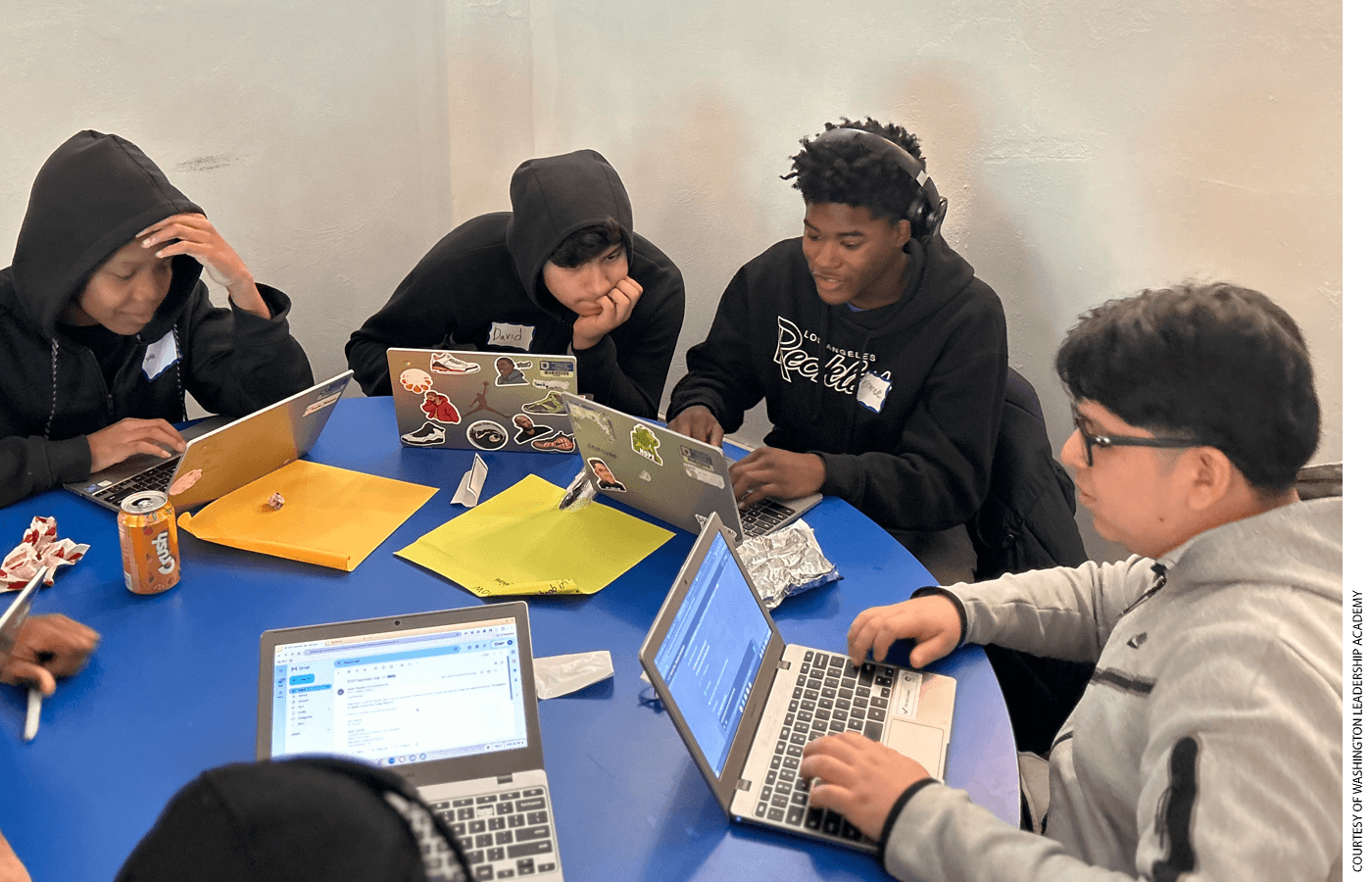
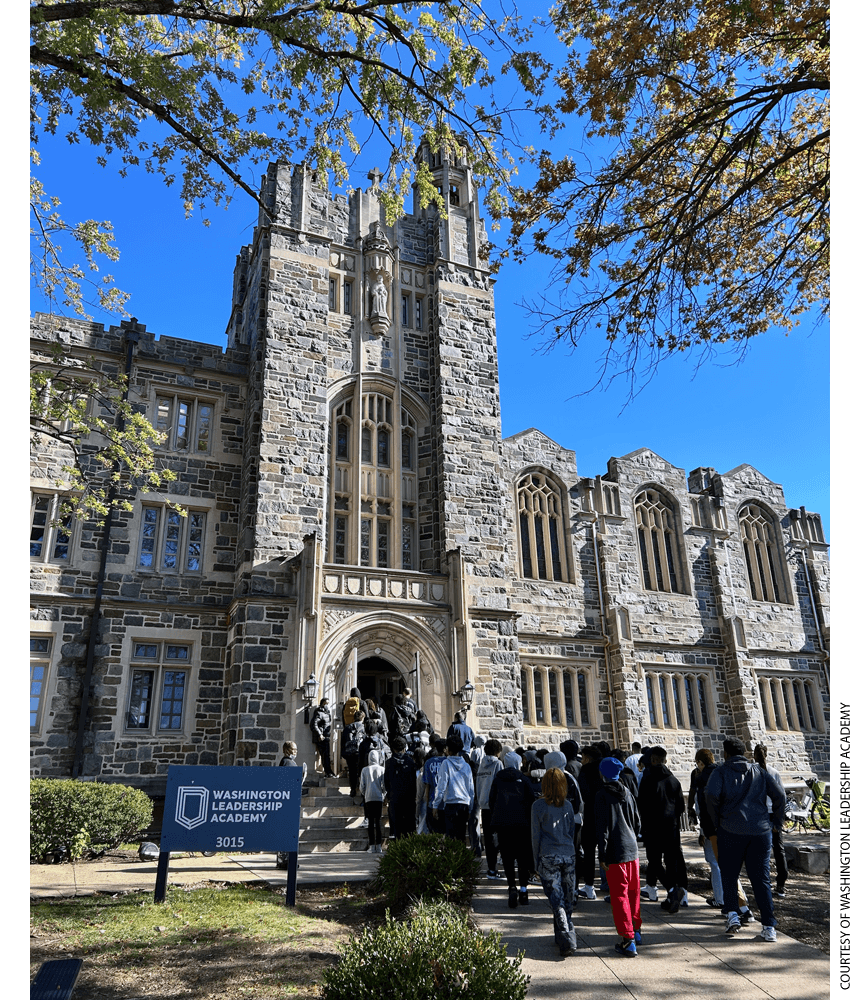
On a Friday morning in early March, about 100 students at Washington Leadership Academy (WLA), a public charter secondary high school in the District of Columbia, gathered in the assembly hall for a “Hackathon,” a hands-on event designed to teach students how generative artificial intelligence (AI) can be used in real life. The Hackathon gave the students a challenge: build a chatbot powered by AI to address real-world needs and problems.
Though most participants had never heard of a Hackathon, let alone participated in one, they were not strangers to AI. When asked what they knew about the technology, students described it as useful but controversial, powerful but prone to error. One junior offered a more precise critique than many adults: “The term ‘artificial intelligence’ isn’t real because to be intelligent you have to be able to teach yourself. It should be called artificial prediction—all it does is predict answers.”
By the end of the day, students had created a variety of chatbots. Members of the school’s student government association shared a bot to help students convey concerns to school leadership. A senior showed me a personal AI receptionist he had built on his own time that answers emails, handles phone calls, and organizes calendars, which he hopes to sell to local businesses. The projects were modest in scope but significant in reflecting that students understood the technology well enough to use it to help others.
That level of AI literacy remains the exception in U.S. schools. Since the public release of ChatGPT in November 2022, schools have faced growing pressure to respond to AI, but state and local policy guidance and technical support have lagged. While many schools are still deciding whether to allow AI at all, the technology has already crept its way into K–12 education, and increasingly so: In December 2025, the share of high school students who reported using AI for homework rose to 63 percent, up from 49 percent just months earlier.
WLA’s decision to embrace AI was not incidental. As D.C.’s first computer science charter high school, WLA was already preparing students for a technology-driven world. But for WLA’s leadership, AI does more than enhance instruction or improve operational efficiency. It has the potential to correct longstanding education inequity. At WLA, the majority of students are Black, Brown, and from low-income households—groups historically among the last to gain access to new technologies in school.
WLA’s extensive experience in technology education, its focus on equity, and its eagerness to integrate AI into student learning combine to offer an early glimpse into what education on the frontier of AI adoption looks like. WLA illustrates both the possibilities and uncertainties of integrating a rapidly evolving technology into teaching and learning, providing lessons for policymakers and educators as AI becomes an increasingly pervasive part of students’ lives.
Digital Trailblazers
WLA’s journey with AI began almost immediately after ChatGPT’s public release in November 2022. Within days, then-executive director Stacy Kane met with school leadership and urged them to take the technology seriously, test emerging tools, and start thinking about what it might mean for the school and its students.
Initial reactions were mixed. Eric Collazo, then WLA’s principal and now its executive director, was not immediately on board. As a former English teacher, the “teacher pride” in him resisted the idea that an AI tool could match what a skilled educator brings to a classroom. Some teachers felt AI presented just another task to master, layered onto already demanding workloads. Others worried about the potential for student plagiarism and the challenges of adopting a new technology they did not fully understand. Some even feared that AI might replace them.
But some staff members wanted to explore AI’s potential in schools, and an AI task force of administrators, students, and teachers began meeting regularly to experiment with tools, test use cases, and figure out what applications were most promising. Task force members were encouraged to speak candidly about their concerns. Dr. Giani Clarkson, a history teacher, was among the early adopters. “You’re either going to put your arm around it, or it’s going to find its way to use a foot and get you out the door,” he reasoned.
What emerged from these meetings was a coalition of educators finding success with AI who were willing to bring others along. Throughout the 2024–25 school year, they led professional development sessions demonstrating how specific AI tools were saving them time and transforming what was possible in their classrooms. Collazo’s own turning point came during a session on how to build chatbots. He had long been in the habit of closing staff meetings by sharing a motivating metaphor, so he decided to design a bot to generate some of these nuggets of inspiration. When the bot produced material he liked, Collazo was sold. “It felt like playtime,” he remembered. “And then I realized, alright, I see the potential here.”
Three factors helped accelerate this early experimentation. First, WLA’s structure as a single-site charter school allowed for faster decisionmaking, with fewer layers of bureaucracy between idea and implementation. Second, school leaders were willing to move ahead in the absence of clear guidance or established models. Third, the school purchased premium versions of AI tools for teachers to test.
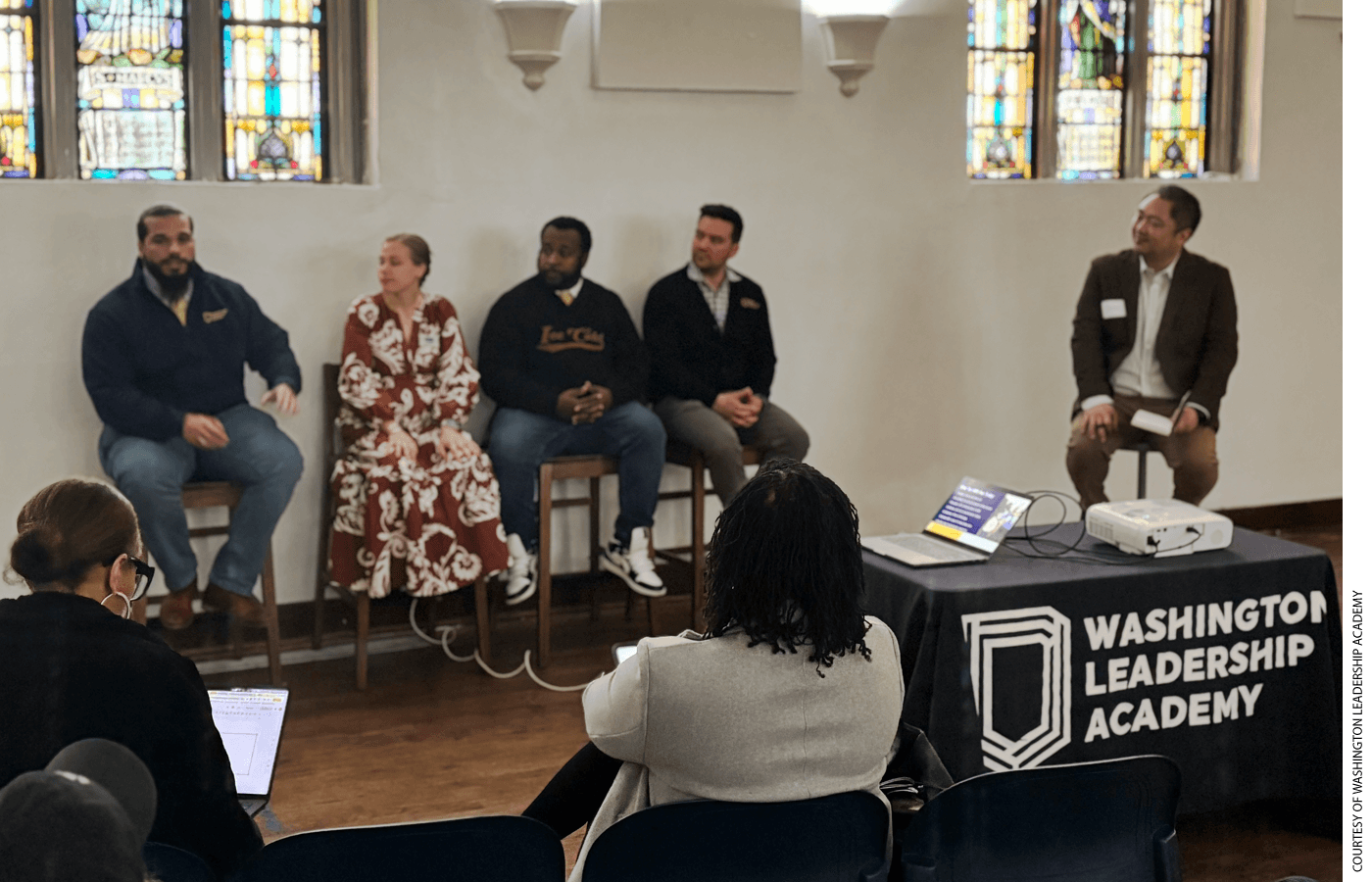
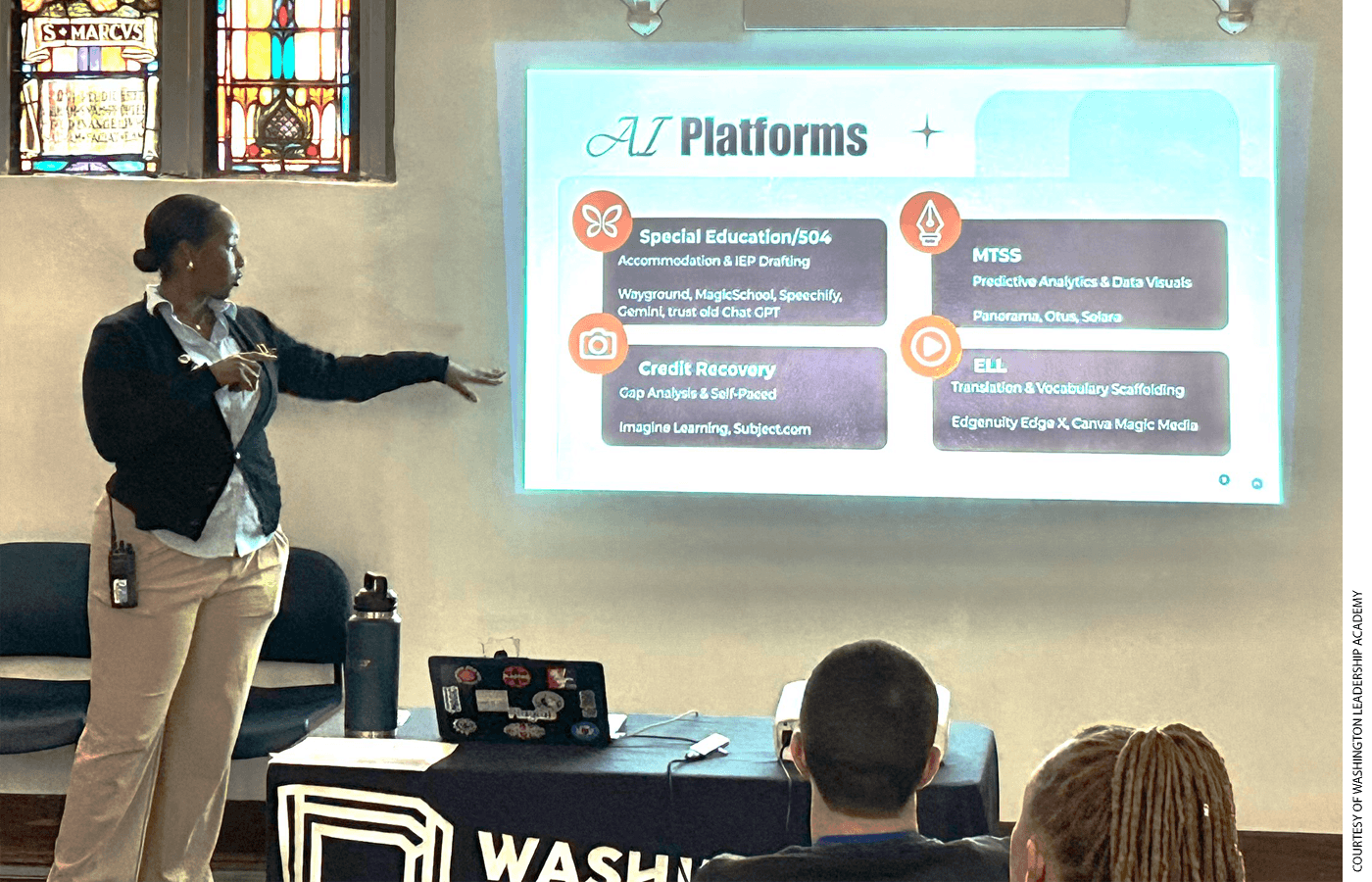
The early forays eventually narrowed to a more defined set of tools and practices. Today, AI is not confined to a single course or initiative. It shows up across every dimension of school life, from classroom instruction and student support to teacher tasks and behind-the-scenes operations.
As part of the school’s broader approach to AI literacy, all freshmen take a computer science course designed and taught by teacher Adrienne Lockhart that introduces core concepts in AI and machine learning. After that it’s up to teachers to deploy AI in their classrooms, guided by a school rubric developed to help determine appropriate student AI use on various assignments, from zero for no use up to four for unlimited use.
Most of the school’s teachers are using AI. In a February 2025 survey, 85 percent reported using it professionally, with more than 80 percent doing so on a daily or weekly basis.
In the Classroom
WLA teachers have deployed AI in instruction in a variety of innovative ways.
In Giani Clarkson’s AP Government class, for example, students studied imperialism by designing a country’s resources to resist being conquered by “Clarksonia,” a fictional nation Clarkson controls. They input their country into a chatbot to see whether they could survive a three-year simulated war against Clarksonia, allocating its population across soldiers, scientists, artists, and educators, and selecting a key natural resource. The bot delivered a verdict on each simulated country, revealing Clarksonia’s resources for comparison but not explaining why a country won or lost; this forced students to think through the causes themselves. “It’s not good enough to just tell them, ‘This is how it happened,’” Clarkson said. “They have to see it in real time and kick the tires themselves.”
Beyond teaching students how AI works and how to use it, WLA is exposing students to AI’s limitations.
Niyesha Coleman, the school’s math instructional coach, built a gamified chatbot that walked students through practice problems, offering hints and feedback in a voice trained to sound like hers. Students had to explain their reasoning for every answer, and sometimes, Coleman noted, the bot got the answer wrong, and students had to defend their thinking against the incorrect response. It was a lesson in both mathematical reasoning and the limits of AI.
WLA students seem to be getting the message. In a fall 2025 survey, two-thirds of the school’s students reported that they had learned strategies for effectively using AI tools, such as crafting prompts, evaluating output, and selecting the right tool—key components of AI literacy. But 70 percent said they thought AI could be both helpful and harmful in their schoolwork.
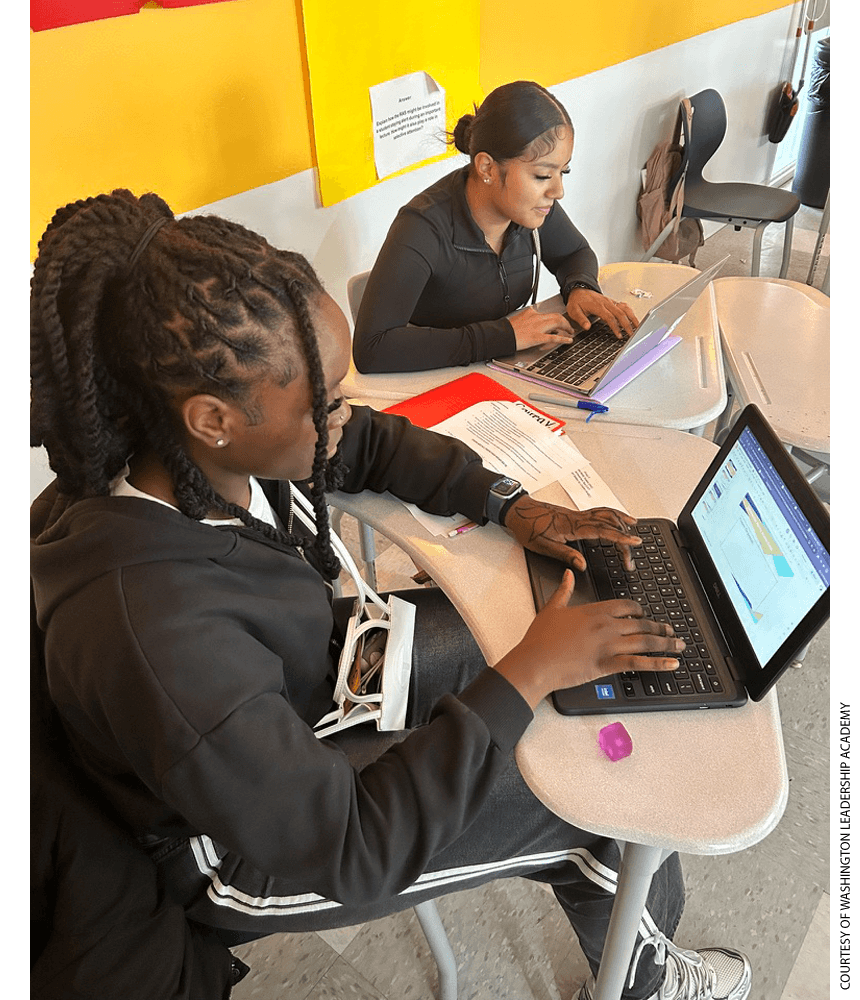
That raises an obvious question: Does AI help students learn? A March 2026 Stanford review of 14 AI research studies revealed mixed results: Students performed better in math, writing, economics, and physics when they were able to use AI tools in their schoolwork. But gains often disappeared when they lost access to AI. The review also found that AI could reduce students’ “cognitive burden,” making academic tasks feel easier, but sometimes at the expense of deeper thinking and long-term retention. Tools designed with “guardrails”—such as tutoring chatbots that offer students hints rather than direct answers—show more promise in supporting long-term learning than general-purpose chatbots that hand students the answer, the review found. The lesson is not that AI inherently helps or harms learning but that its effects depend on how it is designed and deployed.
WLA leaders believe it’s too early to draw conclusions about AI’s impact on their students’ learning, that the relationship between AI use and test scores or other formal measures isn’t yet clear. But some teachers are encouraged by what they’ve seen in their classrooms. Since implementing the chatbot for practice problems in her math class, Coleman has watched students who once struggled to engage with content or tasks become more confident, more willing to take risks, and more invested in their learning—changes she believes will translate into stronger academic outcomes over time. Teachers at WLA, meanwhile, are using AI to support students in ways that weren’t previously possible.
Adam Browning, WLA’s director of academic innovation and AP Psychology teacher, used the new technology to address a typical problem. The College Board, the organization that writes Advanced Placement exams, recently overhauled the AP Psychology curriculum, leaving teachers with few practice questions to give their students. So, he created an AI tool that generated questions modeled on the few already released by the College Board. Students submitted answers to a chatbot, which gave them immediate feedback and flagged Browning if they continued to struggle. The system has more than doubled scores on practice questions.
WLA teachers are also using AI to address the day-to-day administrative challenges that plague their professional lives.
Clarkson, for example, uses AI to generate a weekly newsletter for the parents of his 86 students, something he says he would never have time to do otherwise. The newsletter keeps parents informed about upcoming assignments and office hours and offers words of encouragement, bridging the gap between home and the classroom. Informed parents often mean better supported students, both at home and in school, Clarkson says.
Educators across the nation are also experimenting with using AI for administrative tasks. In the 2024–25 school year, 3 in 10 teachers nationwide reported reducing the time they spend on such tasks by up to 11 percent, or roughly six hours a week, by using AI.
While WLA teachers have embraced AI to handle the behind-the-scenes work of teaching, the school has also begun integrating AI into its operations. Mark Deegan, the school’s chief innovation officer, has led the effort to automate workflows that staff once managed manually. AI now centralizes daily attendance data on a single dashboard, synthesized with a historical record of absences so that staff can identify and reach out to struggling students before their truancy becomes chronic.
Facing the Future
AI integration at WLA has not always gone smoothly, reflecting the struggles of schools across the country as they navigate this fast-changing and still poorly understood technology.
Despite the high profile of AI at WLA, not all teachers or students have bought into the new technology, and teachers and students alike worry about its implications for job security. A junior who hopes to become an animator told me he’s concerned about what kind of work will exist for him in an AI future. Another student, an aspiring psychologist, shared her fear that AI is eroding the human connection and social skills her future profession depends on.
WLA does not shy away from dealing with this anxiety. Teaching leadership continues to facilitate both formal and informal peer-led professional learning, creating space for staff to voice fears, acknowledge the unknowns, and discuss the future of teaching in the age of AI together. Browning told a meeting of AI-skeptical students that part of AI literacy involves learning “to push back on the places we don’t want to see AI because it’s going to limit the creativity of humans.”
The Cheating Challenge
Students’ use of AI to cheat on assignments causes continual challenges and tensions, both at WLA and nationally. With tools like ChatGPT, students can generate full assignments in seconds, raising questions about authorship, original thinking, and academic integrity. One WLA senior explained how this issue extends beyond his school community: “It’s my cousins, my friends’ cousins. They don’t think for themselves anymore because they can just ChatGPT.” The Pew Research Center recently found that nearly 60 percent of teenagers reported that classmates used chatbots to cheat “very often” or “somewhat often.”
WLA’s approach reframes the issue. If a student can paste an entire assignment into ChatGPT and get a passing answer, the problem may not rest with the student, but with the assignment. Tasks focused on summary, recall, or formulaic response are often the easiest for AI to complete and may require little analysis or creativity from students if they do undertake them on their own. In this sense, AI may be exposing weaknesses in traditional assignments that prioritize completion over deeper thinking. Ashley Jeffrey, chief strategy officer at WLA, asked, “Was it rigorous enough for them in the first place? Was it challenging them? Does our education system need to redefine cheating?” This is not a new tension. Collazo drew a parallel to when he was a student and wasn’t allowed to use Wikipedia, a tool his teachers saw as a means of cheating, but he saw simply as a way to find sources. The line between using a resource and outsourcing your thinking has always been contested, but AI is intensifying this issue.
Teachers have responded in different ways. Some, like Adam Browning, WLA’s AP Psychology teacher, design assignments where AI use is expected and evaluated as a skill integral to the assigned task. In one case, students had 30 minutes to produce a full advertising campaign using as much AI as they wanted—a level four assignment.
Other teachers assess their students using no technology at all. “Test day, it’s paper and pen,” said Clarkson, who teaches AP Government. Student presentations in his classes are also non-digital: “It’s just you and the rest of the class.”
The school’s rubric for AI use helps clarify expectations, defining when and how students may use AI independently. When students violate those expectations, the school responds with both educational interventions and disciplinary measures. Students must meet with a teacher, administrator, and parent to discuss their behavior, why it happened, and how to prevent it in the future. School leaders then determine consequences based on the particular situation, ranging from allowing students to redo assignments to in-school suspension or, in rare cases, out-of-school suspension or expulsion.
More broadly, AI has forced educators to consider whether the way they measure learning truly captures student understanding or merely gauges computer-generated content. The question then becomes not how to stop students from cheating with AI, but how to design learning so that they don’t want to cheat in the first place. With student disengagement at historic highs, that shift is likely overdue.
Like the educators at most of the nation’s high schools, WLA’s administrators and teachers know they have not solved the problem of student cheating. But, on the whole, they see cheating less as a reason to abandon AI than as an incentive to move forward with it thoughtfully. As the student who plans to sell his chatbots to local businesses told me, cheating is always going to happen; AI just makes it easier and quicker. What matters, he believes, is that WLA is at least getting students to talk about it openly.
The Privacy Problem
The privacy of student data presents another serious AI-related concern nationally. The Family Educational Rights and Privacy Act (FERPA), the federal law governing student data, was last updated over a decade ago and is largely outdated in the AI era. With the development of AI tools that collect increasingly granular information about how students think, write, and learn, schools have been left to figure out their own guardrails for protecting student data. A mistake can have dire consequences—a recent report by Clever found that in 2025 more than 50 percent of K–12 schools in the United States experienced a cybersecurity breach.
At WLA, protecting student data has meant choosing FERPA-compliant AI tools, meaning the vendor agrees not to sell or share student data, to use data only for education purposes, and to maintain security standards via encryption and access controls to protect the data. When staff must use tools that are not FERPA-compliant, such as ChatGPT, they are regularly reminded to manually remove students’ names and sensitive information. WLA is doing what it can within a regulatory framework that was written before AI existed.
Lagging Policies
WLA’s experience with AI has unfolded largely without policy guidance from the U.S. Department of Education or District of Columbia education officials. It isn’t alone. Although ChatGPT arrived in late 2022, most states didn’t release regulations on the use of AI in schools until 2024, more than a year later. In that vacuum, implementation at WLA fell to a small group of teachers and school leaders experimenting on their own time and building protocols from scratch.
Most schools lacked, and still lack, the leadership and resources to do the same, leading to widespread inconsistency in AI adoption across the nation’s schools. As of December 2025, only about one-third of students nationally reported that their school had a schoolwide AI policy, and those with policies were two to three times more likely to restrict AI than permit it.
EdNext in your inbox
Sign up for the EdNext Weekly newsletter, and stay up to date with the Daily Digest, delivered straight to your inbox.
States are now catching up, and meaningfully so. To date, 35 states have released some form of guidance on AI in education. Most of it is not an enforcement mechanism, but a framework that defines AI and outlines its opportunities and risks in the classroom. During the 2026 legislative session, lawmakers in at least 27 states have proposed 77 bills, a sign that states are moving beyond broad principles toward concrete support for implementation, focused largely on AI literacy, integration, and guardrails.
Recent actions at the federal level have reinforced those priorities. President Trump issued an executive order promoting AI literacy and encouraging classroom integration, while the U.S. Department of Education is directing federal grant funding toward projects that expand AI literacy and integrate AI into classrooms. The U.S. Department of Labor recently released an AI literacy framework to guide nationwide AI literacy efforts across education and workforce systems.
These developments represent real, if overdue, progress. The 2029 PISA, an exam of 15-year-old students from a wide range of international jurisdictions, will include an assessment on AI literacy. Meanwhile fluency with the technology is already becoming a baseline expectation of the U.S. workforce, not a technical niche.
But for many schools navigating daily decisions about tools, policies, and student outcomes, policymakers’ response to AI has been inadequate. WLA’s experience—marked by trial and error, self-directed experimentation, and systems built without a roadmap—highlights the possibilities of AI in the nation’s schools. It has become a school where students understand the technology, teachers use it to do their jobs better, and the conversation about what AI means for the future is happening with students at the table. The March Hackathon at WLA shows the potential: Students weren’t just talking about AI; they were building it.
Whether the introduction of AI in the nation’s classrooms moves the needle on student learning at scale remains to be seen. WLA alone can’t predict that outcome, and the history of educational technology offers a cautionary tale: Many tools have been touted to transform learning, only to fall far short. But WLA’s experience points to the support schools need to deploy AI effectively: dedicated funding for professional learning; clear standards for AI literacy and values across classrooms; and networks for schools to learn from one another to speed implementation. And WLA makes clear that absent these supports, many students, especially those in under-resourced schools, may find themselves unprepared for the world they’re inheriting.
Tara Moon is a policy analyst at FutureEd, a nonpartisan think tank at Georgetown University’s McCourt School of Public Policy. This piece was adapted from the FutureEd report Digital Trailblazers: Lessons from a School on the Frontier of Artificial Intelligence.
Suggested citation format:
Moon, T. (2026). “The Trailblazing School on the Frontier of Artificial Intelligence: A D.C. charter leans into the potential and prepares for the pitfalls of AI.” Education Next, 26(3), 18 August 2026.