


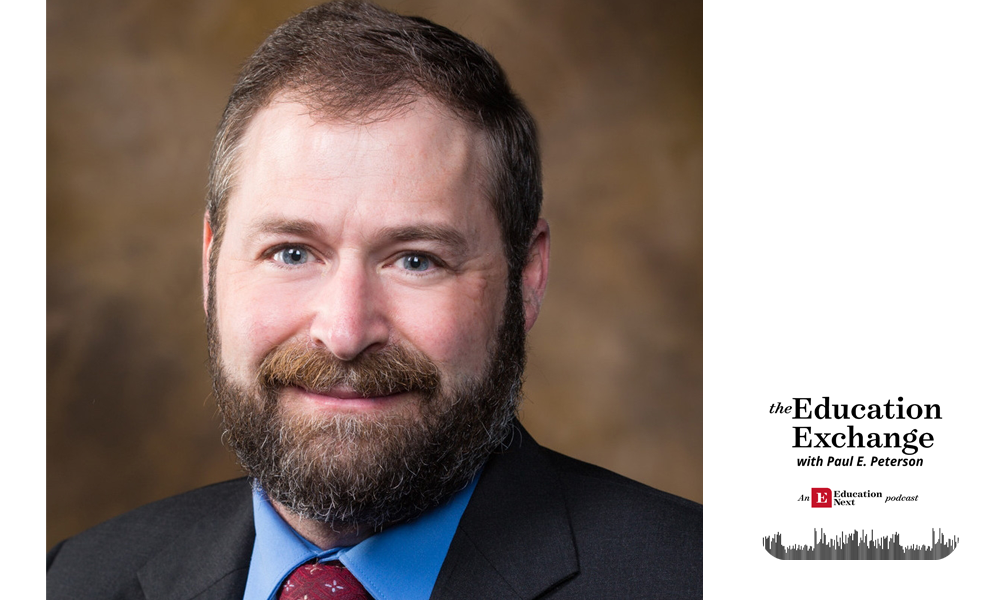
 Patrick J. Wolf, a Distinguished Professor of Education Policy at the University of Arkansas, joins Paul E. Peterson to discuss Wolf’s paper, “The Nation’s Achievement Inequality Report Card: An Assessment of Interquartile Test Score Gaps and Equality Trends in Traditional Public, Charter, Catholic, and Department of Defense Schools,” which was presented at “School Choice: Impacts on Participants, Non-Participants, Educators, and Entrepreneurs,” a conference hosted by the Harvard Kennedy School’s Program on Education Policy and Governance on May 7 and 8, 2026.
Follow The Education Exchange on Soundcloud, Apple Podcasts, Spotify, YouTube, or here on Education Next.
— Education Next
Transcript
PAUL PETERSON, HOST:
This is the Education Exchange with Paul Peterson. I am the director of the Program on Education Policy and Governance at Harvard University. Thank you for joining us. Several studies are showing significant declines in elementary and secondary student performance over the course of the 21st century. But the recent study by a group at the University of Arkansas is especially alarming. The study shows both a decline in achievement and a growing inequality between high and low performing students. The paper is entitled “The Nation’s Achievement Inequality Report Card in Assessment of Test Scores and Equality Trends in Traditional Public, Charter, Catholic, and Department of Defense Schools.” What a title. It’s unbelievably long, but we’ll unpack it. Now, the paper was presented at a conference at Harvard just a couple of weeks ago. The senior author, Dany Shakeel, is a graduate of the PhD program at the University of Arkansas, and he’s now on the faculty at the University of Buckingham in the United Kingdom. Misty Gallo is currently studying at Arkansas, and that’s where Patrick Wolf is a longtime professor in the Department of School Reform. I’m especially pleased to have Patrick Wolf with me today on the Education Exchange. He’s an old friend, former student of mine. I’m sure we will reminisce before we get done here. Thank you, Patrick, for joining me.
PATRICK WOLF: Thanks, Paul. Happy to be here.
PETERSON: Well, Patrick, you report both a decline in student performance and an increase in the inequality between high and low performing students. Now, are these just small changes that we don’t need to worry about or are they serious ones?
WOLF: So, I think they are significant. If we’re looking just at what has happened in the traditional public school sector over the last 20 years based on NAEP scores, these are NAEP scores that are adjusted for student demographics. We benefited from access to the restricted-use data file of NAEP through a agreement, through a license that the Program on Education Policy and Governance had. So this study was literally made possible by PEPG. At least the fact that we were able to control for student demographics was made possible by PEPG.
PETERSON: Well, we’re happy to help facilitate this research. And I’ve been following this kind of work for some time. It’s good that you have now actually pursued this into the 21st century, because some of the work that I was engaged in, we ended in the early days of the 21st century, but now you’ve got a way of looking at it. And, you know, in the 20th century, there were steady gains in student performance, but now things seem to have turned around. What is . . . Could you sum up just about how large an impact . . . how much of a decline actually occurred across the board for the disadvantaged students, that is the bottom 25 percent of the distribution?
WOLF: Yeah. So in the traditional public school sector from 2005 to 2024, the achievement level at the 25th percentile—so that’s the dividing line between the lowest quartile of student performers and the second quartile of student performers—that score declined by between two and five scale score points for those 25th percentile performers. And two scale score points is about a fifth of a year of learning. So five scale score points is almost half a year of learning. And that was the decline over the 20-year period. All of that decline occurred since the pandemic. So pre-pandemic, scores at the 25th percentile in traditional public schools weren’t decreasing. They weren’t growing significantly. But with the pandemic, they declined pretty substantially. In traditional public schools, there wasn’t a significant decline in test scores over this period for students performing at the 75th percentile. That’s the dividing line between the top quartile and the third quartile of performers. Those scores were flat over the 20-year period in traditional public schools. So the 75th percentile held the line in performance. The 25th percentile declined, and that produced a significant increase in the 75-25 achievement gap.
PETERSON: So the gap increases because over the entire period of the beginning of … When’s your beginning point that you’re starting with here?
WOLF: 2005.
PETERSON: Between 2005 and 2024, you’re showing no—
WOLF: Yeah, no substantial change. No substantial change in the average achievement scores at the 75th percentile in traditional public schools. Declines of two to five scale score points for kids at the 25th percentile.
PETERSON: Yeah, now is that in both math and reading?
WOLF: That is in both math and reading, correct.
PETERSON: And is that at the 4th grade and the 8th grade both?
WOLF: It is, yep.
PETERSON: So you’re sort of seeing it consistently decline both subjects, both grade levels that NAEP tests at.
WOLF: Correct.
PETERSON: Now, charter schools are supposed to be better than public schools, according to a lot of folks out there. How did they do over this period?
WOLF: Well, that’s an interesting question, Paul, because at the start of our timeline in 2005, charter schools actually had the largest 75-25 achievement gap among the four types of schools we study. Their gaps were slightly higher than the gaps in traditional public schools, all grades, all subjects. But through the course of the 20-year period in our time series, charter schools were able to hold the line on their 75-25 achievement gap. None of their gaps grew substantially, whereas with traditional public schools, all their gaps grew. So the traditional public school sector passed charter schools with the largest achievement gaps at the end.
PETERSON: But gaps are nice to talk about, but did the kids in the charter schools, did their learning increase? Either the top or the bottom, or are they just not improving?
WOLF: So prior to Covid, the scores were improving for students in the charter sector, especially for students at the 25th percentile. So their scores increased between five and eight and a half. Scale score points at the 25th percentile, pre-Covid. That’s a big surge. And scores were simultaneously improving at the 75th percentile for students in the charter sector. But those gains were more modest between two and six percentiles. So we were seeing in charter schools, before Covid, we were seeing exactly what we ed reformers want to see: students learning more and the disadvantaged students surging the most. But unfortunately, the pandemic disrupted that, and student test scores over the full course were pretty flat for students at the 25th percentile in charters and totally flat for students at the 75th percentile.
PETERSON: Were charter schools hit badly by the Covid pandemic and the closures that took place? Did the charter sector close down the same way the traditional public school system closed down in 2020?
WOLF: Most charter schools were subject to the same closure policies as traditional public schools. It was true in most states. So their independence that’s part of their chartering wasn’t available to them. It didn’t affect their ability to reopen in most states during the pandemic. And that was a real tragedy for them because they had so much momentum going into 2020.
PETERSON: You also look at the private sector … well, you look at part of the private sector. So I want to ask you about why did you only look at Catholic schools? Why didn’t you look at the private sector as a whole?
WOLF: Right, well, we’re tracking changes over time, not just levels, not just performance levels. And Catholic schools are the only subgroup of private schools that have consistently tested on the NAEP with large enough student samples to be reported. So they have to stand in for the private sector, but it’s very specific. These are Catholic schools throughout the country.
PETERSON: So I think there’s a lot of private schools that just don’t want to be tested. And the Catholic schools are sort of unusual in that they say, yes, we want to know what’s happening out there. But a lot of private schools seem to sort of feel like, oh, I don’t know, this is something the government wants, but we don’t want to supply it and we don’t have to. Is that right?
WOLF: Well, the Catholic schools definitely have tended to be more willing to take tests and to be subject to policies, education policies, common to public schools compared to many other private schools which view themselves as independent private schools and aren’t as willing to be subject to those requirements.
PETERSON: So what is happening at the Catholic schools? Do you see the same pattern that you see in the district and the charter schools?
WOLF: Well, what we tend to see, Paul, is in terms of the trends, Catholic schools, unfortunately, are modeling the traditional public schools over this 20-year time period. Now, they started the time period with the smallest 75-25 achievement gaps across grades and subjects. So they were the kings, the Catholic schools were the kings of equality at the start. And this is supported by a rich empirical literature on the Catholic schooling effect, starting with James Coleman, prominently reiterated by Breich and his colleagues. So Catholic schools have long had this reputation for pulling up disadvantaged kids and everybody learning together. And we saw that evidenced in small 75-25 achievement gaps at the start of our time period. But those gaps grew. They started growing around 2015 in most grades, especially 4th grade, and they surged after the pandemic, particularly 8th grade math. The achievement gap in Catholic schools between students at the 75th and 25th percentile increased by 12 scale score points from the pandemic forward. That’s a massive increase of three grade levels in gap growth. So basically Catholic schools have work to do. They’ve lost much, but not all, of their equality advantage when it comes to student performance at the 75th and 25th percentile.
PETERSON: Is that because the more advantaged students, the top 25 percent, are making substantial gains?
WOLF: They were prior to the pandemic, but only in 4th grade. Since the pandemic, there’s been little improvement at the 75th percentile for Catholic school students, and there’s been significant declines at the 25th percentile in most of the grades and subjects. So in that sense, the trend for Catholic schools mirrored the traditional public schools. It’s just the Catholic schools started in a better place.
PETERSON: So they still have a bit of an advantage, you’re saying, but it’s not … it’s eroding.
WOLF: Right. They still have smaller gaps than the traditional public schools of between 7 and 20 percentage points. The biggest gap difference between Catholic and traditional public schools is in 4th grade reading. Catholic schools now have a gap between their 75th percentile performers and 25th percentile performers of 19 scale score points. That’s a pretty small gap. In TPS, it’s 39 percentage points. So more than twice as large of a gap in 4th grade reading scores in TPS compared to Catholic schools.
PETERSON: Maybe that’s because Catholic schools are recruiting a certain kind of student, a certain kind of family that gives them some advantages just because of who they’re working with.
WOLF: Certainly that’s possible. Now again, we were able to adjust for changes in student demographics, but those are just observable characteristics of students. It’s possible that the unobservable characteristics of students in Catholic schools have changed over time, especially since the pandemic, in ways that have expanded these achievement gaps.
PETERSON: So let’s talk about some explanations. I know that’s not exactly what you can do with your data, so it’s a little more speculative. But, what do you think might be the explanation? There’s a number of possibilities out there. What do you think is causing this?
WOLF: Causing the gaps to grow?
PETERSON: Yeah. Why is it that we’re not seeing much improvement? And what improvement we’re seeing is at the most advantaged. And if there’s not improvement, if things are getting worse, they’re especially getting worse at the bottom.
WOLF: There are a number of candidates out there for why student test scores haven’t improved markedly over the last 20 years. Certainly one is a very prominent one is cell phones, student cell phones. Another is the relaxation of No Child Left Behind, results-based accountability. Unfortunately, those two things happened at almost exactly the same time. So we really can’t tease out. They do align with the point in which achievement started to drop, especially for kids at the 25th percentile. Right around 2013, 2015, was when the decline happened. That’s when cell phones became widespread in their use by children, and also right around when No Child Left Behind was attenuated with the ESSA revisions. So it could be one or both of those factors. Certainly on the reading side, where we see pretty substantial declines in achievement for 25th percentile students in traditional public schools, the flight away from the science of reading and the attraction of alternative literacy approaches, such as three-cueing and balanced literacy, that could have played a role. But we see it in math as well, so that’s not a sufficient explanation. I think the top candidates probably are, for these lack of improvements pre-Covid in most sectors, I think the culprit is probably either cell phones or relaxation of results-based accountability.
PETERSON: A lot of people say that … the teacher unions are saying their teachers aren’t being paid enough that they’re being paid less today than they were in 2000. I think in real dollar terms, there’s actually average teacher salaries have gone down. Are there fewer resources, less commitment to using those resources for the frontline worker in the classroom?
WOLF: There certainly aren’t fewer resources. Basically, the funding of public schools in our country have reached record levels. Over a trillion dollars was spent from all sources on traditional public schools in 2025. That equals per pupil spending of over $20,000 a student. So we have been spending more money on public education at least since 2009 on a per-student basis. A lot of that money isn’t making it into the classroom because a lot of it is being spent to staff up public schools and increase the number of non-teaching employees and staff at those schools. So it is entirely possible. Two things can be true at the same time, and that is that It can be true that teachers are not being paid more in public schools over time, and it can also be true that the schools themselves are being paid more over time. They’re just not directing those additional funds toward teachers.
PETERSON: Well, there’s been a lot of interest in social and emotional learning and trying to reach the whole child instead of just the academic child. Maybe what you’re describing here is just a change in the emphasis on academics, but maybe the whole child is actually improving over this period and you’re just not capturing that in your data.
WOLF: Sure, that’s a limitation of our study. We only look at test scores. So we may not be capturing gains in non-test score outcomes. But one of the most important non-test score outcomes is attendance at school. And what we’re seeing post-pandemic is a dramatic increase in chronic absenteeism. Students aren’t showing up. And so if they’re not showing up for school, then they aren’t receiving any kind of formation. They’re not learning. They’re not having values inculcated into them. They are basically starting the process of dropping out. So we have dual crises in our schools post-pandemic, and those are achievement losses—learning loss—and chronic absenteeism. They both have to be addressed, because otherwise there will be very dramatic losses in terms of quality of life outcomes for these students.
PETERSON: Of course, the schools often brag about higher graduation rates than ever before. Have you looked at that at all? And how can you account for why your data is showing this decline and increase in inequality, and at the same time we’re getting higher graduation rates than ever before?
WOLF: We’re looking at 4th and 8th grade, and most of the decline happened since 2015. So not all of these students have graduated yet. Some of the 4th graders … 4th grade … Yeah, I guess we would be right around graduation time for 4th graders when the decline started in 2015. So you’re right, Paul. I mean, there is this disconnect between the achievement levels of students in recent graduation cohorts and their graduation rate. That likely is due to a relaxation of standards in schools where, because of Covid, excuses are given for students. And they are graduating, but they aren’t graduating with the achievement levels that they need to be college and perhaps even career ready.
PETERSON: So maybe we need to wait until we see the long-term impacts on our labor force in years to come to see exactly what the impact of this is going to be.
WOLF: Absolutely.
PETERSON: There’s one story that’s much more positive and we need to spend a little time talking about that. This is sort of like the silver lining in the cloudy sky, a flash of lightning almost that illuminates the landscape in some strange way. And that’s the Department of Defense schools. The Department of Defense schools look just like they are hitting one home run after another. What’s the story with the DOD schools?
WOLF: The Department of Defense schools. So these are schools run by the Department of War. Now, the renamed Department of War.
PETERSON: Oh, D-O-W. I’m sorry.
WOLF: Right, yeah. Well, we label them as Department of Defense in our study because they were Department of Defense schools all the way through 2024. But in 2025, they were renamed Department of War schools. They’re not war colleges. They’re not teaching soldiers. They’re teaching the children of active duty military in their home bases in the United States and also all around the globe. So this is a network of government-run schools across the world serving exclusively active duty … the children of active duty military. Over this 20-year period, they’ve done exceptionally well. Even through the pandemic, the students at the 25th percentile in these Department of Defense schools increased their performance between three and eight scale score points. So the eight scale score points represents about three-quarters of a year of learning. So that 25th percentile score has gone up dramatically in former Department of Defense, now Department of War schools, over this 20-year period, even through the pandemic. And the scores even went up slightly higher for students at the 75th percentile. Only significantly higher in 4th grade reading. In the other disciplines, basically, the 75th percentile students and 25th percentile students are improving together. The gap isn’t closing because the 75th percentile students are keeping up with the improvements of the 25th percentile students. But the gaps aren’t growing in these Defense Department schools. The students are learning together, so gaps aren’t changing, but the improvement levels for both the 75th and 25th percentile—
PETERSON: Well Patrick, I will take that. I will take … If you’re seeing gains by the people in the lowest quartile and the highest quartile, and they’re the same, and they’re pretty substantial, and they continue through the Covid period, so you’re just at a higher level of performance among this group of students, that’s amazing compared to what you’re describing the whole rest of the system.
WOLF: Right. We social science geeks would call that Pareto improving. Everybody’s getting to a better spot. And that’s exciting. The other amazing thing about these schools, Department of Defense schools, is they are so understudied. There have been very few rigorous empirical evaluations of these schools. So it’s difficult to say why they are doing so much better than the other types of schools in our country. My hypothesis is that it is order and discipline. That these children come from families where discipline and personal responsibility are really inculcated heavily in them, instilled in them at a very young age. So they come to school ready to learn, and they’re committed to staying engaged, following the rules, and that can lead to higher learning. And just one little kicker on that is that one key policy in Department of Defense schools is if a student misbehaves, the commanding officer of their parent is notified by school officials. So there is real accountability for behavior built into these schools. And that may very well be the secret sauce that’s leading to these better achievement trends, much better achievement trends.
PETERSON: So the mom or dad will have to do more sit-ups if the child doesn’t behave better in school. Is that what you’re suggesting here?
WOLF: They’re certainly going to get a talking-to by their superior officer, at a minimum. Maybe there’ll be more sit-ups as well.
PETERSON: Well, let me ask you about another thing about those. I read a little bit about Department of Defense schools, and I read that recently they decided to make sure that every child was learning the same thing on the same day wherever they were in the armed forces. Because there’s so much movement among families from one school to another, that it’s very important for all schools to be teaching the same thing at the same grade level everywhere. And that creates a uniformity of pedagogy that doesn’t exist elsewhere in the United States. Could that be a possible explanation for the surprising pattern that we’re seeing with these schools?
WOLF: So that could be part of the explanation, Paul. And we certainly understand why they do it, given that the family might be sent to a completely different country at any point in time, and so the disruption to student learning would be dramatic if you didn’t have this uniformity across the curriculum in these Department of Defense schools. What’s interesting is this is a real contrast with the public charter school sector, right? Because one of the big themes of charter schools is differentiation and distinctiveness: different pedagogies, different theories of student development, different modalities for delivering learning. And so what we see as a contrast in our study is the charter schools that have the most differentiation are showing the best progress on equality. And the Department of Defense schools that have the most uniformity are showing the best progress on achievement.
PETERSON: Well, you know, in Houston, I think it is, or he was first in Dallas, now I think he’s in Houston, there’s a former Army officer who has become the school superintendent, who believes in this uniformity of instruction and really expects of the teachers, especially in the disadvantaged schools—the places where students are not performing so well—he wants all the teachers to be following a rigorous framework so that instruction is at a pace determined by the central administration, not by the individual teacher. And they’re claiming they’re getting successes there. I think Hanushek is suggesting in his research that they’re getting suggestions there. So is this the new reform?
WOLF: Well, I don’t know, Paul. My sense is that standardization and uniformity works when it works. And it doesn’t work when it doesn’t work. Obviously, it’s more important in Department of Defense schools than in other types of schools for the reasons we discussed. It might be more important for kids from disadvantaged backgrounds just because they need that additional structure and predictability. And kids from disadvantaged backgrounds switch schools more frequently than kids from advantage backgrounds. So greater consistency across schools might be more important to them. But we also know that different types of students have different needs, different educational needs, and thrive in different school environments. So I’m not convinced that a wholesale uniformity in curriculum and pedagogy is necessarily the intervention we need right now.
PETERSON: Well, thank you, Pat, for your wisdom, your insights, and for pulling together this fascinating set of data, which really has to disturb Americans and cause them to rethink what is the commitment to education that we have? Is it time to have a reassessment of our educational system? So thank you for joining me on the Education Exchange today.
WOLF: You’re certainly welcome, Paul.
PETERSON: I’ve been speaking with Patrick Wolf. He’s a professor in the Department of School Reform at the University of Arkansas. He, Dany Shakeel, and Misty Gallo are authors of a recently released paper entitled “The Nation’s Achievement Inequality Report Card.” I am Paul Peterson. This is the Education Exchange. Please join me every Monday when our weekly podcast is released on the Education Next website at noon Eastern time.