


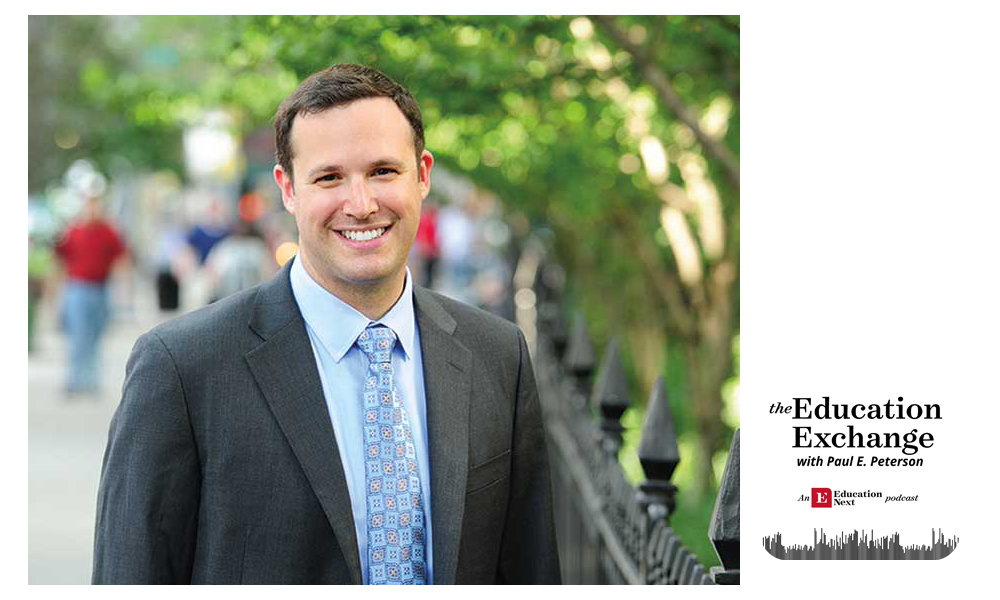
 Samuel Abrams, professor of politics at Sarah Lawrence College, joins Paul E. Peterson to discuss Abrams recent op-ed in Real Clear Politics,
“The Real Crisis in Higher Education Isn’t Just Ideology, It’s Faculty Decline.”
Follow The Education Exchange on Soundcloud, Apple Podcasts, Spotify, YouTube, or here on Education Next.
— Education Next
Transcript
PAUL PETERSON, HOST:
This is the Education Exchange with Paul Peterson. I am the director of the Program on Education Policy and Governance at Harvard University. Thank you for joining us. Earlier this year, I shared with you, my listeners, the news that American teachers have suffered a salary decline of no less than 5 percent over the first quarter of the 21st century. Now, the Chronicle of Higher Education reports that faculty salaries at colleges and universities have also declined. And in a recently released essay, Samuel Abrams explores the significance of these salary declines. He’s a professor of politics at Sarah Lawrence College, which is located just outside New York City in Bronxville, New York. I’m pleased to have Samuel Abrams with me on the Education Exchange today. Thank you, Sam, for joining me on the Education Exchange.
SAM ABRAMS: It is both a privilege and an honor, and I just need to embarrass you for a moment and say that I have had the pleasure of knowing you for three decades now. I met you as an undergrad at Stanford. And your work being a thoughtful scholar who then was concerned with having real impact in the real world is one of the reasons I decided to pursue a PhD. And I’m incredibly grateful to that and to the entire PEPG team and your remarkable crew of graduate students over these past three to four decades.
PETERSON: Well, Sam, thank you very much. I appreciate that. But look, let’s focus on these facts here.
ABRAMS: Of course.
PETERSON: Give us your take on how much faculty salaries that our higher education institutions have changed over the past decade, since 2013.
ABRAMS: So, to be clear, I did not do this analysis. This analysis came from the Chronicle of Higher Education in 2025. And this document was circulating among a lot of professor types. And, if you do inflation-adjusted works, faculty salaries declined nationally about 1.5 percent from 2013 to 2023, while average salaries across all industries nationally rose by about 8 percent, 7.7 percent over the same period.
PETERSON: You know, that second fact is pretty important. You know, a lot of people talk about the affordability crisis these days, but actually, salaries have gone up. I mean, it’s true that inflation has gone up, but even after you control for inflation, the average worker is getting more money today than they did a decade ago by 8 percent. It’s not a lot more, but they’re better off. But that’s not true for the people in education, right?
ABRAMS: Unfortunately, not. And then, you know, professors and faculty tend to live in high-cost areas. Boston and Cambridge is not cheap. New York, where I live, is not cheap. And professors in the New York area regularly see things like our housing, our insurance, our everyday expenses go through the roof. The other day I went to buy some cereal. I won’t name which brand, but a very typical brand that you buy for children was about $13 a box. I put it back on the shelf and said, “No, thank you.” And the fact is, when you look at this, faculty feel poorer, year after year after year. The Chronicle found that real pay fell by 3.2 percent for full professors.
PETERSON: So, this is not just the low-end faculty member, adjunct assistant professor or somebody—an instructor or a lecturer or something like that. It’s all across the board. Even the full professors are seeing a decline.
ABRAMS: Right. Yes. So, like me at Sarah Lawrence. I have actually felt it as in New York, utilities and basic costs of goods and services. Get into a cab and it’s almost $9 before you actually even start driving away. So, the costs are up and up. Our real pay feels lower and lower. And this creates a lot of anxiety. A lot of faculty are talking about it regularly. It hurts in terms of dignity. And we’re thinking about things we’d rather not think about. We’re not thinking about being in the ivory tower as much as we’d like.
PETERSON: Well, so the question I have is whether or not we really have many full professors left on our college campuses. The other thing that higher education is doing, as I understand it, is they’re hiring more and more people who are—you’re really not part of the basic framework, but our contingents. They are hired in an episodic kind of way. Do you have any figures on that?
ABRAMS: I did not pull the figures on that, but it is a fact, and it’s regularly reported in Inside Higher Education, Chronicle of Higher Education, stories in the New York Times, New Yorker, what have you, that numbers of tenure-track faculty are severely declined. The numbers of full-time faculty are much lower. We tend to do less teaching than historically we used to. And our ranks are filled with visitors and adjuncts. I can certainly tell you we see this again at Sarah Lawrence, where as a college, we could not operate without our adjuncts and our visitors. We call them “guests,” but nonetheless they’re there. And they’re not necessarily treated as well. We try to be respectful collectively, sure, but in terms of things like health insurance, benefits, compensation for work, it’s much lower. And if you take a look at who is often on the front lines of some of the recent protests in the last couple of years, and I’ve written about this quite a bit at NYU and Columbia, for instance, they’re overwhelmingly adjuncts. They’re overwhelmingly contingent faculty. And that’s a problem.
PETERSON: So, well, if that’s the case, why is it? I mean, why is it that universities are reluctant to just hire people on the tenure track scale, as they have in the past, and rely on their own employees? Why are they going outside to supplement to such a … They’ve always done that to some extent, but this is over 50 percent or somewhere around 50 percent. That’s a massive change in the structure of higher education.
ABRAMS: I would love to have an open dialogue about that. I think most universities and senior administrators are reluctant to have that sort of dialogue. And, I think you raise a critical point about continuity within higher education, continuity within the academy and within scholarly work generally. There are a number of reasons. You know, you and I are expensive when we are hired, for better or for worse, we’re hired essentially for life. We are significant investments on the part of the school. When the winds change a little bit, they can’t say, “Oh, we no longer need you, or we no longer need that other person. You’re sort of stuck with us.” They don’t necessarily like making bets on faculty that may or may not be good colleagues or appear to be good fits for the school. And it’s cheaper and easier to have that contingency work. At Sarah Lawrence—again, it’s just a good example—a while ago, we over-hired in literature. We’re very unbalanced in terms of what the faculty size and interest looks like, the result of which is we hire an endless number of contingent faculty. When the student demands change, when the student needs change, we don’t have to worry about tenured faculty in certain areas or scholarly work that are no longer necessary in the short term. We can simply say, “Thank you so much. We appreciate it. Your contract for a couple of years is done.” And then we’ll put out an ad for someone else we may need in a different topic or in a different area.
PETERSON: Maybe this is a good thing. I mean, so maybe that’s the way to go in higher education because it’s a rapidly changing area, just like everything else in the American economy. And so why shouldn’t universities have this kind of adaptability?
ABRAMS: Well, you raise a great question. Again, because if you’re an administrator or potentially a parent or one of those sorts of things, and I know you were at one point, it’s actually potentially—
PETERSON: I’m still a parent. I haven’t lost my parenthood status.
ABRAMS: No. College age kids.
PETERSON: Once you have children, they stick around.
ABRAMS: Yes.
PETERSON: Usually! You want them to.
ABRAMS: I hope mine do. We’ll see. But, you know, from a purely administrative perspective, it gives the school quite a bit of malleability and it becomes more nimble. But it’s more than just being malleable and nimble. From a faculty perspective, it’s about, are people anchoring or people putting roots down? Because it’s people like you and me who are here for long periods of time that create the culture, that do more than just teach in particular classes. We often stretch. I’ll stretch outside what I ideally want to do. We tend to be more invested in the place. If you’re at a liberal arts college or a school like Chicago, which you used to be with and is very heavily on undergraduate engagement, we’re paid to do that. That’s part of our job. It’s not just the teaching. It’s the community and the community building. So, you raise a challenging question from a faculty perspective. We want to be incentivized to know we have some stability and that we can put our roots down and that we can focus on big think questions. And I make that clear in the RealClear piece where if you’re rooted, you’re willing to take risks, you’re willing to hold lines, you’re willing to debate challenging topics. If you’re an adjunct and you’re there for a quick buck and then you have to look for more money, you’re not going to necessarily stand up and do the big research. So, to me, it’s dangerous in terms of community culture and in terms of research and productivity. But from an administrative perspective, it’s not awful at all. And it creates some malleability, which again is a real tension among faculty and administrative interests.
PETERSON: It is a matter of balancing these things out. Now, tell me this, administrators … you mentioned that presidents are getting a lot better pay these days than they did even a decade ago. It was up 27 percent or something like that. Of course, presidents are under a lot of fire, too. They have a lot of problems. So maybe they need to be paid more. But is this true of administrators in general? Or is administrative pay … If you’re a garden variety administrator, is your salary going down, too? Is this something that’s happening on the administrative side as well as on the professorial side?
ABRAMS: So, that is, again, a terrific question, and I have seen no research on that, but what’s interesting is I could do the research on that, so I’m going to write that down and actually answer that question empirically for you. What I can say is, and I’ve looked at so many college and university budgets, is that I think the day-in, day-out student-facing administrator is lower or on par with many faculty. But remember, administrative scales are so big right now that, again, at a small liberal arts college, a significant number of the administrators are paid more than most of the faculty. I think at Harvard, not so much. Faculty are well paid, and they’re probably on par with administrators. But Harvard is not typical. I think that if you look—again, we have numbers on this, but I’ve never seen that research question, and I can answer that for you, and I’m going to do that when we’re done—I think the answer is that administrators seem to be paid, generally, more often better than a lot of the faculty. And on so many ads that I’ve seen, especially in the DEI world, they’re paid very well compared to, say, an intro-level humanities professor or social science professor.
PETERSON: Well, I think it is a topic worth exploring, but certainly the numbers of administrators has grown dramatically.
ABRAMS: Yes, that’s unquestionable. Yes.
PETERSON: So, why is it? Is it because students now want things other than an academic education when they go to college and the faculty are not going to provide these other things? Is it the ancillary aspects of a higher education are the most important things in higher education today, and that’s provided by administrators.
ABRAMS: Oh, I don’t think so. You know, I’m going to use one of my favorite words from William James Hall, not too far from you: “mimetic isomorphism.” As soon as we see one of these campuses begin to adopt a certain structure administratively, they all begin to copy them. And then they define themselves as needing more and more. And during the boom, people were asleep at the wheel and said, “OK, we’ll hire more and more folks.” When I was an undergrad, not that long ago, we did not have such a heavy administrative apparatus that was necessary to have folks managing and living in every student residence. We didn’t need a director of this, and then the person had a personal assistant and an assistant director and all of this. No, I think this has just been an explosive growth that people have not fully recognized. I’ve been writing about it for almost a decade now. And then there are various folks, colleagues of mine at AEI and folks at Hoover, have been writing about the administrative growth and bloat. Yale is famous for it. You know, that stuff is fairly public. Stanford is pretty famous for it. Michigan is regularly called out because all their data is fairly public. No, I don’t think this stuff is necessary. It’s part, I think, of the nanny state, if you will, where students are coddled. This, you know, comes out of the coddling of the American mind idea. Students are coddled, need to be handheld and, quite frankly, are treated like children rather than adults. I remember many times I would get into fights and arguments when I was an undergrad, I would go to bed a little frustrated. And I’m grateful I had those arguments. I’m grateful I didn’t have to go to an administrator and talk it out. It made me stronger. It made me more thoughtful. And that’s the purpose of university is dialogue and discourse to find truth, not to be coddled and told you can’t hear that or you can’t say that. So no, I think we lost sight of our goal many times over. And only recently have we begun to realize that, A, faculty have yielded so much of the teaching obligations and formation to administrators, but also that we simply don’t need them. Let students work it out. That’s a big part of higher ed and a big part of real life.
PETERSON: So one of the recent documents that’s emerged is a report by the Yale University Committee appointed by the president. So, this is an official report. And the committee actually identifies three types of criticisms that it thinks are, you know, worth raising. They’re not ill-considered. And they identify these three areas. As one, admissions are not really based on merit strictly, but it’s sort of fuzzy what the rules are for admission to elite universities. And they’re talking specifically about Yale and other elite universities. And then they also say that the curriculum is swayed to the left and professors are teaching progressive point of view, I would say, especially in the humanities and social sciences. And then they also offer the criticism that it’s not that the administration is getting too big or anything like that, they haven’t raised that issue, but they do say it costs too much to go to the university without sort of saying why the costs have gone up. So, what do you think about these criticisms? Are they valid criticisms?
ABRAMS: So, the first about uncertain admission standards, I’m very mixed on that, to be honest with you. I love the idea of meritocracy. I did not have legacy access at all to anywhere. But at the same time, I found that having legacies within a certain constraint helped preserve the culture of these places. And that’s something that I think people often overlook. I’ve spent some time at Harvard since graduating, and when you see certain legacy culture disappear, some of the traditions, some of the things that make a particular space a family, some of the things that make a particular space and endow it with certain traditions and almost a sacred nature of certain rituals, they tend to disappear. So, I certainly value merit. In New York, the question of legacy admissions for schooling in private schools up and down the city is something we talk about all the time. And, you know, there isn’t a consensus. Is that a good thing or not? I’d like to see some more merit, probably fewer legacies. But, you know, can legacies be a feather in my personal opinion? Probably. I think there’s some continuity value to that. As for what is being taught primarily in the humanities and the social sciences, I think they’re absolutely right, they see themselves as scholar activists. This is a huge problem. You can be deeply, deeply ideological and still be intellectually honest. One of my favorite examples of that involves the inequality and social policy program in the Kennedy School, where I was taught by folks like Theda Skocpol and Bill Wilson, and I want to be very blunt, that I don’t agree with them on most policy issues. Were they ideological in class? No. Were they balanced in class? Yes. Were they absolutely dedicated to making sure that there was view-point diversity and diversity of ideas in the room so we understood the data, so we understood the questions and the outcomes. Yes, and I’m grateful for that and remain grateful for that. The students absolutely are not being exposed to an appropriate amount of diversity in most humanities and social science courses. They come in with their priors, they leave with their priors. They act on emotion, not necessarily thought. I actually just put a piece out in the Wall Street Journal arguing that students need more economics, and quite frankly, social science. They don’t often have the basic skills to ask the right questions and look for the right data. So, I completely agree with that point. I also agree that things cost too much. We need to really drill down on why that’s the case.
PETERSON: But how are we going to raise professors’ salaries and cut costs?
ABRAMS: Cut a lot of the administrators. And the other thing is, let’s be very blunt, we both know, and I think most listeners know, that the markets have been on one hell of a run over the last two to three decades, and these endowments have boomed. Where is all that money going to? I certainly believe that it’s not a problem to pay the money managers who make that kind of money for the school. But Yale has a very famous money management team, and they’ve done very, very well. Where is all that money going? I think Yale and any other major school should be somewhat more transparent about where that is, and then let’s have a dialogue over who’s getting paid what and where. At Sarah Lawrence, I look at where our money is going to, and they’ve frozen our salaries or given us a 1 percent or 2 percent increase here and there. They do give administrators, it seems, regular raises and increases, whereas faculty are stagnant. I think many faculty who might listen to this podcast would certainly agree and be able to see that at their own schools. So, it costs too much, sure, we need some more radical transparency. Where’s the money coming from? What are we doing with it? And I think that’s probably correct, but it’s going to vary school by school and management by management.
PETERSON: Well, there’s a fourth criticism that was not mentioned or at least not highlighted in the report, and that’s that kids aren’t learning as much as they once were. And, the other related point is faculty have lower expectations and are not offering as difficult a course and are sort of dumbing down the material and asking students to read simpler essays. And their grading practices have relaxed. There’s grade inflation. So is this… Is this a valid criticism?
ABRAMS: Oh, absolutely. And, it’s valid at Harvard as well. Your now retired colleague, Harvey Mansfield, has been beating this drum. He just wrote a column in the New York Post about this, he said he’s been beating this drum for almost 61 years, I think it was, or he’s been there 61 years and he’s been beating the drum for decades, whatever it may be. And again, look, when faculty don’t feel that they have the dignity that they used to, when they feel that they’re not necessarily supported by their universities as keeper of a very sacred intellectual tradition, and their position has changed, a less than ideal grade is not something they want to deal with. I have over the years given a handful of very underwhelming grades when the students have legitimately deserved it. And, almost every time the amount of paperwork, the amount of back and forth nonsense, I have to deal with from administrators, from parents who complain about it who give the school a hard time, you often say to yourself, is it worth this hassle? What should have happened is the school should have said, “We trust Professor Abrams if he said that and he explained why that’s what it’s going to be.” But they rarely say that. That’s again, as I mentioned in the RealClear piece, a loss of dignity and a loss of professional respect. So, if you’re a typical professor, what is the more rational or purely rational thing to do if you feel overworked and underpaid and not supported by necessarily your dean or your president, and you feel disposable or dispensable, and you’re an adjunct? So, you’re part of this adjunct crisis we’re dealing with of folks who do not have any job stability. It’s much easier to simply give that better grade, make the course easier, have happy students, and walk out thinking, you know, with the students thinking you’re great, and no administrative burden when you’re done. There are folks in New York who work at three or four schools who carry around huge tote bags and literally will go—I’m not going to name names—but from one school downtown to another school downtown to a school uptown. And it is not in their best interest to hold those standards. Teaching is a lot of work. It’s also a deep privilege. And over my, believe it or not, almost 17 years of doing it, because we’ve known each other again that long on a collegiate level, there are times when you have to sit with students. You’ve done it with me, and I’m very grateful for it, and you’ve done it with scores and scores of students. I’m better off for it, but faculty are no longer incentivized to do it. Faculty don’t feel very well paid to do it, and certainly not to diminish the capacities or the interests of a lot of our adjuncts, but it’s hard for them to want to do it, to find time to do it. Many adjuncts report that, for instance, they don’t have an office. So where are they going to do it and spend the time? They’re going to sit in the student union where it’s loud? Probably not. So, yes, I agree with that part of the report very, very deeply. And I think it’s doing our society just real harm. Remember, so many of our leaders come from Yale and Harvard. And to have students who don’t understand the humanities, and who don’t understand the human condition, and don’t understand data analysis, and don’t understand causation, and how data is gathered, and how we assess or assert what is a fact and what isn’t, that’s deeply problematic. One of the things I remember when you and I first met is you would tell me about your conversations with Justice Scalia and how they were just purely humanistic about understanding what is the good and what is passion and what is the point of life. That stuff matters. It may not matter immediately if you’re in a hedge fund or in private equity, sure, but at some point, when you’re making decisions, that’s going to creep up because it’s going to shape your moral compass, to a degree, and help you answer questions. What do I do? What are the downstream effects?
PETERSON: Well, Sam, I get your point, but let me ask this question. A lot of people who are teaching as an adjunct or as a lecturer, actually have a full-time job doing something else. And this is sort of an ancillary activity. And, so they do it more or less as recreational or as a way of getting some stimulation. They find the excitement of the classroom in one course here and there as something they sort of appreciate. And so the kind of salary they’re getting may not be such a big deal, and they may be bringing a lot to the classroom setting from their real-world experiences.
ABRAMS: So, I don’t know necessarily how true all of that is. I don’t think I’ve ever seen great numbers on that. And again, that would be an empirical question we can answer. But, you know, certainly you see that in law schools. You see that in business schools. Our law schools here in New York have lots of attorneys who work at big firms who absolutely would be part of the adjunct community. I’m thinking of a lot of the folks that I see around the city at the New School, Sarah Lawrence, and so on, whose jobs are not attorneys or lawyers coming in to sort of essentially moonlight, but this is their job. And we know plenty of folks who do that. I think one of the great things from this conversation, and this is why I love these things, is that there now two very clear empirical questions that I’m going to need to go answer and write up because I spend a lot of time studying this, looking at this, and cannot tell you those answers formally, but we could figure that out. I don’t know what the breakdown is among, say, the banker who’s enjoying teaching something at NYU Stern at night versus the numerous people who teach—I don’t want to get single people out—but the numerous people at Sarah Lawrence who teach where this is their primary job. And it is not just an evening activity where they get stimulus and enjoy the back and forth. From my perch, again, as a liberal arts professor around with students, I see lots of faculty in this position, who don’t have these sort of moonlight jobs. But again, my impressions are not data. My impressions are not empirical trends. So, I love this. I now have two projects to do. I’m going to call my research assistants later and get on this.
PETERSON: Well, I have enjoyed this conversation as well, Sam. So, thank you very much for joining me on the Education Exchange.
ABRAMS: Thank you for asking.
PETERSON: I’ve been speaking with Samuel Abrams. He’s a professor of politics at the Sarah Lawrence College in Bronxville, New York. I am Paul Peterson, this is the Education Exchange. A new podcast is released on the Education Next website every Monday at noon Eastern time.