

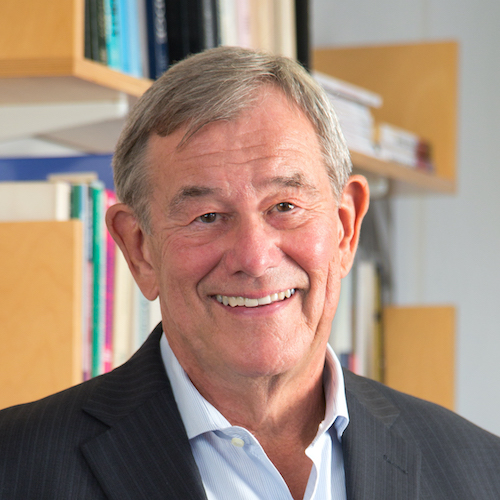
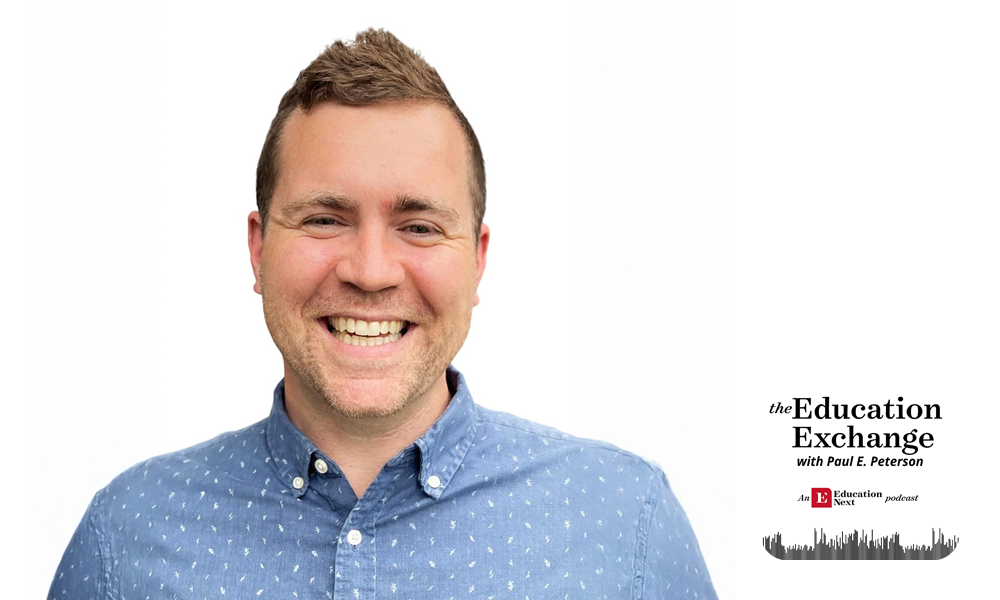
 Patrick Graff, a Senior Fellow with the American Federation for Children, joins Paul E. Peterson to discuss Graff’s paper, “Declining Public School Enrollment and the Rise of Universal Private School Choice Programs,” which was presented at “School Choice: Impacts on Participants, Non-Participants, Educators, and Entrepreneurs,” a conference hosted by the Harvard Kennedy School’s Program on Education Policy and Governance on May 7 and 8, 2026.
Follow The Education Exchange on Soundcloud, Apple Podcasts, Spotify, YouTube, or here on Education Next.
— Education Next
Transcript
PAUL PETERSON, HOST:
This is the Education Exchange with Paul Peterson. I am the Director of the Program on Education Policy and Governance at Harvard University. Thank you for joining us. Public school enrollments have fallen by over a million students over the past six years, and they’re expected to fall by nearly 3 million more by 2031. Meanwhile, private school enrollment is on the uptick. Well, are the two trend lines related? FutureEd says they are. This is a think tank in Washington, D.C., that issues reports on the state of American education from time to time, and they make the claim that private enrollment has been slowly rising even before the pandemic. And newly expanded school choice policies are likely to continue accelerating that shift. Sixteen states now offer or are launching programs that provide public funding for private tuition to any student in the state. Well, that’s what FutureEd says. But Patrick Graff and Brian Fitzpatrick say no in a paper presented last week at a school choice conference held at the Harvard Program on Education Policy and Governance. Patrick Graff is the legislative director for policy at the American Federation for Children, and the paper by the two of them is entitled “Declining Public School Enrollment and the Rise of Universal Private School Choice Programs.” Patrick Graff joins me on the Education Exchange today, and I want to thank him for sharing his information with all of you who are listeners. Patrick, thank you for joining us on the Education Exchange.
PATRICK GRAFF: Thank you, Paul. Great to be here.
PETERSON: Well, there’s two topics in the title of your paper. The first topic is declining enrollment, and the second is school choice, universal school choice. So let’s start with the second topic, and then we’ll get on to the declining enrollment issue. So, what do you mean by universal school choice?
GRAFF: Yes, well, if you go back to 2020, there were no states with universal private school choice. And what we mean by that is often a state that expands a private school choice program such that any student in the state can attend and receive money from the state for private education. In addition to that, a lot of states now have these Education Savings Account programs where you can spend on all kinds of educational expenses beyond that private school tuition expense. You know, for the purposes of paper, we’re really interested in these states that have expanded eligibility greatly. So these would be states, including kind of near-universal states post-2020. You know, at that point, we had zero states. Now, with the passage of Texas last year, we are now up to 17 universal eligibility states and eight of them have uncapped funding. So, as many students as apply could receive funding from the state for these private school choice programs. So massive amounts of expansion in the last five years. And really, we’re starting to only now just understand what is happening as a result of these big expansions.
PETERSON: Well, of course, we’ve had school choice since 1990, at least in one form or another. And I suppose you could even say before that, but in the past, these government programs that gave money to families were focused on the low-income families, usually, or those with children with special needs. So it was a more targeted program. Only specific kinds of people were eligible for the school-choice programs. So what’s new about the universal . . . school-choice program is that it’s universal. It’s for everyone, no matter what your income is or whether your child has a disability or not, you’re still eligible for participation in the program. Do I have that right?
GRAFF: That’s right. And this really has happened in the last five years. So this is a brand-new thing to the school choice movement more broadly.
PETERSON: So this strikes me like that could really have an impact on the enrollment in our public schools. And we are seeing that we have declining enrollment. As I mentioned, that could be 4 million student decline in this decade. Some of this has already occurred. Some of it’s clearly going to happen. It’s written in the cards. So how much of this is being driven by the school choice program?
GRAFF: It’s a great question. And I got really interested in this last summer when I saw a report from the New York Times. Dana Goldstein there was doing some reporting down in Orlando for The Daily. And they were looking at what is happening to the Orlando school district. They’re losing all of these students. They don’t have the same enrollment that they used to. We know that these historic enrollment declines are happening in public school. And at the same time, you have this contemporaneous increase in private school enrollment, especially in Florida, which now has over half a million kids in their private school choice programs there, across a number of different programs for kids doing education at home for kids with special needs, as well as kids in kind of your brick and mortar private schools, as well as these small microschools. So there’s a lot of diversity in the Florida private school market now. And so, I saw in that report, they were making this connection between, you have this huge private school choice program that’s growing and where are the students in the Orlando public schools? But I also knew it didn’t ring quite true to me because there’s good theoretical reasons to believe that, in fact, a lot of these enrollment shifts are going to happen gradually and pretty slowly over time. Florida’s only passed their universal expansion as of 2023. And so they were really attributing a lot to something that happened quite recently. And I think we now have a good understanding that this will . . . and happen over time. And so myself and Brian Fitzpatrick of the Fordham Institute, we set out. We basically said, hey, let’s build a data set that can answer this question. So we looked at public school enrollment from 2012 all the way up until 2024, as well as data that we maintain at the American Federation for Children on private school choice enrollment over time as well. So we have these data going back decades and can look at what happens when a state passes universal school choice and does it change the trajectory of public school enrollment? And I think that is a key point because public school enrollment is declining across many, many states, including states that have no private school choice. So I think the key question is, are those states that do have private school choice, are they mistaking other sources of decline? Are they missing those and instead pointing at the private school choice program when, in fact, that might be a much smaller part of the puzzle?
PETERSON: So what are some of the other factors that are affecting enrollment in our public schools across the country? And more so in some states than others. And I think that’s important to keep in mind that the way you look at it is that you’re looking at states compared to one another. So that’s how you can come up with an explanation because you can see it. This is happening in this state, but not in that state. So it’s a comparison among the states that’s doing this. But if just looking at it nationally, what are the big factors driving the decline in student enrollment?
GRAFF: Yes, so there are a number of them. So I think the biggest one is birth rates. If you go back to the Great Recession of 2008, that was about the tipping point in terms of when we really started to see birth rates declining across the board and kind of continues until today. I mean, as of right now, we have about 3.6 million births per year in the United States, and that was at a peak of 4.3 million in 2007. And as a result of these fewer births, our total fertility rate is about 1.6, which is below the 2.1 replacement rate. So every year we’re having fewer and fewer kids. They age up, go to kindergarten. And as a result, a lot of our big cities are now having fewer and fewer kids enroll in kindergarten. So this is by far the largest driver of enrollment loss. And I think the shocking thing is that a lot of this is in big cities, in states, blue states with no private school choice. So if you look at places like LA Unified, you know, their total enrollment is down 40 percent from two decades ago. So they’ve had this huge gradual decline that has accelerated recently. And, you know, a lot of states, the pandemic school closures, you can see right on the charts just looking at this over time, there’s a big drop as a result of the pandemic in enrollments as well. And so that hasn’t really recovered. And so underneath those birth rates—
PETERSON: You’re basically saying that it’s the fertility rate has declined nationwide and especially in particular places. And this is . . . you can look five years later, that’s going to affect how many kids are available to go to kindergarten and then first grade, second grade, and down the line. So you can actually predict out into the future how the decline in the fertility rate is going to necessarily impact student enrollments over the next five to seven years.
GRAFF: That’s right. And I mean, a lot of these public school districts are doing this modeling and they do know that these problems are on the horizon. So I think the question is, you know, what states are adapting to this well and which ones are not in terms of right sizing their systems, thinking about how to reduce their workforce potentially in order to teach the number of kids they have rather than the number of kids that they used to have 10 or 20 years ago. You know, another complicating factor here is state net migration. So we know that families are moving across state borders as well. There are some states that a lot of families are moving into, and there’s a lot of states that families are moving out of. And I think a key question here is we know, for example, that places like Illinois, Michigan, California have all lost more than 5 percent of their public K–12 student population over the last five years since the pandemic, despite having no universal private school choice program. And so that’s really what kind of piqued my interest because I also knew that Florida, despite having the largest private school choice program, their public school enrollment is actually up, almost a percentage point since 2020. So those are big differences in terms of these enrollment shifts. And just at a descriptive level, we knew that this was happening. And so we decided to put together something that was more of a quasi-experimental design to try to get a little bit of leverage on these differences across states and trying to create comparisons that were fair and kind of netting out differences before they had universal private school choice. And then kind of testing as of that impact what happens to public school enrollment in those states.
PETERSON: So with all of these factors, and let me just add in the international migration, because immigration of families from abroad was off-setting some of this. You were having, I know in New York City and Los Angeles, you were having a lot of . . . immigrants that had come in from Mexico or in some other way and were settling in some of our big urban areas. And the school sort of saw this as a plus because it off-sets some of the decline in their enrollments. But that, too, is going to disappear in the next five years, we must expect.
GRAFF: No, that’s right. I mean, a lot of that already is disappearing. And so that is another driver of a little bit of that disenrollment in K–12 public schools. You know, and really our headline finding is that we see no noticeable impact of the switch to universal on public school enrollments.
PETERSON: How do you do that? What’s your methodology that actually, you know, zeros in on what is the impact of the universal choice programs on enrollments in schools when there’s so much happening out there? All this stuff is going on simultaneously. How can you attribute to the school choice program a specific effect? What’s your technique?
GRAFF: Yeah, so we use kind of a classic design that has some new innovations on it. So let’s say you want to study Arizona’s Universal Education Savings Account program. And you say, hey, we know that they passed this new Universal Program in 2022. We want to know what happened to these public school enrollment shifts. But, you know, as you said, there’s all these other things happening in Arizona that could be causing it that’s not that policy. So how do we kind of create this parallel universe, that’s counterfactual, where Arizona did not pass universal Education Savings Accounts as and we could see the public-school enrollment trends in that world? So basically what we do is we create a synthetic Arizona. So it’s called a synthetic difference in differences is the name of the method that we use to basically create kind of in this pretreatment period. So before you go universal, you create a set of states that kind of contribute to a synthetic version of Arizona in the pretreatment period to make it look their enrollment trends are exactly very much similar over that pretreatment. period. And then once you hit universal, you know what happens in those synthetic versions, if you will. And that trajectory continues over time. And then you compare that to how the trajectory changes for Arizona post-universal expansion. So you do that.
PETERSON: Let me just make sure I understand that. I think I’ve got that. So you look at the trend in Arizona and then you look at the trend in some places around the country in other states which didn’t have anything like the Arizona School Choice Program, the Universal Choice Program, and you say, okay, they’re identical to Arizona in the period before Arizona passed this new law. So I would expect that these two places should stay exactly the same because they were the same before. We should expect them to stay the same. And then . . . Let’s see if this program changes anything. I think that’s the method. Did I get that right?
GRAFF: That’s right. Yeah. So you think about these control states. So these are states that do not have these universal programs. And it’s weighted so that it looks just like those states that did pass universal school choice before they did so. And you’re tracking that over time and making sure that those are the same and equal over time before this intervention of universal school choice. And then see, you might have a state that’s already on the decline in terms of public school enrollment. And you want to know, did the decline accelerate? Did they continue to lose even more students? Or did it actually, you know, could it stay flat? Did nothing change? And really, that was our finding is that the impacts were very small, not statistically significant. And that we actually believe that some of these impacts are going to be gradual and building over time, which kind of coheres with the little bit of the research that we do have on the impacts of universal programs so far.
PETERSON: So what you’re sort of saying is that actually you’ve got a very boring paper here. You find these programs, which get so much attention in the news media, the New York Times fixates on and other newspapers do, and Teach Your Ed does. They all say, oh, there’s this terrible school choice program coming along. And you say, no, actually, it’s pretty boring because its really had no effect on enrollment at all. Right?
GRAFF: Well, I wouldn’t go that far. It is a boring paper insofar as it’s getting a lot of attention, but I think it’s really unwarranted in a lot of ways. You know, I think, you know, I, my background is in research. I was trained as a sociologist and love doing education policy research. But, you know, my day-to-day work is working in school choice and helping families sign up for these programs. And, you know, what we know is that awareness of them takes time. Even in these universal states, a lot of families don’t even know they exist, despite them being around for several years.
PETERSON: I’m going to bring up a point, though. I love your paper, to be honest. I love your paper. And I was sort of making fun of the boring point there. But I just wanted to highlight the fact that your finding is that there’s no effect. But now I’m going to ask you a critical question here. Couldn’t that school choice program be the very reason families are moving to Arizona or Florida or other states that have a universal choice program? And so . . . what you’re saying is just immigrants, you know people moving around, it could be that the movements themselves are affected by the school choice programs. Is that possible?
GRAFF: That is one of our theories is what might be happening underneath the surface here. So we are not able to test that directly in this paper. But anecdotally, we have heard that story a lot. We know that there are families, for example, that are moving into Florida to take advantage of the private school choice program. And, you know, the thing is with schooling decisions is that parents don’t stay within one sector for their kids’ whole educational career once they move to a state. Maybe one of your kids goes to a private school. Maybe one goes to a magnet or a charter school. Maybe you home school another child. And all of these are options in a place like Florida that has seen over the past decade over 500,000 new families on net, move into the state. So they have a lot of population moving into the state of Florida. That is going to be, especially overtime, distributed across school sectors and what is a very choice dynamic system. And I think public schools are benefiting from that in addition to the private school choice programs.
PETERSON: So it could be that you’re underestimating the effect of these programs a little bit, but you’re saying it’s probably not a big impact now. But of course, these universal school choice programs have only been in place for a few years and it takes a while for them to get well-known, and they’re expanding in size. And looking forward over the next 10 years, what looks like nothing now might be quite substantial downstream. Isn’t that what the critics are worried about?
GRAFF: I do think that that is the larger point. So, I mean, we do find that there are families switching to take advantage of these programs. You know, the first year after universal, you know what happens is a lot of the families who now become eligible who are already in a private school jump into the program first. Right. So in a lot of these states, you have about 60 to 70 percent of your enrollment is coming from those private schools. And the remaining 30 are people who are switching just in that immediate year after. But these are folks who have really close ties to informational networks so that they can make that school decision right away. It takes supply to adjust. You have to have more private schools for families to enroll in them. And you also have to allow for families to learn about them and make that decision, right? So it’s very hard to switch schools mid-year for example so by year two and three and four we know that more and more families switch out of other schools into them and so you know . . . To your point, we’re only looking over the first four years post universal for a number of these programs. So we really see this as a short-run finding. And the enrollment impacts in terms of switching are there, but they’re very modest. I think the real impact is over 10 years. And I think from a political dimension, that’s what opponents of these programs are worried about is 15 years from now. How large will those impacts be? And so they’re talking about it now as though that is what is causing the public school enrollment loss now, when, in fact you know, you might be looking 10 or 15 years down the road and then starting to see some sizable impacts.
PETERSON: But of course, the other factor is that these programs are funded at a fairly modest level. And, you know, most people are sending their kids to traditional public schools that are operated by school districts. So, you know, a program is relatively small. This can’t have a huge impact on a great big system like the American public school system.
GRAFF: Yeah, to keep it in context, right, there’s almost 50 million kids in public K–12. So it’s about 49.5 million. The total private school population is just under 5 million. So it’s around 10 percent, a little bit under that overall. And, you know previous research from this past fall out of Tulane kind of looking at this question of what happened to private school enrollments as a result of expansion universal, they found an increase of about 3 to 4 percent, increase in private-school enrollment. Well, you know, if the base rate is one tenth of about 50 million, right, that’s about .3 to .4 percent of the public-school enrollment overall. So that makes sense with the findings from our paper as well. It’s just kind of the mirror image of that, really, that, you know, you’re seeing this bump up in private school enrollment in the short run. I think what we’ve seen from a lot of states is this is going to continue to happen. But I think a lot of folks also don’t realize that there’s a lot of movement within states between different types of public schools as well. And so part of what is happening here is in some ways, one type of public schools . . . so you might be thinking your traditional public school in Orlando, for example, being like, well, there’s all these kids that are now going to charter schools or all these kids that are now using open enrollment to transfer out of the city school system and go to a neighboring district. And so all of those are public school enrollment, but they’re moving between the public system. And I think, unfortunately, what ends up happening is that the private school choice program becomes the scapegoat, even though a lot of the movement is happening within this broader public sector.
PETERSON: Well, I was going to ask you about that question, because it seems to me that if you put the charter schools and the universal choice program together and said, okay, let’s look at their joint impact on your traditional public school, your district school—then the impact might be substantially larger than the one you’re describing today.
GRAFF: Yes, that’s right. What I think—with the charter impacts, those have been happening over a much longer period of time, but have been growing much faster. So the charter sector has been continuing to grow. And a lot of these choice friendly states are also greatly expanding their charter sectors. And I think, you know, a key move here that you see in places like New York, for example, is they put a cap on charter schools. They know that families want to send their kids there and they’re worried about that enrollment loss. And, you know, the problem for the traditional system with charter schools is that for every charter seat you add, that’s almost a pure one-to-one loss in terms of kids switching. Almost 100 percent of those kids are going to be switching from a public school into a public charter school. Whereas with private school choice, at least in the short run, it’s going to be closer to 60-40, not the same proportion. So it represents a larger loss for the traditional public school system, which I think is part of the challenge.
PETERSON: And it could be impacting the charter schools. So it could be parents send their children to charter schools, but when the private school, universal private school comes along, they may say, well, there’s a private school out there I’d rather send my child to than this charter school that I’m currently sending them to or what I’ve otherwise sent them to.
GRAFF: Yeah, that’s right. And I think, I mean, we’re seeing that as well, right? When you live in a choice-centric system that families are more aware of what they are, and start making those decisions because they’re open to them. And I’m really excited as well that this new Education Freedom Tax Credit at the federal level, this new Federal Education Tax Credit, I think will continue to open up more opportunities for families, particularly in states that have no private school choice currently, as well as states that do have private school choice. And some of our lowest-income families are still priced out of, let’s say, high school, for example. So to your earlier point, right, in Florida, if you’re getting about $8,000 a year to go to a private school, that could take you to many, many most elementary schools that are private in the state. For high school, that’s another question, right? You’re going to be talking maybe something closer to $15,000 or $20,000 a year to go to a private high school. And so a lot of them will switch back to public school for high school, often against their will because they don’t have the access for that. And for us at American Federation for Children, that’s a big priority. Is how do we get access to these low-income families first? And I think what will be incredible about this new tax credit is that scholarship organizations will be able to fundraise additional scholarships to layer on top of the state Education Savings Account program there in Florida, for example, to be able to make things like high school accessible in some ways for the first time. In addition to states like Colorado who have opted into the Education Freedom Tax Credit but do not have a state private school choice program, they’re going to be able to offer choice for the first time as well. So I think there is some awareness that, you know, public-school enrollments are dropping. They’re looking for resources because that’s where the funding comes from. I would encourage a lot of them to also look at the Education Freedom Tax Credit. Public school students are also eligible for scholarships from these. I actually think we’ll see a lot of Education Savings Account students using scholarships to receive services from public schools and their affiliated tutoring services, special education services as well. So I think What Florida has demonstrated is that public schools can also be serving, for example, homeschool families who are using an Education Savings Account and receiving state funding that way, who otherwise would have never been in the public school system. They were homeschooling. But if they can offer a class, they can offer these different opportunities. That’s also additional funding, even though you won’t have that enrollment.
PETERSON: I’m wondering if there’s a reverse causal effect that your analysis is bringing out. Is it possible that with states with growing enrollment, let’s say with the in-migration of people from other states and with the general growth of the economy, there’s a feeling, well, let’s try everything. So places like Oklahoma or Arkansas or Arizona, Florida, places that are enacting these choice programs, universal choice programs are willing to do so because there’s resources for that and for the district schools as well. So there’s not as much competition as there is in the places like Illinois or New York or Massachusetts where there’s a fight over a scarce resource. There’s not so many students and there’s limited resources. The pot’s not growing.
GRAFF: I think that’s a really good point. I mean, there is a benefit and a future one as well. I mean, if you look even further down the road, just a growing population in general is going to be really great for these states’ economies. So I think policymakers are looking at not just their overall policy environment for what will attract a new population to our state, but what is the education-policy environment that’s going to be attractive to families? You know, if I’m a young family, wanting to have kids, and let’s say I can’t afford a house in a large urban city, you know, why would I stay there and try to make it work in an apartment when I could move to another state where housing is cheaper? There’s support for—private school choice, for example, or a charter school if we wanted those options. I don’t necessarily have to go buy a house in the nicest zip code possible in order to get access to what are considered the good schools. So I think a lot of families are making strategic choices, and there’s a lot of information out there now. So I’ve heard anecdotally that, that is happening, and I think policymakers are responding to it.
PETERSON: Well, so you’re throwing some caution out there. You’re telling everybody, don’t expect change to be dramatic over the short run. There’s . . . the system really hasn’t changed all that much with the introduction of a pretty radical new program the Education Savings Account Program which gives money to anybody in the state, just about, to go to a private school if they would like to, but you are also sort of saying this could have some huge long-term effects. So what do you think is the most important of these two points?
GRAFF: I would say do not fear the long-term huge effects, because I think they’re actually very positive. If you look at some of these longer running private school choice states and I’ll go back to Florida because we have some of the best data on this. You know, we’ve had and I know that has been highlighted on this program that there have been evaluations of how public schools in high competition areas change over time as a result of creating programs like this. And Florida is a state where we actually have 15 years post introduction of the very first tax credit scholarship program back in 2003 to look at how did the public schools change as a result of that. And what we’ve seen is actually public school scores, including scores for the low-income kids, have gone up at a much higher rate in these high competition areas as a result of the expansion of school choice. So I think we should continue studying this in other states. But I actually think that this is a huge boon to student outcomes. It is not necessarily a huge boon to the bottom line of the traditional education system. And I think that that is part of where the concern is coming from and why you’re hearing a lot of these media reports is that they know that their part of the pie is starting to shrink and are trying to hold on to it, as firmly as they can.
PETERSON: Well, thank you, Patrick, for explaining all of this to our listeners, and thanks for joining me on the Education Exchange.
GRAFF: Thank you.
PETERSON: I’ve been speaking with Patrick Graff, the Legislative Director for Policy at the American Federation for Children. He and Brian Fitzpatrick have presented a paper at the Conference on School Choice at the Harvard Program on Education Policy and Governance. And the paper’s titled “Declining Public-School Enrollment and the Rise of Universal Private School Choice Programs.” I am Paul Peterson. This is the Education Exchange. Please join me every Monday when our weekly podcast is released on the Education Next website at noon Eastern time.