


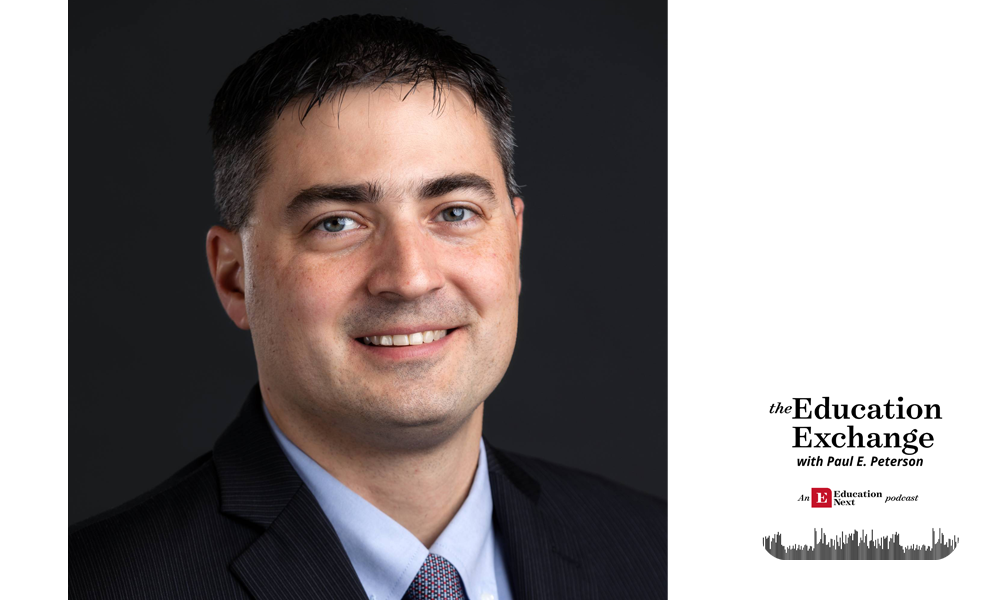
 Michael Henderson, associate professor at Louisiana State University, joins Paul E. Peterson to discuss Henderson’s paper, “Blowback or Buy-In: Public Opinion in Response to Charter School Penetration,” which was presented at “School Choice: Impacts on Participants, Non-Participants, Educators, and Entrepreneurs,” a conference hosted by the Harvard Kennedy School’s Program on Education Policy and Governance on May 7 and 8, 2026.
Follow The Education Exchange on Soundcloud, Apple Podcasts, Spotify, YouTube, or here on Education Next.
— Education Next
Transcript
PAUL PETERSON, HOST:
This is the Education Exchange with Paul Peterson. I am the Director of Harvard University’s Program on Education Policy and Governance. Thank you for joining us. Throughout the 21st century—that is, the 25 to 26 soon-to-be 27 years of this century—charter schools have been showing a steady increase in the number of students enrolled. Though it’s now about 8 percentage points, according to government statistics, and maybe it’s gone up since 2022 when that information was released. Public support for school choice is also on the rise, according to many sources out there. The question is, however, what are the drivers of this? What is the thing that’s driving the changing support for school choice and the changing numbers? We’re lucky today to have with us Michael Henderson. He’s a professor at Louisiana State University. He’s brought these two facts together into one analysis that looks at the politics of public opinion and school choice. He’s looking at trends both by the presence of a charter school in a community, and by one’s political affiliation or partisan affiliation. Now the paper that he has put together was presented at the Harvard Program on Education Policy and Governance that I direct. It was held at our School Choice Conference a couple of weeks ago. It’s soon to be available on the PEPG website. It’s entitled “Blowback or Buy-In: Public Opinion in Response to Charter School Penetration.” So, thank you, Michael, for joining me on the Education Exchange.
MIKE HENDERSON: Thank you for having me.
PETERSON: Mike, according to the information that people are putting out there, there’s a rising level of support for school choice, but what’s the level of support today? Does it vary depending on how you ask the question? What is available from the data you have?
HENDERSON: Absolutely, I think the simplest way to put it is that Americans are … American support for school choice is pretty robust. It does vary, as you mentioned, by how you ask the question. It varies somewhat on what kind of school choice you’re asking about as well, but in almost any form, whether you’re talking about Education Savings Accounts, charter schools, tax credits, funded programs, support tends to be … the share of people who support these programs tends to be higher than the share of people who oppose them.
PETERSON: How important is the political party affiliation in the support for school choice? Is that the determinative factor?
HENDERSON: It was very … and it’s one that, in the really the last decade, decade and a half, has grown. As you well know, if you go look at all these other kinds of issues outside of education, it’s no surprise that Democrats and Republicans often take different viewpoints. What was interesting is that in the realm of school reform, including school choice, we did not see nearly those kinds of gaps until really about the last 10 years or so. It varies a little bit by topic to topic. So now we do see that Republicans tend to be, on average, stronger supporters of forms of school choice than Democrats do.
PETERSON: Well, what happens when somebody actually has the choice of a charter school in their community? About 8 percent of students are attending charter schools. So, there’s a lot of places out there that have a charter school right in their local community. Does that take politics out of the picture, or does it modify the story a bit?
HENDERSON: Yeah, it’s really interesting. As you noted, charter school enrollment has really expanded in recent years, essentially doubled in the last 20 years. So we’re around 4 million or so students are enrolled in charter schools. It’s all over the place; 38 different states have seen increases in their charter school enrollment. I was curious about what happens when people see more charter schools in their communities…in their local communities, their local-school districts. Do they become more supportive? Do they become less supportive? And there’s good reason to think that they might be responsive to these local conditions. But at the same time, because we’ve started to see, especially in our national political rhetoric, there’s been an increasing divergence among party leaders on charter schools made as science called symbolic politics. Things like partisanship and ideology, will that swamp out these local conditions. And so I found that the answer really depends on the moment. So on average, if you look at the entire span of the data that I look at, which is really roughly 2014 to 2021, on average there does not seem to be much impact of the presence of charter schools or changes in the presence of charter schools, I should say, on favorability towards charter schools. However, there is a diversion impacts by party, such that where there are more charter schools and where there are more students enrolled in charter schools, you actually see the party gap shrink somewhat to where Democrats and Republicans are closer to each other on how they feel about charter schools than in places where they’re not seeing growth.
PETERSON: Well, Mike, where do you get your information from? What’s the data set that’s providing you with this information?
HENDERSON: I had to combine a couple of data sets. The challenges to doing this kind of project is you need to know a few different things, and you put them together. You have to know what people think about charter schools, and you want to be able to look at that over time, so you want questions about charter schools that are the same, asked the same way, because, as we noted a few moments ago, the wording matters. But then you also need to … so you can get that from surveys. So I used the Education Next Poll, which is asked consistently about charter schools for a very long time. But you also need to know where these individuals live, because what I really want to look at is enrollment in their local communities. And again, the Education Next Poll has the trick to solve that, because when we crafted that poll, we did it in such a manner that we knew—
PETERSON: Oh, you were involved in the data collection yourself, then, right?
HENDERSON: That’s right.
PETERSON: So you believe these data?
HENDERSON: Of course! It was, yeah … I mean, you were involved as well, so like by definition it’s perfect data, right? So that’s the survey data; that’s where that part comes. But the real challenge is you need to know the percentage of students … local students enrolled in charter schools. And that turns out to be a lot harder to get than you might think, because the way that those data are often captured administratively through these government reports is oftentimes individual charter schools or charter school networks will get classified as their own, what they call local education agency, which is essentially like a school district. And then their enrollment counts won’t be grouped within traditional public school district enrollment counts, so you won’t necessarily know what percentage of students in an actual geographic area are in charter schools, because you don’t have those things merged together. But the folks at the National Alliance for Public Charter Schools solved this problem by coming up with what they call Geographic School Districts Identification, in which they took all the charter schools, took their addresses and geo-coded them into the jurisdiction in which they operate so that we can get an overall share of a geographic school district within its boundaries: what percentage of students in that district are in traditional public schools, what percentage are in charter schools. And so merging those together allows us to see how opinion might change as enrollment changes.
PETERSON: Has the number of those places where you find charter schools, has that gone up over this time period between 2014 and what did you say 2020—
HENDERSON: 2014 to 2021 is the timeframe I look at. And that’s mostly just because of some details related to when the data are available. When the charter school data are available, when the survey data are available, that’s when I could get that overlap, where I had all the identifiers I needed to put all these pieces together. Yes, but the answer to your question is, yes, we see charter school enrollment going up. It’s going up in a lot of different places, just like we see in the national aggregate data with numbers going up, going up across many states and districts. We see that in these data as well.
PETERSON: So, when you get … I mean, your title of your paper is something about “blowback or buy-in.” So what are you getting? Are you getting blowback or are you getting buy-in?
HENDERSON: So, it turns out you’re not really getting either. Instead, what you’re getting—and this is really, I think, the trick of it—is in the earlier part of this period, so in the mid 2010s, what you’re getting is you’re getting in charter school enrollment local conditions. The amount of students in your community enrolled in charter schools, as that increases it mitigates partisan polarization, right? So that Democrats and Republicans come closer together. So you might be able to say that as a form of buy-in, Democrats are becoming more supportive in these districts of charter schools as their local enrollment grows. But there’s also some evidence that Republicans are getting a little bit less supportive in those districts. So that’s an interesting puzzle. What’s also interesting is you look at the back part of this period. So by the time you’re looking at 2019, 2020, 2021, that mitigation goes away. Local enrollment doesn’t matter at all. It’s not improving … or it’s not increasing or decreasing support, and it’s not bringing Democrats and Republicans closer together. It’s almost like enrollment doesn’t matter anymore. There’s a big partisan divide, and that partisan divide is as big in places that have no charter schools as in places that have seen their charter school enrollment grow by several percentage points.
PETERSON: Well, why do you think that’s happening? I mean, I can think of some guesses, like there’s been a big campaign on “Charters leave kids left behind and hurt the public schools.” That’s been a campaign in recent years that may not have been there originally. Or maybe just overall polarization. What do you think is the driver of this?
HENDERSON: I think it’s a combination of those things. We know just from decades of studies of public opinion that when political leaders—prominent political voices—start taking divergent positions on issues, we know that mass opinion in those groups will tend to follow. It’s not one to one, it’s not completely, but we do tend to see those kinds of shifts, and that’s how we oftentimes see polarization emerge. Leaders start taking different opinions, and then those of us in the rank-and-file start to diverge as well. And I think we’ve seen that with respect to charter schools in a way that was pretty stark right around the time of this study. As you well know, Democrats and Republicans, particularly at the national leadership of these parties, did not have radically different views of charter schools in the 1990s and the early 2000s. So for example, if you look at things like the national parties’ platforms and presidential elections, both parties are talking positively about charter schools from the early 90s all the way through 2012. By 2016 we see a difference. By 2016, the Democratic Party platform becomes much more critical and aggressive in its views on how to manage charter schools. We see that in 2016, 2020, 2024. Joe Biden described himself as not a fan of charter schools and moved… pushed some policy directions to sort of curb certain … or add certain regulations, for charter schools. And then at the same time you saw the Republican party maintain its support for a variety of forms of school choice, including charter schools. By 2024, the Republican platform did not specifically name charter schools, but it did strongly endorse universal school choice in any manner that it can find, so you can see that the support for charter schools will be part of that. So, I think it’s that, I think we start to see the Democratic party move away from charter schools at the national leadership level. And I think, so we start seeing Democrats respond. And as it gets tied into parties and this national issue, then local conditions tend to not matter as much.
PETERSON: Well, sometimes we say about politicians is that they follow whatever the public wants, and so they’re just paying attention to what people are demanding. So, how do you know that this is being led by the politicians in Washington or state capitals, and not by, you know, a ground swell from the bottom up?
HENDERSON: That’s a really great question, and it’s one … I mean, to be perfectly honest, it’s not one that this study is designed to be able to disentangle. It does … I think the strongest evidence that can come out of this kind of analysis is by breaking out the period into these different time periods. Taking the overall sample and dividing it into different time periods. And so looking at how the expansion of charter schools in an era when the parties were not taking as divergent positions, how that impacted opinion, and so we can see that we see a depolarization. But then we go forward and look at a period when the national leaders have taken different positions, and we see that they have … we see that polarization is pretty strong. But that’s pretty indirect evidence. But I think we can point to some other things. So, for example, a number of years ago, the same survey included a variety of experiments where we told survey respondents what their … what different presidential … presidents and former presidents, the positions they took on a variety of issues, including charter schools. And it turns out that if you told survey respondents that Donald Trump supports charter schools, then guess what happens? Republicans become more supportive of charter schools compared to a control condition when we don’t tell them Trump’s position, President Trump’s position. And Democrats become much, much less supportive of charter schools than if you look at Democrats in the control condition. So looking at an experiment like that suggests that these kinds of dynamics, where leadership opinion can move mass opinion, very much at work.
PETERSON: A lot of people remind me that it’s in the Black community and the Hispanic community that you find the greatest level of political support for charter schools, and these are the communities that vote disproportionately in favor of the Democratic Party. So, do you have any information on the racial and ethnic composition of the people who are expressing these opinions?
HENDERSON: Yes, so your strongest critics, or the folks that … the folks where … the subgroups in which you’ll see the highest or the lowest levels of support will be white Democrats. There is a divergence between white … on average, between white Democrats and Black Democrats on a variety of forms of school choice. Charter schools is an example of that. So, you do get strong support among Republicans, and you get strong support among Black Democrats, and you get much lower levels of support among white Democrats.
PETERSON: Now, how about the presence of charters in the neighborhood? Does that have a bigger effect on minority parents?
HENDERSON: No, it doesn’t have as much of a strong effect there. My guess is probably because there’s already a high level of demand. So their opinion doesn’t become less supportive or more supportive. Where you see the more this movement is among white Democrats.
PETERSON: Did you look at parents distinct from non-parents?
HENDERSON: No, I didn’t look at parents distinct from non-parents. It’s probably … you probably could do that, because many of the years that this survey was done, there are large over-samples of parents, so that could be something to look at. I was really trying to … my interest was in the political … the possible political manifestations or consequences of sort of local policy change, or local policy conditions. Because as much as … you and I have talked about a moment ago about how opinion often follows leaders, we know it works the other way too. In a democratic republic, there’s going to be some concern for policy sustainability. There’s some concern about having some sort of political capital to support it, and so I think it’s interesting to know if communities are supportive of charter schools more broadly than just those who have direct impacts. But generally, parents tend … in general tend to have more support for charter schools and most forms of school choice than non-parents.
PETERSON: How about the south and the north, the regional differences? We know that red states are experimenting with choice much more aggressively than blue states. Are you picking up any regional differences here?
HENDERSON: No, and I think it’s partly because there’s much more … there’s a lot … charter school expansion is happening in so many different parts of the country across a variety of regions, including red states and in blue states. We’ve seen expansion of charter schools almost everywhere except the Great Plains. It’s kind of where we’re not seeing a ton of the action. Maybe the most rural of states. But in the Midwest, in the Northeast, in the Mid-Atlantic, in the Southeast, and in the West, and the Pacific coast, we’re seeing expansions in all of these kinds of places. So my sense is that we’re seeing more consistent expansion of charter schools across a variety of geographic regions than we are, for example, with ESAs, where those really are coming out most prominently in red-leaning states.
PETERSON: Well, one of the things that everybody wants to know, what is probably impossible to tell, is whether or not you’re getting more political support where charter schools are doing a good job. I mean, the way it should work is that we know that some charter schools are doing tremendously well, and we know that other charter schools are really not performing up to standard. So, it should make a difference whether or not the charter schools are good or not.
HENDERSON: Absolutely.
PETERSON: I know that’s tough to ask about, but can you give us any hints on that?
HENDERSON: Yeah, it really should make a difference, because again we know from outside of school topics, there is a lot of evidence that, as important as things like partisanship are and ideology are—those things are the big movers—but it would be a mistake to say that Americans are completely impervious to actual policy conditions or local context. Those things matter sometimes too. And in fact our friends, almost 20 years ago—looking at traditional public schools—our friends Will Howell and Chris Berry looked and saw that test scores in local school districts, traditional public-school districts, mattered for how individuals evaluated candidates for school board office. So we know these kinds of things matter. And it matters, of course, with local unemployment, and people evaluate political leaders based on that too, and a variety of other things. So I would expect that the performance of charter schools would … could matter. It might matter most for parents, so that would be another reason to try to disentangle parents. But the difficulty there is getting consistent data on the performance of individual charters … well, really, charter schools and you’d have to be able to deal with some … sort of aggregate that up some way to the performance of charter schools in a local district. Because I don’t have respondents linked to the nearest charter school to them or anything like that. It’s the charter school enrollment in the geographical boundaries of their public-school district. So, the data would be tricky to get, but I think that’s the piece you would need to be able to see if people become more supportive of charter schools when those charter schools are performing well. Become less supportive when those charter schools are performing worse.
PETERSON: Well, Mike, do you have any concluding thoughts? Anything that I missed asking about?
HENDERSON: No, I don’t think so. I think we really covered the gist of this here. I would just say that I think some of the interesting puzzles that remain are one that you mentioned: how does performance play out in this? The other ones are like, why do we see, at least in the early years, some declines in Republican support as charter schools expand? That might be related to performance. It might be related to maybe in a … they see the charter schools, they’re like, this is fine, but they like these other forms of choice more, which we don’t know. But I think that’s an interesting puzzle. But overall, I think the major takeaway here is that we’re seeing a shift to where partisanship seems to matter more than what’s happening on the ground in the communities in which these people live.
PETERSON: Well, thank you, Mike, for joining me today to discuss this fascinating paper on the state of public opinion in the charter sector.
HENDERSON: Thank you so much for having me. It was a pleasure.
PETERSON: I’ve been speaking with Michael Henderson. He’s a professor of political science at Louisiana State University. He is the author of a paper entitled “Blowback or Buy-In: Public Opinion in Response to Charter School Penetration”. I am Paul Peterson. This is the Education Exchange. Please join me every Monday when our weekly podcast is released on the Education Next website at noon Eastern time.