


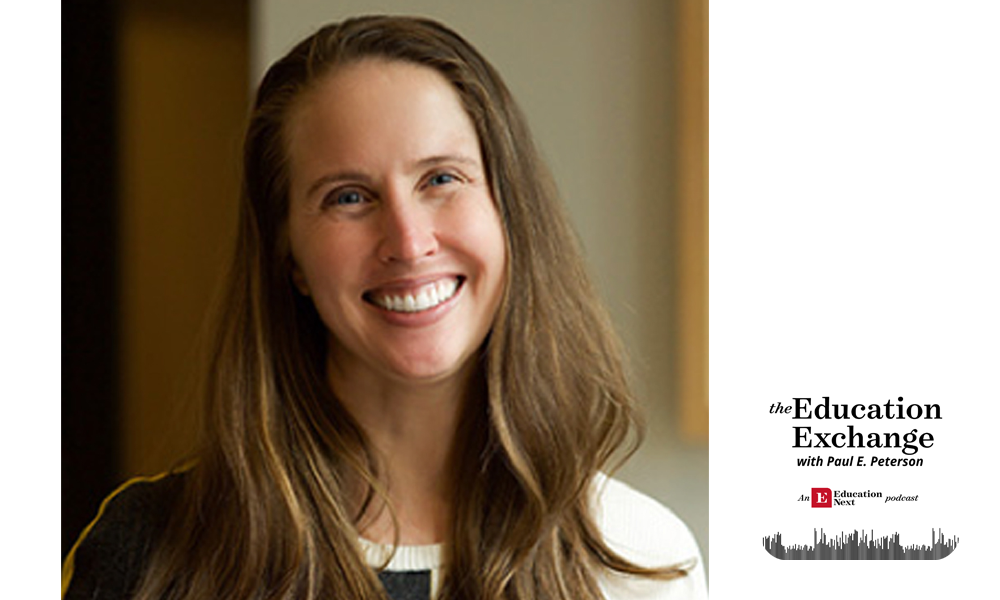
 Jennifer L. Jennings, the Class of 1988 Professor in Domestic Policy and Professor of Sociology and Public Affairs, Director of the Education Research Section, joins Paul E. Peterson to discuss Jennings’ new book, The Scarcity Loop: How School Choice Reshapes the Rationing of Public Education.
Follow The Education Exchange on Soundcloud, Apple Podcasts, Spotify, YouTube, or here on Education Next.
— Education Next
Transcript
PAUL PETERSON, HOST:
New York City public schools are in trouble. Student reading and math performance has been declining and its scores are lower than most other big cities that participate in the National Assessment of Educational Progress. It’s well below that of Miami-Dade County, which spends a little more than a third as much as New York on its schools. The low performance in New York abounds despite the expenditures of over $30,000 a year annually per pupil. And that’s 50 percent more than the national average of around 18,000 according to the last government statistics. In her new book, Scarcity Loop: How School Choice Reshapes the Rationing of Public Education, Jennifer Jennings identifies school choice as one of the reasons so many high school students are finding it difficult to get access to good schools. I am pleased to have Jennifer with me on The Education Exchange today. She’s a professor of sociology at Princeton University and she heads up the university’s research section. Jennifer, thank you for joining me on The Education Exchange.
JENNIFER JENNINGS: Thanks so much for inviting me, Paul.
PETERSON: Well, Jennifer, you argue that many high school students from low income families are finding it difficult to access good public schools, and your book does a great job of discussing the cumbersome process by which parents have to apply for the school of their choice. Requirements differ from one school to the next, procedures differ. Open houses operate in different ways. It’s hard to get the information. There’s no common application form as there is when you apply to college. Why does New York City have such a weird system of public school choice?
JENNINGS: So let me start by just clarifying one point. The book is certainly not intended to be a verdict on school choice or to say that the reason why we don’t have enough good schools measured a variety of ways for kids in New York City is because of school choice. But let me just take you back for a second.
PETERSON: Okay. So that’s an interesting point. So what are the wonderful things about school choice in New York City? I missed that when I read your book, so maybe I didn’t read it carefully enough.
JENNINGS: Some of the, I think, successes have been, for example, not on the assignment side, but on the supply side, which I make a distinction between in the book. If we go back to 1970, we had 86 gigantic high schools that were just way, way too large to function for a population that was actually larger than it is now when we have 440 different buildings. And so I do think that the opportunities that came both in the 1970s with respect to the career magnets that were started later with the small schools’ movement part one, later with the small school movement part two, and the book isn’t about charters. There were very few at the time I was studying.
PETERSON: Why didn’t you spend more time on charters? I really was disappointed because your book has school choice in its title.
JENNINGS: Yes.
PETERSON: And you don’t discuss the major form of school choice in New York City charter schools.
JENNINGS: So I would argue that’s not the major form for high school. So at the time … So the data collection’s happening a decade ago. There were a relatively small number of kids that were in charters. Of the full school population for grades nine to 12, it was something on the order of three to 4 percent. By 2026, it’s now up to 8 percent of the total population, including privates and 10 percent if you knock out the privates. It’s not the same fraction it is for K to 8.
PETERSON: 2 percent of the students in New York City attend private school?
JENNINGS: In New York City at present, 18 percent I believe attend private.
PETERSON: So it’s 18 percent. So 18 percent of the students in New York City attend either a charter school or a private school is what you’re saying.
JENNINGS: I’m saying 18 percent … This is in 2026. Attend private school. I want to say about 8 percent attend a charter school and the balance attend a traditional public school.
PETERSON: Right. But that’s a pretty big increase since the time you did your research.
JENNINGS: Yeah. Absolutely. Absolutely.
PETERSON: So would you say that was an improvement?
JENNINGS: So I looked at these data. Our colleague Mike Petrilli asked me about this last week, and so I think that the charters have been—
PETERSON: Is he your colleague?
JENNINGS: Well, he’s everyone’s colleague, isn’t he?
PETERSON: Yeah.
JENNINGS: So a couple of things there. Charters in New York City are not drawing the same population across a couple of different metrics as New York City writ large. You see that particularly with English language learners and they’re much more likely to have a higher fraction of girls, which is interesting relative to other high school students. If you look at the—
PETERSON: Well, English language learners … I thought the charter school population was almost exclusively either Black or Hispanic.
JENNINGS: Yeah. So for high school—
PETERSON: It’s the white population that’s not going to charter schools, not the Hispanic population.
JENNINGS: So the Hispanic population in New York City is quite diverse. We have a lot of folks who are English language learners. It’d be folks who are coming to school not speaking English. So those would either be recent immigrants or very young kids. If you’re at the high school level and you’re an English language learner, you’re almost certainly a recent immigrant to the country. So I think that’s an important distinction there, but I think in … I just looked at these numbers last week. I think that the population is something on the order of 55 percent Black, it’s infinitesimally Asian and white and 45 percent Hispanic.
PETERSON: So it’s overwhelmingly serving low income population, wouldn’t you say, the charter school sector?
JENNINGS: So I would want to look at their … I wouldn’t equate their race with their SES. I think that’s probably a good guess.
PETERSON: The only thing we have is the free and reduced lunch, but a pretty high percentage of them are taking free and reduced lunch.
JENNINGS: I suspect that they’re similar. We also know that if you look at the overtime private into charter switchover as folks are deciding to come out of the private sector, especially the Catholic sector over time.
PETERSON: Well, that would be because it’s free.
JENNINGS: Of course. Of course.
PETERSON: It’s easy to transfer from the private sector to the charter sector if the charter sector is good. So why don’t people transfer from the private sector into the district schools?
JENNINGS: They do. They absolutely do. Certainly at the high school level, you see a lot of movement over. I think it’s about 10 percent of the total applicants for New York City public schools are actually private school students. And some of them apply to one school and if they don’t get it, they’ll stay private. Some of them go through the whole process. But I think to your question is have charters improved New York City schools? Yes, absolutely. I don’t think there’s any doubt about that, but even though that’s—
PETERSON: Yeah. We just looked at a study in Harlem. We’ve just launched a study in Harlem where we’re looking at the test scores of all the students in Harlem after the charter’s expanded rapidly. And we see a big increase in student performance in the charter schools, but also in the public schools in Harlem. So we see the public schools are benefiting from that charter school jump up that happened in 2007 when the cap was raised.
JENNINGS: Yeah. I think the competition effects are there. I would argue that they’re small. They’re something on the order of—
PETERSON: Oh, they weren’t small. They weren’t small in Harlem. They were large.
JENNINGS: Okay, interesting. Nationally, the estimates, if we look at some of the Florida data elsewhere, we’re talking about coming from the—
PETERSON: Harlem is unusual because there’s lots of charter schools there. So I would agree with you. It’s not the same thing as in places where you have minimal charter schools. So they’re only 5 percent, which is 7 percent is the national average at most. So probably their presence has less of an effect though. It’s a positive effect according to the New Orleans study that was done recently.
JENNINGS: Mm-hmm.
PETERSON: So tell me, would it be better if we got rid of all the choice system and we just gave the job to the government to allocate students to schools?
JENNINGS: No, absolutely not. And that is decidedly not the argument of the book, just to be clear. The argument of the book is to try to understand the ways in which the processes and factors that allocate … It looks at higher income kids too. But majority low income population to schools change when we aren’t doing defaults based on residents. And part of the argument is—
PETERSON: Okay. So you’ve got an improved standing. What do you recommend based on your new improved standing?
JENNINGS: My improved standing.
PETERSON: You don’t recommend getting rid of choice, so you recommend …
JENNINGS: No, I absolutely don’t.
PETERSON: So what are you recommending?
JENNINGS: I think that if you’re going to set up a system of choice, and I think the Department of Education has made major efforts to do this, and our own project, which was a randomized trial of informational interventions for 60,000 eighth graders, also tried to do this. I think that you need to make a system that reflects the population that you have.
PETERSON: Why do you have to do that?
JENNINGS: I would argue it’s the role of the state to provide, if you’re going to provide a service … It’s one thing to say—
PETERSON: Well, when you have choice, some people are going to exercise choice.
JENNINGS: Let me finish, please. The other is to—
PETERSON: Some people exercise choice and other people are not. So that’s necessarily going to be the case.
JENNINGS: But everyone has to choose. Everyone has to choose for high school. There’s no default. You have to choose.
PETERSON: I understand that, but I asked you, what would you recommend?
JENNINGS: Right. So if you let me finish, I’ll tell you. I think the first thing that we should be thinking about is trying to ensure that where you go to school matters less. So that improving the base over time—
PETERSON: How are you going to do that? What’s the mechanism for doing that?
JENNINGS: Hold on. Let me finish my points, Paul. One at a time. The second thing that I would do is to ensure that we’re aware of the fact that half of the families, their dominant language is not English. They need additional support if we’re going to require everyone to apply to high school. And I’d say even honestly for the most advantaged moms, this is a really, really difficult process.
PETERSON: Well, I couldn’t agree with you more.
JENNINGS: Okay, great.
PETERSON: I find the New York City school system’s choice mechanisms for high school to be so bizarre and confusing that you’re absolutely on target if you’re recommending that we should simplify them.
JENNINGS: I think we should. I also think third, we need to be aware that a lot of our population, we’ve got about one in 10 kids who are in shelter or temporary housing and a very residentially mobile population. When they put in their application in December, I interviewed lots of folks where they don’t know what their address is going to be next year. And so we just need to be—
PETERSON: What would you do to simplify the choice process that you find confusing for low income people who are immigrants and are moving a lot? I quite agree with you. All that’s happening.
JENNINGS: Yeah. So I think—
PETERSON: So what would you recommend?
JENNINGS: There needs to be supports. The way that we try to in not doing as well as we could do it, but try to support kids who are applying to college. There needs to be-
PETERSON: No, no, no. We’re talking about applying to high school here.
JENNINGS: I know, but what I’m saying is that if you’re going to create a process that has the same structures and complexity, which anyone who’s been through the New York City process would say—
PETERSON: Same. So what does this word same mean? Why does everything have to be the same?
JENNINGS: It doesn’t have to be the same, but I think that—
PETERSON: It’s easy to make things the same. If you make things rotten across the board, everything is exactly the same. I don’t think that should be the goal. Don’t you think the goal should be …
JENNINGS: No one’s arguing that should be the goal, Paul.
PETERSON: … high quality schools as many as possible?
JENNINGS: I think that’s absolutely what the book argues, is that we need to refocus our attention on supply and specifically on the geographic distribution of supply.
PETERSON: … of charter schools, and that’s the best vehicle we have for improving the supply of choice schools that are of high quality. Why didn’t you talk about that?
JENNINGS: Because the book was about the overwhelming majority of … You can’t write a book about everything. The overwhelming majority of—
PETERSON: But you should write about the most important things and the things that are making a difference.
JENNINGS: It is an opinion that it’s the most important thing. I think for the 70,000 kids applying to the public system, they would probably argue that it matters in terms of magnitude as well. But you’re not wrong that charters are part of the story. But I guess I’m interested to hear how would my story change if the charters were part of it? And I have some hypotheses about this I can share with you, but I’d love to know from your perspective, what would be different in my argument?
PETERSON: I didn’t write a book on this topic. Now let me ask you this question though. A lot of poor Asians are attending schools in New York City and their performance is going up, and a lot of them are getting into the very best schools in New York City, Stuyvesant, Bronx Science, Brooklyn Tech, schools that are so tremendously difficult to get into. And you have a much higher percentage of Asian students attending these schools than you do white students.
JENNINGS: Yes, we do.
PETERSON: Even though they’re a smaller percentage of the population. So why are they able to find out how to do this when nobody else can?
JENNINGS: Yeah. I think that there’s a couple of arguments for why you see those patterns. The first is an immigrant selectivity argument that people aren’t randomly assigned from other countries to come here. You have certainly a selective population, even if you’re poor here, on average, you are better off in your home country. Second, you have a culture, a system—
PETERSON: Are you saying that the immigrants who come to New York City are the poorest population of the Asian immigrants are not among the poorest segments of the population?
JENNINGS: I’m not arguing that they’re not poor. I’m arguing that there are other … This is a very huge immigration literature. There are other factors like their parents’ relative status in their home country, including educational attainment that … This is the classic, your cab driver’s a doctor in another country.
PETERSON: So in other words …
JENNINGS: It’s all about income. I think income—
PETERSON: … you’re saying family background makes a difference. It’s really the family that counts.
JENNINGS: Hold on. I think that it’s the family—
PETERSON: I agree with you. The family is the key. But if the family is the key …
JENNINGS: So I think it’s the family, but it’s also the parallelism in the two systems because if you’re in China or other East Asian countries, you have a seminal test, the Gaokao to get into college. There’s a culture and a set of additional shadow education that’s around getting into a particular school. And so we have an ecosystem that’s been set up in the city, and I’m not of the opinion that it’s necessarily problematic or bad, but that reproduces that structure in the city—
PETERSON: I’m sorry, I can’t handle that. Reproduces that structure. Could you tell me what that means?
JENNINGS: Sure. So what I mean is that in China, folks study large numbers of hours for multiple years in order to pass this high school exam into college. By the same token, they—
PETERSON: So they study harder. Asian kids study harder because their parents expect them to. Is that what you’re saying?
JENNINGS: Yes, I am saying that. I am saying that, but the reason why the parents expect them to—
PETERSON: Isn’t that the solution that we should try to figure out how we can create an educational system that will encourage students to study harder and to—
JENNINGS: You and I can both get behind that, right? Yes. I think that’s fantastic. But I think that that in and of itself doesn’t solve the fact that 5 percent of the seats are going to be for specialized schools. Somebody’s going to get them, somebody isn’t. I honestly think we spend a lot of time on that issue much more than is—
PETERSON: I agree that there are many students in need of special education, including my son, who’s extremely handicapped and requires very special attention. But I don’t think that we can address the problem, the larger problem that you’re talking about here can be addressed unless we change the way we hire teachers, reward teachers, assign teachers. And you don’t talk about that in your book at all.
JENNINGS: No. I do not talk about the multiple factors that are constitutive of high school quality. You’re absolutely right. We know most of the variation, by the way, is not between schools, but within schools in effectiveness. And so certainly—
PETERSON: Well, that happens within schools because teachers have the choice of who they want to teach and what students they want in the classroom. They have lots of flexibility. And in addition to that, senior teachers can move to the part of the city that they want to, and the more senior teachers who are paid much more assign to themselves, the students who are least in need of more intensive instruction.
JENNINGS: I think you’re perhaps overstating the amount of agency that individual teachers have in both placing themselves in schools and-
PETERSON: What does the union contract say?
JENNINGS: The union contract certainly doesn’t say you have the right to pick your own students within a given school. No principal would be willing to agree with that. But to your point—
PETERSON: Well, you certainly have the right to pick your school.
JENNINGS: You have the right to pick your school subject to availability and also subject to that … You can’t just come into a New York City school anymore without the principal signing off. They’re not just bumping rights like there used to be. And I think that’s been a huge improvement, quite frankly.
PETERSON: Have we seen any evidence that that’s working?
JENNINGS: I think you’d want to define working there. Has it improved student achievement? I haven’t seen any studies that specifically try to estimate the effect of that on student achievement. Certainly the teacher evaluation reforms that we did across the country in the 2010s turned out to be a precisely estimated zero for a number of reasons that we could talk about. But I still think irrespective of whether we see student achievement impacts, I think it makes sense to allow principals to control the folks they hire. You can’t run an organization without that kind of control.
PETERSON: Well, now you disagree then with this article that Hannah-Jones has recently released, which says that the principals are hiring the teachers and the teachers are not performing at all, that they ignore the needs of the students.
JENNINGS: So I can say a few things about the particular article. There’s a lot to talk about there. The first thing I’d say is if you look at the Matt Barnum and Chalkbeat reported that the value added of that school and the state accountability system is above average. Make of that what you will. And the only person who can speak to Nikole Hannah-Jones’s experience with those teachers is Nikole Hannah-Jones and her daughter. I’m not in a position to question what she reported. Do I think that there’s bad teaching that happens in every district, including out here in Princeton, New Jersey and in New York City? Absolutely. Absolutely. But I guess the thing relative to the book that’s the most interesting about the Nikole Hannah-Jones article is the extent to which she experienced this as her own personal choice, and it is, and it was. But this whole system is structured, that she has these choices as structured by a long history, which of course she understands as well as anyone. So I think it was interesting the way in which school choice can make these decisions feel very intimate.
PETERSON: Well, how did the school system structure her choice? Her daughter wanted to go to a different school and she said, “No, I think you need to stay in public school.”
JENNINGS: The distribution of schools in New York City has to be considered going back to how it was 50 years ago.
PETERSON: She could have gone to a charter school that was within walking distance very easily.
JENNINGS: Sure.
PETERSON: She never applied.
JENNINGS: She may not have wanted to go to a charter school, and I think that choice advocates would—
PETERSON: Well, isn’t the problem hers then? Why is it the structured system that’s her problem instead of it’s her decision which was wrong?
JENNINGS: I don’t find what one person’s decision is to be a particularly interesting.
PETERSON: But you said it was structured before.
JENNINGS: It is structured in the following way.
PETERSON: I don’t believe it was structure. She had plenty of choices. She’s a rich person. She can do whatever she wants. She could go to a private school. She’s got lots of money.
JENNINGS: She absolutely could, and she had strongly and clearly articulated reasons for not wanting to do that.
PETERSON: Well, that’s up to her. I agree with you. That’s up to her. I wouldn’t call her choice structured.
JENNINGS: I would say that the set of schools—
PETERSON: Structure implied that you don’t have a choice. She did have choice.
JENNINGS: She absolutely had choice. I agree with that. I think that’s what the whole article’s about. But if you look at the underlying distribution of schools … I’m calling that a structure, perhaps I should use a different word. I’ll call it the population of schools. That she had access to. It is a function of the choices that have been made over the last 60 years, which result in, for the high school level, there being a higher level of Black-white segregation than there was in 1970. At the elementary school level, that’s reduced a little bit, but that was the choice she was making.
PETERSON: The structure that creates that is the high immigration of non-white students into New York City and the white flight from New York City. So we have many fewer. I think we have 20 percent of the population in New York City school system today is white.
JENNINGS: It’s less than that. At high school level it’s—
PETERSON: I hear you saying we should have a desegregated system with 20 percent of the students white in every school.
JENNINGS: No, that’s not what I’m saying. I’m saying—
PETERSON: Well, you said it should be the same.
JENNINGS: I never said it should be the same, Paul. Show me a place, get in the text and show me where I said it should be the same.
PETERSON: Well, our listeners can do that. That’s for them to do.
JENNINGS: Okay. What I’m trying to point out is that the choices that parents have today are a function of choices. This is an obvious point that other policymakers have made over time. And so the extent to which she is choosing between … Select a school that has a lower fraction of Black kids and overwhelmingly 80 percent Black school, I’m not sure what her particular … The kind of alternative for high school was going to be.
PETERSON: Well, she’s made that choice already. We know what she is in now. She went into a school that has a mixed population that happens to have an outstanding principal and it has an outstanding record. She’s made a pretty good choice. It’s not a choice of an all white school by any means. It’s a very—
JENNINGS: No, absolutely not. I didn’t say it was an all white school.
PETERSON: She attacks the school. What I couldn’t believe was that she attacked the school that she had selected because all the evidence that other people report back to me is that this is one of the best schools in New York City.
JENNINGS: The high school that her daughter attends?
PETERSON: Now attends.
JENNINGS: I think she’s unfamiliar with the particular school, and I think it’s a very sought after school. In what way do you see her as attacking the school, the high school?
PETERSON: Oh, she said that the kids were racist and treated her daughter inappropriately.
JENNINGS: How would you or I be able to adjudicate that claim except through her daughter?
PETERSON: Well, she doesn’t give any footnotes. She doesn’t have any citations. It’s very hard. It’s a journalist speaking, so yeah, very difficult. Okay. So we’ve established a number of things though in this conversation that actually make me quite hopeful about what you’re recommending, because you are recommending that we improve the quality of our schools, and you are recommending that we should introduce more charter schools in order to have a fair system, randomized assignment, a fair system, and that would be a mechanism for really enhancing the quality of the schools in New York City. Can I infer that from—
JENNINGS: May I say something on that point?
PETERSON: Yeah.
JENNINGS: The randomized assignment claim falls apart a little bit in some of the New York City schools. The best example, which has been well documented by AEI’s Robert Pendicio, as well as by MDRC, is the Success Academies.
PETERSON: Well, that study by MRDC was a long time ago, wasn’t it?
JENNINGS: The point is there are post-processing things. It’s not just a lottery and you can show up. There’s a lot of things that parents are asked to do before they actually enroll between lottery. Not at all schools, but certainly it’s well documented at some schools, and schools have a reason to do that. But let’s not pretend that anyone can just walk in, be in the lottery and show up on the first day and that’s it.
PETERSON: You have to, as a family make a commitment to really caring about your children’s education. Do you think that’s something schools should not expect of their parents and their families?
JENNINGS: As a former teacher and also as a researcher, I’ve never met a parent who doesn’t care about their kids’ education. I’ve met parents who have different things going on in their life that make them more or less able to deal with it. I’ve met parents who are totally befuddled by the school system, which is very different from where they grew up in the Dominican Republic and they went down the street. But I think the ability to navigate a process shouldn’t be mistaken for caring about your kid’s education. I don’t know how we could ever really—
PETERSON: So you are opposed to the schools that say we want to have parents sign on the bottom on a document that they’re going to do X, Y, and Z to support their children’s education come to the school?
JENNINGS: I think it’s fine to have them sign it, but yeah, I do think in a public school system, which the charter schools are part of, that making that a condition of enrollment is inconsistent with the reason why charter schools were started. And similarly, like in the book—
PETERSON: It may be inconsistent with some views of why they were started, but is it a bad idea?
JENNINGS: I can tell you what happened when we did this in New York City, and this is covered in the book. We’ve required for the new small schools for families to show up. In some cases it had to be a parent showing up at an information session. Often there were only one to two, they weren’t announced anywhere. And it’s not at all surprising that certain families were not able to do that. So on every characteristic, you see stratification there. I think you feel more comfortable with that than I do.
PETERSON: That’s inconsistent with what I hear about charter schools in New York City.
JENNINGS: I was just speaking about small schools in the book which we’re talked about.
PETERSON: What parents tell me, they say there are hundreds of students who can’t get in even though they apply because they lose the lottery. There’s a scarcity of charter schools.
JENNINGS: That’s also true, but that’s not inconsistent with what I just said, for example, about Success Academy.
PETERSON: You said only one or two would show up, and so it sounded like nobody wanted to go there.
JENNINGS: No, no, no. I was saying they would only offer one or two open houses. This is for high schools and it’s not for charter schools because they did not write a book about charter schools. Maybe you can put a request in for that to be the next one. But what this book tried to do is to understand how having this, you have to show up and make informed consent affected who was able to be in the lottery. First priority for those schools, and it changes who’s able to do it. I think that different people with different normative commitments are more or less comfortable with a public system creating these hurdles for families to have to jump through. The kids who would most benefit from going to a good school are often the families that don’t have, for whatever reason, and neither you nor I can fix that, the ability to jump through those hurdles easily. And that’s what I worry about.
PETERSON: How about the new federal education tax scholarship program? The governor of New York has just agreed to participate in. So is this a good idea for New York? Is this a way to begin to address this problem? It’ll give students more resources and it’ll give students more choice to look at private school options.
JENNINGS: If it was a differently regulated federal tax credit that said, let’s take the poorest kids in the Bronx, let’s give them each $50,000 and let’s require good private schools to take them, we could have a real conversation about supporting private choice, but that’s not what it is.
PETERSON: Well, of course you’re creating a mythical system here. Who’s going to be willing to create a program that’s going to cost $50,000 per pupil? That’s not politically realistic. Is this a politically realistic conversation?
JENNINGS: Our average spending, honestly, right now in New York City at the public level is something on the order of the 30s. So you can take whatever the average spending is at present and use that number.
PETERSON: Let’s take the $30,000.
JENNINGS: If we were going to say we’re going to give—
PETERSON: My guess is that that will be available. That will be available in New York City.
JENNINGS: We’re going to give priority to poor kids. There’s no requirement. Almost everyone is eligible.
PETERSON: Why does it have to be a requirement? Why wouldn’t we expect a scholarship program to be set up to help those who are particularly needy?
JENNINGS: Well, I think—
PETERSON: Do you think the scholarship program’s going to try to … These agencies that the governor is setting up are going to have the ability to identify their population. Are they going to identify the richest kids and assume the taxpayer’s going to give them money for that purpose?
JENNINGS: I think that the law would’ve been written differently if the goal was to help poor kids. You would’ve said you have to serve kids below 100 percent of poverty. I have no idea what SGOs are going to do, but—
PETERSON: So you’re going to be against them because you don’t know what’s going to happen?
JENNINGS: Well, I can tell you a number of reasons why I’m against them, and I can also tell you what I’ve found in other states. I’m studying vouchers in a number of different states right now. The schools don’t have to take kids. And so that’s I think a first order thing that you feel comfortable with and I wonder why we’re using public money for. Second, they don’t have to serve disabled—
PETERSON: You want any school must accept … Any private school in the country must accept students.
JENNINGS: Sandy Jencks—
PETERSON: What if they have an identity, a mission, a particular purpose? Do they have to accept any student?
JENNINGS: If they want public money, I think, yeah. Sandy Jencks laid this out in 1965.
PETERSON: Why is that a good use of public money? Shouldn’t public money be used to improve the quality of our schools instead of coming up with rules that say you can’t have it unless you have this or that or the other?
JENNINGS: I think that the role of the state is first to ensure that the people who have the least have opportunity because our society’s continued functioning is dependent on ensuring that no one is staying at the bottom forever. So I think that, as I was saying, the voucher program that Sandy Jencks laid out, say 1965, that was about thinking about poor kids, the school having to accept the voucher amount and not charging more money, which is what’s happened in other states.
PETERSON: So did you support the voucher program in Milwaukee when it was announced back when Sandy wrote that essay?
JENNINGS: For poor kids specifically in the 1990s when the counterfactual was really bad in Milwaukee, there probably were a few tweaks I would’ve made, but I can get closer to behind a program that is intended to serve a population that is not always well served. But there need to be guardrails, which include you can’t just say you don’t have a spiritual reference from your pastor you can’t come to my school. In the other parts of the world that use vouchers, there are very, very strong guardrails on what they’re … They have to teach a common curriculum, they have to take common tests, they have to be inspected by an inspectorate. They can’t just say, “You’re gay, you’re disabled, I’m not going to take you.” And I think that if private schools are willing to make that bargain, I think there’s a world in which I could live with it. I’ve never seen any private school that’s willing to do that in the United States.
PETERSON: Yes. Well, or anywhere else in the developing world where you have—
JENNINGS: The Netherlands, the UK.
PETERSON: … of private schools. Yes. The developing world has a very high prevalence of private schools and the religious schools are-
JENNINGS: Oh, I’m sorry. I though you said the developed world.
PETERSON: Yeah. So let’s do a thought experience. Let’s assign everybody to the school of the zip code, which is what in fact we have in many, many cities. I think you say there are eight cities that don’t do that.
JENNINGS: Yeah. I think there’s now nine, but yeah.
PETERSON: Okay. So most places we assigned kids to school by their zip code. Is that really what we should be doing? Are you prepared to do that?
JENNINGS: No. But actually I took up your very specific thought experiment in this book. And if I can find the page, I’ll tell you what the findings are. Basically, if you do the simulation … And of course people wouldn’t live in the same place as they would if that was the system. So holding that to the side, randomly assigned people to the next school, blah, blah, blah, blah, blah. There’s no difference in racial segregation than what we have at present. There’s no difference in SES segregation as measured by free and reduced priced lunch. So it’s not achieving those goals. There is a substantial difference in the odds that kids who are at the bottom and top of the achievement distribution are actually being educated in the same school. And so I think that there’s no reason to me that we can’t have ability grouping within schools rather than sending kids off to separate schools, which I think actually makes it harder to improve the overall supply of schools because two thirds of our applications are going to one fifth of our schools. And I think so long as there’s selective only schools and everyone else, it’s really hard to build capacity across the rest of the system. But yeah, so we took you up on that. I absolutely am not arguing for going back to residential assignment. Boston’s an interesting example that’s tried to simplify by creating a series of home zones that have some requirements where you’d have priority in high achieving schools irrespective of where you are in the city. So I think that model at least tries to pull in the complexity—
PETERSON: Well, the best study on that model, which is also a study of New York City, shows it makes no difference how far you travel to school.
JENNINGS: Yeah. In terms of achievement. Yes.
PETERSON: Nothing on achievement. So I quite agree with you that there’s not much improvement that you get from this bizarre public school assignment. But then of course that doesn’t mean that you wouldn’t get a lot of improvement if you gave schools the resources and told them, “Do what you think is best and then let’s see what you can do.” And then they don’t have to hire union teachers. They don’t have to go through the collective bargaining system. They don’t have to be subjected to all the regulations of a big city school system. So it seems to me that would be another thought experiment. I think it’s hard to justify a zip code when all the schools in Weston and Wellesley and Westchester County are virtually all white and exclusive to upper middle class people and they are funded at a very high level. How is that solving the problem?
JENNINGS: Oh, I absolutely argue in the book that that type of assignment is no model of justice that I’m going to get behind. There’s no theory of justice that argues for Princeton or Weston or Brookline or name your favorite rich suburb. We can say we’re going to take away those lines. I think what would likely happen is that people would flee to private school. I don’t think people in Princeton have historically, for example, been open arms and saying … Where I taught in Trenton, kids from Trenton, “Come on down. We’ve got some extra space.” You can say release the boundary, but it doesn’t release the political problem that caused the boundary in the first place. So I am not for attendance zones by any means. Quite the opposite. I set out in this book to try to explain what it looks like on the ground, and I really do hope you’re going to dive in a little bit more just to try to understand the human texture of some of the problems that we’re talking about.
PETERSON: Well, there are some great stories in there. I love the one about the young boy who fought the battle to get into a special school. He reminded me of a Harvard professor. Not a Harvard professor, a Harvard student I just met who went to a KIPP school for his high school. And he said his local public school was a mess. His family were immigrants, and he saw that here this school down the street looked a lot better, so he decided to go there and they really changed his life by giving him opportunities, but he had to fight the public school. He ended up forming a political group to protect the charter school from being abused by the policies of the public school system. I think there’s so much opposition to charter schools for no good reason when that could be the very solution to the problem that you’re identifying.
JENNINGS: Yeah. I, for one, am not opposed to charter schools. I would like to see charter school law enforced more vigorously across—
PETERSON: What does that mean? Charter school law enforced more vigorously?
JENNINGS: Yeah. So if you say that in fact you have to have a lottery, that doesn’t mean you have a lottery and then have 15 different hurdles you have to go through after that. That to me is quite clearly in violation of at least the way that New York State and New Jersey charter laws are written, which I’m the most familiar with. So I think that that—
PETERSON: You’re saying that’s illegal? Are you saying that’s illegal?
JENNINGS: To my understanding, yes. You’re not allowed to—
PETERSON: You say. Has the courts ruled that illegal?
JENNINGS: I don’t think anyone’s challenged it. I don’t think anyone’s challenged it.
PETERSON: Well, if nobody’s challenged it’s probably not easily challenged. It must be defensible. Otherwise, somebody would challenge it.
JENNINGS: That’s an open question.
PETERSON: Oh, there’s a lot of groups, most importantly, the New York City Union who opposes charter schools and will fight them at every possible … With every tool in their kit. And if they haven’t filed a lawsuit on that principle, then they must have figured it out that they’re not going to win it.
JENNINGS: That’s an empirical question. I can’t predict the past or the future about why people did what they did or didn’t do.
PETERSON: Right. Well, we can only speculate, but thank you, Jennifer. It’s a spirited conversation we’ve had here. We’ve brought out the central issues. We’ve both agreed that the New York City choice system to high schools is so difficult and it just imposes so many hurdles to families that we need to start thinking about some alternative to that. And I’m delighted that you’re not opposed to the charter school option. I also am very pleased to hear you say that you’re really committed to creating more quality schools, and that should be a very high priority of our country going forward.
JENNINGS: Hopefully there’s no one in this field that isn’t committed to creating better schools for all kids.
PETERSON: Well, thank you very much. I’ve been speaking with Jennifer Jennings. She’s a professor of sociology at Princeton University and the author of a new book entitled The Scarcity Loop: How School Choice Reshapes the Rationing of Public Education. I am Paul Peterson. This is The Education Exchange. Please join me for a new Education Exchange podcast released on the Education Next website every Monday at noon Eastern Time.