

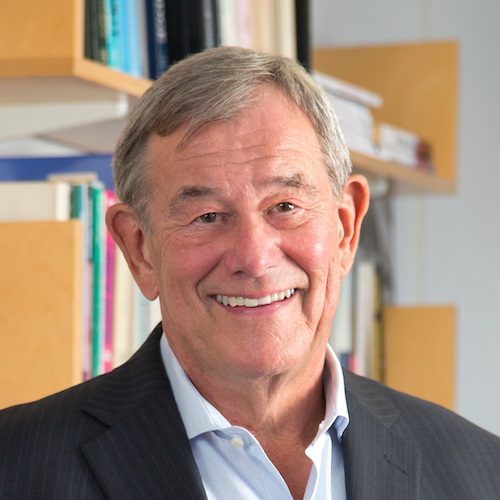
 Clint Bolick, the 44th Justice of the Arizona Supreme Court, joins Paul E. Peterson to discuss the St. Mary Catholic Parish v. Roy case, a religious education case that will be heard by the United States Supreme Court in their upcoming term.
Follow The Education Exchange on Soundcloud, Apple Podcasts, Spotify, YouTube, or here on Education Next.
— Education Next
Transcript
PAUL PETERSON, HOST:
This is the Education Exchange with Paul Peterson. I am the Director of the Program on Education Policy and Governance at Harvard University. Thank you for joining us. The Supreme Court has accepted for consideration a case involving a faith-based preschool program operated by St. Mary Catholic Parish in Colorado. It’s St. Mary Catholic Parish v. Roy. The school refused to sign a statement that said they would accept all applicants regardless of a family’s sexual orientation. When the state denied their application, St. Mary’s argued that their freedom of religion had been violated, and it was a violation of the Constitution’s First Amendment. The lower courts actually sided with the state of Colorado and the agency responsible for this case. So, the whole case would have been settled there. This was at the federal circuit court level, except that the Supreme Court agreed to review the case. So that suggests that the Supreme Court may have some suspicions about the way the case was decided at the circuit level. So that makes this case particularly interesting in the discussions of education and law and the whole meaning of the First Amendment. And we’re very fortunate today to have with me on the Education Exchange, Clint Bolick. He’s an Associate Justice of the Arizona Supreme Court, and he’s one of the country’s leading authorities on the meaning of the First Amendment. And I’m so pleased to have him with me. Clint, thank you for joining me on the Education Exchange.
CLINT BOLICK: Paul, it’s always an honor and a pleasure.
PETERSON: Clint, to set the stage for understanding the St. Mary’s Parish case, let me first ask you about the tension between the No Establishment and Free Exercise clauses that are contained in the Constitution’s First Amendment. Some people point in different directions. Could you just sort of elaborate that for our listeners?
BOLICK: Sure. And this question is particularly salient for me. When I was interviewing with Governor Doug Ducey for my appointment to the Arizona Supreme Court, one of the questions he asked was, which is more important, the Free Exercise Clause or the Establishment Clause? And I’d never been asked that question before. And I suspect I answered it differently than all of the other folks who were applying for this position, who I’m sure took the safe harbor and said, “Oh, they’re equally important.” But the fact is, as a I’m going to answer the question two ways. First, as a constitutional textualist, which I am, and if you read these two clauses, they’re not in tension at all. The Establishment Clause forbids the establishment of religion. It was designed to address a very particular problem. First of all, England had a church, an official monopoly church, the Church of England.
PETERSON: Well, so did Massachusetts. The Puritans had their church. It was instated and established for decades, a century or more.
BOLICK: Exactly. And a number of the states, a number of the colonies established official religions. And so, the Establishment of Religion Clause says Congress may not establish religion. It didn’t even say the states couldn’t establish religion. So, it was designed to address a very specific problem in a very narrow way. And, you know, from my perspective, the establishment clause from a textual perspective really does very … should do very, very little today. Now, the second part of my answer is how has the U.S. Supreme Court interpreted it? The answer there is historically, at least going back to the mid-20th century, very, very broadly. Advocates convinced the court that the Establishment Clause meant separation of church and state. And a number of the court decisions and justices embraced that notion and said there literally should be a wall of separation between the church and state. And as a result—
PETERSON: I think Jefferson said that first of all, right?
BOLICK: Yes.
PETERSON: In some communication that he had.
BOLICK: That’s right.
PETERSON: So, they cite Jefferson, though he wasn’t at the Constitutional Convention.
BOLICK: That’s absolutely right. And I suspect he would have written this more differently if he thought it should be an absolute wall of separation. But the current court has taken a very, very different view of the Establishment Clause. And basically, it has resolved what it perceives as tension between the two clauses by requiring neutrality, by requiring non-discrimination.
PETERSON: I have to interrupt you here for a minute because, Clint, you argued the Zellman case back in 2002 before the Supreme Court, and you won that case 5–4, or your point of view won that case, and you argued it very intelligently. And Sandra Day O’Connor from Arizona, no less, was the deciding justice. So, did that case turn on the meaning of the Establishment Cause?
BOLICK: It did. And it’s amazing, Paul, how far a distance the court has traveled since that decision in the early part of this century. In only 20 years, as you pointed out, that was a 5–4 decision ruling that a school choice program could include religious schools consistent with the Establishment Clause. Twenty years later, the court has resoundingly held that choice programs can’t exclude religious schools. And not only that, it really has to take them as they are. And that’s where this case is. You know, can religious schools … You will remember in the design of the voucher programs leading up to the Zellman case, we were very careful to require the schools to accept students on a non-discriminatory basis. And even some of the programs guaranteed the students an opportunity to opt out from religious activities. And we did that because we felt that that was necessary to ensure constitutionality. Now, I don’t think those rules are necessary.
PETERSON: But this court was decided against St. Mary’s Parish at the circuit court level. So, it was a 2–1 decision because there’s only three judges that were involved in this decision. They ruled against St. Mary’s by a 2–1 vote. So, what did the majority rule? Why did they say these regulations could be imposed on this school?
BOLICK: Well, generally speaking, as a normative proposition, non-discrimination requirements are a part of the state’s police power. And not only that, but non-discrimination requirements are often considered to constitute a compelling government interest. The other aspect of it is that this is government funds. And typically, certainly you are somewhat familiar with the idea of government regulation accompanying public funds at the post-secondary level. But that’s, you know, I mean, that’s like day following night. And the Court of Appeals said you’ve got public funds, and you’ve got a compelling government interest, therefore it’s upheld. The dissenting judge, by contrast, looked at recent U.S. Supreme Court opinions and said, no, you cannot force this school as a condition of being a part of a program to abandon its religious views. And this is not an atypical opinion these days. I can think going back, for example, to the Boy Scouts case a few decades ago, and that involved the direct imposition of civil rights laws. But the court held that as a matter of freedom of association and freedom of religion, the Boy Scouts could exclude gay scoutmasters. And there’s been the Hobby Lobby case since then, you know, a whole host of cases holding that you cannot compel religious institutions to abandon core religious tenets as a condition of government aid or government regulation.
PETERSON: Well, the dissenting judge also said that there were a lot of exceptions that were secular in nature. That is to say, special arrangements could be made for students with disabilities. You didn’t have to have a common application of the law in that case. And siblings were accepted, and there were other exceptions. So, if you have secular exceptions, you have to have religious ones as well. Was that a compelling dissent?
BOLICK: I think it was. And in fact, I think he identified the Achilles Heel of the government regulation here. Not only were there a whole host of, as you called them, secular exemptions and the church; the diocese applied for an exemption, and the state turned it down. But there were there was also what. is referred to as a community exemption. And that is that schools that organize for a particular community are entitled to participate in this program. And that includes the LBGT community could open its own school organized around its own community do whatever it deemed appropriate with regard to educational programs or the types of families that would be invited in. When you are that—and I hate to use this word because it’s so pejorative—but when you’re so brazen about allowing one and not allowing another, the court’s simply not going to accept that. And if I were a wagering man, and I’m sure all of these things are in online betting these days, I think it would be a very, very simple win to bet on the court ruling against Colorado here.
PETERSON: But of course, you know, it could be a narrow decision, or it could be a broad decision. It could limit this to the very specific facts of this case, or it could broaden out. And one of the ways it could broaden out is have an impact on religious charter schools, which has been an issue that already has come before the Supreme Court and the Supreme Court divided equally 4–4 in a Catholic virtual charter school in Oklahoma. But since that was divided 4–4 and Justice Amy Barrett accused herself, there’s a lot of possibilities that that issue might come back to the Supreme Court.
BOLICK: Yeah, I think it almost certainly will. And Paul, when those words tumble off your lips, religious charter school, I don’t think either you or I had ever said those words prior to certainly 10 years ago or maybe even as recently as five. It’s almost, you know I think we considered it almost oxymoronic. And I was weaned on constitutional law during the time of the court’s decisions that were much more restrictive with regard to the Establishment Clause. And one of the bright-line distinctions was funding is one thing, particularly when the funding is directed by third parties. That is, you’re not giving a direct subsidy to a religious organization. You’re putting it in the hands of parents or students, like in the GI Bill program. But public schools cannot be religious. And that was certainly an undisputed tenant when I went to law school. And certainly, you know, if I had been asked that in the Zellman argument, I would have said it categorically exactly that way. But in the last 23 years, an awful lot has changed. And as you pointed out, when a religious organization was turned down for opening a charter school, the court divided 4–4 on that issue, with the court taking the principle of non-discrimination and applying it even in the charter school context. And that is, if you allow non-profits to operate schools, you must not be able to discriminate against religious nonprofits. And I don’t know where Justice Barrett would be. You know, she used to teach at Notre Dame and I know what her former colleagues on the Notre Dame law faculty think about this issue. And I suspect if that comes up with the current composition of the Supreme Court, that they will rule 5-4 in favor of allowing religious charter schools. And I have to tell you, Paul, I am not 100 percent certain I think that’s a good idea.
PETERSON: Well, a lot turns on whether you call these public schools or private schools. Now, I think the religious charter school applicants, the people who want to set up one, they are saying, well, we’re actually a private school. We’re this non-profit. We get government money, it’s true, and we have to be authorized by the government, that’s true. But we’re not really public schools. But other people will say those are the very facts that make you a public school. So, are they public schools are private schools?
BOLICK: So, it’s sort of like the Obamacare decision where it was a tax in some instances and not a tax in others. And I’m not being facetious about that at all. Charter schools have been held to be public schools for certain purposes. For example, you know, with regard to due process, most courts have held that charter schools must provide due process. Private schools do not, because they’re not state actors. But for other purposes, they’re considered private schools. So, they’re clearly a hybrid… a hybrid model. But the court may very well go beyond that and say exactly what I said a few moments ago, which is, no, if you allow nonprofits to operate charter schools, whether they’re public or private, you must not discriminate against religious entities in doing that.
PETERSON: Well, of course, this opens up the whole question. If you’ve got secular public schools today, why can’t you have government-operated or government-subsidized schools everywhere? Maybe you must have religious schools across the country. I mean, other countries do that. You know, Australia does that. Britain does that. France does that. Canada does that. It’s a familiar part of the international landscape, but of course, it’s always been unthinkable in the U.S. context. But could that change?
BOLICK: You know, I think that it could change. You know, certainly charter schools … So that would require an awful lot of intervention in state constitutions. Now, we’ve already seen the court limits state constitutions in the context of the Blaine Amendment, where state constitutions sometimes forbade the inclusion of religious schools among educational options. And that was precisely the point on which the court ruled in favor of the religious schools. As you well know, pretty much every state constitution has a public school system that is part of its educational guarantee. It’s supposed to be uniform in most states. It is supposed to be secular in most states. And that would be an awful lot of tinkering if the court went beyond the charter school context, which is designed to be different and designed to invite the private sector into the educational marketplace. I think theoretically we could get there, but I have a feeling that that won’t happen. But then again, I wouldn’t have predicted 20 years ago that we’d be where we are today.
PETERSON: So, you know, it’s a dangerous area, probably, for the Supreme Court to go into. The Supreme Court likes to … it has a lot of respect for its own legitimacy and the need to protect it. And maybe if they want to restructure all of American education, that’s asking more of the Supreme Court than it can deliver. It did it once in Brown, but it took a long time to make that decision. And it took a long time to implement it. And in many ways, the system persists in practice, though not in law. The Supreme Court may be a little bit reluctant to do a lot. Will they just sort of maybe make this St. Mary’s Parish case a small case that’s really irrelevant to the charter issue?
BOLICK: So probably not. This is, and I think as a general proposition, what you’ve just said, that the court likes to generally move cautiously, is true. And in fact, in this area, you may remember the case Trinity Lutheran, which was kind of the first step in this area where the court said you’ve got to include religious providers if you’re allowing secular private providers. But the court in a footnote—and I found this absolutely hilarious—said this decision is limited to playground equipment. We do not opine on what would happen if the aid was not playground equipment. It was turned out to be, you know, one of the most inconsequential decisions ever. And yet in the very next case, the court spoke very, very broadly. And since then, has been speaking very broadly on these issues. You know, the Mahmoud case recently broke significant ground by holding that parents have a right to opt their kids out of classes that they consider to be religiously objectionable. And that was not a modest opinion. So, the court … one thing that I think all six of the conservative justices are very pro-religious liberty and very, this is an issue that animates all of them. And as a result of that, I think that they have thrown caution to the wind a little bit.
PETERSON: Well, now, the case has been, you know, in the courts already that talks about religious charter schools as a Jewish school, or somebody wants to set up a Jewish school as a charter school in Oklahoma. It’s building off of that former Oklahoma decision. And he hasn’t really shown that he’s got a constituency for this charter school, and the state authorizer has sort of rejected your application because it doesn’t look like you’ve got enough strength in the community for this kind of a school. And he says, well, I can’t show it until I get approval. Maybe the Supreme Court will just say he doesn’t have standing, or we don’t really want to take a case. Is that problematic?
BOLICK: The court, you know, on the one hand, having a Jewish school as the plaintiff in a lawsuit helps in the sense that so many of these cases, if not every single one of these cases has involved Christian schools. And, you know, the court really hates to be perceived understandably and shouldn’t be perceived as simply advancing Christianity, because the principles that they articulate in these cases are universally applicable. And so having a Jewish school, I think all things being equal, the case of the court would like that. The flip side is they really hate cases that are factually complicated or where there are problems. And so, if they don’t think that it’s a clean case where they can articulate principles in a clear fashion, then they will turn down that case. But something that you and I recently discussed is, what happens to this entire issue when Muslim schools start getting into the act? As I just said, the principles are applicable. Certainly, you know, I think even here, what the court will be looking at is that this is a core aspect of the religious mission that is being presented here. And certainly, secular rules like against violence and that sort of thing. But what about requiring girls to wear traditional Muslim garb? What about separating girls from boys? Those sorts of things that certainly would be core to the Muslim faith. Are they both— I just don’t see how you could differentiate those sorts of cases. But in terms of public opinion, you could see public opinion on these cases turn very, very quickly when people realize we’re talking about all religions here, not just Catholics as we are here in the Colorado case.
PETERSON: Well, some of the liberals on the Supreme Court have said this is a very dangerous, slippery slope. If we start supporting religious institutions as schools, we’re going to be fostering conflict in society because you can obviously point to Ireland and you can point to Bosnia and you can … there’s many examples around the world of religious affiliations generating intense conflict to say nothing of the current situation in the Middle East. So, is this … just as a matter of, you know, what society should be doing, is this something that the courts should hesitate before they wander into this space?
BOLICK: So, you know, I there is… Really what the court is determining is the realm of the permissible in the democratic space. And that’s, I think, where those conversations and debates should take place. When you were talking about Bosnia and Northern Ireland, that actually came from the Zellman case. You may remember that the dissenters said, if we uphold vouchers, we’re going to have riots in the streets. We’re going to have religious strife. And that was absolutely silly. And we saw absolutely zero of that in Cleveland and in other places. But when you have direct taxpayer support of overtly religious schools, I think that is a bit more controversial. And I do think that even if the court opens this door further, which I think it will in the St. Mary’s case, at the end of the day, these programs have to win majority support in the legislative arena to happen. And so there will be very spirited debate.
PETERSON: Well, Clint, this has been an illuminating conversation. I know our listeners are very interested in what are the implications of the case that’s now before the Supreme Court. And I very much appreciate your sharing your time with the Education Exchange. Thank you for joining me.
BOLICK: Thanks for having me.
PETERSON: I’ve been speaking with Clint Bullock. He’s the Associate Justice of the Arizona Supreme Court and authority on First Amendment freedom of religion law. I am appreciative of all of you joining me on the Education Exchange. I am Paul Peterson. Please join me for a new Education Exchange podcast released on Education Next website every Monday at noon Eastern time.