


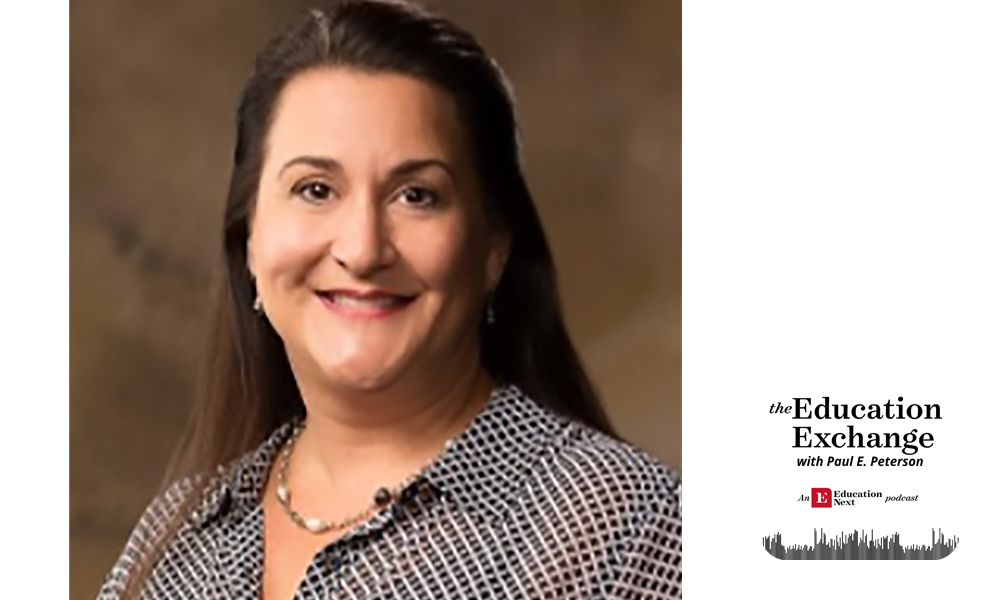
 Angela R. Watson, a senior research fellow at the Johns Hopkins Institute for Education Policy, joins Paul E. Peterson to discuss how regulations with the new Federal Scholarship Tax Credit may exclude home schools and microschools.
The Emerging School Models: Broadening the Landscape for Choice conference will be held by the Harvard Kennedy School’s Program on Education Policy and Governance in Cambridge, Mass., on Sept. 17 and 18, 2026.
Watson’s brief, “The Trouble with Defining Homeschooling: Why Strict Definitions of Homeschooling Need a Reality Check,” co-written with Christy Batts, is available now.
Follow The Education Exchange on Soundcloud, Apple Podcasts, Spotify, YouTube, or here on Education Next.
— Education Next
Transcript
PAUL PETERSON, HOST:
This is the Education Exchange with Paul Peterson. I am the Director of the Program on Education Policy and Governance at Harvard University. Thank you for joining us. In just four months, taxpayers will be able to receive a 100 percent credit on their federal tax return if they donate up to $1,700 to an authorized foundation under a new program called the Federal Scholarship Tax Credit Program. That’s $1,700 you can donate. And if you are a married person and you’re filing a joint return, you can donate $3,400. It’s a substantial sum of money. Now, children are able to receive a scholarship with this money. You can’t give this money to your grandchildren, unfortunately. You have to give it to a foundation. And then if the child is from a family that’s not among the wealthiest, they can use this money to attend a private school or to use monies to supplement their schooling in some other way. Now, the U.S. Department of the Treasury is writing the regulations for this new piece of legislation. And they’re not necessarily a Department of Education, they’re a Department of the Treasury. And the Treasury Department, or is what we usually call it, the process has— and they have their own ideas about things. It’s taken them a while to figure out exactly how to do this, because writing tax law is highly complicated. The final regulations aren’t even in place, and it’s four months before the deadline, so it’s getting to be a hair-raising story right now. But early drafts of the regulations indicate that microschools could be left out of this new potentially large source of federal funding. Now we’ve got to talk about microschools. So, microschools are enrolling about a million students, 2 percent of all children. They could be the fastest growing sector in education as more and more families are looking for small comforting contexts for their children. To discuss the dust-up over this new set of regulations that may or may not appear, I am pleased to have with me on the Education Exchange, Angela Watson. She’s an Associate Professor of Education at Johns Hopkins University, and she’s Director of the Homeschooling Research Lab, rapidly becoming the place to go for information about what’s happening in the homeschooling sector. So, Angela, thank you for joining me on the Education Exchange.
WATSON: Thank you, Paul. Thank you for having me. Always a pleasure.
PETERSON: So, Angela, before diving into this controversy, could you first share with our listeners your understanding of this new federal scholarship tax credit?
WATSON: Yes. So, this is a tax credit that states can opt into that would provide a scholarship for students. And under the current wording, it is who are eligible to attend a public school, which is everyone, and then who then are enrolled in a public–private school. And so, this is where the rub is that it may exclude microschoolers and also home schoolers in many many states across the United States depending on how students in both of those sectors are legally defined in those states.
PETERSON: I gave you my estimate of the number of microschoolers. You’re more knowledgeable. You’re following this sector pretty closely. How many students would you estimate are enrolled in microschools?
WATSON: I think that estimate is probably pretty clear. It’s really tricky. We don’t have any counts. We don’t have any official counts on the number of microschooled students. And in many states, microschooled students are legally classified as homeschoolers, right? So those students are actually showing up in our homeschooling numbers. In some scenarios, and depending on the state, they might also be categorized as private schoolers. Or now, even public schools are opening up microschools. Right. You could have a family that identifies as being…having microschooled students and they might end up in all three of those sector buckets, public, private or homeschooled.
PETERSON: So, and how many microschools do you think there are approximately?
WATSON: I think it’s completely unknown. We see in the nationally representative surveys that ask people about sectors, the number … percentage of parents who say that they have a child in a microschool ranges anywhere from single digit to 3, 4 percent to 12 percent… I’ve seen as high. And so, it just really, I think, fluctuates and depends on the survey sample that we have. We just don’t have a good idea.
PETERSON: Well, I was cautious and I said 2 percent or about a million students. So, it’s at least that probably.
WATSON: I would say at least, yes, at least. It’s very popular. It’s very popular in social media and in the media and just in the rhetoric around education. Lots of discussion about microschools.
PETERSON: Now, are microschools mainly religious, do you believe?
WATSON: No, not at all. I don’t think that is the case. Microschools pop up for a variety of reasons. Very oftentimes it’s a teacher who has left traditional sectors, traditional teaching, you know, schools and has opened up her own school for a variety of different things. You see nature schools, STEM focused schools, farm schools, all different kinds of things that parents are looking for that are outside of what we would traditionally think of but are not religious.
PETERSON: Well, now can I call … I got to give you this example because it’s such a good example. My daughter set up a microschool with her neighbors in the middle of Covid.
WATSON: Yes.
PETERSON: They abandoned it when it was over with, but for a period of time there, they were running from one house to the other in hopes that they could have some kind of an educational experience in person when the public schools were shut down. Is that a microschool?
WATSON: So, it is very tricky, right? There is no one definition for microschools either. Microschool sounds like it’s going to be small, but there are microschools that have 125 or 250 students at elementary grades. That sounds very much like a traditional school. And so, what you’re describing with your daughter at the time; we called those pods, right? Learning pods or pandemic pods. Lots of families did that. It also sounds today very much like co-op where parents will educate their kids outside of a traditional setting and share the duties amongst themselves, or maybe they hire a teacher or a tutor. So yes, all of these things are within the gray area of these definitions. And currently that would probably be classified as homeschooling.
PETERSON: Can microschools register as private schools?
WATSON: Yes, in some states they can. It depends. Some states, private schools have to be accredited. If that is the case, then that throws up a barrier for that microschool to legally define itself as a private school. There are also lots of regulations that hybrid schools or that private schools would have to meet. And there are some incentives there for a microschool to not declare itself a private school, but to instead have each parent within its school say that they are homeschooling their child.
PETERSON: Well, I know that sometimes a private school encounters a lot of problems because they… You know, fire regulations, you know, you’ve got to have fire regulations when children are involved can be quite awesome. And the same is true for safety regulations and guardrails of one kind or another. So is the avoidance of that term private school sort of to avoid some of these sort of regulations that have nothing to do with education per se, but a lot to do with the conditions under which children are supposed to be kept.
WATSON: Yes, I think that’s absolutely right. In this scenario of your daughter, you could imagine that had she declared whatever they were doing as a private school, in some states, private schools have to have separate bathrooms for boys and girls and the teaching staff, right? And for the adults. And so in that case, you would have to have three separate bathrooms, but you only have four to six kids in your school, you can see that it becomes a little bit ridiculous. And you can imagine why schools in that scenario would opt to not be a private school and instead declare that they’re homeschooling students individually.
PETERSON: Well, why can’t we just have an all-gender bathroom and lock the door?
WATSON: I don’t know. I don’t make the rules!
PETERSON: All right. If they don’t register as private schools, will they be eligible for participation in the federal scholarship tax credit program?
WATSON: So, my understanding of the way that it is currently phrased, they’re using the Coverdell language from prior education savings accounts, prior legislation, prior tax law as their precedent. And in that, all students who are eligible to attend a public school will be eligible to receive the tax credit. However, they can’t spend the money. That is the problem, right? They’re only allowed to spend the money on certain things having to do with enrollment in a public or private school. If they are legally classified as a homeschool, they currently do not qualify as being enrolled in a public or private school. While they’re eligible to receive the money, they can’t actually use it. And so that’s the problem that I think is going to need to be solved.
PETERSON: Well, can they hire a tutor?
WATSON: No, because they’re not a part of a school. Now, in some states, homeschooling is allowed. The practice of schooling at home is allowed as a private school. Now, in those states, those students would be eligible, right? Because if I live in California, I open Angela Watson Private School for my two children, and then I would qualify, my students would qualify as being enrolled in a quote-unquote private school, and we would be eligible. In other states, though—I think I counted 25, 26 states define the practice of schooling at home as homeschooling—in those scenarios, those students would not be eligible. And of course, in those states with microschools, if those students are part of legally homeschooling, they also would be excluded.
PETERSON: One of the things that’s becoming clear here is that these Treasury regulations interact with state regulations. And so, the way they’re going to work in one state is going to be different from the way they’re going to work in another state. There’s not going to be a uniform practice under these regulations. It’s going to be depending on what’s going on in your state.
WATSON: Right. In Arkansas, it’s homeschool. So in Arkansas, it’s homeschool. They would be excluded, homeschoolers in our state. And we have a lot of homeschoolers in our state. So, they would be excluded. North Carolina, they’re technically private schools. North Carolina has a huge percentage of homeschoolers, some of the highest number in the country, they would be included in this federal tax credit should their state decide to opt into it. So, it becomes it becomes a battle of words. And I think this is something that our lab has really worked on is when I say homeschooling, you think you know what I mean, and everybody thinks they have a firm understanding and agree on what we’re talking about and we don’t agree and have a firm understanding. And the Treasury Department thinks they understand what the words homeschooling mean, but they actually don’t understand you know that in many cases these people are in traditional school settings. They’re attending schools, brick and mortar three to four days a week. What do we do about virtual students? It’s a very nuanced spectrum of education happening in this country that just doesn’t easily fit into public private schools.
PETERSON: Well, we’re going to have a conference at Harvard in a couple of weeks. It’s on September 17th and 18th. Register today, folks, because the seats are disappearing very fast. But go to the program on Education Policy and Governance to do that. Sorry for the promo. I think you’re going to be there.
WATSON: I will be there!
PETERSON: If you want to meet Angela Watson in person, she’ll be there. But now let me ask you this question. Can’t you use this money to buy your uniform or other supplies or your sports clothes or for some supplemental kinds of activities, even if you are in the homeschooling sector and not going to a private school.
WATSON: No, I don’t think so. I don’t think you’re eligible to receive anything if you are legally classified as a homeschooler at this time. Now, each state will have some say in what can be used. But the current Coverdell laws allow for technology, computers, curriculum, that type of thing, you can use it for that. But I don’t know about sports uniforms or extracurricular activities under the Coverdell.
PETERSON: How about online education? Let’s say you want to take your courses online and you’re going to have some microschool, but the microschool is going to be using online capacities. Can that activity be subsidized?
WATSON: I think it’s going to be tricky. It should be, in my opinion, subsidized. However, if that is not enrolled in a school, then I don’t know if that will cover, right? If you are simply taking a couple a la carte classes online at a virtual provider that is not actually a school, then I don’t know if that would qualify or not.
PETERSON: I guess … how about, I was thinking about experiential education learning in the great outdoors. I guess you can do that if it’s a private school, but you can’t do it otherwise.
WATSON: Right. If you were enrolled in a school, charter school, magnet school with an outdoor theme, then yes, I think that you could qualify.
PETERSON: Well, now, the way this program works is the money goes— You donate the money as an individual. You get your money back on when you pay your taxes because you can deduct it off your tax bill. But you donate it to a foundation. Now, do these foundations come up with their own rules.
WATSON: Yes. It’s a scholarship granting organization. They could theoretically homeschool…group could come up with their own scholarship granting organization. The laws around that are going to be defined by each state though. And so that will vary from state to state. Whether you have to have a certain number of students, you can’t discriminate against certain types of students, et cetera, et cetera. I think that’s very much still being decided. But yes, theoretically, there could be room for those students. Again, if they are in a state that currently is defined as a school for whatever part of homeschooling or microschooling they are participating in.
PETERSON: Well, so a lot of governors of blue states, Democratic governors in Democratic states, are reluctant to participate in this program. I know of just one who has said he’s ready to do so, the governor of Colorado. But if they want to participate, can they say, “OK, we don’t really like private to subsidize private education. Private education is just fine, but we don’t want to subsidize it.” Can they limit this federal tax credit scholarship to ancillary programs that are part of public schools?
WATSON: Can they? I don’t know. Are they going to try? Yes. I think that they are going to try to do that. Yes.
PETERSON: So, they may try to do that. And then, well, why wouldn’t they? Is the Treasury going to say you can’t do that?
WATSON: I think that at least the intention is that it’s for all students. I believe that the wording of the proposed policy is for all students, right? And so trying to carve out only certain groups of students, I believe, goes against the intention. Whether they can do that or not in their own states, I think we’ll have to see. And certainly my guess is they will try. Some have talked about trying that already.
PETERSON: Well, you know, the homeschooling community is very powerful. Are there any advocates that are really working with the Treasury Department on this question?
WATSON: I believe that there are. So generally, the homeschool advocacy community is opposed to public funding of homeschooling. However, in this case, best I can tell, the homeschool community does like the federal tax credits, right? And so they are in favor of those or at least not strongly opposed to them. And I believe that the Homeschool Legal Defense Association has been active with the Treasury Department in trying, at least in the discussions and trying to inform how these laws are written.
PETERSON: Well, so, Angela, before we close shop here, can you tell me a little bit about your Homeschool Hub, which is sharing information about microschools and many other things on your website? What can people find out when they go there?
WATSON: We’re very excited about it. The Homeschool Hub just quickly is a catalog of all of the information on homeschooling across the United States, state by state, with 20 years of longitudinal participation counts, and then also all of the policy information. So in the years ago, before the invention of this hub, you had to go state by state. Every state’s different. It was a very complicated and time-consuming process. We’ve done all that work for you and put it together in one place so that you can easily access all of the information. We’re also in the process right now of developing an interactive dashboard. And we’re partnering with some Tulane work on collecting kind of comprehensive data. And they’re missing the homeschool piece. And we’re working with them to really dig into that and to collect disaggregated data at the county and district level where it’s available. So, we’re working hard to get just a better and better picture of this growing segment of American education.
PETERSON: Well, are you going to have on that website how the federal scholarship tax credit is going to work in your state? Because one of the themes of this conversation has been every state is different. So that means I got to find out about my state. Is your hub the place to go for that?
WATSON: We will absolutely have a place on our interactive dashboard for funding. Currently, the way it’s designed is for whether or not the state has an ESA or a state-level tax credit, but we could absolutely include the federal tax credit on that dashboard and information. So that’s a great suggestion.
PETERSON: Well, then I have to ask you, is this dust-up that we’re talking about here just a short-term thing? Is this going to get settled in the next four months? I see some people saying, don’t worry about it. This is a little… complication that’s going to get resolved. Are you optimistic?
WATSON: Well, I mean, I think, yes, it has to be solved, right? Or there’s going to be a battle. And then I think, from my perspective, and I don’t write tax law, so I don’t know all of the issues that this may cause. But if currently we are using the word “school,” which is very old fashioned, right? We’re talking about you have to be enrolled in a public or private school. If they could simply change that to “learning environment,” that would solve all of our problems, right? So that could—
PETERSON: Ah, but it would introduce new problems.
WATSON: I’m sure it probably would.
PETERSON: I’m going to take my grandchildren on a trip down the Danube and I’m going to invite a bunch of other kids along and I’m going to call that a learning environment.
WATSON: Yeah, right.
PETERSON: So how are you going to keep me from cashing in on that?
WATSON: I mean, it would be a learning environment. I think that sounds like a pretty awesome trip. I want in on it.
PETERSON: Well, it wouldn’t be a learning environment, but if everybody can do that, this would be a scandal, right? I can see this on the front page of the New York Times. on Tuesday, next Tuesday, if I do that.
WATSON: Well, I mean, there are still parameters within the law about what you can use the money for, right? So, it would still be things like computers, technology, curriculum, courses, right? You would still be able to control within that, that it wouldn’t, you know, be, I don’t know, learning to drive race cars or something, you know?
PETERSON: Microcars. They have them. So anyhow, Angela, it’s great chatting with you. And I look forward to seeing you at our conference on the 17th and 18th of September. And I thank you for joining me on the Education Exchange.
WATSON: Thank you. Thank you for having me.
PETERSON: I’ve been speaking with Angela Watson. She’s a professor of education at Johns Hopkins University, director of the Homeschool Research Lab and sponsor of the Homeschool Hub. I am Paul Peterson. This is the Education Exchange. Please join me for a new Education Exchange podcast released on the Education Next website every Monday at noon Eastern time.