
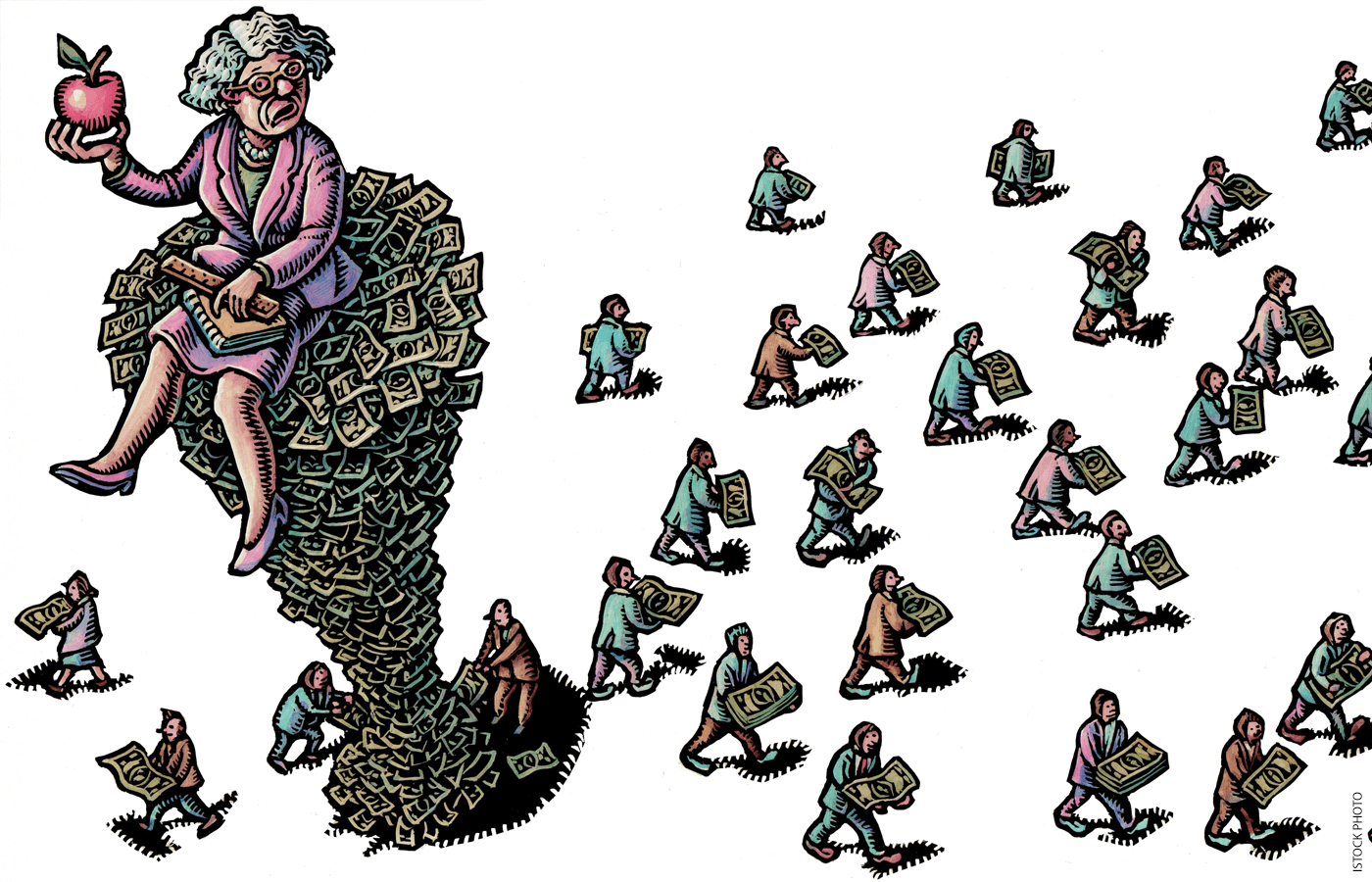
Public schools are spending more per pupil than ever, but teachers are enduring serious salary cuts. New money is instead being used to hire more non-teachers and fund pension plans that penalize beginning teachers. Meanwhile, about a fourth of all students are chronically absent from school, and average student achievement has fallen steeply.
These facts do not come from corrupt, impoverished nations located at the far corners of the world. Nor are they statistical concoctions devised by a bizarre combination of left-wing progressives and right-wing conspiracy theorists. Rather, the data come directly from reports submitted by local school districts to the U.S. Department of Education’s National Center for Education Statistics (NCES) and the National Assessment of Educational Progress (NAEP), an NCES-administered survey of student performance.
The official government data have been carefully assembled by the Reason Foundation with detailed citations to original sources for those who find the facts unbelievable.
Those facts show teacher salaries across the country remained essentially flat between 2002 and 2020 (after adjusting for inflation), then they declined by 6 percent between 2020 and 2022 (the most recent period for which information is available). Over the entire 21-year period, real annual salaries fell from $75,152 to $70,548, on average. In the recent three-year period, a downward shift in salaries occurred in nearly every state; only Minnesota managed to buck the trend, and its real average salary level increased by only 2.5 percent over the entire 21 years.
As school districts were cutting the salaries of those on education’s front line, they spent a lot more money on other activities. As of 2024, total U.S. spending on public schools came close to the $1 trillion mark, or an average of $20,322 per pupil—36 percent higher than the per-pupil expenditure level of $14,969 in 2002 (even after inflation adjustments). Per-pupil expenditure in 2023 varies widely across the states, from a high of $36,976 in New York to less than a third that amount in Idaho ($11,937). Eight states are spending more than $25,000 per pupil, while the bottom ten states spend less than $15,000. Admittedly, the cost of living varies widely across the United States, and adjusting for these differences accounts for about half of between-state differences in expenditure levels. Even so, states vary substantially in the amount of money they spend on their schools.
Increases in expenditure are driven partly by the rising cost of teacher benefit plans. Nationwide, about $1,801 of the per-pupil increase in expenditure went for that purpose. Much of the increase simply pays for the pensions of teachers who have retired or left the teaching workforce. Those should have been paid out of funds set aside when the teachers were working, but unfortunately districts failed to fund their benefit plans adequately.
Nor are the funds spent on teacher benefits a substitute for salaries needed to cover the expenses of beginning teachers. In most states, entrants to the teaching profession are not vested in a pension plan until after they have taught for several years. Meanwhile, payouts favor those who serve for 25 years or more, including the lion’s share of superintendents and other top-level administrators. Teachers who leave the profession before five years in the classroom are at risk of receiving no pension at all, a fact of major significance when one considers that those under 30 years of age (the new entrants into teaching) leave the profession at a rate of 10 to 15 percent per year. In other words, more than half of all new teachers will likely get no pension benefits.
EdNext in your inbox
Sign up for the EdNext Weekly newsletter, and stay up to date with the Daily Digest, delivered straight to your inbox.
Rising benefit costs explain only a part of the rising cost of education. Most of the new expenditure has gone toward hiring more personnel, even though the number of students has been rising only slowly and is now destined to fall. Enrollments grew by only 4.1 percent over the 21-year period, yet the numbers of adults in school districts increased by 22.8 percent, including large increases in the number of administrators, counselors, social workers, speech pathologists, and instructional aides. Non-teachers now account for over 50 percent of all public school employees.
It is hard to justify the way school districts have allocated their resources over the course of the 21st Century. Clearly, large increases in public school funding did not stem the decline in student performance on NAEP that began around 2015 and accelerated during the Covid pandemic. Nor have the extra counselors, social workers, and instructional aides prevented chronic absenteeism from rising to include about one-fourth of the student population—50 percent higher than during the pre-pandemic period. Some argue it would be worse had we spent less money and hired fewer personnel, but studies show that extra dollars spent during the pandemic did very little to ameliorate the steep drop in student performance .
In the second quarter of the 21st century, school districts—if they are to spend their resources wisely—need to adjust expenditures to the anticipated 5 percent decline in enrollment, pay beginning teachers more, introduce parity into their pension and health-care policies, and restrain funding of non-instructional activities at the expense of teacher salaries. Those changes would not guarantee that students will learn more, but they are worth a try.
Paul E. Peterson is the Director of the Program on Education Policy and Governance and the Henry Lee Shattuck Professor of Government at Harvard University, and a Senior Fellow at the Hoover Institution. He is the writer of the Substack “The Modern Federalist,” where this post was originally published.