
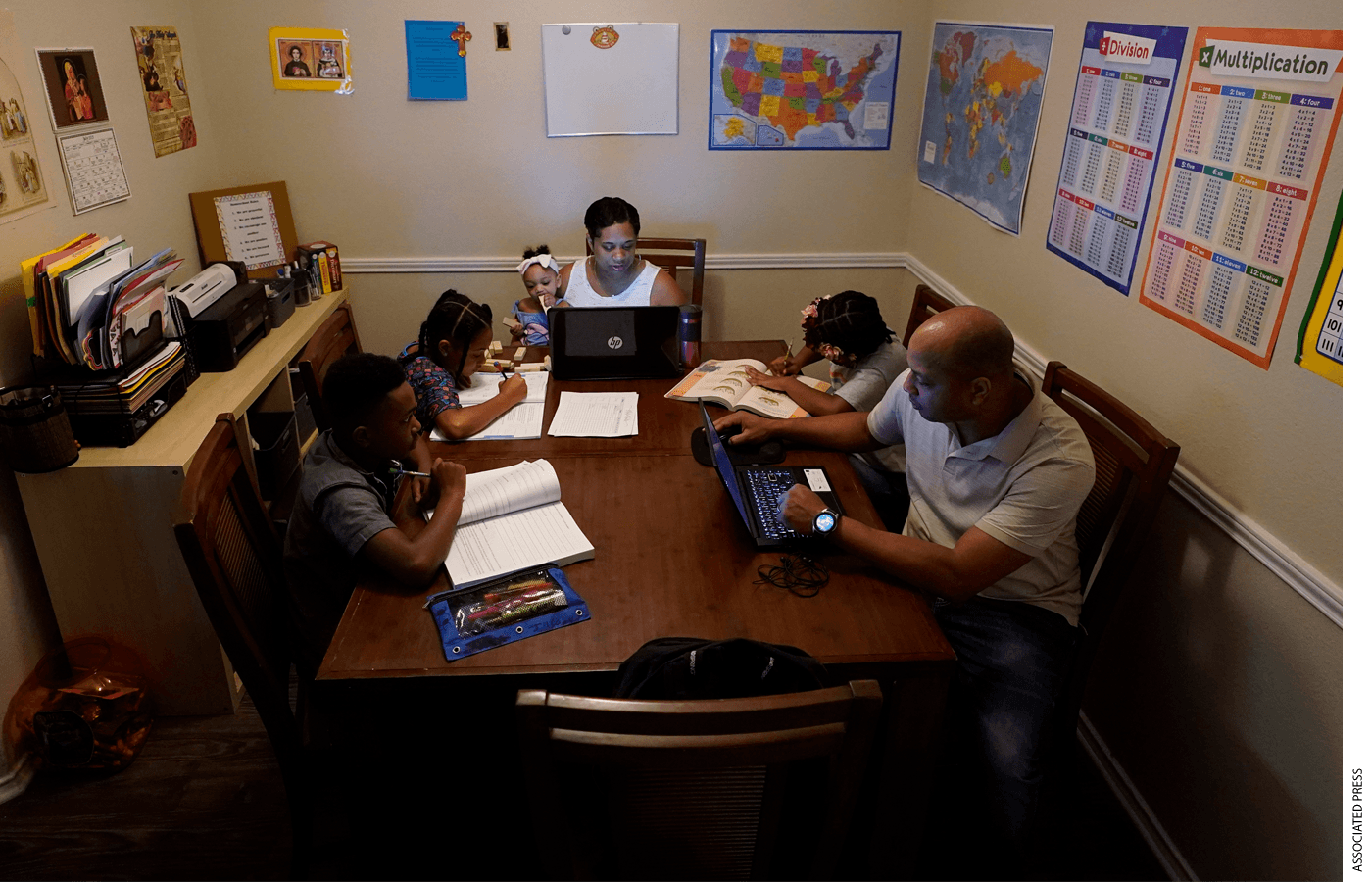
In rural North Carolina, one public district is testing a microschool model where middle schoolers study with AI support and learn entrepreneurship by helping run an Airbnb. In rural Indiana, another district leader helped launch a nature-based public microschool after watching families who did not see traditional schools as a good fit for their children consider homeschooling.
These experiments are small and in their early stages but point to an important shift: Some forward-thinking public school leaders are beginning to treat the exercise of school choice not simply as a threat but as a source of valuable information. As homeschooling remains elevated after the pandemic and states expand charters, vouchers, and education savings accounts, district leaders are hearing loud and clear that many families want something different. Public schools need to understand what that “different” is.
West Virginia Board of Education President Paul Hardesty recently put the new reality plainly: Public schools are “competing for enrollment, whether we want to believe it or not.” The only viable response, he argued, is to become “more accommodating, more receptive and more accessible to parents and students.” That is exactly the right mindset. And to become more responsive, public schools need better information about why families are leaving and what they are seeking instead.
That response does not have to look the same everywhere. Some districts are creating smaller and more flexible learning environments. Others are expanding career-connected pathways or doing better at communicating the options they already offer. In Alabama, Jefferson County Superintendent Walter B. Gonsoulin Jr. launched over 20 high school career academies that award industry certifications. And in Des Moines, district leaders have begun using enrollment data and parent outreach to better understand when families are leaving and to communicate what their schools offer.
North Carolina is leaning into that same idea. The Department of Public Instruction’s “Find Your Fit, Build Your Future” initiative highlights the many choices available within public education, from early college high schools and CTE credentials to gifted programs, magnet schools, charter schools, virtual learning, and specialized programs built around community strengths. It is a smart way to lean into choice competition. Families may be seeking something different, but “different” does not have to mean outside public education.
These moves show that public schools are not powerless in a choice-rich environment. They can create new programs, communicate more clearly, and build stronger relationships with families. But those efforts are only as good as the information behind them. If school leaders want to respond wisely to school choice, they need to know what families are choosing away from and what they are choosing toward.
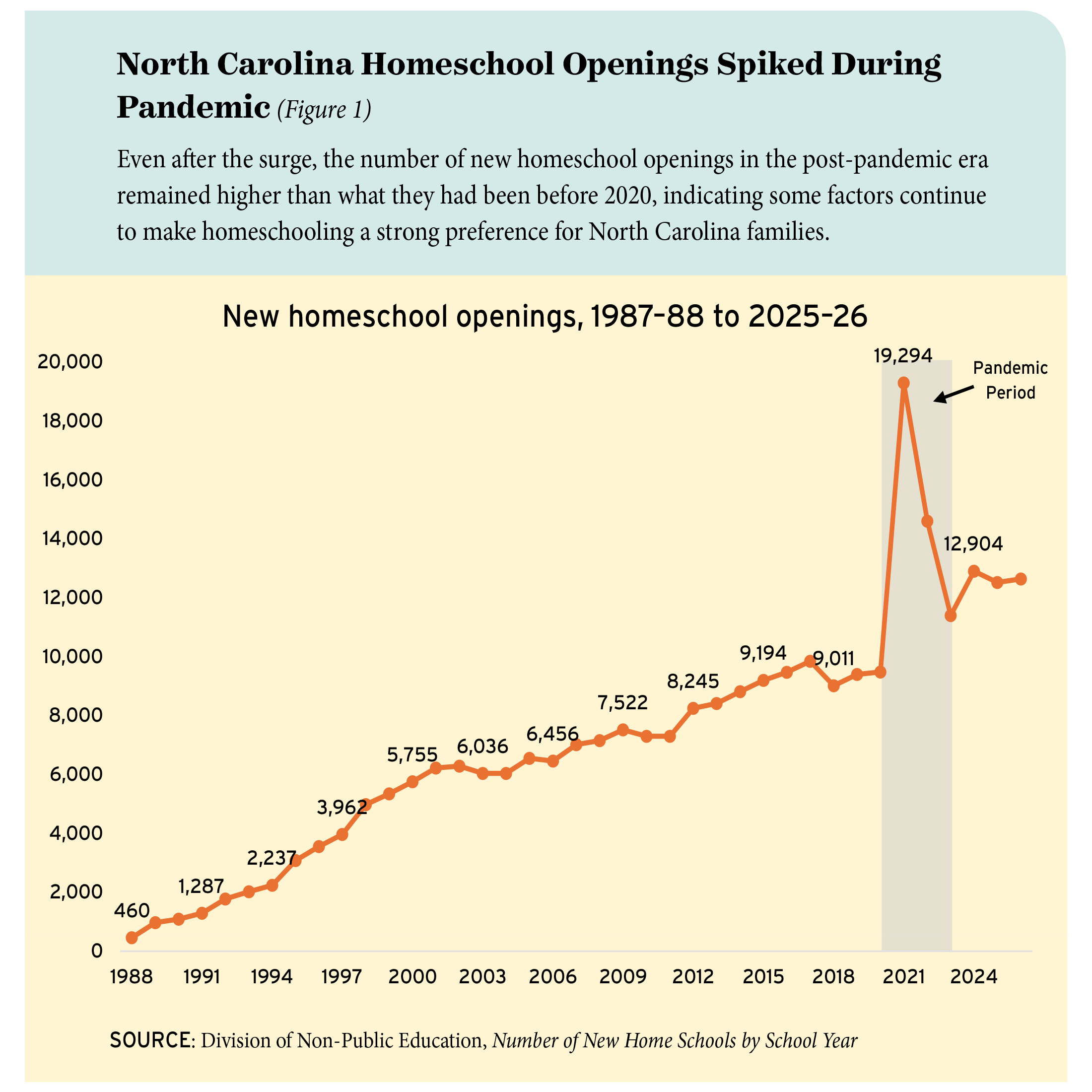
North Carolina is a useful place to ask that question because both parts of the story are visible here: Public schools are trying to highlight more choices within the system, and homeschooling has become a large, persistent option outside it. In the 2025–26 school year, North Carolina counted 95,190 homeschools serving an estimated 152,897 students ages 6 to 17. Homeschool openings spiked during the pandemic (Figure 1), surging from 9,481 new openings in 2019–20 to 19,294 in 2020–21. But they remain elevated today. In 2025–26, the state recorded 12,643 new homeschool openings, still a substantially higher number than before the pandemic.
When a sector is this large and continuing to grow, public school leaders should be asking not only how many families are choosing it, but why.
One useful feature of North Carolina’s homeschool registration process is that it invites parents to select a reason they’re homeschooling. Parents can choose one response from the following drop-down menu options: “dissatisfied with the public school system,” “the coronavirus pandemic,” “child is advanced and requires individualized and specialized instruction,” “child has special needs that require individualized and specialized instruction,” and “dissatisfied with my child’s current private school.” Alternatively, parents may provide an open-ended response. Because families’ decisions to homeschool often reflect multiple considerations, requiring parents to identify a single primary reason necessarily provides only a partial account of their motivations. Even so, these responses offer a useful window into the concern parents identify as most salient at the time of registration.
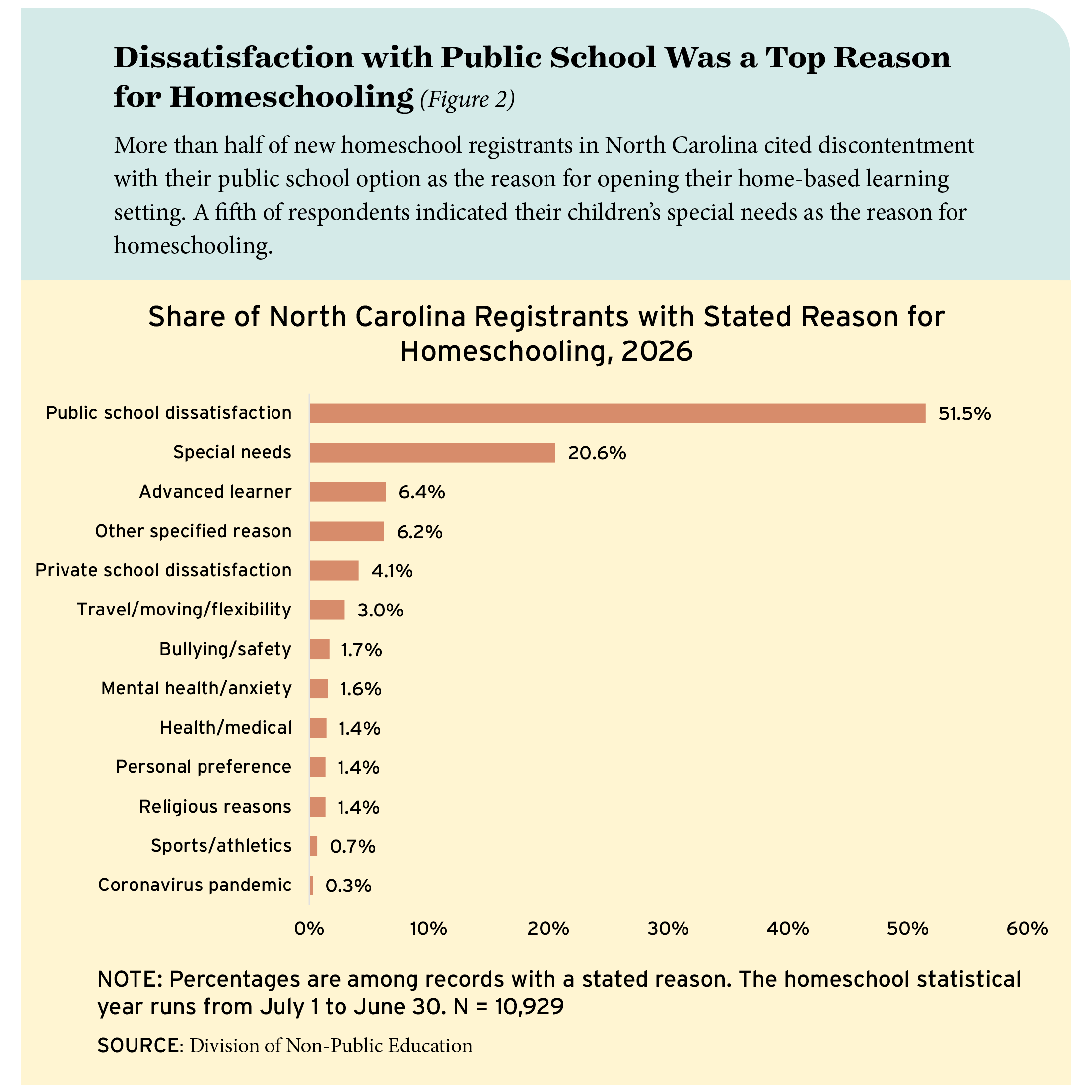
The most recent data are striking. Among 2025–26 homeschool registration records with a stated reason, 51.5 percent cited public school dissatisfaction (Figure 2). Another 20.6 percent selected special needs, 6.4 percent indicated wanting to accommodate an advanced learner, and 4.1 percent cited dissatisfaction with a private school. Smaller shares chose travel or flexibility needs, bullying or safety concerns, mental health or anxiety, health or medical reasons, religious reasons, sports or athletics commitments, or multiple overlapping explanations.
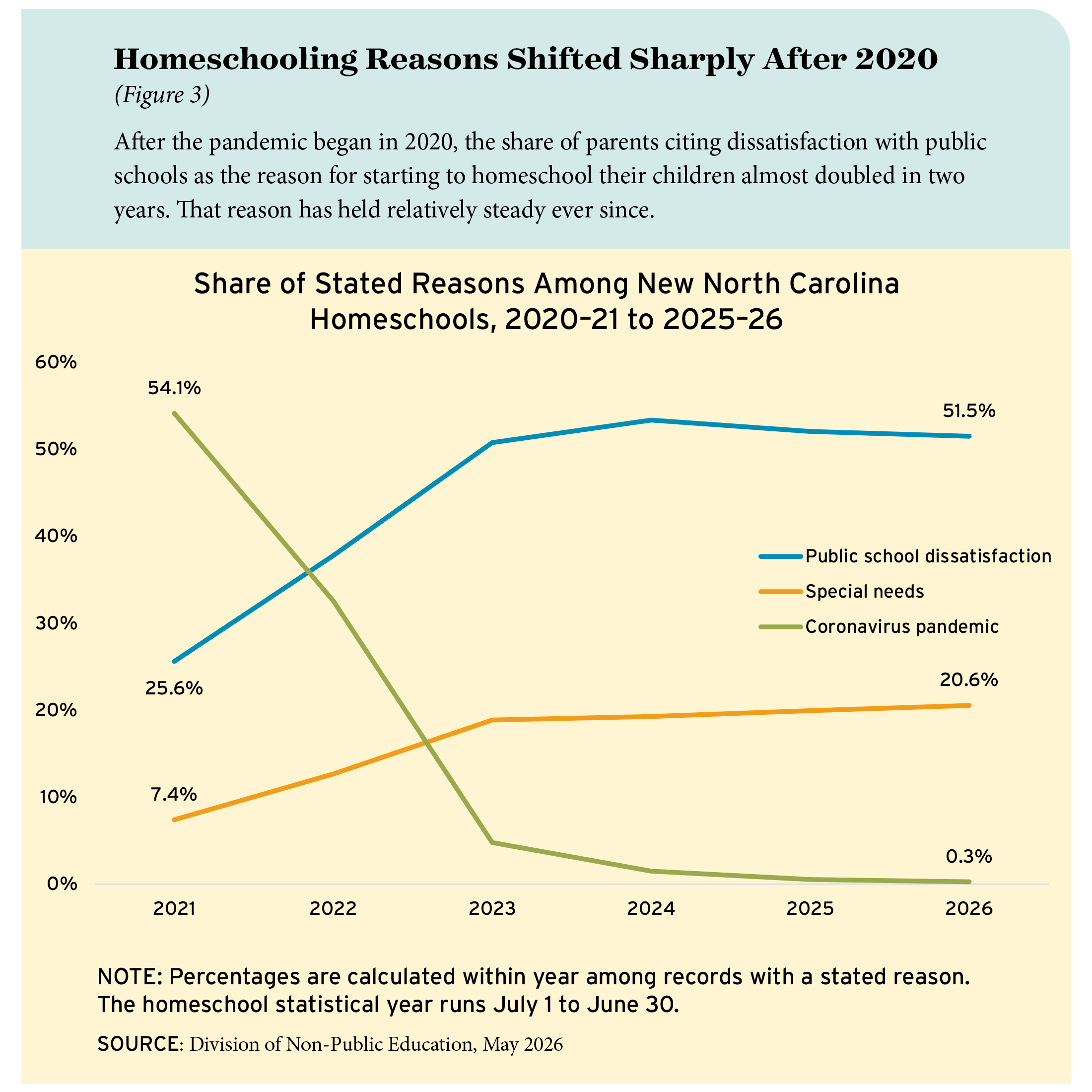
Families’ stated reasons for homeschooling have evolved over time (Figure 3). In 2020–21, the coronavirus pandemic dominated, at 54.1 percent of the reasons reported. But by 2025–26, the pandemic had nearly disappeared as a stated reason, leaving public school dissatisfaction and special needs as the two most commonly selected reasons for opening a homeschool. Although these categories are broad and likely overlap in practice, the results suggest that the concerns parents identify as their primary reason for homeschooling have shifted from an acute, pandemic-related disruption to more enduring educational considerations.
This pattern of responses should give public school leaders pause. Rising from 25.6 percent in 2020–21 to 51.5 percent in 2025–26, public school dissatisfaction is now the leading reason parents give for homeschooling. Among 2025–26 records with a stated reason, public school dissatisfaction was more than 12 times as common as private school dissatisfaction. As such, policymakers should resist the temptation to explain the homeschool boom away as a pandemic artifact, a lifestyle preference, or a purely ideological choice. In North Carolina, many parents are saying something much more direct: The public school system is not the best place for my child.
EdNext in your inbox
Sign up for the EdNext Weekly newsletter, and stay up to date with the Daily Digest, delivered straight to your inbox.
To its credit, North Carolina is already taking steps to make parent voices more central. Superintendent Maurice “Mo” Green recently launched a statewide Parent Advisory Council designed to strengthen family engagement, elevate informed family voice, build trust, and give parents a role in shaping the future of public education. Former Superintendent Catherine Truitt’s earlier Parent Advisory Commission also recognized the value of listening across sectors, reserving seats for traditional public, charter, private, and homeschool parents. Her explanation was on point: “If we’re going to be the first choice for families, then we need to understand why some families are choosing not to send their kids to us.”
Homeschool registration offers another opportunity to listen. Where states already require a homeschool notice or registration, they should add a few optional, carefully designed follow-up questions. If a parent reports dissatisfaction with a prior school, ask what drove it: safety, academics, school culture, special education services, lack of flexibility, limited program options, or something else. If a parent reports that a child has special needs or is academically advanced, ask what kind of support or customization the family was seeking.
This type of information could be useful across the education landscape. District leaders would know the precise reasons families are leaving the public sector. Likewise, private schools could learn why some families find their schools unsatisfactory. Charter schools, microschools, and hybrid programs could better understand what families are looking for. Policymakers could identify patterns by region, grade level, and student need. Better data would strengthen the constructive work already underway.
The best public school leaders are not hiding from school choice; they’re learning from it. They are building new public options, highlighting pathways families may not know about, and creating better channels for parent voice. Better homeschool-registration questions would strengthen that work. If families are saying that the public school system does not work for them, system leaders should seize the opportunity to ask why, study the answers, and use what they learn to become more accommodating, more receptive, and more accessible to the families they hope to serve.
Anna J. Egalite is a professor of educational evaluation and policy analysis at North Carolina State University and a visiting fellow at the Institute for Governance and Civics at Florida State University.