



“All the things.” “All the crazy things.” “Too much leeway and free-for-all.”
That’s how educators in Idaho, Maryland, and New Jersey describe technology use in their schools—and that’s just regarding the digital tools educators are expected to wield, let alone how kids are (mis)using learning tech.
Today, as many as 99 percent of teachers work at schools that provide laptops or tablets to K–12 students, who then spend a daily average of 98 minutes on screens at school, navigating a jaw-dropping average of 48 unique digital tools annually. Yet academic achievement continues its freefall, and far from blossoming into a generation of computer whizzes, U.S. students have become less digitally literate, as evidenced by their performance on the International Computer and Information Literacy Study. That’s probably because, all too often, districts fork over millions for learning tech without clear purpose, teachers don’t know how or why to use the tools foisted upon them, and kids are gaming and scrolling YouTube Shorts during class.
How did we get here?
A Short History of “Throwing Technology into the Classroom”
On January 1, 2010, neither Google’s Chromebooks nor Apple’s iPads existed. There was no Google Classroom or Canvas; their fellow learning management systems Blackboard and Schoology were in their infancy. When students used computers at school, it was in a computer lab, at the library or media center, or at a shared classroom desktop. Meanwhile, student achievement was rising in both reading and math.
Almost overnight, learning-tech mania would grip American education. By 2013, four and a half million iPads had been sold to schools, and Chromebooks had arrived in 2,000 schools and counting. And thus began the era of 1:1 devices—school-owned tablets or laptops assigned to individual students. That year, James Siddall, now a school psychologist, embarked on his doctoral work on 1:1 device usage in grades 3–12. Already, Siddall recalls, “There were a lot of districts moving to throw technology into the classroom, but I don’t think there was a really thoughtful, comprehensive process.” His doctoral dissertation project grew out of his work with a South Carolina school district that was one of the few even interested in establishing goals for technology use, let alone committed to working with an outside research team to ground practice in evidence.
By 2016, half of K–12 schools had given students 1:1 devices. Many other schools, including the one where I was teaching English language arts, offered access to carts of shared laptops or tablets. Another 12.6 million devices⸺enough for a quarter of that year’s public-school student population⸺shipped to K–12 buildings. Apple offered an astonishing 80,000 “educational” apps. By the following year, the New York Times was sounding alarms about the “Googlification of the classroom,” and educational technology investments reached $9.5 billion.
The rationales for at-school screen time varied: Digital programs will boost student achievement. Tech can better differentiate the curriculum for diverse learners. Devices enhance student engagement. Schools must teach 21st Century Skills. Students must become adept at computer use so they can perform well on newly computerized state assessments (otherwise, they’re “screwed,” one parent told me).
But despite all the bluster about building digital skills, many schools were actually doing less to equip students to use tech well. By 2019, high school graduates were more likely to have taken a dead language, Latin (2.7 percent), than typing (2.5 percent). Fewer states required dedicated technology courses, assuming that children were adequately equipped by dint of being “digital natives,” or maybe they’d just pick up the skills by tapping on an iPad during class.
And as we all know, when school buildings closed in 2020 because of the pandemic, teachers and students had no choice but to rely on devices for remote learning. By way of the Elementary and Secondary School Emergency Relief Fund (ESSER), districts received huge influxes of cash, with which they purchased apps and programs by the dozen, trying whatever they could to help teachers keep students engaged. (As one of those millions of desperate teachers, I too threw everything against the wall to see what would stick.)
But when schools reopened, they didn’t return to their previous ways of operating. One reason was that Covid hadn’t fully subsided; amidst the late 2021 Omicron spike, over half my students worked remotely while quarantined. That alone prevented a clean break with our device reliance. But more broadly, it was hard to pull back from everything being delivered online. Families had grown accustomed to seeing everything their kids were doing. Administrators required us to post every little thing to Schoology.
Increasingly, too, teachers themselves have been educated via learning tech. Members of the last high school class to graduate before the advent of Chromebooks are turning 34 this year; the youngest folks to have started teaching pre-Chromebooks are pushing 40. The Wall Street Journal has reported on teachers “panicking” when they can’t access digital curriculum because they’ve never taught any other way.
It’s perhaps an uncomfortable truth, but another factor is the recent wave of state mandates to adopt high-quality instructional materials. In a recent New York Times survey, half of teachers reported that “their school’s core curriculum required students to work online.” Amplify, for example, reaches 18 million students and teachers through its reading, math, science, and Spanish language curricula, all of which have required digital components. Yes, Amplify is evidence-based, but its use still translates into kids spending more time on screens.
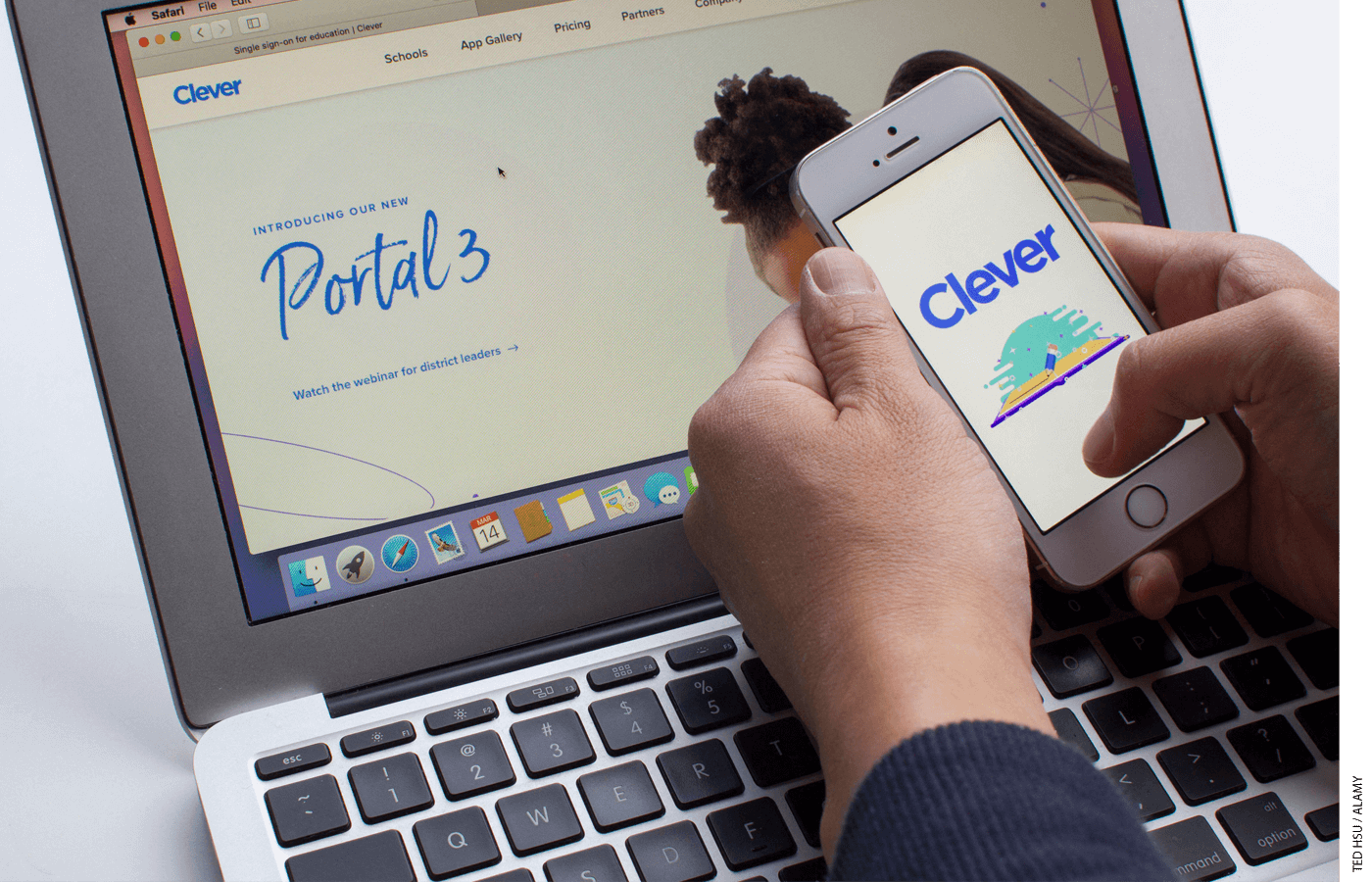
And now, districts are buying more tech to address problems created by their existing tech. Sixty percent of U.S. students use Clever, which offers a single sign-on to access all their myriad accounts. As one parent explained, her kids sign into Canvas to sign into Clever to sign into any of their apps. (No wonder students get so off task; it requires major executive functioning capacity to get on task in the first place!) To help teachers manage all the devices, GoGuardian (most recently valued at $1 billion) and its competitor Securly enable monitoring of students’ screens, while Google’s new Class Tools connects teachers’ and students’ screen activity. For Google, it’s all going according to plan: Its educational products are literally designed to create a “pipeline of future users.”
That’s not to mention all the supplementary materials available for purchase. Teachers can pay to become a Microsoft Certified Educator or Google Certified Educator (Multiple levels available!), or set out on an Apple Teacher Journey (Collect digital badges along the way!). Participating in a cohort of the Chromebook Academy costs $299, but if that’s too much, the tech guru behind it offers seven other courses and “bootcamps” with prices from $99 to $249. On Google’s educational products alone, book titles include The Chromebook Classroom (brought to you by the Chromebook Academy), The Google Infused Classroom, Stepping Up to Google Classroom, 50 Things You Can Do with Google Classroom, 50 Things to Go Further with Google Classroom, and 50 Ways to Engage Students with Google Apps.
And so, despite the continuing decline in student achievement, the plethora of ongoing legal cases surrounding violations of children’s privacy, and financial sustainability questions, ed tech forges ahead. In 2024, K–12 ed tech spending reached $30 billion, and the overall ed tech market was valued at an estimated $163 billion; each of those figures is expected to double in less than a decade. PowerSchool (which owns Schoology) was recently sold for $5.6 billion, and Instructure (which owns Canvas) for $4.8 billion. Kahoot!, a game-based learning platform and the parent company of Clever, is worth $1.6 billion. Digital curriculum provider IXL Learning has annual revenues of $1.1 billion. And so on.
In just 15 years, technology has transformed K–12 education. But are teachers any better equipped to navigate it today? In short: Nope.

“What We Do to Teachers Is Overwhelm Them with All of These Tools”
Almost half of respondents to a 2022 Education Week teacher survey described their ed tech training as “mediocre” or “poor.” As of 2023, more than half of new teachers⸺who, one would hope, have had the most up-to-date training⸺felt ill prepared to use technology in the classroom. A 2023 survey of Illinois teachers revealed that 65 percent “never,” “rarely,” or only “sometimes” received a “consistent and clear explanation” for newly adopted digital tools, and 70 percent had no opportunity to provide input into the choice of tech products.
In California, veteran high school teacher Eileen shakes her head at her district’s annual purchases of “really expensive tech products that we’re not getting any training on,” which results in the products not being used, not being used effectively, or taking a whole lot of time to figure out. On the East Coast, reading specialist Gina reflects, “I think sometimes what we do to teachers is overwhelm them with all of these tools, and not necessarily provide them the training.” She wonders how schools can expect students to use learning tech appropriately “when the teachers don’t really know the platform.”
And when teachers don’t know what to do with all that learning tech, many use it superficially. “Teachers use it as a pacifier,” asserts Jim, a high school teacher in New York state. Elsewhere, elementary school special educator Laura says some colleagues deploy tech as a “babysitter” to distract some students while they conduct learning interventions with others.
Kris Perry, CEO of the nonprofit Children and Screens, explains that insufficient training on learning tech may cause particular harm to new teachers because “they’re still learning how to teach. They’re still learning to manage a class.” Without support, she cautions, there’s a substantial risk that they will become “dependent” on having devices to deliver content and to “soothe” their students.
Now add ChatGPT and its competitors into the fray. As of summer 2025, only 67 percent of American schools had provided any AI training to any teachers. Only half of teachers have had even one professional development session on AI. Yet, the number of digital tools that teachers access continues to climb, as does AI usage among educators, far outpacing the guidance they’re receiving.
And that’s just part of why students aren’t getting the academic gains that all this tech was supposed to deliver.
Researchers and Educators Alike Doubt Devices Are the “Best Way” to Learn
At best, the evidence on learning tech’s academic benefits is minimal. The few rigorous, post-pandemic studies on tech in U.S. K–12 classrooms have found that any positive outcomes are mostly tied to specific programs, such as a “curriculum-driven” math practice tool that boosted 3rd graders’ math skills. Otherwise, studies show that increased device usage correlates with worse reading performance among 4th and 8th graders and a widening of longstanding achievement gaps among K–3 students. Looking at international data, psychologist Jean Twenge has identified a relationship between school device usage and lower academic achievement.
On the flip side, research has demonstrated the importance of human interaction for all sorts of learning. Among typically developing readers, social-emotional skills have a significant positive correlation with reading comprehension. That’s because social skills, vocabulary, and reading comprehension are reciprocal skills, relying on and enhancing one another. More broadly, positive student-teacher relationships promote better teaching practices, especially in the higher grades. And at a more basic level, eye contact boosts communication and shared understanding among human beings. In short, as Perry told me, “If you act like the human element can be replaced with a device, you’re ignoring the research.”
Educators on the ground also highlight the importance of screen-free interactions for learning. Over the quarter-century that Jim’s been teaching, his literature students have increasingly struggled with irony and metaphor. He believes “it’s because they’ve never used their brains to imagine” due to constant screens in their lives, and screen time at school only makes the problem worse. Special education math teacher Janessa watches her 9th graders breeze through problems on their Chromebooks without retaining the information she believes they would’ve absorbed better through writing by hand. Her students enjoy watching math lessons presented “like a TikTok reel,” but, Janessa affirms, “The best way of learning is with someone.” Alana, an English as a New Language (ENL) teacher, allows her students to use their iPads as a bilingual dictionary, but that’s about the extent of her learning-tech use. “The best way to learn a language is to be forced to talk to other people meaningfully,” Alana explains. “A device will pale in comparison, a hundredfold, compared to a competent ENL teacher. . . . The answer is not, ‘You don’t speak English, so you carry around an iPad.’”
The migration of entire courses onto learning management systems should worry us, too. Janessa observes that not only students, but also their families are less invested in getting kids to show up to school because their assignments can all be submitted online. In Maryland, administrator Nichole describes her school’s attendance challenges as “insane,” adding that among their chronic absentees are “the best and the brightest,” who know they can pass in absentia by way of Schoology.
Formal policies sometimes reiterate the message that, thanks to learning tech, students don’t need to make in-person attendance a priority. In Orange County, California, students as young as kindergarten can apply for “independent study,” meaning that the student can complete all work online, without physically attending school, for an extended period. According to a parent whose child completed the Orange County independent study last year, “You do not need to have any kind of legitimate reason.” The official paperwork even says that “vacation travel plans” are an acceptable basis for the request. Students using the independent study option don’t count toward classroom absences, which boosts schools’ attendance rates without students being physically present. No wonder a quarter of secondary students ages 12 and over don’t see chronic absenteeism as a problem.
And whether they’re in class, on the couch, or at the beach, students don’t read a screen the way they read a page. Neuroscientists have shown that middle schoolers’ brains just don’t engage as deeply with digital texts. Moreover, teachers now assign readings in a hodgepodge of formats. Some come from an online textbook, others are linked in different modules of the learning management system, and still others are pasted on lecture slides. As a result, students can have a tough time figuring out what they’re supposed to study (let alone retaining it). “If you’re throwing out random chapters and PDFs that may be coming from different books,” Siddall says, “then that’s an added skill set that we need to teach students: how to combine that information and synthesize it.” But most educators aren’t conscious of this issue.
Excessive device usage may also stunt the development of essential soft skills. With so much screen time at school, on top of the screen time they’re getting elsewhere, Laura believes, kids’ attention spans are shot. “Their brains are switching every five seconds,” she says. “As if teaching wasn’t hard enough!” Tammy, a parent of three in Maryland, reports seeing “a lot less flexible thinking” with increased school device usage. Siddall believes that too much screen time at school “encourages more social atomization.” Today’s students suffer from “a severe lack of ‘with-it-ness,’” observes Jim.
These concerns evoke what the social psychologist Jonathan Haidt has called the opportunity cost of screen time. Imagine a digital social studies curriculum that teaches the content just as effectively as a hard-copy curriculum meant to be delivered by a live human. Even if the academic outcomes are identical, what opportunities have schools sacrificed by having students learn from a device? If they had discussed the causes of World War I as a class, for example, they might well have learned the same content and advanced their interpersonal communication skills.
Finally, even when learning tech has academic potential, students find ways to game the system. Meghan, a Virginia parent who volunteers weekly at her kids’ elementary school, regularly witnesses students taking advantage of digital math activities meant to be tailored to students’ individual skill levels. They figure out how to get assigned the easiest option so that they can check the box and move on.
And that’s when they’re ostensibly on task.

“They Horse Around on the Internet, and They Absolutely Cheat”
A nationally representative Education Week survey found that 56 percent of educators believe that “off-task behavior on laptops, tablets, or desktops is a major source of distraction that cuts into students’ learning time.” The New York Times reports that 70 percent of teachers say that “school-issued devices distract from schoolwork.”
No doubt, kids have tended to stray off task since the first schoolhouse doors opened, but today’s distractions far exceed passing notes or sneaking a comic between textbook pages. Students of all ages play games or browse YouTube in class. Some chat on social media, or if that’s blocked, they email each other using their school accounts. As they get older, they do all that, plus shopping, searching for violent content, gambling, and viewing porn.
Screen-monitoring tools such as GoGuardian have improved things⸺in math, Janessa has been happy to see more kids engaged and asking her for help⸺but they’re no silver bullet. Gina says that at her school, “We block a bunch of sites, and somehow they find a way to get around it.” Siddall sees this as an inevitability, not a glitch: “Kids are going to break out of their systems. Content monitoring systems are always going to be behind what they’re capable of.”
With generative AI, teachers and administrators also say that cheating has reached new heights. For essays, Jim’s students now exclusively use pen and paper: “I cannot verify anything that is generated on the computer anymore.” On assessments, Eileen has seen students use Ctrl+C to copy a “cheat sheet” before the browser lockdown tool kicks in, and then they press Ctrl+V to paste the information as soon as the exam opens.
Perhaps surprisingly, the data don’t indicate that AI has caused a rise in cheating⸺but these data likely don’t tell the whole story. Some observers doubt that programs like Turnitin work effectively. But even in a best-case scenario, plagiarism detector Turnitin’s data are necessarily limited by the number of schools that use its product, and by the assignments that teachers actually run through the detector (not typically short answers or quizzes, as students well know). Research from Stanford relies on student self-reporting, but students may not understand what constitutes cheating anymore. Alexandra, a parent in California, thinks nearly all kids cheat using AI, and many genuinely “don’t know that it’s cheating.” Twelve of her middle schoolers’ 14 teachers have given them zero guidance on AI use; the other two just say not to copy and paste. But they all run the kids’ work through an AI detector, so clearly, they have expectations they haven’t communicated.
Unfortunately, Alexandra’s experience is far from unique. As of summer 2025, over 80 percent of students reported that “teachers did not explicitly teach them how to use AI for schoolwork,” and a mere 31 percent of schools have a written AI use policy for students. In this brave new world, how can kids know what constitutes cheating if it’s never been defined for them?
Regardless of their intent, for many students, the reality today is that, as Eileen pithily remarks: “They horse around on the Internet, and they absolutely cheat.”
Meanwhile, Learning Tech Creates New Problems for Families
All this tech was supposed to enhance family engagement in the learning process. But in practice, even a seemingly straightforward learning management system can create more confusion for students and those supporting them at home. Alexandra explains: “Canvas runs my life. I have Canvas Parent, and I have Canvas Student. . . . It still fills me with trepidation because some teachers will have all their assignments in there, but the times that they’re due are all different.” Whereas students in the past submitted hard-copy assignments at the start of a class period, now assignments might be due electronically at the start of class or at the start of the school day, noon, 11:59 p.m. Friday, 11:59 p.m. Sunday, or a countless number of other times. When her second child entered middle school, Alexandra hoped that she would be better equipped to support her, but instead it became more burdensome to keep track of the expectations and systems of the 14 different teachers assigning work to her 6th and 8th graders.
When the inconsistencies multiply across platforms and tools, the obstacles grow correspondingly. Across the country from Alexandra, Tammy says her kids have a hard time knowing where to start looking for their materials among StudentVUE, Canvas, and Clever. If her kids’ schools “streamlined their systems,” she says, “that would have the biggest impact on our lives. That is the thing that is hardest for parents, and for my kids.” Elsewhere in Tammy’s Maryland district, a parent of two elementary schoolers told me that her kids’ school kept changing the apps they asked parents to download every year. It became too overwhelming for her to keep up, so she quit using any of the school’s apps. So much for keeping families in the loop.
Needing to use school devices at home also creates new problems for families. Brittany, a stepparent in Georgia, says that her 11th grader’s MacBook “one thousand percent interferes” with efforts to maintain boundaries around screen time. Her stepson insists, “I need it for school!” His grades show that he eventually completes all his assignments, but still, Brittany wonders what he is up to each time he disappears into his room clutching his laptop; she recognizes that parental supervision of teens has its limits. “You’re not in the room with them every thirty seconds,” she says. “There’s only so much you can really do without hovering so intently.”
Brittany also sees the device as exacerbating existing challenges for a child who’s already navigating multiple households with multiple sets of rules. “It’s very difficult,” she explains, “when you go from one house, where the machine turns off at 9:30, and then you go to the other house, where you do what you want until 1:00 or 2:00.” Indeed, Brittany and her partner struggle to enforce a 9:30 p.m. screen-time cut-off when that’s at odds with what’s being communicated by both her stepson’s other household and his school, with its 11:59 p.m. deadlines. And Brittany’s family is far from alone. We don’t have data on living arrangements for kids of parents who never marry, but we do know that a third of today’s divorces result in shared custody. That adds up to millions of kids.
So, should we just chuck the Chromebooks, accept the sunk cost of the 1:1 era, and hotfoot it back to the 20th century? Even the parent who deleted all her apps doesn’t think so. “As much as I would love for [my kids] to have screen-free schooling, that wouldn’t really prepare them for the world.”

What Should Come Next: Fewer Products, More Purpose
It’s time for districts and schools to take stock, set goals, and develop strategy around learning-tech use. Sounds simple, yet this has rarely happened. The following three changes could help educators get started:
First, abandon the delusion that kids are tech-savvy just because they were born recently. All students need developmentally appropriate, explicit, and dedicated digital literacy instruction. According to recent federal data, only 61 percent of schools provide students with digital literacy training via “formal or structured digital literacy curriculum.” Six out of 10 schools is far too few, when just about 10 out of 10 schools are putting devices in children’s hands. But what’s more, over half of those who responded that they provided such training only provide it within other classes, such as social studies and math. Yes, more states are adding computer science graduation requirements, but high school is simply far too late to be teaching core digital skills.
It’s true that kids can poke holes in their schools’ content monitoring systems, but that doesn’t mean they’ve gained the digital skills that we actually want them to have. Alana describes her high school students as “really computer illiterate. They are not good at using computers. They struggle to save something correctly.” As recently as 2022, I taught juniors (in IB courses, no less) who begged to use their phones to write essays in class because they were uncomfortable typing on a keyboard. Today’s teens should not be less computer literate than my peers and I were two decades ago.
If the school deems a child old enough to use a laptop or iPad, then the school should provide meaningful instruction to that child about using that device. Starting at the elementary level, dedicated media or technology classes can provide all sorts of digital instruction. Some schools teach research skills with Kiddle, a kid-friendly search engine. Others help kids stay safe online after the school day ends; one parent happily reported that her 1st grader received instruction about what personal information was OK to share in an online profile (Home address? Absolutely not. Favorite color? Go for it!). Let’s make that happen for all kids.
Second, stop pretending that AI isn’t infiltrating students’ lives. Districts and schools urgently need to recognize that AI requires a formal policy response. If teachers are poorly trained on AI, students’ needs are outright ignored. Recent federal data reveal that only 14 percent of public school leaders say that all their students “are taught about ethical/appropriate uses of AI.” Heads, it’s time to exit the sand.
At minimum, schools need a written AI use policy, which must be discussed explicitly with students. If schools choose to ban all AI use, they’ll need to back up that policy by accepting only pen and paper submissions.
EdNext in your inbox
Sign up for the EdNext Weekly newsletter, and stay up to date with the Daily Digest, delivered straight to your inbox.
Although that’s an acceptable, consistent course of action, it’s not ideal. In one sense, the rationale for AI education resembles the justification for sex education: Students are always going to find ways to get access, and equipping them with information can keep them safer than sweeping reality under the rug and crossing our fingers that they’ll figure things out on their own someday. Steve, an administrator whose New Jersey school is among the few with a formal AI policy, says, “We acknowledge that AI is here, and we view ourselves as being responsible for exposing students to what it is, its capabilities, and the potential dangers and pitfalls.”
So what can an AI policy look like? In Washington, D.C., the tech-forward high school Washington Leadership Academy (WLA) created a schoolwide rubric, with scores from 0–4, to indicate the acceptable level of AI use for any given assignment. Zero means no AI whatsoever; 2 means that AI is permissible for help with drafting and revising, but students “must critically evaluate and modify any AI-generated content”; and 4 encourages students to “use AI creatively,” no holds barred. Students receive consistent guidance around the policy, and there are defined consequences for inappropriate AI use. Not every WLA student feels optimistic about AI, but they still find it “scary” that peers at other schools aren’t getting any instruction around AI.
In some cases, AI may reconfigure education more fundamentally. Adam Browning, WLA’s director of academic innovation, believes that AI will increasingly allow for more self-paced work, compelling more serious consideration of course credits based on standards rather than the number of hours spent sitting in a classroom. (“But,” he cautions, “not everything should be self-paced.”)
Going far beyond WLA, the AI-based Alpha School has forged ahead in this direction, relying entirely on devices for academic instruction. There’s clearly some demand for the approach, as families have shelled out as much as $75,000 annually to send their kids there. But given everything we know about the value of human teachers, in conjunction with the lack of serious evidence supporting education that’s delivered wholly via technology, I remain deeply skeptical of such an extreme.
Above all, pursue solutions, not shiny objects. Although WLA embraces tech, its students aren’t constantly jumping between different digital tools. Some years ago, the school encouraged individual teachers to explore all the tools they could find, which Browning says enabled them “to go into the wilderness of AI tools and come back with a plan.” Together, the WLA team narrowed the lineup to a select handful, and teachers now receive in-depth and ongoing professional development on each of their three AI platforms. Browning says it’s not necessarily about whether their tools are the absolute “best” in an abstract sense, but rather about ensuring that teachers are effectively supported in using what they have. “We believe in purposeful technology, not pervasive technology,” he affirms.
WLA also embeds everything in Canvas so that students don’t have to navigate multiple links to access content or assignments, which helps them stay confident and on task. “As long as they stay on Canvas, they will stay on Canvas,” Browning explains. “The second they have to leave, they will get lost on the web.” (And that’s at a school that requires four years of computer science!) WLA’s intentional, systemic streamlining efforts save students, teachers, and families from wasted time and logistical headaches.
And across school settings, tech provides essential supports for students with disabilities, who comprise 15 percent of the public-school population. Tools such as speech-to-text and screen readers are integral to many students’ access to the free and appropriate public education that’s both ethically just and legally mandated. And for students with chronic illnesses or mobility conditions, virtual school may be the best bet for consistent access to schooling. Such accommodations can make all the difference for millions of kids.
When it comes to specific classroom activities, administrators and educators largely agree that they should be device-based only when it provides a clear advantage. For example, Michigan teacher Amanda recently brought her 3rd graders outside to take pictures of clouds with their iPads. Next, the kids used the (free!) Photos app to label their photographed clouds by type, and then they discussed their work. Without devices, a gaggle of eight-year-olds poking their fingers toward the sky would’ve struggled to figure out which clouds their friends were looking at. In Amanda’s lesson, however, their devices helped them make real-world observations, enhanced their understanding of the science lesson, and fostered a face-to-face conversation.
Systemwide planning and ongoing professional learning are key to ensuring that all kids are getting meaningful lessons such as this one. First, goal setting should happen at the district- or school-wide level: Starting with student-outcome goals and planning “backwards” from there, what is the district or school hoping to achieve? How can learning tech help teachers reach those goals? As Browning explains, for WLA, “Tech is never the starting point. The content is the starting point.”
Once those broader goals are established and they earn buy-in, teachers need initial and follow-up training on the specific tools they’re using, including (but not limited to) a formal overview of the product. Observing other teachers effectively using a tool can be a huge help. Teacher observation rubrics and feedback cycles could include one or more components for effective deployment of learning tech. Some schools designate an individual to lead this work. As her school’s “tech chair,” Amanda does everything from coaching colleagues to working with an Apple programmer to standardize the home screens on students’ devices.
District leaders also need to become more purposeful in their purchases. Too often, educators tell me, vendors come to school boards and central offices to promote their products; genuinely wanting to help teachers and students, board members and administrators hand over the credit card. Teachers are then expected to use the product du jour, regardless of its relevance to their students’ needs. Instead, as Laura suggests, districts could conduct a survey asking teachers what they most need devices for. Based on the results, the district would provide access to a limited number of top-priority, evidence-based tools that align with defined goals.
Changes on the procurement side could also benefit students and schools. Outcomes-based contracting would align incentives by requiring goal setting up front and tying payments to student outcomes. A more ambitious—but not unrealistic—idea laid out in the Handbook of Children and Screens is to hold learning-tech companies accountable to clear industry standards, such as product alignment to developmental science and substantial evidence of benefits to students. A third party, such as Consumer Reports or a governmental body, could monitor compliance.
Deploying a more carefully curated selection of learning-tech products would save school districts millions of dollars. Such streamlining would also make it more feasible to provide support to teachers, who would then be better equipped to implement tech purposefully. Using devices only for the activities where they add value should also allow for more face-to-face time, gradually building back those rusty soft skills and the perceived value of in-person attendance. Sure, kids will still manage to horse around and cheat, as they always have, but schools can make those opportunities far fewer while also building those 21st Century Skills we keep hearing about.

Meredith Coffey is the senior policy and operations associate at the Thomas B. Fordham Institute. From 2016 to 2022, she taught English language arts in traditional public high schools.
Suggested citation format:
Coffey, M. (2026). “Logged In, Tuned Out: Fifteen years and billions of dollars later, what has learning tech accomplished?” Education Next, 26(1), 10 March 2026.