



For the better part of a century, most public school teachers in the United States were paid according to rigid “step and lane” systems, with pay and tenure based on education and years of experience. Meanwhile, performance evaluations were infrequent, did not include measures of student learning, and rated virtually every teacher as good or great. In the 2010s, education leaders and policymakers began to shift their focus from uniform longevity to individual effectiveness—most notably after the 2009 federal Race to the Top grant program incentivized states to adopt new performance-based systems for teacher evaluation, retention, and compensation.
The changes were swift and sweeping: By 2015, 43 states had revamped their teacher-evaluation systems. By 2020, 22 states considered teacher performance in tenure decisions; by 2022, 23 states at least partially tied teacher pay to performance (see “The Teacher Evaluation Revamp, In Hindsight,” feature, Spring 2017). Research has found positive impacts from new evaluation systems, which typically feature robust classroom observations, feedback, and student test-score data (see “Can Teacher Evaluation Improve Teaching?” research, Fall 2012). Other studies have found positive impacts of performance pay on student learning, including gains due to higher rates of turnover among low-performers (see “A Lasting Impact,” research, Fall 2017), and reassigning strong teachers to higher-needs schools (see “The Power of Performance Pay,” research, Spring 2025).
What about performance-based tenure rules? Traditionally, teachers have earned tenure after three consecutive years on the job—simply showing up to work on the first day of year 4 has enacted employment protections for life. But some states are changing those rules, including by requiring more years in the classroom and by setting minimum performance standards linked to multiple measures of effectiveness. If such conditions incentivize teachers to improve, that could be especially meaningful for early-career teachers, who experience dramatic growth and high rates of turnover in their first few years on the job.
I investigate this scenario in Tennessee, which implemented a new multiple-measures evaluation and tenure system in the 2011–12 school year. Under the new rules, teacher performance is assessed annually on three measures of effectiveness, including robust classroom observations and a value-added estimate based on student test-score growth. Teachers can qualify for tenure after five years in the classroom, but only if they earn “above expectations” effectiveness scores in years 4 and 5.
I look at changes in teacher value-added from 2008 through 2015 to identify the effects of the new evaluation and tenure system over time. I look at two groups of teachers: novices in years 1–3 of their careers who anticipate and then experience new tenure requirements along with new evaluations, and teachers in years 4–7, who are already tenured under the former service-time requirement but experience the new evaluations and associated feedback on their performance. I compare changes in these teachers’ value-added to that of similarly experienced teachers before the 2012 reforms.
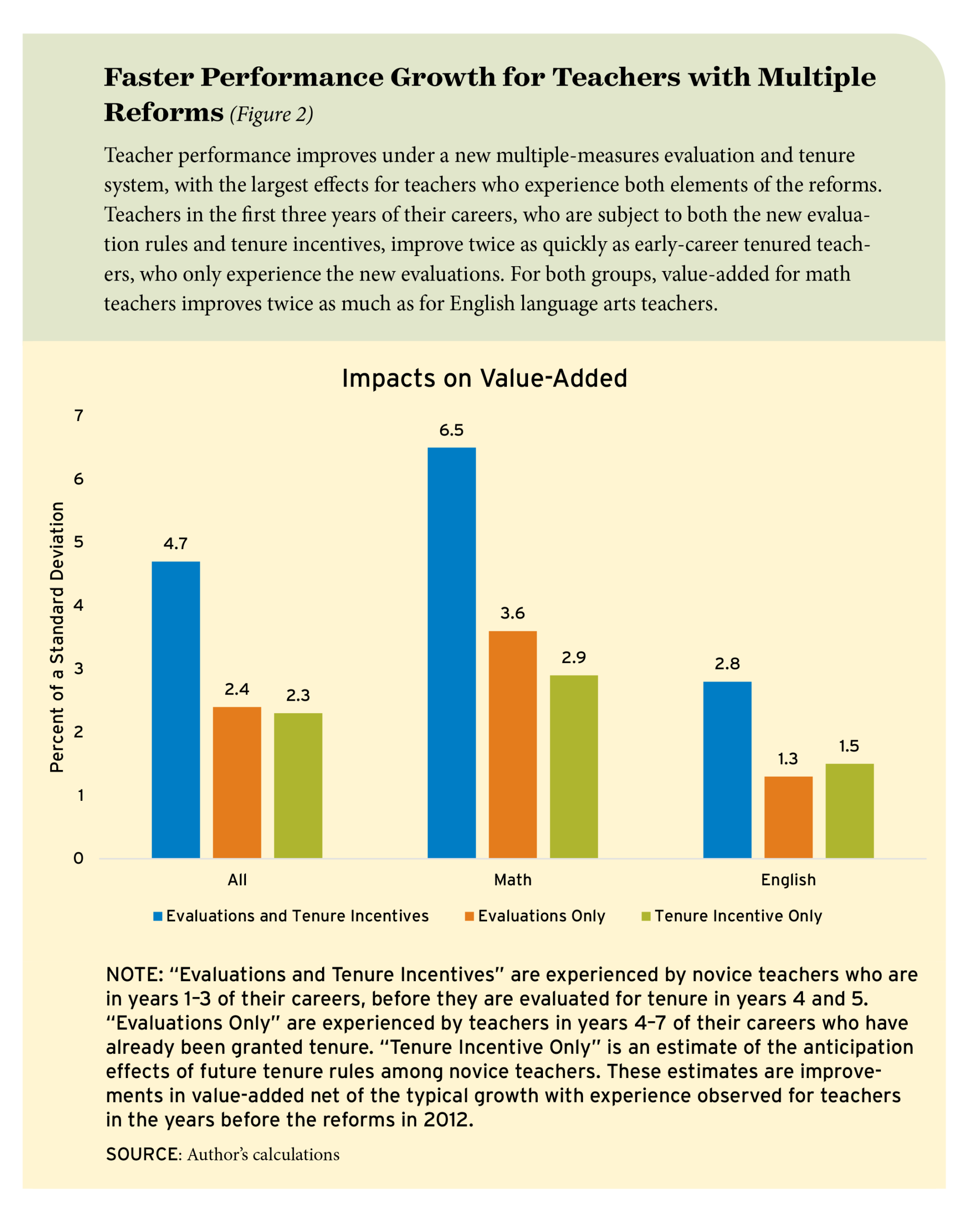
Across the board, teacher performance improves as soon as the new evaluation system begins. But the improvement gains are twice as large for pre-tenure teachers: Value-added increases by 4.7 percent of a standard deviation of student test scores over and above average early-career growth before the reforms. On its own, the new evaluation system boosts value-added by 2.4 percent of a standard deviation for both pre- and post-tenure teachers, and the new tenure incentives increase value-added by another 2.3 percent of a standard deviation for teachers held to those rules. These differences translate to up to two additional weeks of instructional time and $2,000 per student in net present earnings.
I find that these improvements are largely experienced during teachers’ first three years on the job, when they are anticipating the future tenure incentive but before formal tenure rules apply in years 4 and 5. The gains are also lasting: Value-added does not decline after a teacher earns tenure despite the fact that the incentive to earn a high score goes away. The cumulative effect of the performance-based tenure rules for new teachers is 7.9 percent of a standard deviation in value-added growth in the first six years of their careers.
In summary, teacher performance improves before any scores count for earning tenure, and performance remains at the new higher level after teachers earned tenure. These anticipatory and persistent effects are consistent with skill improvements caused by the evaluation program and its performance incentives.
A New Teacher Evaluation System
Tennessee’s teacher evaluation and tenure reforms began at the start of the 2011–12 school year following the state’s 2010 First to the Top law and $501 million federal Race to the Top grant. The law requires that all teachers and principals be evaluated annually and permits student achievement data to be used in tenure decisions, among other innovations.
Under the new rules, each teacher’s evaluation includes three performance measures: a classroom observation rating, a value-added score, and an additional student achievement measure selected by the teacher. All three measures make use of a five-point expectations scale: (1) “significantly below expectations,” (2) “below expectations,” (3) “at expectations,” (4) “above expectations,” and (5) “significantly above expectations.” At the end of a school year, the three measures are weighted and averaged to determine the teacher’s “level of effectiveness” score on the same five-point scale.
First, classroom observations account for half of a teacher’s overall effectiveness score. A school principal or other administrator conducts observations using a detailed rubric that describes specific teacher behaviors and associated scores. Every teacher is observed up to three times each year and scored in categories like presenting instructional content, managing student behavior, and academic feedback. Observers provide feedback after each visit, and the task-specific scores are averaged for the final observation rating.Previously, observers had used a less robust rubric, and after being observed two to three times annually through year 3, a teacher was not formally observed again until year 8.
Second, value-added scores account for 35 percent of their overall effectiveness score. Known locally as Tennessee Value-Added Assessment System, or TVAAS, the scores are estimated by the SAS Institute and often referred to as the “student growth score.” When describing TVAAS to teachers, Tennessee emphasizes the growth characteristic and that students are compared to peers who scored similarly in prior years. While Tennessee principals and teachers have had access to TVAAS reports and value-added scores since the early 1990s, they were not formally used for personnel decisions prior to the new evaluation rules in 2012.
Finally, the student achievement score accounts for 15 percent of a teacher’s rating. This measure is also usually based on student test scores but typically focuses on the level of student achievement as opposed to growth. Each teacher defines this measure for herself, in collaboration with her school principal, choosing from a state-approved list of student assessments. The teacher and principal set the criteria that will map from student scores onto the five-point expectations scale, such as a class or grade-level pass rate on state tests, or some other commercial assessment.
In this research, I study only teachers who teach math and English language arts to students in grades 4–8. The description of Tennessee’s new evaluation system in the preceding paragraphs applies to these teachers, for whom value-added scores can be calculated. Evaluations for teachers in non-tested grades and subjects are different, notably teacher value-added scores are replaced with alternatives like student growth portfolios or school- or district-level data.
Tennessee’s Tenure Reform
Also starting with the 2011–12 school year, teachers’ annual level of effectiveness scores determine whether they earn tenure. Previously, teachers had been eligible for tenure based on how long they worked in a district. At the end of a three-year probationary period, a district had two options: either fire the teacher or grant them tenure. Some 90 percent of eligible teachers received tenure under the old system.
Under the new system, a teacher is first eligible for tenure after teaching for five school years, not three. Tenure is granted based on teacher performance in years 4 and 5 on the job: Only teachers who earn effectiveness scores of 4 or 5 in both years qualify. Teachers whose scores fall short can continue working on a probationary contract in year 6 and beyond, but they can only earn tenure after scoring 4 or 5 two years in a row.
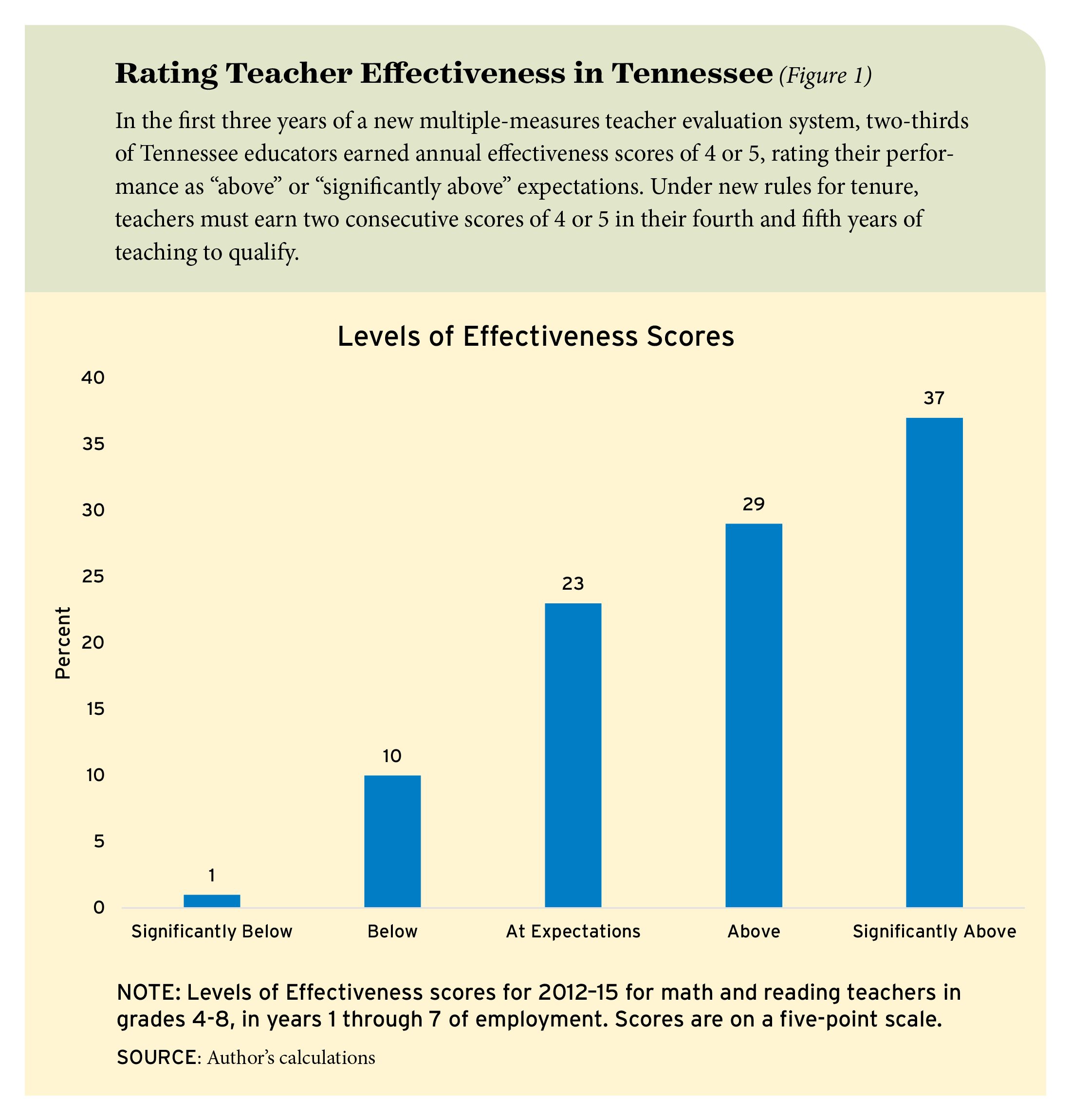
These new rules are a real constraint on tenure. I look at the level of effectiveness scores of teachers in years 1 through 7 of their careers. Only about two-thirds of teachers earn scores of 4 or 5 during that time (see Figure 1). In any two consecutive years, just 57 percent of teachers score 4 or 5 in both years. However, teachers in their fourth and fifth years on the job earn higher scores, with 63 percent meeting the tenure requirement.
Tenure is revoked when a teacher earns two successive scores of 2 or 1, which rates their performance as below or significantly below expectations. In practice, however, this is rare: Fewer than 5 percent of teachers earn disqualifying low scores in two consecutive years. Schools may continue to employ teachers who lose tenure, if they choose, and teachers can regain tenure by earning scores of 4 or 5 twice in a row again.
Notably, the new tenure rules apply only to teachers who began working in 2009–10 or later—teachers hired before then were already tenured by the time the new rules took effect.
Assessing Impacts
One way to summarize these many details is to think in terms of a pair of experimental treatments. The first treatment is the change in performance measures for all teachers. The new evaluation system expands annual evaluations to every teacher, not just pre-tenure teachers. Further, classroom observations are based on a more comprehensive rubric, and teachers’ value-added scores are formally used in their performance evaluations. The second treatment is the change in performance incentives attached to the new measures: new tenure rules that require teachers to score “above” or “significantly above” expectations in both their fourth and fifth years on the job.
I estimate the impacts of these treatments separately and in combination, based on Tennessee data from 2007–08 to 2014–15. I focus on math and English language arts teachers in years 1 through 7 of their careers with students in grades 4–8, who are tested annually in those subjects. In all, my study includes data for 11,000 teachers and 720,000 students.
In my analysis, only teachers hired in 2009–10 or 2010–11 receive both the evaluation and tenure treatments. For these novice teachers, the tenure incentive treatment begins in year 4 and ends after year 5 if they successfully meet score requirements. By contrast, teachers who are in years 4–7 when the new rules begin never experience the tenure incentive treatment. These early-career teachers are subject to new performance evaluations but are already tenured under the old rules.
I focus on changes in teacher value-added in both of these teacher groups. For the novice teachers who receive both treatments, these first estimates capture the additional growth between their first and second, or second and third, years in the classroom. This analysis captures the anticipation effects of the new tenure incentives, because teacher performance only counts toward tenure awards in years 4 and 5 of their career. I then estimate changes in value-added between year 5 and 6, after incentives end, to identify persistent effects of performance incentives. These estimates show the additional growth in value-added, caused by the reforms, on top of the typical growth new teachers experience in their early years on the job.
For the tenured early-career teachers who only receive the evaluation treatment, the estimates describe growth between years 4 and 5, or 5 and 6, or 6 and 7—years when many teachers have completed their most dramatic growth but are continuing to improve. Still, again, these estimates capture the additional growth in value-added net of the average growth observed for teachers in years before the tenure reforms in 2012.
Novice teacher value-added improves by 4.7 percent of a standard deviation in the first year of Tennessee’s reforms (see Figure 2). That gain is in addition to the typical performance growth at the outset of a new teacher’s career. While both math teachers and English language arts teachers experience gains in performance, value-added for math teachers grows by more than twice as much: 6.5 percent of a standard deviation, compared to 2.8 percent of a standard deviation for English language arts teachers.
How much of the improvement in value-added would have occurred without future incentives? Robust new evaluations and feedback can reduce the costs of a teacher’s investment in her skills, but future incentives, like tenure, may increase the returns on a teacher’s investment in her skills. Those future returns alone could generate skill investments and performance gains.
Indeed, I find that value-added for tenured early-career teachers, who do not anticipate or experience the incentive, improves about half as rapidly, by 2.4 percent of a standard deviation. Math teachers improve by 3.6 percent of a standard deviation, while English language arts teacher performance grows by 1.3 percent of a standard deviation.
And what happens when novice teachers’ performance evaluations begin to count toward tenure, starting in year 4? Given that new incentive, we might expect a meaningful improvement in performance; however, I find only a small, estimated increase of 1.3 percent of a standard deviation in teacher value-added between years 3 and 4. This impact is relatively imprecisely estimated, and thus I cannot reject the possibility of no change in their value-added. In other words, the gains to performance overwhelmingly accrue in a teacher’s earliest years when they anticipate the future tenure incentives, but when their performance scores do not yet count for earning tenure.
Nearly two-thirds of novice teachers earn tenure after year 5 of employment, and their scores in year 6 no longer count for tenure. The conventional view of performance incentives would predict a decline in value-added after year 5 when tenure incentives end—but that doesn’t happen. I find suggestive evidence that teachers continue to improve and can rule out any notable decline in performance after the incentive is removed. The persistence of higher value-added is consistent with teachers having improved their skills in response to the new evaluation program’s tenure incentives.
What about the teachers who did not earn tenure? Roughly one-third of teachers do not earn consecutive “above expectations” scores by the end of year 5. These teachers are allowed to continue working in year 6 and beyond under a probationary contract and can eventually earn tenure if they score above the cutoff any two years in a row.
EdNext in your inbox
Sign up for the EdNext Weekly newsletter, and stay up to date with the Daily Digest, delivered straight to your inbox.
I compare attrition among these low-scoring novice teachers to tenured early-career teachers with similarly low effectiveness scores—in other words, teachers who would not have earned tenure had they been subject to the new rules. Some 4.6 percent of low-scoring teachers who don’t earn tenure on time quit or change jobs compared to 5.4 percent of low-scoring teachers who were tenured under the old, performance-blind system. Both groups have higher rates of attrition than the average Tennessee teacher in the years before the 2012 reforms. But the tenure incentives do not affect attrition. In that regard, the new tenure rules are not successful as a selection policy—at least not selection out of teaching. The reforms may have influenced selection into teaching, among newly hired teachers, but that is outside the scope of this study. I also find that value-added essentially holds steady for teachers who continue teaching on a probationary basis in year 6 who remain subject to the tenure incentive.
Implications
Teachers, like most workers, respond to robust performance evaluations and employment incentives—and in the case of Tennessee, these responses boost their effectiveness in the classroom and, therefore, student achievement. The impacts of these measures are best understood by considering their influence on teacher behavior over time. I find evidence of both anticipation and persistent effects following Tennessee’s evaluation and tenure reforms. First, novices’ value-added improves by 4.7 percent of a standard deviation as a result of robust new evaluations and the future prospect of tenure decisions. Further, value-added does not decline after a teacher is granted tenure and the incentive ends.
Ignoring these anticipation and persistent effects substantially understates the benefits of teacher evaluation and tenure reforms. Consider a research design which assumes incentives only affect performance by raising effort when scores are linked to explicit incentives. The average teacher’s value-added improves by just 1.5 percent of a standard deviation in years 4 and 5, when scores count for earning tenure. Looking at the cumulative effect of the new tenure requirements across years 1 through 6, however, value-added grows by 7.9 percent of a standard deviation.
This pattern of effects—especially the anticipation effects and persistent effects—is consistent with teachers having invested in skill improvement as a response to the evaluation program’s performance incentives. An alternative argument, sometimes raised in education policy discussions, is that evaluation on its own and without any extrinsic incentives can improve teacher performance, because teachers are motivated professionals who will use the individualized feedback from evaluation to improve. The evidence presented here does not necessarily contradict that hypothesis; however, the gains of 2.4 percent of a standard deviation among already-tenured but still early-career teachers, who only experienced the evaluation reforms, are half as large as those for novice teachers, who were subject both to new evaluations and new tenure rules. If “motivation” plus “feedback” alone were sufficient for evaluation-induced skill improvements, then both groups would have experienced similar value-added gains.
The most direct application of these results is in understanding the effects of similar teacher evaluation programs. Many states, like Tennessee, have policies that link teacher employment security to multiple-measures evaluation systems, including classroom observations, student surveys, value-added, and other evidence of student learning. My analysis shows that such programs can improve early-career teacher performance, making their students better off.

Eric S. Taylor is a professor at the Harvard Graduate School of Education and a research associate at the National Bureau of Economic Research. This article is based on “Employee Evaluation and Skill Investments: Evidence from Public School Teachers” (NBER Working Paper No. 30687, 2024). The Tennessee Department of Education provided the data for this study but does not guarantee its accuracy or endorse the findings.
Suggested citation format:
Taylor, E. S. (2026). “The Lasting Benefits of Tougher Tenure Rules: Evidence from Tennessee.” Education Next, 26(3), 15 September 2026.