

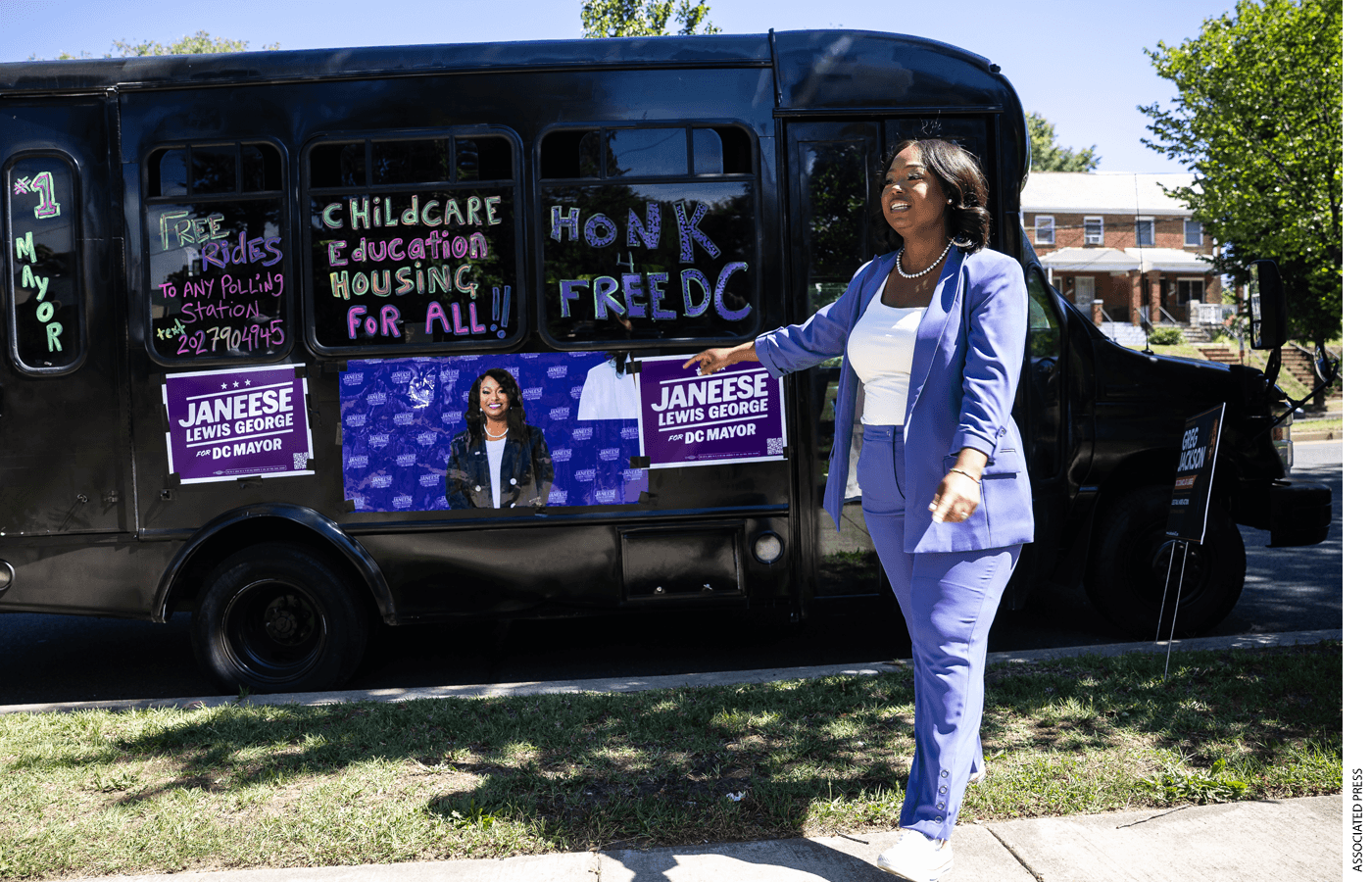
“Quality education starts with people, so it’s important to expand the workforce at schools to ensure there are enough professionals to meet the needs of all students. —Janeese Lewis George, Democratic nominee for mayor, Washington, D. C.
“I wouldn’t like it. . . Maybe we’ll take back Washington, run it on a federal basis. . . We’re not gonna lose our businesses.” —Donald Trump, President of the United States
Not all elected socialist Democrats are alike. To be sure, most join Bernie Sanders in his condemnation of billionaires, support for Palestinians, and enthusiasm for socialized medicine. They pay monthly dues to the Democratic Socialists of America (SDA), though they can customize their contribution to as little as a dollar at a time. But Democratic Socialists, once elected, must act under the constraints of office. Mayors cannot do much to turn billionaires into paupers, return land to Palestinians, or fix an over-bureaucratized medical system.
Almost all mayors, socialist or not, share power with governors and state legislators who respond to distinctly different constituencies. New York City’s Zohran Mamdani cannot impose a special income tax on billionaires without the approval of the state. He is not in charge of the public transit system—that is the job of a regional entity. Only the State of New York can extend rent control to more housing units inside the Big Apple. State law governs the formation and closure of charter schools and protects schools that use exams as a basis for admission.
Mamdani is also constrained by New York’s powerful business and investment sector, which threatens to leave town when radical proposals are voiced and contributes heavily to political campaigns, including those of state legislators, many of whom come from upstate New York and have little appreciation for Manhattan’s Democratic Socialists.
Mamdani appoints the commissioners of the police and fire departments as well as the chancellor of the public school system. But state laws limit the actions these agencies can take. It is an exaggeration to say Mamdani’s job is limited to adding more bicycle-bus lanes, overseeing the city’s sanitation and sewer system, and endorsing other SDA candidates. But like the socialist mayors of Milwaukee, who in the early 20th century built the country’s finest sewer system, Mamdani has focused on enhancing city operations, not social transformation. He is still in his first year, but thus far the New York City mayor can still be complimented for being a sewer socialist.
Not so Janeese Lewis George, the Socialist Democrat destined to become mayor of the District of Columbia. When she takes office in January 2027, she will be able to exercise, under the Home Rule Act of 1973, both the powers of a mayor and those of a governor. Unlike Mamdani, she need not bend to the wishes of a state legislature hostile to progressive projects.
Lewis George can also ignore the business community, mainly because the private sector is limited to hotels, restaurants, lawyers, and K-Street lobbyists. The operations of federal agencies are largely locked into place. The core of the District of Columbia is more likely to continue to gentrify than be hollowed out.
District authorities do share power with the federal government. Their taxation and expenditure policies must be approved annually by Congress, and the federal government can block local action at any time. But Lewis George has less to fear than it might seem. Given the polarized climate that divides Capitol Hill, nothing can be passed by Congress and signed by the president unless both political parties embrace the law. Republicans have nominal control of both ends of Pennsylvania Avenue, but it takes but a few wayward Republicans in the House for Democrats to block the majority, and Senate filibuster rules preclude one-party action on just about everything. The annual budget is largely an extension of past practice, and rules constrain what can be done via reconciliation procedures.
Lewis George’s main obstacle will be President Donald J. Trump. Once the Socialist Democrat takes office, a donnybrook seems nearly inevitable, as neither side has much to lose from an unconstrained brawl. Trump can only strengthen his position vis a vis Republicans by picking a fight with a black Socialist Democrat. Lewis George can solidify her power within the District by taking on a MAGA president. As the cage fight intensifies, Democrats in Congress and across the country will roar racism. When Trump issues executive orders overruling District action, the District will file lawsuits that wander through the courts.
At risk is the learning of children attending public schools in the District of Columbia. Over the past two decades, student achievement in the capital has leaped forward at a time when declines have been registered nationally. In 2007, the average achievement of District students on the National Assessment of Educational Progress (NAEP), the Nation’s Report Card, trailed the national average by 23 points in reading and by 25 points in math—roughly three years’ worth of learning. By 2024, District students had closed that gap to just 5 and 7 points in the two subjects, respectively. As schools improved, student enrollments rebounded from their nadir of just above 70,000 in 2007 to nearly 100,000 in 2026.
EdNext in your inbox
Sign up for the EdNext Weekly newsletter, and stay up to date with the Daily Digest, delivered straight to your inbox.
The gains can be attributed to a set of school reforms put into place when Mayor Adrian Fenty, elected in 2008, appointed Michelle Rhee school chancellor. She replaced the standard “step-and-lane salary schedule” based on years of experience and education degree with an opportunity to attain a triple-digit salary if excellence was demonstrated in the classroom. Teachers could choose either a red path that kept the existing salary schedule or a green one that paid exceptional teachers a large jump in salary. Union leaders within the District and across the country provoked an uproar, inducing Fenty’s defeat and forcing Rhee’s resignation.
Despite the controversy, the essentials of the Rhee reforms have remained intact to the present day. In a peer-reviewed article, a notable research team shows the advances on the NAEP may be attributed to the reforms. The head of a D.C. think tank, Thomas Toch, calls it “one of the most important reform success stories in the country, in part because the city has continued to do well by its students.”
The Washington affiliate of the AFT is nonetheless demanding abandonment of the merit pay plan, and if Lewis George remains faithful to the philosophy of the SDA that has sponsored her rise to power, she will acquiesce to its demands. “We have a much friendlier and more listening ear,” says Laura Fuchs, the local AFT president. “What Janeese represents, in so many ways, is that she takes us seriously and believes we are partners.” Lewis George has yet to commit herself to the union position, but if the AFT gets its way, the merit pay plan in the District could be dismantled. Trump might try to intervene, but expect union leaders and Democrats across the country to rush to her support.
A child-injurious brawl need not happen. A Mamdani-like resolution is possible. Lewis George may resist union pressure—she has already indicated her support for charter schools—and she could choose to cooperate with the president on his efforts to beautify public spaces and forgotten fountains. The Trump-Mamdani accommodation observable in New York could repeat itself in Washington, D.C. It is not too late for Lewis George to subordinate the philosophy of the SDA to the interests of the District. Sewer socialism can happen in the nation’s capital just as it once did in Milwaukee and now seems likely in New York.
That is the hope of this long-time political scientist and school reformer. But I’ve been around long enough to recognize when politics is pointing in another direction. The kindling for a political firestorm has been laid along the Potomac.
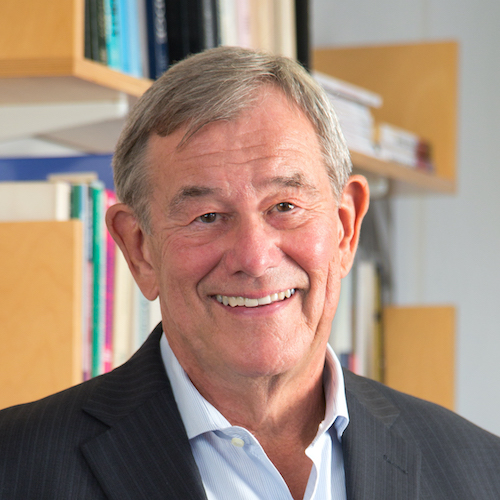
Paul E. Peterson is the Director of the Program on Education Policy and Governance and the Henry Lee Shattuck Professor of Government at Harvard University, and a Senior Fellow at the Hoover Institution. He is the writer of the Substack “The Modern Federalist,” from which this post was adapted.