



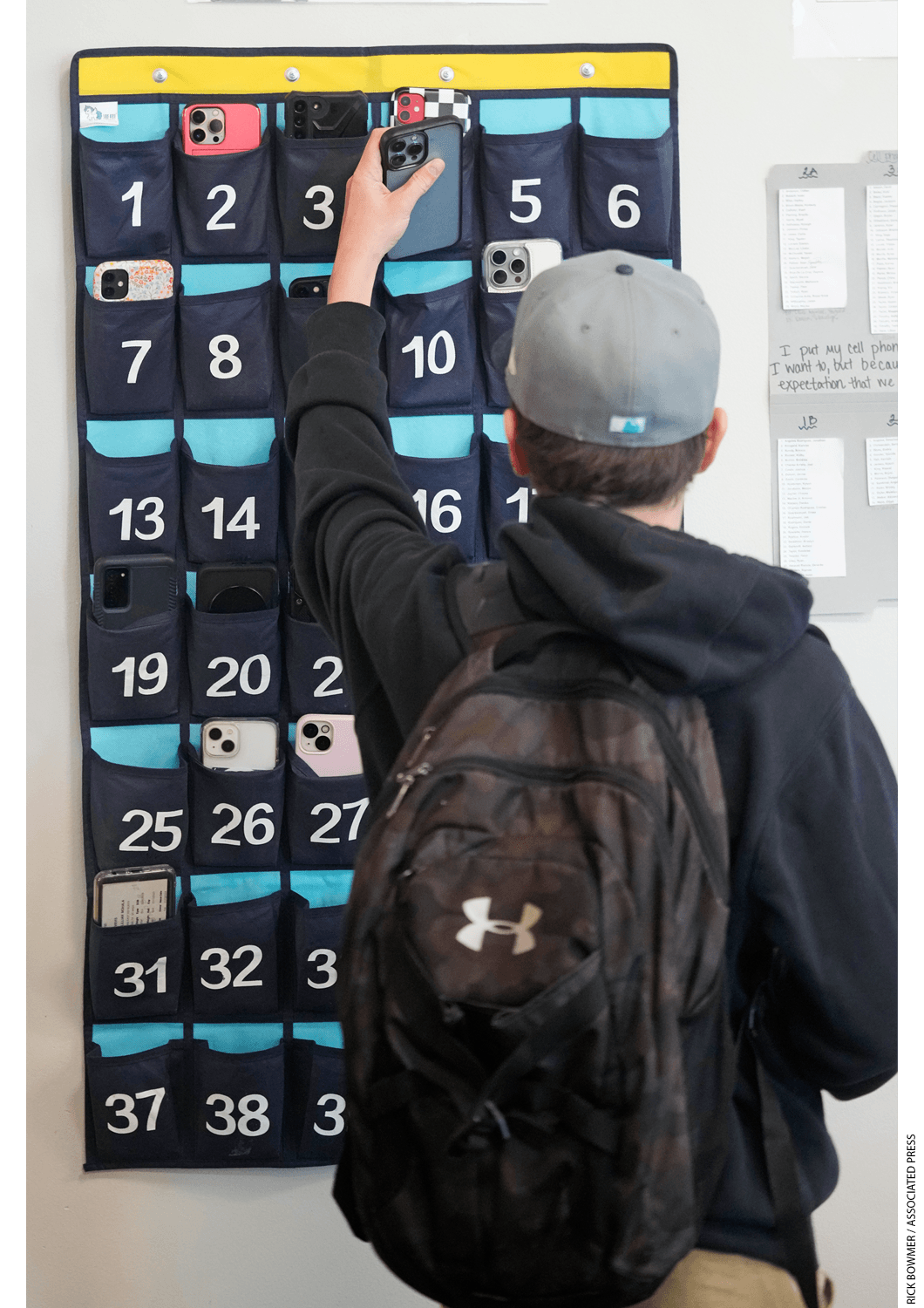
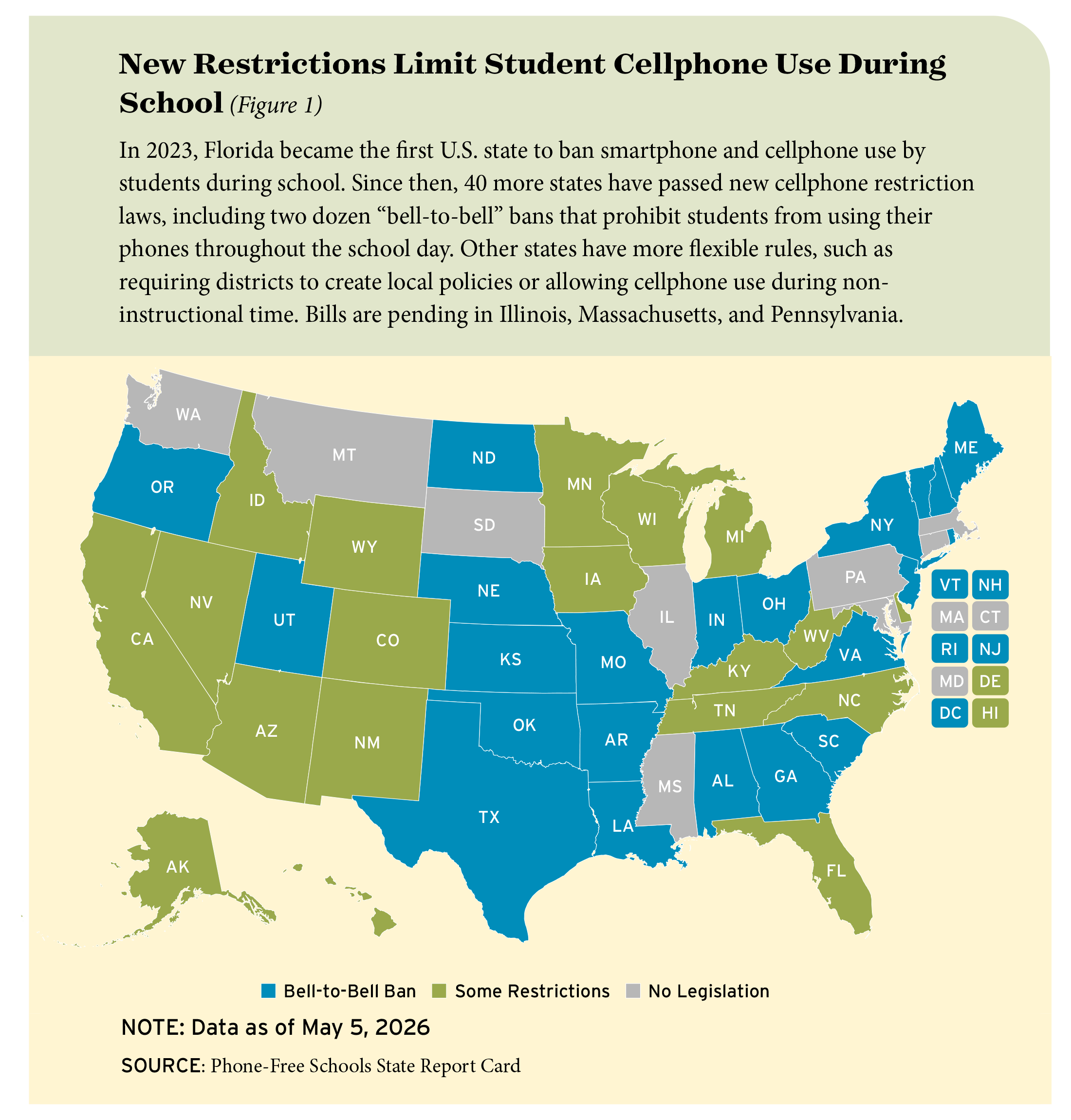
Schoolwide cellphone limits are quickly becoming the norm across the United States. In the past few years, 22 states and the District of Columbia have passed “bell-to-bell” laws, which prohibit students from accessing cellphones throughout the entire school day (see Figure 1). Another 19 states have passed more flexible laws, which leave the rulemaking up to local districts or allow cellphones during noninstructional time. Legislation banning or restricting phone use is currently under consideration in Illinois, Massachusetts, and Pennsylvania.
These policies are popular with educators (see “Take Away Their Cellphones,” features, Fall 2022). A 2024 survey by the National Education Association found that 90 percent of teachers favor banning cellphones during class and 83 percent support stricter, bell-to-bell restrictions. A 2025 survey by the RAND Corporation found that 70 percent of school principals—and 81 percent of middle and high school principals—believe cellphone bans have a positive impact on school climate. However, bans are less popular with students. (Perhaps not surprisingly, that same RAND survey found that just one in 10 students supports banning cellphones in school.) They are also controversial among parents, many of whom cite safety concerns. In a 2024 survey by the National Parents Union, 56 percent of parents said students should sometimes be allowed to use their phones at school.
Missing from these debates is evidence of a ban’s impacts on student learning. We bring such evidence to bear from Florida’s first-in-the-nation statewide cellphone ban, adopted in May 2023. That law banned cellphones during instructional time but allowed local districts to impose additional restrictions according to their needs; a 2025 Florida law instituted a bell-to-bell ban in elementary and middle schools. Our study looks at one of the nation’s 10 largest districts, where local leaders imposed a “bell-to-bell” ban that prohibits using phones, earbuds, and smartwatches throughout the entire school day, including noninstructional time. We track changes in test scores, attendance, and disciplinary incidents and use geolocated cellphone-use data to observe changes in student cellphone use during the school day. Finally, we compare outcomes at schools that had the highest and lowest level of pre-ban student cellphone use to estimate the causal effects of the ban.
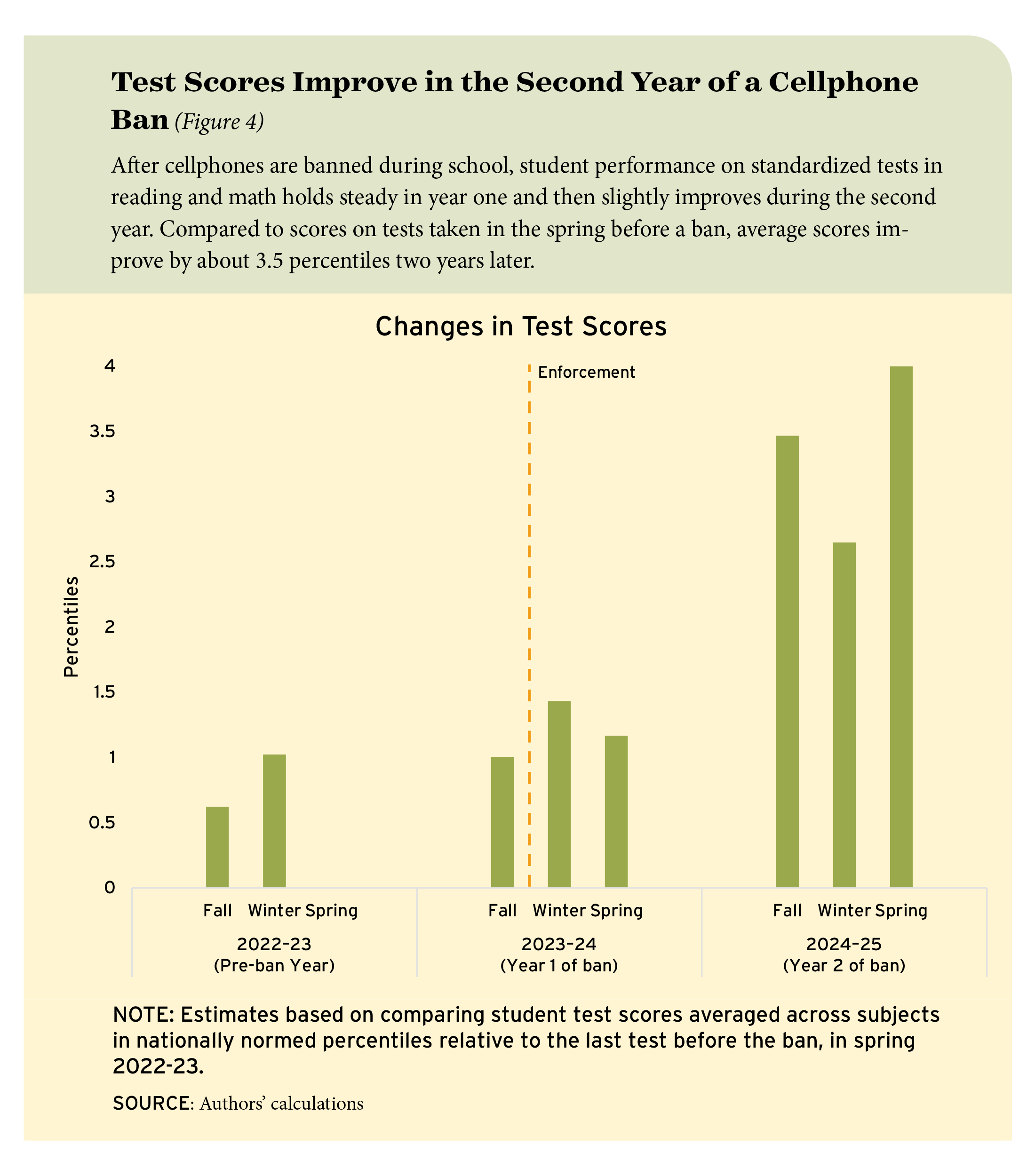
We find that prohibiting cellphone use works: Among high school students, daily cellphone visits fell by more than 80 percent after the ban was imposed. However, we also find a temporary spike in suspension rates in the ban’s first year: The overall suspension rate jumps by 25 percent, with the biggest impacts on Black students. At schools with high levels of pre-ban cellphone use, the rate of in-school suspensions for Black students increases by 30 percent, while rates for white and Hispanic students remain steady. However, disciplinary rates return to pre-ban levels in the second year, and student performance on reading and math tests improves. By the end of the second year, scores are up by about 3.5 percentiles compared to scores from May 2023, the end of the pre-ban year. Schools with the highest pre-ban cellphone use experience the largest positive impacts.
Finally, we look at trends in student attendance and find significant reductions in the number of unexcused absences in both the first and second years after the ban. The changes are especially large at middle and high schools, providing suggestive evidence that improved student engagement and school climate could be important factors behind the observed test score benefits.
Overall, our findings reveal that cellphone bans improve student outcomes, but these benefits come at the cost of temporarily elevated suspension rates when the new rules are first enforced. As states and school districts nationwide seek a reset on student cellphone use, the challenge is to minimize short-term adverse effects until a new cellphone-free status quo is established.
A “Teachers’ Bill of Rights”
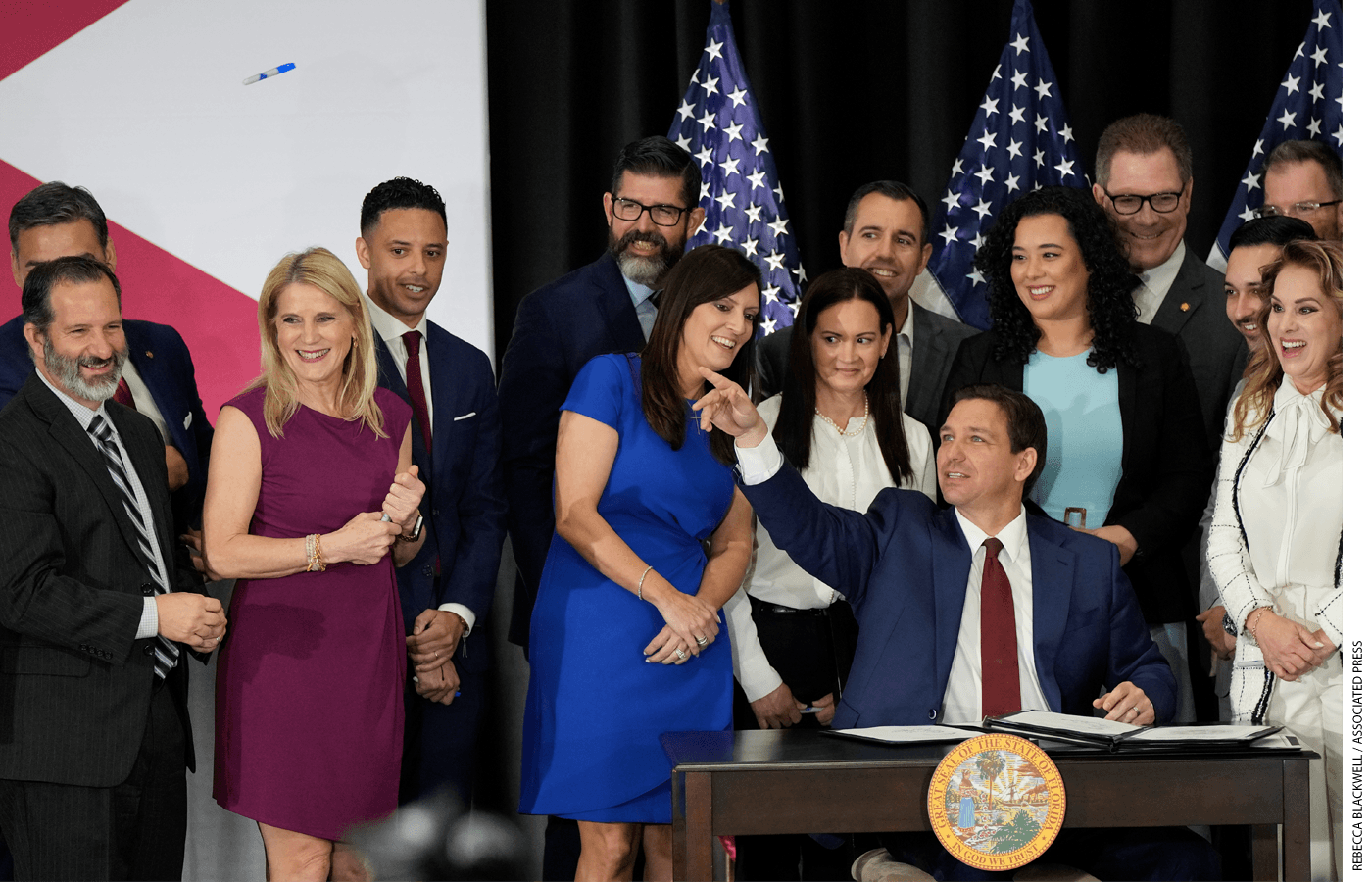
In 2023, Florida Governor Ron DeSantis signed House Bill 379, one of a set of state education laws known as the “Teachers’ Bill of Rights.” The measure established new rules for Internet safety, required districts to educate students about the risks of social media and block access on school devices, and prohibited students from using wireless communication devices, including phones, watches, and earbuds, during instructional time unless directed to do so by a teacher for educational purposes.
The large, urban district that we study took an even stricter approach, setting a bell-to-bell policy requiring that wireless communications devices be silenced and put away in students’ bags during the entire school day, including lunch and while transitioning between classes. In keeping with the statewide law, students with special needs were allowed to use their devices to monitor a documented health condition. In the case of a schoolwide emergency, students were allowed to take out and use their devices.
The new rules were in effect at the start of the 2023–24 school year and enforced after a short grace period. Starting after Labor Day, if a student violated the rules, their device was to be confiscated and returned at the end of the day. In addition, the student could be punished, including being suspended from school.
This new ban occurred in a context in which cellphones—and in particular, smartphones—have become pervasive in American middle and high schools. In 2024, 95 percent of teenagers and 57 percent of children aged 11–12 had their own smartphone. Those figures have risen rapidly over the last decade; in 2015, just 67 percent of teenagers owned a smartphone.
During that time, incidents of depression and anxiety among adolescents have soared. The share of high school students who report experiencing persistent feelings of sadness and hopelessness increased to 40 percent in 2023 compared to 30 percent in 2013. These trends have triggered public debates about the causal link between the rise in smartphone use among adolescents and decline in their wellbeing. Rigorous evidence about this causal link remains scant. Still, many argue that the adverse effects of smartphones on social isolation, sleep deprivation, and attention fragmentation are responsible for the observed declines in adolescent outcomes (see “No Simple Answer for Kids and Screens,” reviews, September 2025). There is indeed descriptive evidence suggesting that prolonged use of smartphones in children and adolescents are associated with higher rates of anxiety and depression, body dissatisfaction and eating disorders–especially among girls—sleep issues, and cyberbullying.
The potential link between smartphones and student achievement is also a growing area of concern (see “Anxiety, Depression, Less Sleep … and Poor Academic Performance?” what next, Winter 2024). In 2024, 12th-grade reading scores on the National Assessment of Educational Progress (NAEP) fell to a 30-year low, with nearly one-third of students scoring in the lowest “Below Basic” category. Scores had peaked in 2009. And on NAEP student surveys in 2023, the share of 13-year-olds who say they read for fun “almost every day” was about half of what it was a decade earlier: 14 percent compared to 27 percent in 2012.
Estimating Impacts of a Ban
Our study focuses on a three-year period: one year before the ban (2022–23) and the first two years under the new rules (2023–24 and 2024–25). We look at detailed student-level data, including test scores in grades 3–10, disciplinary incidents, and absences, and track outcomes over time relative to the start of the ban. We also investigate differences by student demographics, gender, and grade level.
While the ban was in place at the start of the 2023–24 school year, disciplinary enforcement did not begin until September. Our analysis tracks changes in student performance and suspensions throughout each school year. Florida administers state tests in August/September, December, and May, which allows us to observe student achievement three times a year. Further, we observe the date of each disciplinary incident, which reveals how disciplinary incidents and suspensions changed immediately after the district started referring students for disciplinary action for cellphone-use infractions and whether those changes persisted throughout the year.
In addition to tracking changes descriptively over time, we also compare outcomes at schools based on their relative levels of student cellphone use before the ban. We use detailed smartphone activity data from Advan, a private research firm that tracks foot traffic using point-of-interest coordinates. We look at building-level data from January 2023 to December 2024, focusing on the average number of unique smartphone visits (pings) between 9am and 1pm on school days in the last two months of the 2022–23 school year (right before the ban took effect) and the first two months of the 2023–24 and 2024–25 school years. To disentangle student activity from the smartphone activity of teachers and staff, we subtract the average number of unique smartphone visits between 9am and 1pm on teacher in-service workdays in the same school year, when students are not present, from the average when school is in session. We then sort schools into three groups based on student cellphone use and compare outcomes for those in the highest and lowest groups, allowing us to estimate the causal effects of a cellphone ban.
Results
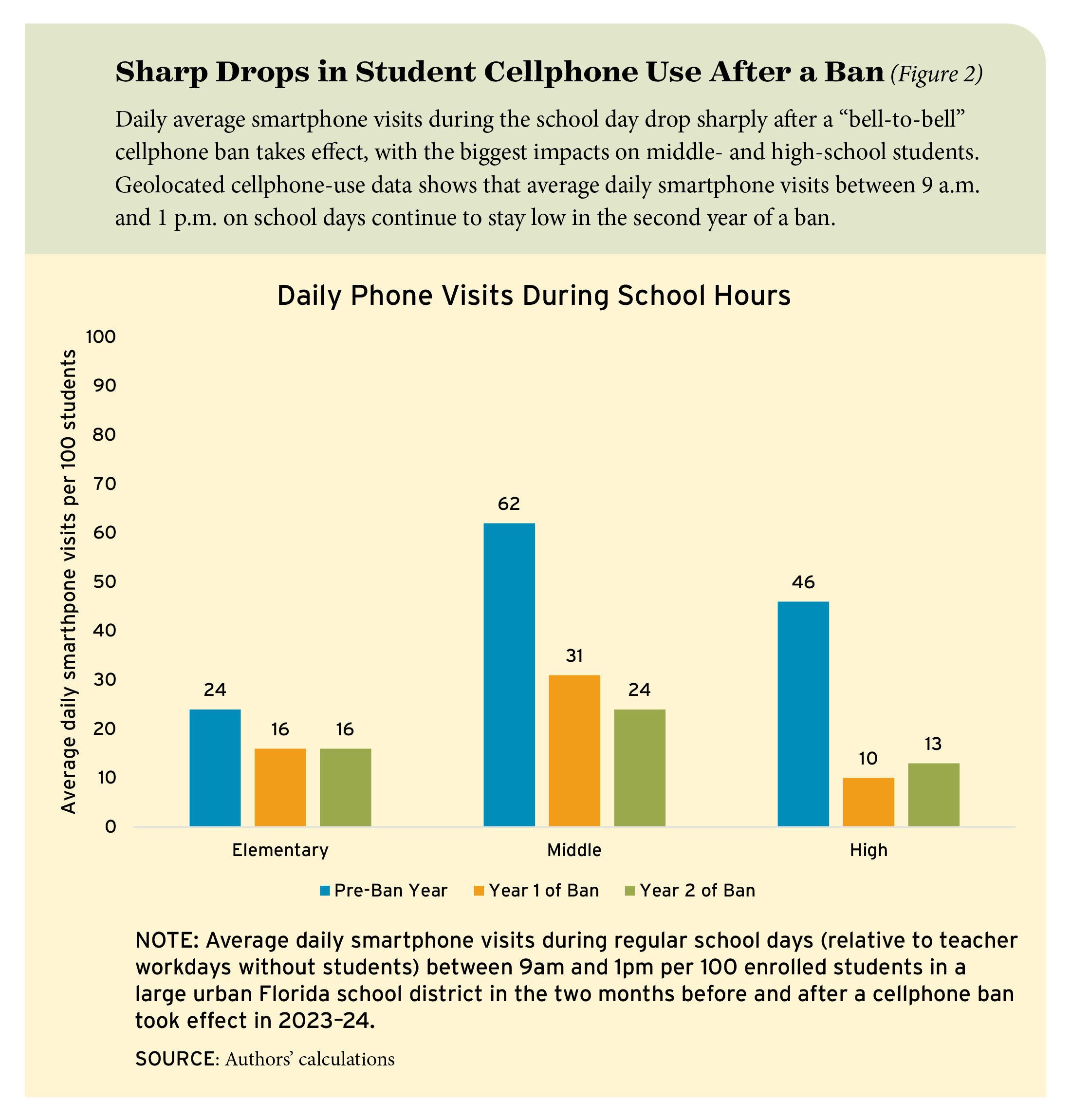
After a “bell-to-bell” cellphone ban takes effect, students are dramatically less likely to pick up and use their phones at school. Looking at cellphone-use data during school days, we find steep declines in the average daily phone visits per 100 students in year one (see Figure 2). In high school, cellphone use drops by more than 80 percent, from 46 daily visits per 100 students to 10. In middle school, cellphone use falls by half, from 62 daily visits to 31. In year two, middle school visits continue to fall another 23 percent, to 24 daily visits per 100 students, while high school use ticks slightly upward to 13 visits per 100 students.
Discipline
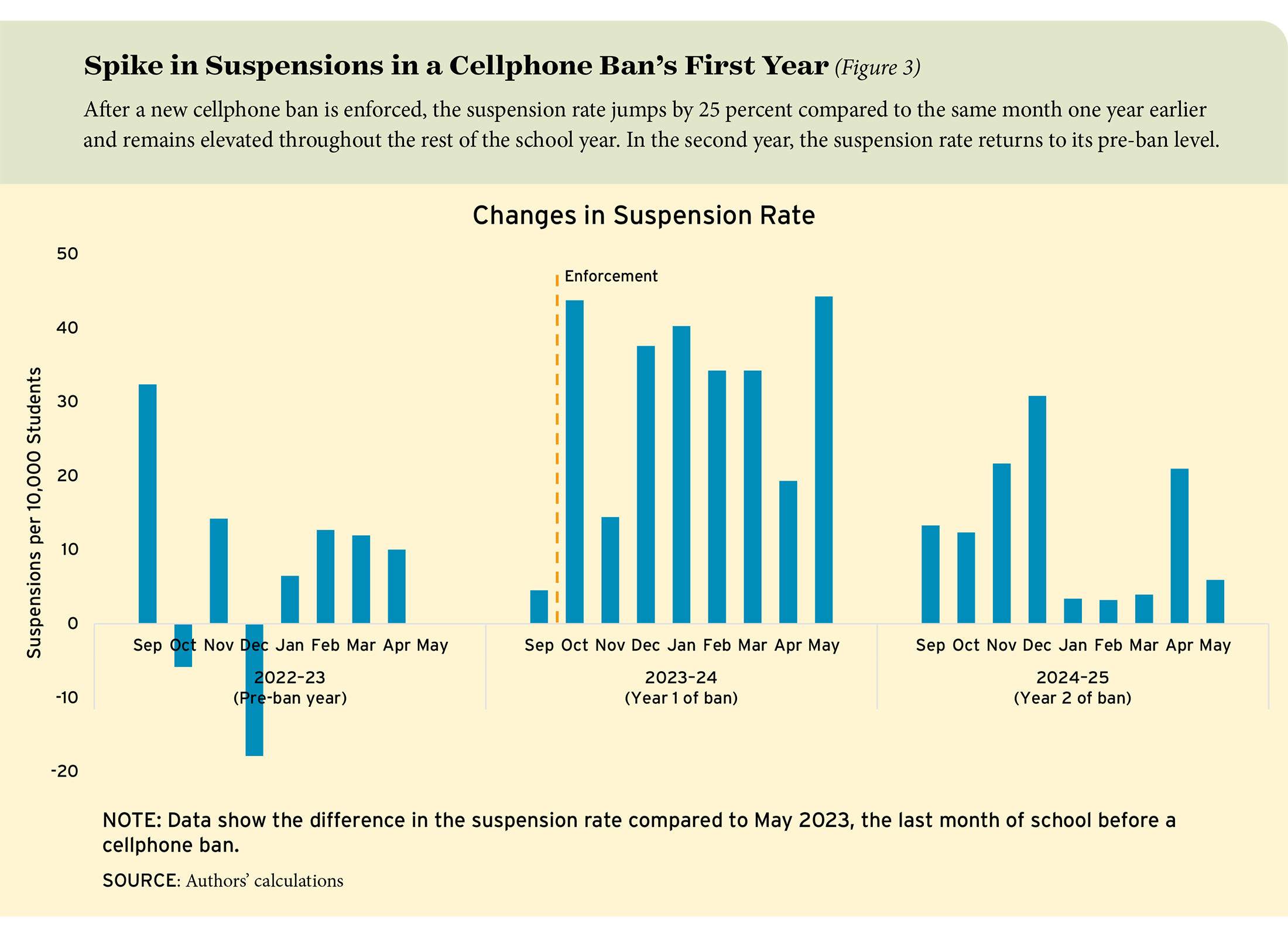
In the short term, we find a significant spike in the rates of disciplinary incidents and suspensions (see Figure 3). Once a new ban is enforced, the suspension rate jumps by 25 percent compared to the same month one year earlier and then remains high throughout the first year of the ban. In the second year, discipline and suspension rates return to pre-ban levels.
The temporary increase in disciplinary sanctions districtwide as the cellphone ban was implemented provides suggestive evidence that the ban led to more students being punished. To strengthen the case that the ban was responsible for the jump, we investigate differences in disciplinary actions and suspensions at schools that had relatively high and low cellphone use before the ban. We make these comparisons separately for students grouped by race and gender. This shows that Black students experience the most substantial increases in disciplinary referrals immediately after a cellphone ban. In the first year, a cellphone ban increases in-school suspensions by roughly 30 percent for Black students but has no significant effect for white and Hispanic students or on out-of-school suspensions. These effects disappear in year two.
Academic achievement
Our analysis also looks at student performance on standardized tests, which students in Florida take three times each year. We average results across subjects and report changes in nationally normed percentiles. Scores remain stable in the first year of a cellphone ban but improve modestly in year two (see Figure 4). Overall, at the end of the second year of a cellphone ban, scores are up by about 4 percentiles compared to the final tests administered during the pre-ban year.
EdNext in your inbox
Sign up for the EdNext Weekly newsletter, and stay up to date with the Daily Digest, delivered straight to your inbox.
We then again compare changes at schools with especially high and low pre-ban cellphone activity, which confirms that students in high-use schools made the largest improvements. We look at spring tests, which are used for school accountability and high-stakes student-level decisions such as grade promotion and future course placement. Compared to improvements in schools where cellphone use was less frequent before the ban, we find a cellphone ban in high-use schools increases test scores by 1.1 percentiles overall, 1.2 percentiles for Black students, 1.4 percentiles for white students, 1.4 percentiles for male students, and 1.3 percentiles for middle and high school students. We do not find any significant effects for female students or for students in elementary school.
Attendance
To what extent can these positive effects on test scores be driven by the potential effects of the ban on school climate and student engagement? We use student attendance as a proxy and focus on unexcused absences. The results indicate that the ban reduced the number of unexcused absence days by 5 percent to 10 percent, driven primarily by students in middle and high school. We find no significant effect on student absences in elementary schools. The ban’s effect on unexcused absences in middle and high schools is large enough to explain nearly half of the positive effect on student test scores, though it’s important to note that the change in absences may reflect many other unmeasured dimensions of school climate.
Potential and Pitfalls for Phone-Free Schools
Many frustrated parents and teachers have wondered what would happen if cellphones disappeared overnight. Our study looks at the most likely realistic version of that fantasy, and one that will be in place in half of all U.S. states in coming years: a bell-to-bell cellphone ban enforced through disciplinary referrals. We find that this type of ban can work—students in the Florida district we study were far less engaged with their phones during the school day, with phone visits among high school students plunging by 80 percent in the first year. Students also experienced benefits from this major change in behavior. Within two years, they earned higher test scores and were less likely to be absent.
These findings paint a picture of a policy that improved the student learning climate, at least after a period of transition. However, enforcing the ban also led to a spike in disciplinary actions, and the largest effects were for Black students. While this effect disappeared by the second year, these findings should inform states and districts introducing cellphone bans and the schools tasked with implementing and enforcing them. Amid a nationwide surge of policies and soon-to-follow wave of implementation, decisionmakers should investigate practices to ensure a smooth and equitable implementation period.
David N. Figlio is the Gordon Fyfe Professor of Economics and Education at the University of Rochester. Umut Özek is a senior economist at the RAND Corporation.
Suggested citation format:
Figlio, D. N. and Özek, U. (2026). “Can Banning Cellphones Save Student Learning? Evidence from Florida, home of the first statewide mandate.” Education Next, 26(2), 12 May 2026.