


Standardized testing plays an important role in American education. National and state tests make it possible to compare academic achievement across schools, identify gaps, and track progress over time. However, many of the skills that families and employers say they want students to have, especially soft skills, decision-making, and intellectual curiosity and grit, are hard to capture in a short, fixed-response format.
One practical way to teach and assess those skills is structured debate. Debate guides students to make a claim, support it with evidence, and engage seriously with counterarguments, while also providing an entertainment catalyst to drive engagement.
Because debate takes a lot of work to execute, applying it at scale is difficult. Organizations like the National Association for Urban Debate Leagues help expand opportunities, but many students are not exposed to debate or opt not to participate in it as an extracurricular program. Enter Artificial intelligence. AI has the potential to facilitate debate-centered instruction, mitigate the high costs of participation, and improve students’ learning experiences during the school day. Testing remains essential to learning and assessment, but AI could become a complementary tool for cultivating reasoning and communication skills in the classroom.
The Need for a New Learning Model
In many classrooms, student assessment still centers on questions that can be graded quickly and consistently. That structure is understandable but can leave little room for activities that require students to explain their thinking in full sentences and revise their views in light of new information. Debate can help fill that gap. It has long been a powerful way to build cognitive flexibility and communication skills. Yet many students engage in debate only as an extracurricular option rather than a standard component of learning.
International organizations, such as UNESCO and their 2030 framework, have urged schools to invest in honing skills like critical thinking and collaboration because students will face complex social and economic challenges as adults. But access to structured argumentation remains uneven. Schools with more resources are more likely to offer debate programs, while students in rural or low-income communities often have fewer opportunities for sustained practice in reasoned discourse.
While debate-centered instruction has traditionally been constrained by the cost of scaling across students, augmenting the pedagogy with AI would allow teachers to run structured debates more often and use the resulting student work as one input into a broader picture of learning. AI can support the teacher before class, during discussion, and after class. The key design choice is that the teacher sets the goals, the rules, and the norms, while AI handles some of the repetitive preparation and summarization work.
Here are four ways AI can make debate-based instruction more feasible, along with reasons to be cautious about how it is used:
1. A practice partner, not a substitute for peers. An AI tool can pose questions to students, ask them to clarify a claim, and prompt them to consider an alternative explanation. Used well, AI can help students arrive to class better prepared for a face-to-face discussion. Used poorly, it can crowd out the social learning that comes from engaging with other students. Schools should treat AI as a tool for preparation and evaluation, not the main event.
2. Step-by-step support for different skill levels. Teachers often face a wide range of confidence and skill in one classroom. AI can respond to that variation by generating custom sentence starters, examples of evidence, and progressively harder follow-up questions. Personalization makes it easier for hesitant students to participate while still challenging advanced students to refine their reasoning.
3. Better exposure to counterarguments. Students learn more when they must respond to thoughtful objections. AI can help a teacher assemble a balanced set of counterpoints quickly that includes perspectives students might not encounter in their immediate community. Because AI systems can generate errors or misleading claims, teachers should anchor debates in vetted materials and make source checking part of the exercise.
4. Feedback teachers can use, with clear limits. AI tools can summarize a debate, flag where evidence is missing, and highlight patterns in student reasoning that a teacher might miss in real time. That can save time and help target instruction. AI should not be treated as an authoritative grader. Teachers remain the final arbiters of student performance, and schools should be transparent about what student data is collected and how it is used.
How AI Can Reduce Screen Dependence
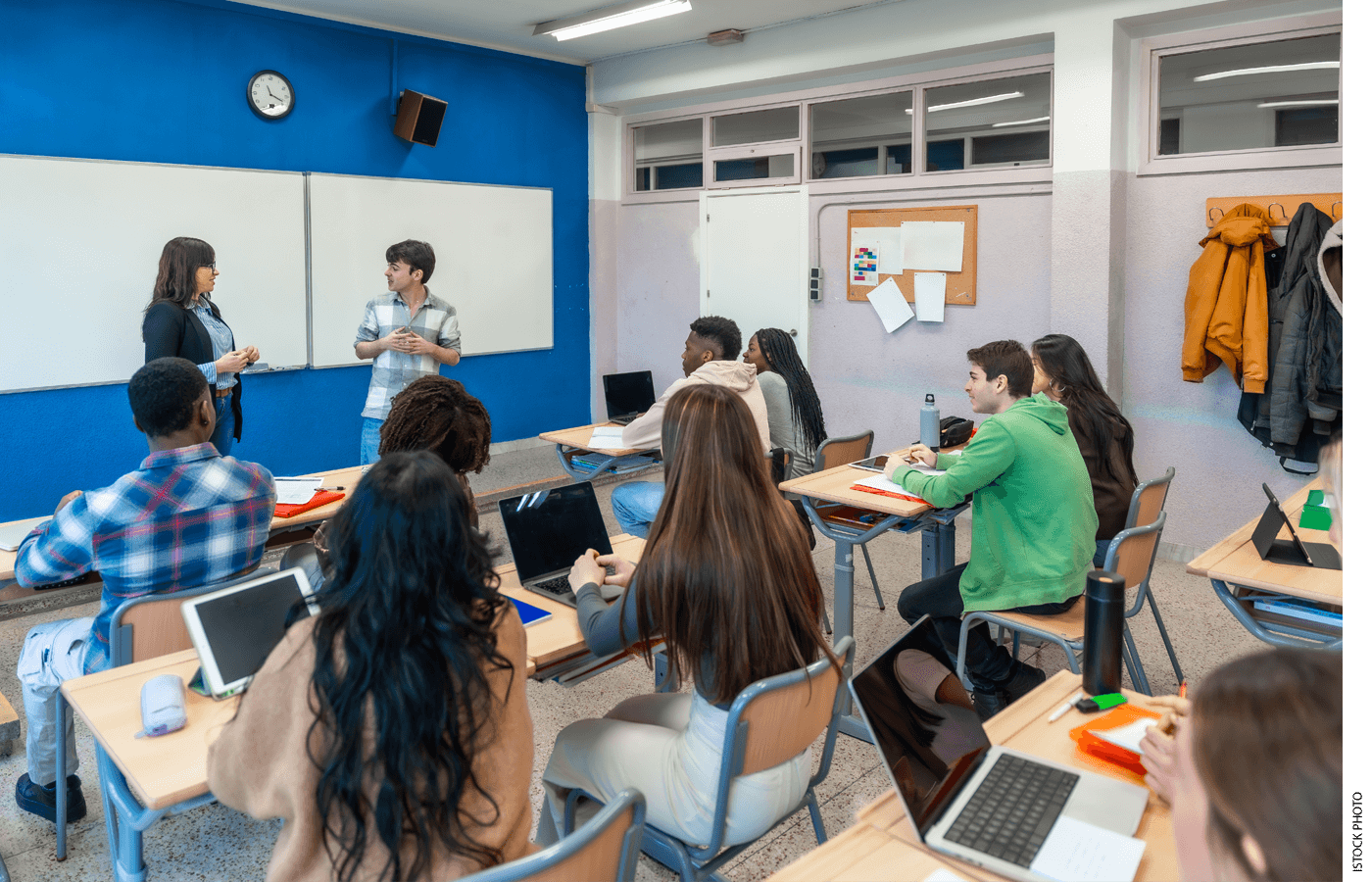
One concern about classroom technology is that it can increase students’ time on screens and shift their attention away from discussion. Debate-centered instruction offers a useful counterweight to this wariness because debate is, at its core speaking, listening, and reasoning in person. Schools can also design AI-supported debate in a way that keeps devices closed during class.
In a limited-screen version of augmented debate-centered instruction, the teacher uses AI before class to draft a debate prompt, assign roles, and prepare a short packet of readings or evidence. Students annotate those materials on paper and engage in preliminary debate in small groups or as a whole class. After class, the teacher can use AI to organize students’ notes, summarize what claims they made, and identify common gaps to address in the next lesson. Although debate would be facilitated through an AI-supported platform, and the resulting exercise would occur with the help of software and hardware, the final result would be more social interaction and less dependence on technology.
EdNext in your inbox
Sign up for the EdNext Weekly newsletter, and stay up to date with the Daily Digest, delivered straight to your inbox.
Consider a middle school civics lesson on whether cities should restrict short-term rentals. Students receive a reference sheet of evidence and then open an AI-supported debate platform that assigns roles and keeps time. As students speak, the platform provides quiet, student-specific prompts on screen such as “State your claim in one sentence,” “Cite one piece of evidence from the sheet,” or “Answer the strongest objection you just heard.” Students who need more structure see more prompts. Students who are better prepared see fewer. The teacher circulates and listens. After the debate, the platform generates a brief, student-level report aligned to a simple rubric: clarity of claim, use of evidence, engagement with counterarguments, and civility as defined by class-specific norms. The teacher reviews it, makes judgments where needed, and uses the results to plan a short follow-up writing task that asks students to revise their position based on the best opposing argument they encountered.
What Debate-Centered Learning Builds
Debate pushes students beyond passive recall and toward higher-order thinking. When students argue a position, they practice organizing ideas, choosing relevant evidence, and anticipating challenges. Over time, debate can improve skill transfer because students develop a general method for weighing evidence and revising stances rather than memorizing a single answer.
Debate also strengthens communication. Students must listen closely, speak clearly, and respond under time pressure. The value of this skill-building is supported by longitudinal research. A ten-year study of the Chicago Urban Debate League found that students who participated in policy debate were more likely to graduate high school and scored higher on standardized reading and writing assessments than non-debaters. These gains persisted after controlling for prior achievement and socioeconomic background, suggesting debate had a unique impact on academic skills. Participants also reported greater resilience and academic self-efficacy, consistent with the idea that regularly defending and revising arguments builds perseverance.
Under transparent rules and clear norms, debate can also develop social and civic engagement. Students learn to separate a person from an idea, critique claims respectfully, and treat disagreement as a normal part of learning. In polarized environments, practicing structured disagreement can help students engage contrary viewpoints with curiosity rather than contempt.
Expanding Access to Debate
A major appeal of AI-supported debate is that it can affordably offer argumentation practice to more students. Historically, rigorous debate training has been concentrated in selective programs or well-resourced schools. If AI reduces preparation time, more teachers can incorporate short debates into existing units in English language arts, history, science, and civics.
Of course, implementing AI-supported debate is not automatic. Schools need training, clear formats, and strong classroom norms. But the potential is real in three areas:
1. Wider reach. Teachers in rural and urban schools alike can use AI to generate debate prompts, role cards, and evidence packets that match their curriculum and context, even when local coaching expertise is limited.
2. Flexible formats. Debates can be short and frequent—such as five-minute claim-and-rebuttal exercises—or longer, structured exchanges that span an entire class period. They can also be oral, written, or mixed, depending on student age and classroom goals.
3. Bridging opportunity gaps. Lower-income schools often face staffing shortages, fewer enrichment opportunities, and limited resources for extracurricular activities. If teachers can integrate argumentation into regular instruction with modest added cost, more students can build the skills that debate programs have long delivered to a smaller subset.
Debate-based instruction is not new, but as a means of equipping and evaluating students it can complement the tradition of standardized testing. Tests remain useful for education systems to assess what students know and can do. The question is how they can strengthen the parts of learning that are hardest to measure at scale, like students’ ability to reason through contested questions and communicate their views clearly.
AI-supported debate is one promising tool. When designed carefully, it can help teachers run structured discussions more often, give students more practice responding to counterarguments, and reduce in-class screen time by shifting AI work to preparation and reflection. Given the ubiquity of AI, including in schools, the question is no longer whether to use it but how it can augment the learning experience. Debate provides a natural use case and has the added benefit of improving the way instructors assess competency over an array of metrics.
The most sensible path is to pilot this method, measure its impact on student writing and reasoning, and adopt clear guardrails on accuracy, privacy, and the role of teacher judgment.
Christos A. Makridis is an associate professor at Arizona State University’s W. P. Carey School of Business and Digital Fellow at Stanford University’s Digital Economy Lab.