




Based on media accounts and the rhetoric of politicians, one might think teachers are fleeing their profession in droves, whether because they are underpaid, overworked, or simply dissatisfied.
Like most good stories, this one holds some kernels of truth. For example, high-quality surveys from RAND find that teachers report higher levels of job-related stress and burnout than other working adults.
And yet, the objective data on teacher behavior tell a rather different story. Contrary to warnings of a profession in decline, schools employ more teachers than ever, both in raw numbers and especially in per-student terms. Moreover, teachers aren’t “fleeing” the profession under any normal definition of the word. According to the most recent federal data, just 8.4 percent of K–12 teachers who taught in 2020–21 left the profession before the start of the next school year. Broken out by school type, the rate was a bit lower for public school teachers (7.9 percent) and a couple points higher for those working in private schools (11.7 percent).
How do these rates of teacher turnover compare to workers in other fields? In a 2007 study, Doug Harris and Scott Adams found that teachers behaved similarly to other well-educated professionals. They reported that teachers had lower rates of turnover compared to social workers, about the same as accountants, and slightly higher than nurses.
With all the shifts in education policy over the last two decades, not to mention Covid-19 and other societal changes, do these patterns still hold? How does teacher turnover compare to other professions today?
To tackle these questions, we set out to replicate and update the Harris and Adams analysis. Using the same methodology, we compiled national data spanning more than 40 years. We find that, while there have been some fluctuations year to year, the rate at which teachers leave the profession has been remarkably stable through the decades. Teachers continue to leave their chosen profession at lower rates than social workers leave theirs. Teacher turnover also looks pretty similar to the rate at which nurses leave nursing and is close to the rate at which accountants leave accounting.
In short, policymakers should understand teacher turnover as similar to that of other well-educated professionals—that is, relatively low. As such, policymakers would be better off isolating trouble spots in specific districts, schools, and subjects, and responding accordingly, rather than treating turnover as a generic problem. Similarly, rather than seeing turnover as something that should be avoided at all costs, policymakers should pursue strategies to enhance teacher quality by rewarding the best teachers over efforts to retain all teachers regardless of skill and effectiveness.
Turnover in Teaching Is Comparable to That of Other Professions
How extensive is teacher turnover? That’s a question that needs to be addressed relative to turnover in other professions. In their 2007 paper, Harris and Adams attempted to do so by comparing teachers with college-educated workers in similar fields—nursing, social work, and accounting. Nursing and social work both have “caretaking” aspects and, like teaching, are dominated by women. Accountants were and remain less likely to be unionized, and they earn higher weekly wages.
While none of the three comparison groups offer a perfect parallel to teaching, they are all highly educated professions that require some form of license or certification. Perhaps because of the time and investment these workers have put into preparing for their careers, they have lower turnover rates than other workers. Within education, for example, teachers tend to have lower turnover rates than staff members whose roles do not require a college degree or a professional license.
Our data come from the Current Population Survey (CPS) conducted by the U.S. Census Bureau and the U.S. Bureau of Labor Statistics. This ongoing survey asks people to report both their occupation in the current week and their primary job one year prior. The category of “teachers” includes both public and private school teachers, although public school teachers make up the bulk of the respondents. Survey results from the National Center for Education Statistics (NCES) suggest that private school teachers are several percentage points more likely to leave the profession than those who work in public schools.
We use the CPS survey to calculate our own estimates of turnover rates, essentially measuring the percentage of people in a given profession who leave it over the course of 12 months. This calculation does not include what NCES calls “movers”—teachers who switch to a new school or district. Because CPS sample sizes can be small, especially among the non-teaching professions, we follow the same procedure as Harris and Adams and pool the data across 10 years.
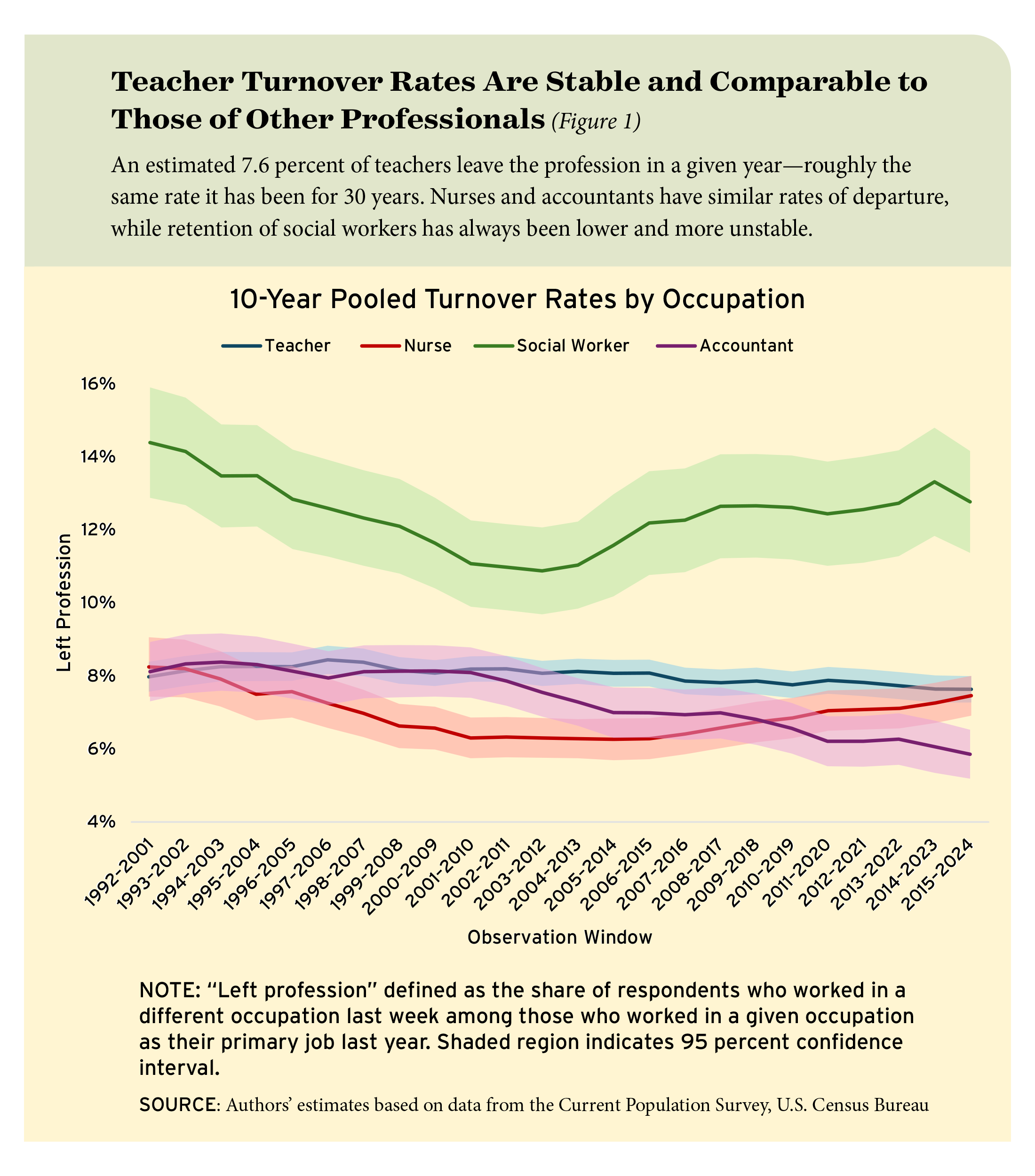
From the most recent data, which combine results from 2015 to 2024, we estimate that 7.6 percent of teachers leave the profession in a given year. This rate has remained relatively stable over time, and teachers continue to leave their profession at about the same rate as nurses (see Figure 1). Turnover rates among accountants have declined by a couple percentage points over time, while the rate for social workers has gone up and down but has been consistently higher than the turnover rate for teachers.
While we prefer the pooling method for comparing turnover, we also looked at the annual turnover rates for the four professions. Given the smaller sample sizes, the annual results are noisier than the 10-year pooled numbers, especially for social workers and accountants, but this approach allows for a more detailed look at specific years over more than four decades. We know of very few sources of data that can track teacher turnover over such long periods of time. Notably, Dan Goldhaber and Roddy Theobald have collected data on teacher turnover in Washington state going back to the mid-1980s, and they found that the rate of teachers leaving the state’s public schools has ranged from about 6 to 8 percent since that time. Even when including teachers who stay in the profession but change schools, they find that total turnover rates have remained within a relatively narrow band from about 14 to 20 percent.
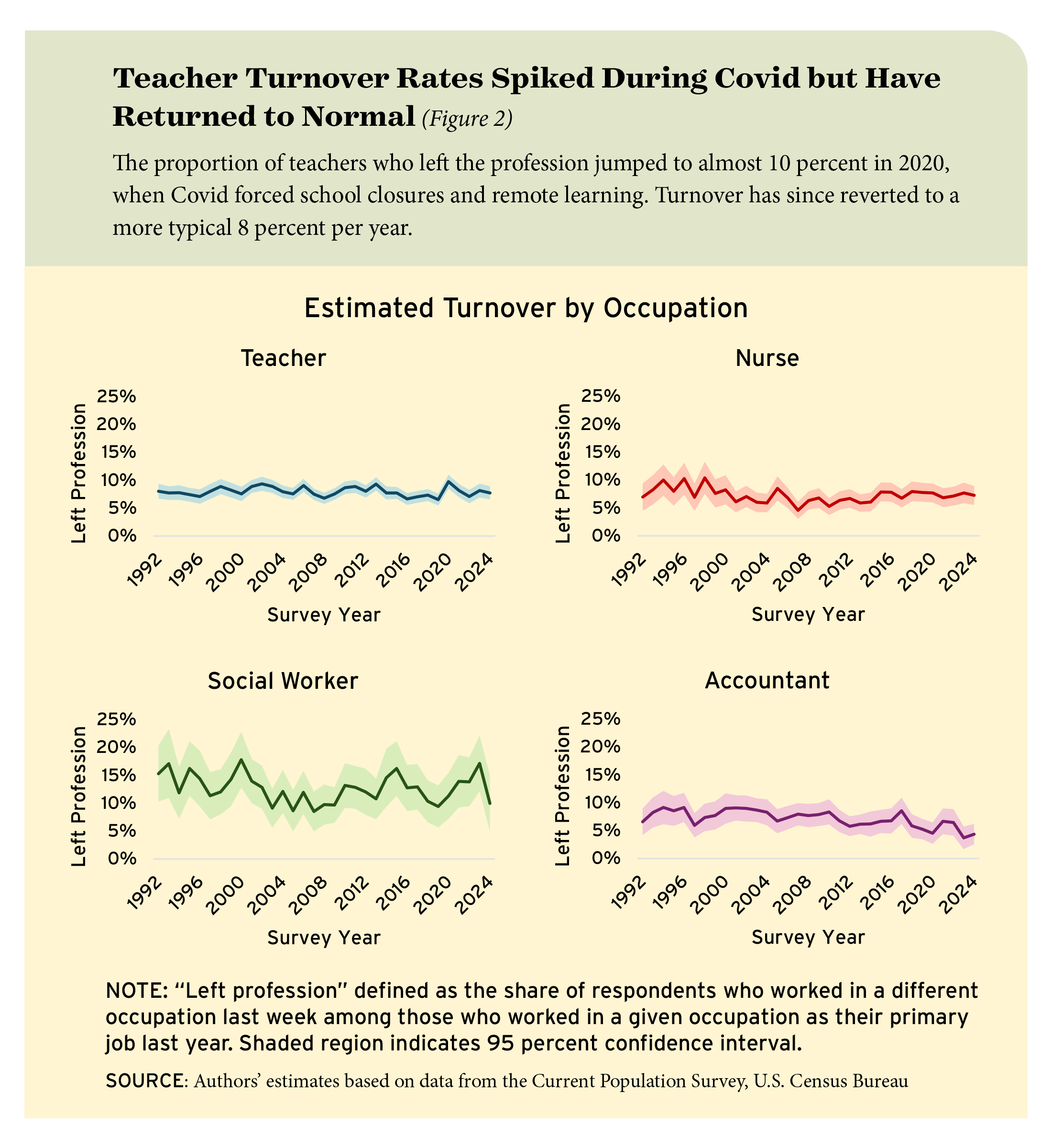
The CPS data do not allow us to consider people who switch jobs within their chosen profession, but they do suggest that stability within the teaching profession is a national phenomenon. Figure 2 shows those results, with the lines indicating the estimate for each year and the gray bands representing a 95 percent confidence interval. For teachers specifically, a notable uptick in turnover occurred in the Covid era, with the percentage of people leaving the profession rising from 6.5 percent in 2019 to 9.8 percent in 2020. But, like other federal and state data sets, the CPS data indicate that teacher turnover rates have already come down from that post-Covid spike. The most recent one-year rate shows that 7.7 percent of teachers in the CPS sample left the profession from 2023 to 2024.
These numbers capture the turnover rate across all members in a given occupation, regardless of their age or experience level. However, the composition of the members of a given occupation can change over time in ways that could affect and potentially distort the overall turnover rates. For example, teacher turnover tends to follow a U-shaped pattern, with higher turnover in the early years of an educator’s career, low turnover in mid-career, and higher rates again as workers near retirement age. And indeed, as University of Pennsylvania professor Richard Ingersoll has documented, the teaching profession has changed in important ways. It has become “grayer,” in that today’s teachers are on the whole more likely to be older, and “greener,” in that teachers are less experienced, than teachers of the 1980s and 1990s. These underlying trends could affect the overall turnover rates.
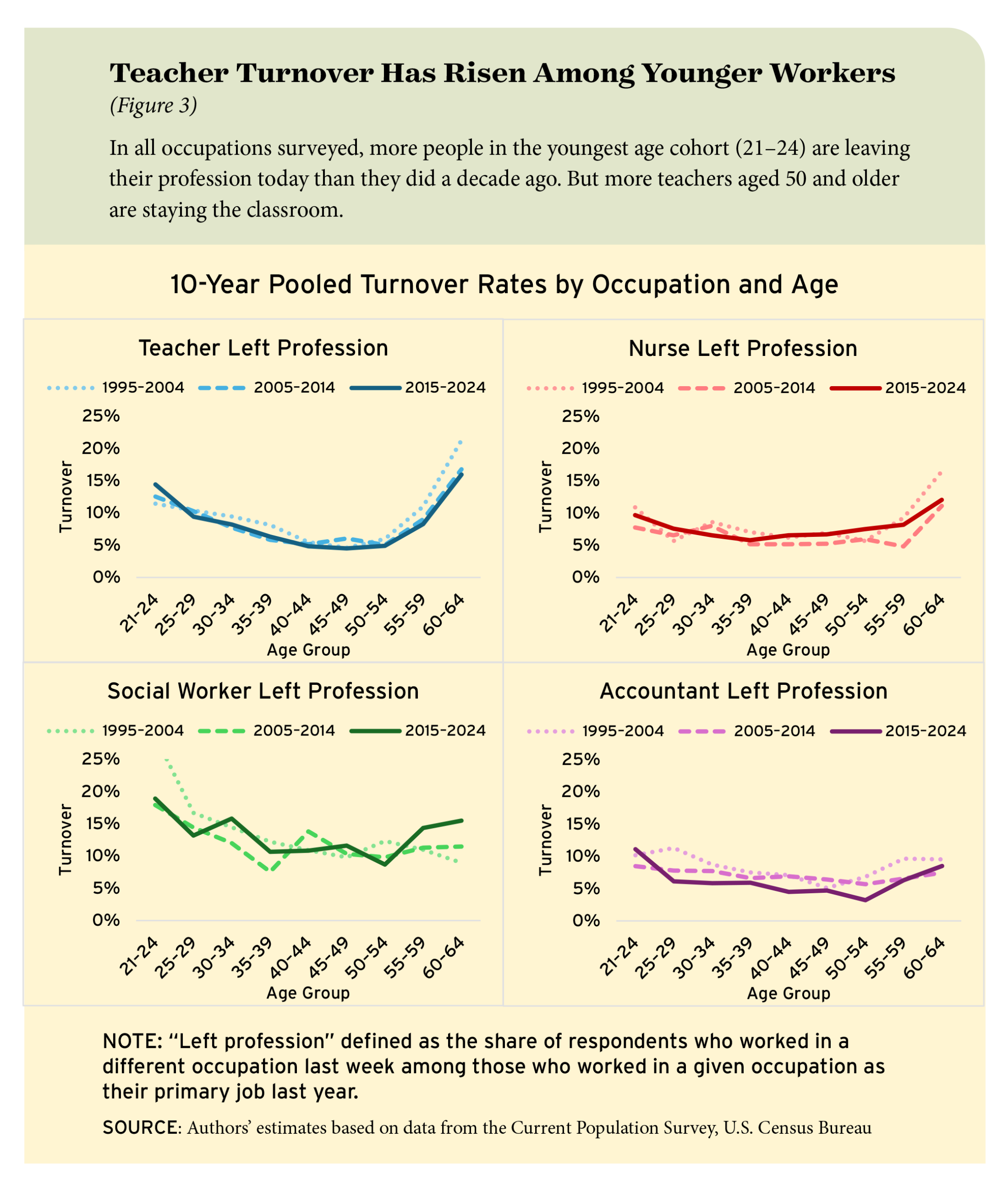
The CPS survey does not ask people how long they have been working in their given occupation, but it does ask their age. To examine how these age trends have changed over time, we compared three non-overlapping 10-year periods: 1995–2004, 2005–2014, and 2015–2024 (see Figure 3). Slicing the turnover rates in this way reveals that older teachers have become slightly less likely to leave the profession in recent years than they were in the 1990s. Meanwhile, the youngest teachers—those in their early 20s—have become progressively more likely to leave, though only to a small degree.
Looking at the comparison occupations, older nurses, like older teachers, have become less likely to leave the profession than they were in the 1990s. We do not observe the same changes among social workers or accountants. The age-related data also allow another way to compare professions. As the charts show, teachers have a more noticeable U-shaped turnover curve than the other professions do. For example, teachers in their 40s are actually less likely to leave than nurses of the same age, but younger teachers (those in their 20s) and older ones (those in their early 60s) are 3 to 5 points more likely to leave than nurses of the same age are.
The CPS data also allow us to look at specific types of turnover. That is, did the worker leave their occupation for a different one (switchers); did they leave as they search for new work (becoming unemployed); did they leave the labor force; or did they retire? For these trends, we examine teachers in isolation.
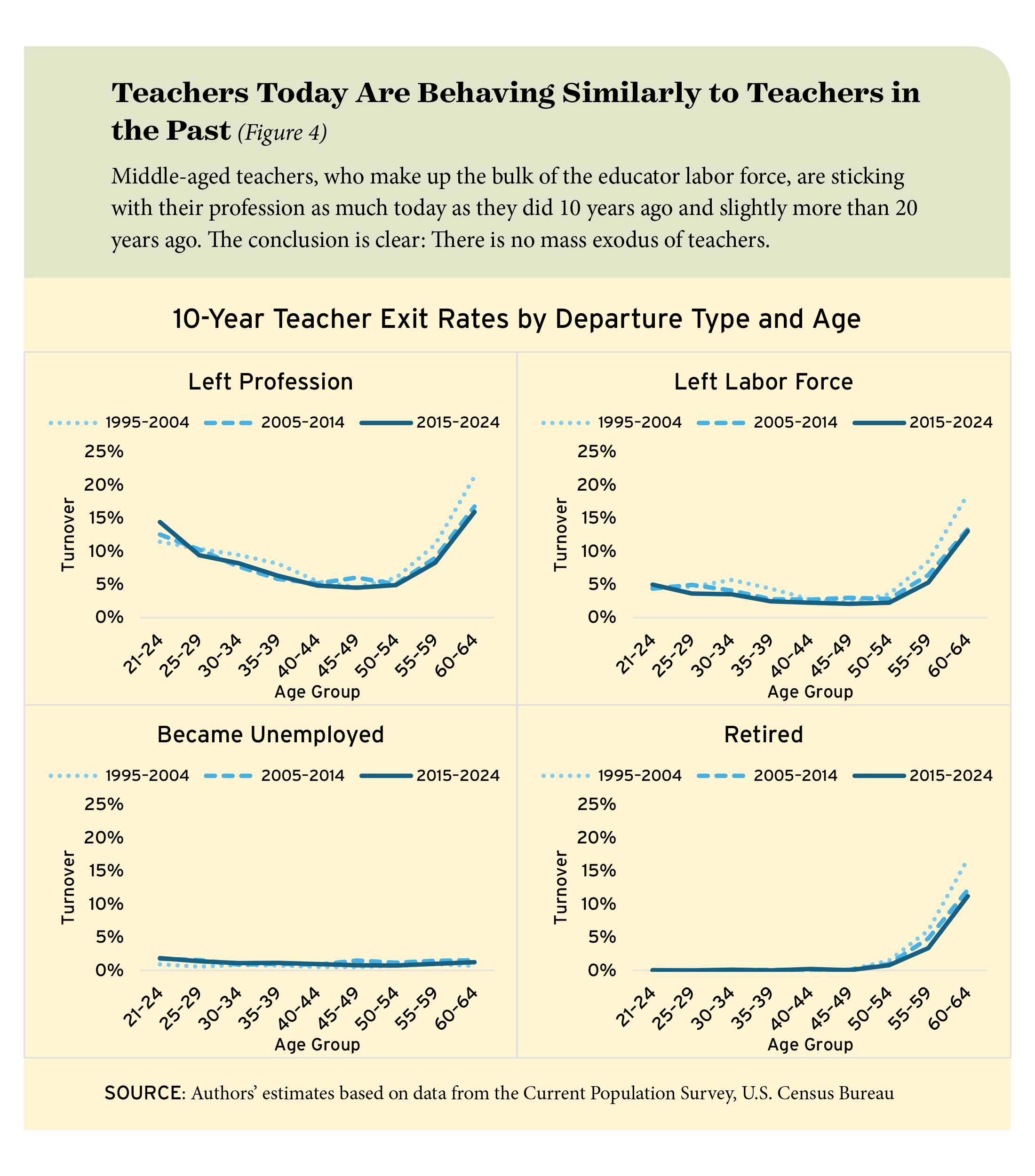
Figure 4 breaks down teacher turnover rates by age and type of departure. Unemployment rates for ex-teachers remain low across time and age ranges, with perhaps a slight uptick among the youngest teachers. But there are three more notable trends. One, the increase in turnover among the very youngest teachers really does seem to be driven by people switching careers (top left chart of Figure 4). The 21- to 24-year-old bucket is the smallest of our age categories, but it does show increased turnover rates over time. Two, the decrease in turnover among older teachers is evident across all departure types except becoming unemployed. Fewer older teachers are switching careers, leaving the labor force, and officially retiring.
Three, it’s worth pausing to focus on teachers in their 30s and 40s, who make up the bulk of the teacher labor force. As these charts show, the behavior of today’s teachers has changed remarkably little compared to their peers in the 1990s and early 2000s. Middle-aged teachers are not leaving the profession in large numbers.
Accurate Conceptions of Teacher Turnover Matter
The popular press and politicians often frame teacher turnover rates as unsustainably high and harmful to both kids and the systems that employ them. This narrative gained momentum in the wake of Covid-19, as observers worried that elevated turnover might become a permanent fixture of the education landscape.
According to information from the Current Population Survey and other sources, these fears are largely unfounded. The assumptions that teacher turnover rates are abnormally high or increasing over time are not supported by the data. It appears that the Covid spike was temporary, as turnover rates have returned to their pre-pandemic levels.
EdNext in your inbox
Sign up for the EdNext Weekly newsletter, and stay up to date with the Daily Digest, delivered straight to your inbox.
It is true that teacher turnover can cause harm. It can negatively affect students in that they’re more likely to be assigned to novice teachers, who tend to be less effective in their first years in the job. Turnover also costs school districts money because they incur expenses when hiring a new teacher to replace a departing one. According to estimates from the Learning Policy Institute, it can cost a large district up to $25,000 to recruit, hire, and train a new teacher. Too much turnover can also harm a school’s internal culture and make it harder to implement school improvement initiatives, such as adopting a new curriculum or pursuing other turnaround efforts, which might be more efficiently achieved with a stable team.
It is important to note that our data reflect national averages, and teacher turnover is indeed much higher in some schools and districts that serve high-need, low-income students. Even though these schools are outliers, the high turnover in these places is something that policymakers might want to target and address.
But turnover can also have benefits. Teachers who leave the profession tend to be lower-performing than the ones who stay. When schools and districts toughen up their evaluation systems and practice selective retention, they can drive up those differentials even further and retain their best teachers while pushing out their lowest performers. Evidence from Washington, D.C., suggests that this type of churn improved the overall quality of the district’s teacher workforce because it was able to hire new teachers who were even better than the ones who left.
Moreover, though teaching experience does have value, not all teachers improve at the same rate, and some teachers who are new to the profession can outperform teachers with more experience. The goal for a district leader, then, shouldn’t be to eliminate all turnover, but to focus on retaining the most effective educators and those who work in the hardest-to-staff schools and roles.
Treating teacher turnover as a generic problem might lead state and district policymakers toward overly cautious and blunt policy decisions. It risks discouraging innovation in how teachers are prepared for the profession and how they’re paid and evaluated once in it. A more nuanced approach—one that prioritizes teacher quality over sheer quantity—can help school systems better serve both educators and students.

Chad Aldeman is an education writer and the founder of Read Not Guess. Samuel Yi is the founder of Clarifi Analytics and former talent strategist at San Antonio Independent School District and Teach for America.
Suggested citation format:
Aldman, C., and Yi, S. (2025). “Are Teachers Abandoning Their Profession in Large Numbers? On the contrary, data show teacher turnover remains consistently low.” Education Next, 25(4), 18 December 2025.