



While high school GPAs have been gliding upwards for years, college admissions officers have relied on Advanced Placement (AP) exams as a more stable, rigorous measure of college readiness. That confidence is now misplaced—at least for most of the exams that dominate the AP landscape.
The College Board has phased in a new scoring system that has inflated student results on nine of the most frequently taken AP exams. The share of students receiving the top score of 5 on these exams has jumped by an average of 61 percent in just four years. The share receiving a passing score (3 or higher) has risen by 37 percent.
Some less common AP exams still appear to function as reliable indicators of high academic achievement. But for the most popular exams, high school counselors and college admissions committees must go beyond a quick glance at the AP scores listed on an application. They now need to look closely at which AP exams a student took, and in which years.
Trevor Packer, the senior vice president in charge of AP programs, denies that any score inflation has occurred. He has described the claim that AP is being “dumbed down” as “entirely false.” This essay explains how the scoring system has changed, demonstrates that inflation has occurred, and shows why the official denials are misleading.
Why AP Matters
High performance on AP exams is an important way students signal readiness for rigorous college work:
- Scores of 5 on multiple tests serve as a positive signal that a student is prepared for admission to Ivy League and other highly selective institutions.
- Many selective but non-elite colleges award course credit or waive introductory course requirements for scores of 4 or 5.
- Most non-selective colleges grant credit for a passing score of 3 or higher.
The financial stakes are high. By substituting a high school AP course for a college course, students can reduce college costs and shorten their time to earning a degree. Reflecting this, more than 1.3 million high school students in 2025 paid a $99 fee for each of over 4.8 million AP exams.
Given these stakes, the integrity of AP exams depends on a scoring system that is stable across subjects and from year to year.
How AP Scoring Used to Work
Until 2022, the College Board used a relatively consistent procedure to set score distributions:
- Each AP exam was reviewed every 5–10 years by a panel of approximately 10 to 18 experienced college professors and high school teachers.
- These experts had deep subject-matter knowledge and a clear sense of what level of performance justified advanced placement in college.
- They determined what share of test takers should receive each of the five AP scores (1 through 5).
Under this system, the distribution of students awarded scores of 5, 4, 3, and so on was anchored to the standards of a carefully selected expert group and remained fairly stable over time.
The Shift to a New Scoring System
After 2021, the College Board began phasing in a different approach for nine of its most popular exams:
- English Language and Composition
- U.S. History
- English Literature and Composition
- World History
- U.S. Government and Politics
- Psychology
- Biology
- Human Geography
- Chemistry
Less commonly taken exams—such as Music Theory, Art History, Japanese, Italian, and Physics (Electricity and Magnetism)— continue to be scored under the traditional expert-judgment system.
What Happened to the Scores?
Under the new system, performance on the nine popular exams suddenly “improved” in ways that are historically unprecedented:
- Top score (5): The share of students earning a 5 increased from about 10 percent in 2021 to 17 percent in 2025, on average—a 61 percent increase. Under the old system, the share of 5s awarded in these subjects, on average, hardly changed over the previous six years.
- Top two scores (4 or 5): In 2021, just 28 percent of test takers received a 4 or 5 on these nine exams. By 2025, that had jumped to 45 percent, a gain of 17 percentage points—or a roughly 63 percent increase.
- Passing scores (3 or higher): The share of students receiving a 3 or better rose from roughly 52 percent to 71 percent over the same period, a 19 percentage-point increase—resulting in a 37 percent jump in passing rates.
Such large, rapid gains call for explanation.
Three Possible Explanations
Three broad explanations (or some combination of them) could account for this sudden surge in scores:
The test-taking pool became more selective. Perhaps weaker students stopped taking AP exams, leaving a stronger group of test takers.
This is easily rejected. Since 2021, the number of AP test takers has increased, not decreased. The pool has expanded rather than narrowed to a high-performing elite.
Teaching and learning improved dramatically. Perhaps teachers and students suddenly found far more effective ways to teach and learn AP material.
If students’ knowledge truly improved so dramatically, we would expect to see similar gains on other large-scale, independent tests. In fact, national and international data tell a different story:
- NAEP (National Assessment of Educational Progress) scores in 8th-grade math, reading, and science were already slipping before Covid and have fallen sharply since. 12th-grade math and reading scores also declined between 2019 and 2024.
- PISA (Programme for International Student Assessment) scores show stagnation in science and reading for U.S. 15-year-olds since 2015, and a decline in math.
These results provide no evidence of a sudden, broad-based leap in academic achievement. If anything, they point to stagnation and decline.
That leaves a third explanation.
The scoring system was relaxed. Perhaps a new evaluative approach altered the way tests were scored so that higher scores were given for the same level of performance. Let’s take a look.
Evidence-Based Standard Setting (EBSS): The New Method
After 2021, the College Board introduced what it calls “Evidence-Based Standard Setting” (EBSS) to determine score distributions on its most popular AP exams.
Under EBSS, the College Board consults hundreds of college instructors instead of relying on a small panel of carefully selected experts. These instructors are asked to recommend what proportion of students should receive each AP score.
In practice, the standards produced by this large, dispersed group are substantially lower than those set by the traditional expert panels.
The Impact of EBSS
With the implementation of EBSS, the share of passing scores rose sharply across the nine popular courses that that used it. The size of the increase varies by subject:
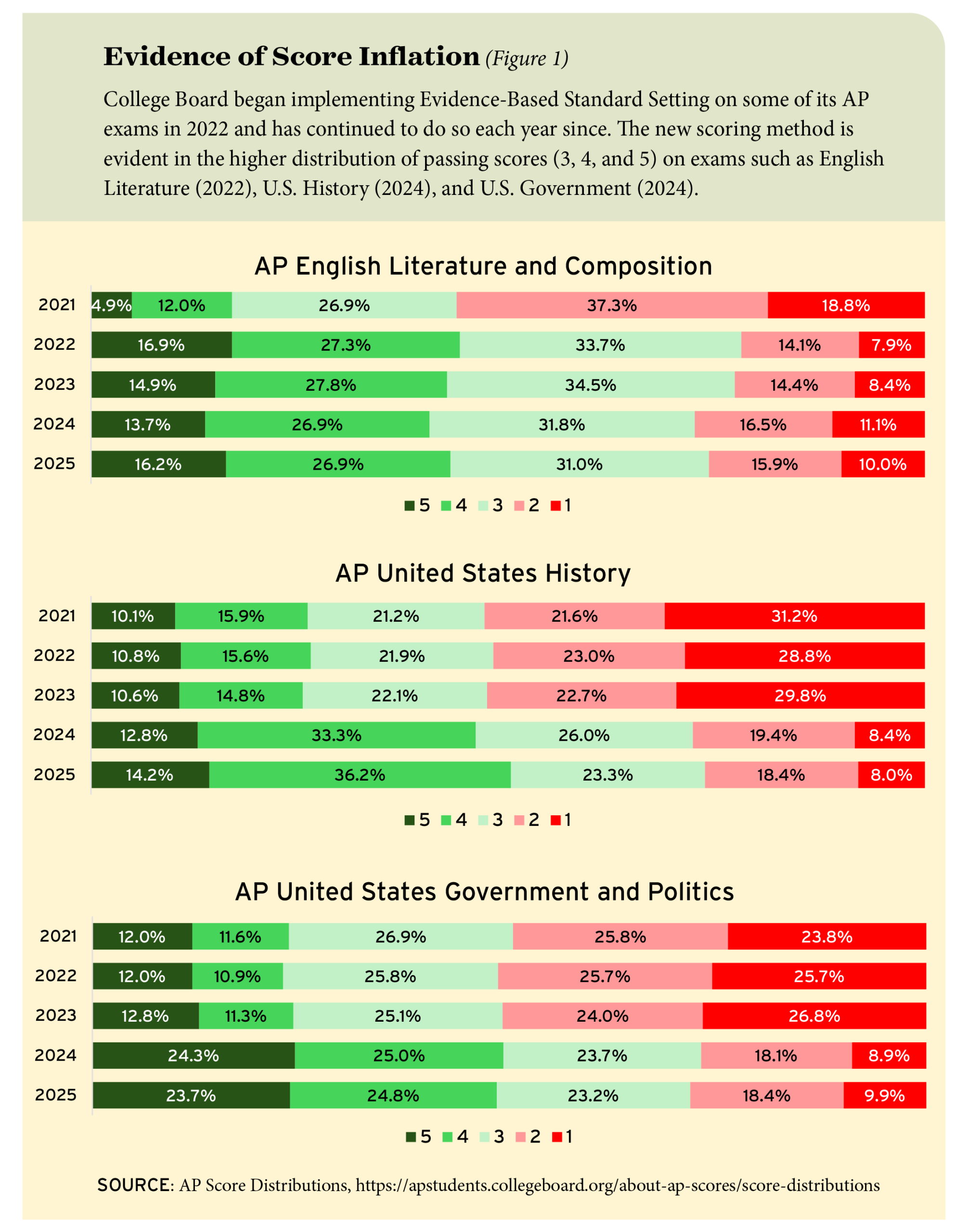
- In English Literature, U.S. History, U.S. Government and Politics, and, the share of 4s and 5s rose by 24 percentage points or more (see Figure 1).
- In Psychology and English Language and Composition, the increase was smaller but still substantial—about 9 or 10 percentage points.
- In each of the nine subjects, EBSS is associated with higher scores and higher passing rates between 2021 and 2025.
- The largest score increases on each exam within this period correspond to the specific year when EBSS was first applied.
These patterns are precisely what we would expect if the scoring standards had been relaxed.
Parsing the Official Denials
Trevor Packer insists there has been no “dumbing down” of AP exams, stating, “The exams themselves have not changed . . . Well-established equating processes ensure the difficulty of AP Exams remains consistent from year to year.”
This statement is technically correct but strategically framed. It emphasizes one piece of the puzzle (the difficulty of the test questions) while ignoring another (the conversion of raw test scores into AP scores).
Dumbing down does not require easier questions. It can be achieved just as effectively by changing how test scores are mapped onto the 1–5 scale—exactly what EBSS does.
According to one report of a public appearance, Packer acknowledged that the College Board aimed “to bring all exams to between a 60 and 80 percent success rate.” In 2025, the average passing rate on the nine EBSS exams was 71 percent, almost exactly the midpoint of that target range. EBSS appears to have been used to recruit scorers whose standards would produce the desired “success” rates.
Packer further claims that fluctuations in passing rates are driven by changes in student performance, pointing to recent declines in pass rates for AP Calculus BC, AP Statistics, AP Physics C: Mechanics, and AP Government and Politics courses. He neglects to highlight that:
- All but one of these courses have not been subjected to EBSS.
- For AP U.S. Government and Politics, the 2025 pass rate is only slightly below its 2024 level—after a 20 percentage-point increase following the adoption of EBSS.
The pattern is consistent: where EBSS is applied, scores rise substantially; where it is not, scores tend to reflect the stagnation or decline seen in broader national tests.
AP vs. IB and the Role of Marketing
To justify higher AP passing rates, Packer points to the International Baccalaureate (IB) program, where roughly 80 percent of candidates succeed. The comparison is misleading:
- IB is an integrated two-year program, not a set of independent single-course exams.
- Earning the IB diploma requires sustained performance across multiple subjects and assessments over time.
Nonetheless, the comparison reveals something important: the College Board is attentive to market positioning. If IB can boast an 80 percent “success” rate, AP’s passing rates must appear competitive to students, parents, schools, and policymakers.
Financial Incentives and Score Inflation
Market considerations are not incidental to the College Board. They are central to its operations:
- In 2024, over 86 percent of College Board revenue came from fees and similar payments, including 48 percent from the basic AP exam fee.
- In 2024, total revenues exceeded $1.17 billion, and the organization held reserves of over $2 billion.
Generous compensation at the top reinforces these incentives:
- The CEO received $2.3 million in total compensation in 2024, comparable to the pay of the president of Stanford University, though Stanford’s operating budget is about ten times larger.
- The second-in-command earned $1.5 million.
To sustain these revenues and salaries, the College Board must keep AP attractive to schools and students. Guaranteeing that more than two-thirds of test takers “succeed”—via relaxed scoring standards—serves that purpose well.
If this requires inflating AP scores, so be it. The more troubling question is why a senior vice president feels compelled to deny the inflation and to frame it instead as a story of scoring becoming “more precise.”
EdNext in your inbox
Sign up for the EdNext Weekly newsletter, and stay up to date with the Daily Digest, delivered straight to your inbox.
Implications for Admissions Officers and Counselors
For college admissions officers, high school counselors, and policymakers, several implications follow:
- AP scores are no longer directly comparable across subjects and years. A score of 4 in AP U.S. History today (post-EBSS) does not mean the same thing as a 4 in U.S. History before 2021, nor as a 4 in AP Music Theory (still scored under the old system).
- The most popular exams are the most inflated. The very tests taken by the largest number of students—those that dominate application profiles—are the ones whose standards have been relaxed.
- Context now matters critically. Evaluators should:
- Note which AP courses and exams a student took.
- Check the year(s) in which those exams were taken.
- Recognize that high scores on EBSS-affected exams are far less informative than scores on exams that retained traditional standard setting.
AP exams, once a gold-standard external check on grade inflation, now vary in reliability. Without close attention to subject and year, admissions decisions risk being distorted by hidden inflation.
Conclusion
The College Board’s shift to Evidence-Based Standard Setting for its most popular AP exams has produced an unmistakable pattern of score inflation, even as broader measures of student achievement show stagnation or decline. Official statements that “the exams themselves have not changed” hide the central fact: the scoring system has changed, in ways that dramatically raise reported performance.
AP remains influential in college admissions and credit decisions, but its signals are no longer uniform or stable. Those who rely on AP scores must recognize that some exam results reflect not a surge in student learning but a quiet lowering of the bar.
Paul E. Peterson is the Henry Lee Shattuck Professor of Government and Director of the Program on Education Policy and Governance at Harvard University. He is also a Senior Fellow at the Hoover Institution, Stanford University.