


In 2024, Laurence Holt of the XQ Institute wrote in this publication about “The 5 Percent Problem,” a term that quickly became common parlance within the ed-tech zeitgeist (see “The 5 Percent Problem,” features, Fall 2024). Holt argued that when it comes to measuring the student-learning outcomes of various ed-tech programs, the results often only apply to the 5 percent of students who “used the program as intended. The other 95 percent see minimal gains, if any.”
Holt’s primary focus was on online math programs, and the central concern running throughout his essay involves whether and how students might “get the recommended dosage” of using various ed-tech tools. Whether the problem arises from unmotivated students or unenthused teachers or disparate access to tech or some combination thereof, the challenge when framed this way is getting students to opt in to using a particular technology.
Generative AI does not suffer from this problem. Uniquely perhaps in the history of ed-tech, AI has been broadly embraced by students worldwide, to the point the phrase “AI is inevitable” has become commonplace in education discourse. There are pockets of resistance, of course, and over the last six months we’ve seen mounting opposition to AI across multiple vectors, most prominently with data centers. Nonetheless, we all know students are using AI frequently. “Dosage” is not an issue.
In the nearly four years since ChatGPT was commercially deployed, however, we have suffered from a lack of high-quality empirical research on the impact of students using generative AI. There are notable exceptions—such as these—but a recent research landscape analysis out of Stanford indicated that, out of more than 800 studies of AI in education, a mere 20 produced credible causal evidence. Meanwhile, at least one prominent meta-analysis purporting to show massive learning gains stemming from AI has been retracted, though not before being viewed 400,000 times. The field is a mess.
Perhaps this is because studying AI in “the real world” poses serious challenges. We know AI tools are free and widely available to students. We also know many are using them after school hours for various purposes, including to help with their schoolwork. But quantifying this is very difficult, because it’s hard to peer into the home lives of children. And it’s equally if not more challenging to connect out-of-school behavior to measurable learning outcomes; the data sets are not easy to link. Accordingly, research on AI’s education impact has tended toward lab studies or small-scale evaluations.
No longer.
Evidence of AI’s Impact on Learning
Recently, the study “The Generative AI Learning Penalty: Evidence from Chinese Secondary Education,” authored by David Strömberg, Victor Lei, and Yanhui Wu, went viral after The Economist published data visualizations from the research paper. The working paper came out in June 2026 and uses data from approximately 27,000 Chinese students in grades seven to 12 to explore a straightforward question that has preoccupied me for several years: “How does self-directed use of generative AI affect cumulative learning over time in ordinary school settings?”
We will get into the details shortly, but here’s the headline summary of the results:
- Between 2023 and 2025, approximately 80 percent of all students started using generative AI. After just five months of use, approximately 50 percent of these students engaged in “full homework outsourcing,” meaning, they essentially stopped doing their homework independently and used AI instead.
- Over time, this caused significant learning loss as measured both on monthly closed-book tests and via the comprehensive high-stakes exams that China uses to determine high school and college placement for students. By the end of June 2025, overall student performance fell by 24 percent on the high school entrance exam and 18 percent on the college entrance exam—a massive decline.
- There is no evidence—none—of any corresponding learning benefit arising from students using AI. As such, the researchers state plainly that “our findings show that generative AI, which is likely to become a prevalent technology for education, has a substantial negative impact on student learning.” (My emphasis)
Put simply, we now have rigorous, empirical evidence on the real-world, long-term impact of students using AI. This research indicates that AI substantially harms learning for half of all students, what the researchers call the “Generative AI penalty,” and provides no discernible benefit to the other half. Again, by the time this study concluded, 50 percent of students using AI with regularity had fully outsourced their homework to generative AI. For these students, when at home, they just stopped thinking about their schoolwork.
In homage to Laurence Holt’s 5 Percent Problem, I have taken to calling this finding the “50 Percent Problem,” a conservative measure of the harm stemming from widespread AI adoption by students, rather than their failure to use it. I say it’s conservative because the researchers who conducted the study go further and suggest that “the negative effects on learning outcomes appear to be mostly driven by the 81 percent of AI-using students, who spend less time on homework than even the fastest non-AI student, receive high homework scores matching the capability of generative AI tools they are using, and yet very low exam scores.” Whatever number you prefer, however, the point is that a massive number of children are learning less because of AI: at least half and almost surely more than that.
As I’ve said repeatedly for several years, generative AI is a tool of cognitive automation. It’s both predictable and tragic that students are learning less because of it. This new empirical research provides us with a clear measure of the degree of this harm.
What the Data Show
So, let’s turn to the data itself. In what follows, we’ll look at the performance of students who did and did not use AI over time across multiple learning activities.
The baseline results come from the 81 percent of students who eventually used generative AI for schoolwork but capture only the period before they began using the technology—these results are labelled “Pre AI,” and charted in green. Next, there are data from the admirable group of students, all 19 percent of them, who did not use generative AI at any point between 2023 and June 2025 when the study concluded—these are labelled “Never AI,” and charted in blue. The third set of results capture the performance of the first group of students after they commenced usage—these are labelled “Post AI,” and charted in red. It’s worth noting these students did not all start using AI at the same time, as adoption phased in over time. (For the data wonks, the researchers used “student-month” rather than student as their unit of analysis, meaning that each student produced multiple observations based on data collected each month. Remarkably, the researchers were able to capture the precise point in time students began using generative AI by having them record the registration dates for the AI tools on their devices.)
We’ll start by looking at the amount of time students spent on their homework. Then, we’ll look at how students scored on these same assignments. Finally, we’ll examine how student performance changed on monthly closed-book exams, as well as on China’s very high-stakes high school and college entrance exams.
1. What is the impact of AI on the amount of time that students spend on their homework?
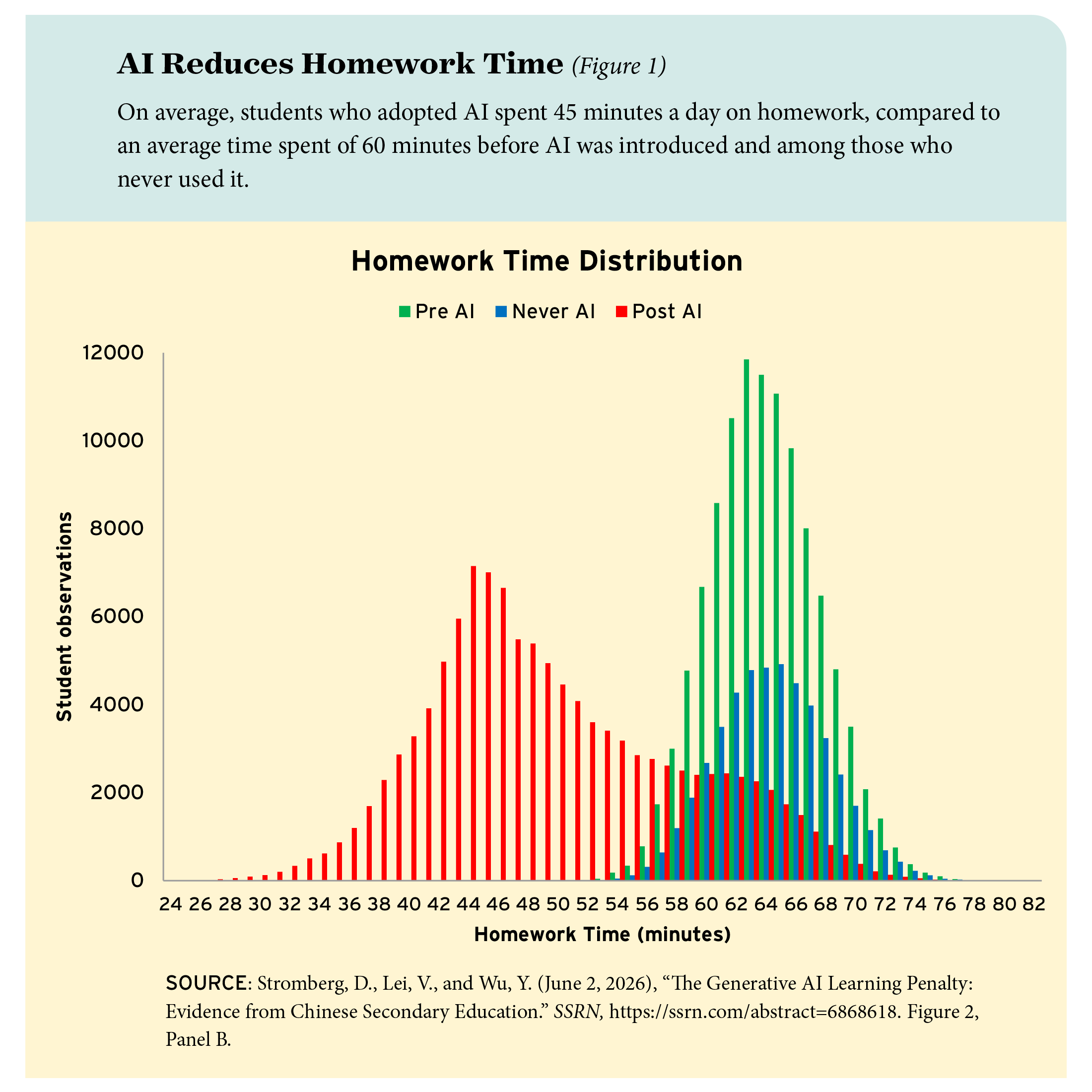
The researchers were able to track homework time because students had to log in online to download their assignments and upload them upon completion. The results here are unsurprising—AI significantly reduces the time students spend doing homework. On average, both the Pre AI and Never AI students spent about an hour on homework, across a range of 50 to 80 minutes. In contrast, most Post AI students spent around 45 minutes, and some even cruised through in a mere 25 minutes (presumably the minimum amount of time it takes to copy-and-paste answers from a chatbot).
This is AI as tool of cognitive automation working exactly as intended.
2. What is the impact of AI on how students score on their homework?
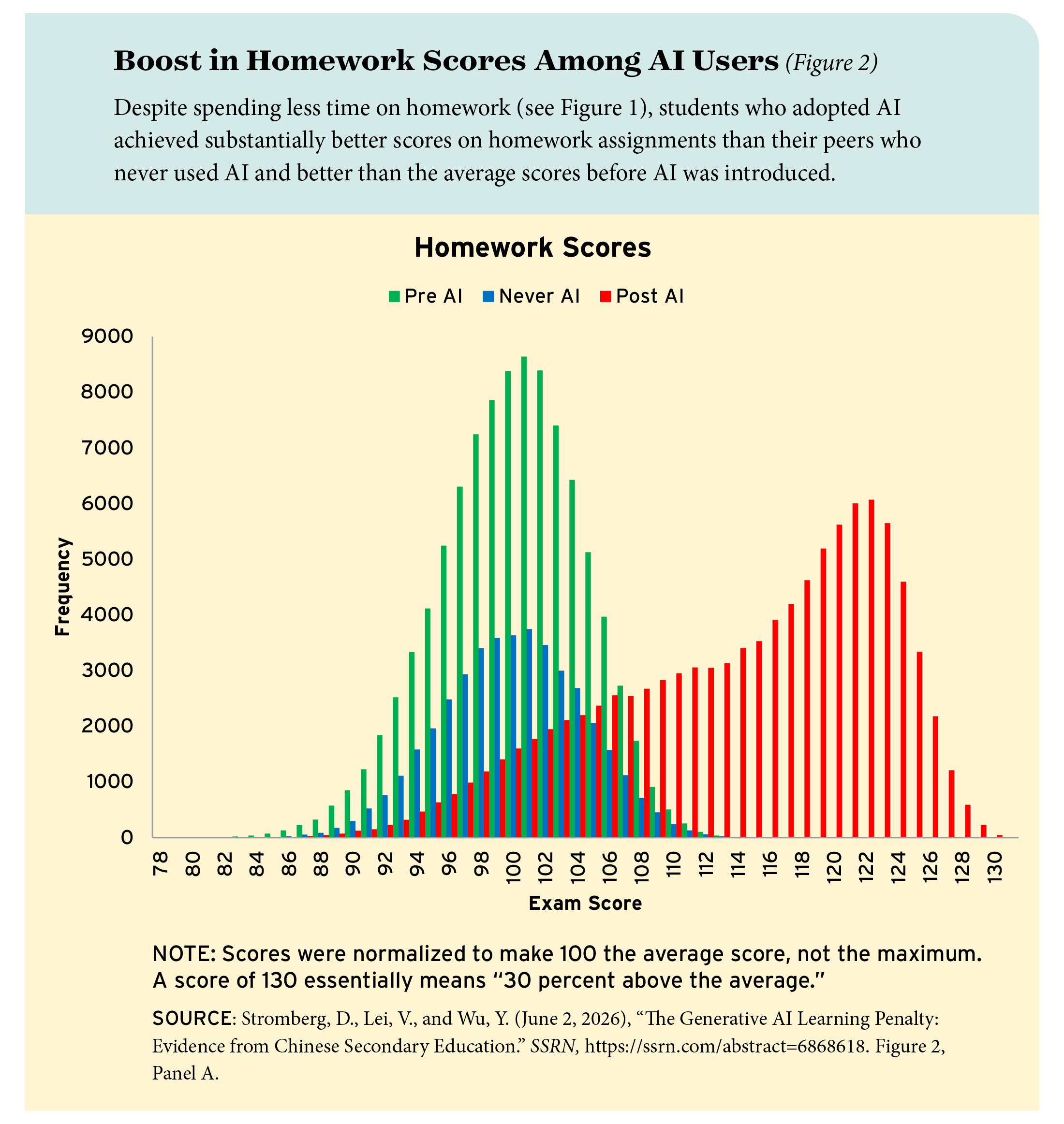
Like politics globally, there’s a substantial shift to the right.
Here again we see that Pre AI students and Never AI students have near-identical results, as we’d expect. Not so with the Post AI students, who see a huge shift in purportedly “positive” outcomes, with scores far higher than even the most studious Never AI student managed to achieve. Note the scores here were normalized to make the average score a 100 (not the maximum), so a score of 130 essentially means “30 percent above the average.” To restate, the Post AI students studied less yet scored better than their peers. That’s a pretty sweet deal for them.
But it’s worth reflecting on the broader implications of this within schools. When I talk to students about AI, one thing I hear them say frequently is that they don’t want to be played for chumps (my term, not theirs). Meaning, if they know their classmates are using AI and getting better grades as a result, even those inclined to resist AI may feel pressured into using it, just to keep pace.
It’s a cognitive race to the bottom.
I’ll also add that homework scores are obviously a very imperfect measure of student learning. A great deal of education research, and certainly the studies often promoted by ed-tech vendors, use comparable “point in time” data of supposed learning akin to what we see here. This is understandable, to a degree—it’s very difficult to gather information on long-term learning outcomes. But what ultimately matters in education is building durable student knowledge. The seductive danger of AI that’s being exposed here is that, by using it, students may have falsely believed their schoolwork was proceeding swimmingly. In this sense, AI fosters a mental masquerade as scores go up while actual learning goes down.
Now, to remove the mask.
3. What is the impact of AI on how students perform on closed-book exams?
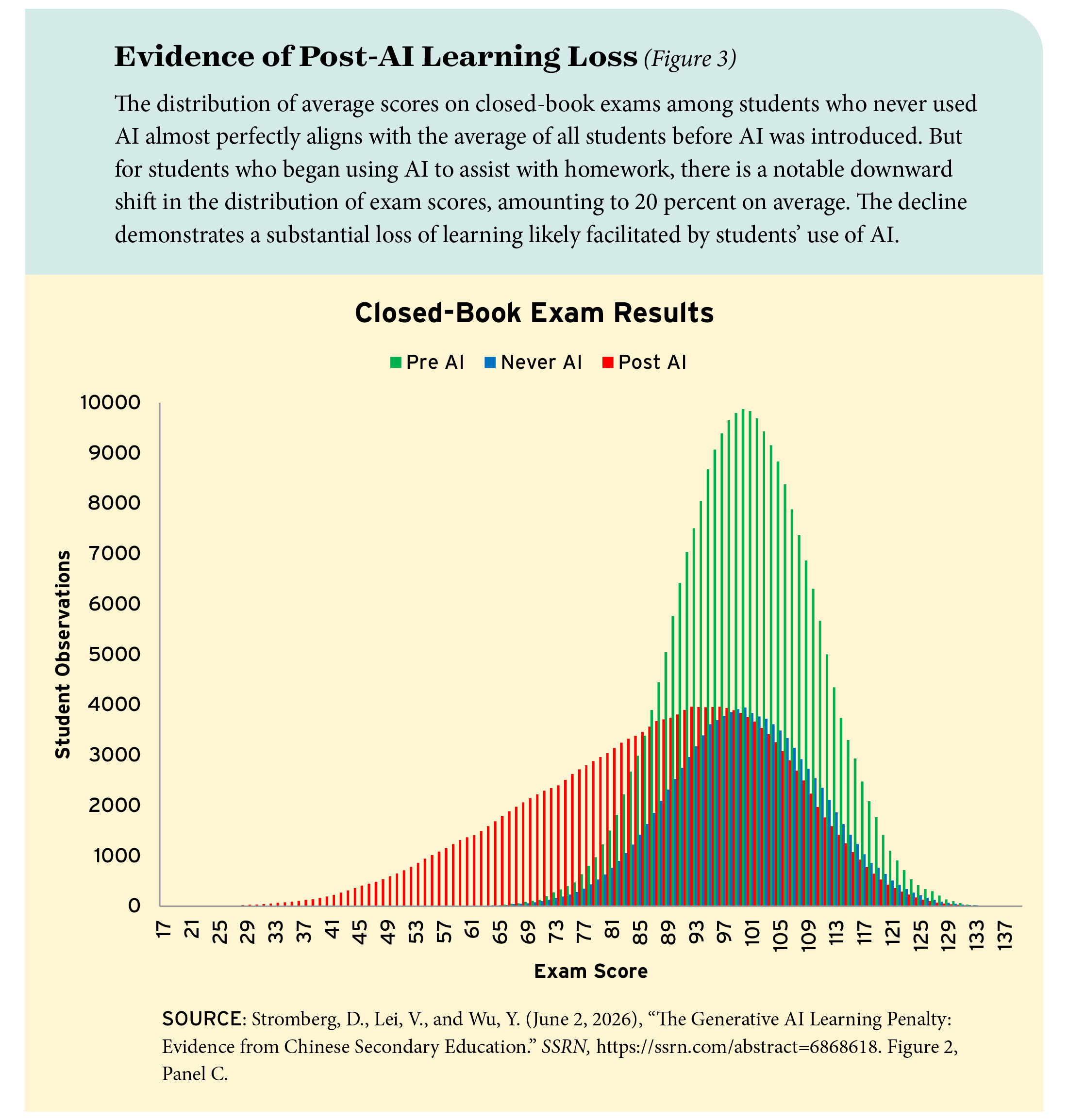
As Democrats are hoping for the upcoming midterms, there’s a massive shift to left.
Consistent with the two previous data sets, we again see near-perfect alignment between the Pre AI and Never AI students on monthly closed-book exams. But now the adverse impact of AI is laid bare: the Post AI students are scoring at levels far lower than their Never AI peers. Indeed, many score far lower than any student did prior to AI’s existence.
The steep downward shift evident from comparing the green and red distributions represents what I call the “Deadweight Learning Loss” caused by generative AI. What we’re seeing here is unambiguous evidence of a decline in overall student performance that grew over time as students adopted AI. The average decline was 20 percent with a 1.4 standard deviation (SD). Although far from an apples-to-apples comparison, this decline vastly exceeds the estimated learning loss in the U.S. after the pandemic (approximately .25 SD in math and .13 SD in reading).
What’s more, over time this Deadweight Learning Loss had significant adverse consequences for students on the comprehensive high-stakes high school and college entrance exams that China administers to determine student placement. For students who adopted generative AI two or more years prior to being tested, the estimated negative effects are 24 percent (1.5 SD) for the high school exam and 18 percent (1.3 SD) for the college exam.
If you are a parent with a child who is in junior high or high school and uses generative AI and has college on the horizon, this data should terrify you. This isn’t about academic integrity; it’s about a generation of kids being told AI is “inevitable” and “the future” and encouraged to act accordingly when we’ve yet to develop firm norms about what’s acceptable to do with these tools within education. Students are using AI in ways that are harming their cognitive development and foreclosing their life opportunities. These harms are not remediated easily, if at all.
Generative AI is cognitive cancer, and we are doing next to nothing to stop it from spreading.
Heading Off Objections
First, I want to credit The Economist for putting this research on my radar and for raising broader attention to its harrowing findings. Yet, remarkably, in the brief article accompanying the research data we’ve just covered, the anonymous magazine author suggests that “AI can boost learning productivity but only for those who use the technology intelligently.” Similarly, Blake Richards, a researcher at Google who works “on the intersection of machine learning and neuroscience,” argued on social media that AI is not really the problem here, because “if you control for how long students spend studying, then students using AI actually perform equal or better” than those who did not.
Motivated reasoning is a powerful force. Here, of course, “controlling” for how long students spend studying erases the major findings of this research. But let’s leave that aside, and probe whether this argument can be justified on its own terms. Does this study suggest that AI can boost learning if used “intelligently”?
As best I can tell, this claim is premised on this correlation between homework completion time and closed-book exam results:
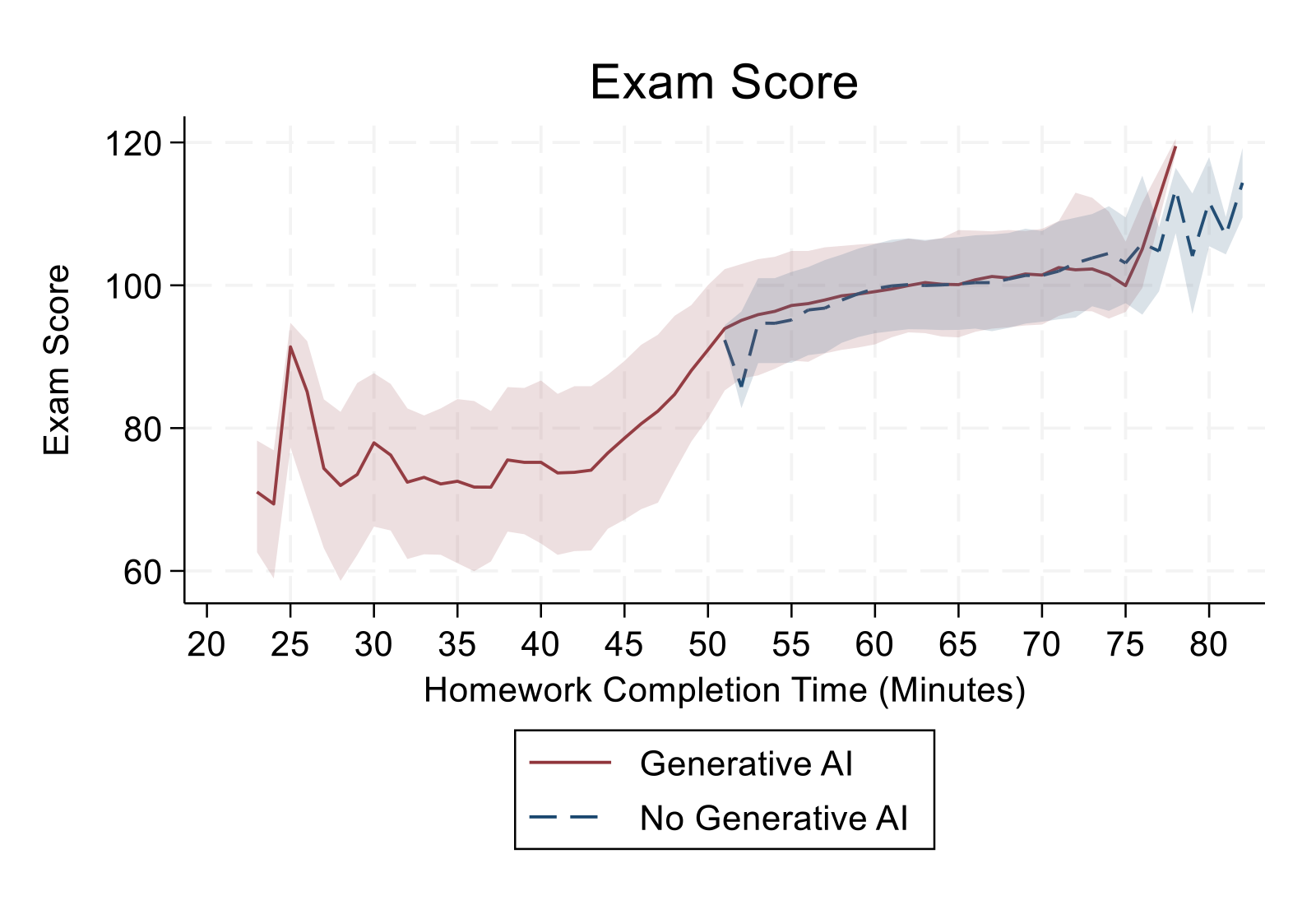
If we ignore all that pesky data on the left side of this chart (which, of course, we shouldn’t) and just focus on the overlap between the Generative AI students who continued to study for the same duration as the No Generative AI students, it’s true there’s no major gap between them. It’s also worth noting there’s no discernible benefit to using AI either—apart, that is, from the spike at 75 minutes.
So what’s the deal with the spike? Might we cling to it as proof of the “promise” of AI? Well, here’s a good lesson on why one should always be careful eyeballing charts without access to the relevant underlying data. According to David Strömberg, the lead researcher, we’re talking about a vanishingly small number of students:
It is very rare for students who have adopted AI to spend 75 minutes on homework. This occurs for only 20 students, and for each of them only in a single month (0.2% of AI student-month observations). More than five months after AI adoption, we never observe students spending 75 minutes on homework. In fact, in this group, only four students spend more than 65 minutes on homework.
So let’s get real. Given this study involved almost 27,000 students, indexing on these 20 studious students who used AI isn’t just putting lipstick on a pig, it’s smearing its body in Revlon from snout to tail. We need to stop pretending there will be some massive benefit to learning if only we train kids properly on how to use AI. It’s not a force multiplier for learning; it’s fundamentally harmful.
EdNext in your inbox
Sign up for the EdNext Weekly newsletter, and stay up to date with the Daily Digest, delivered straight to your inbox.
A different and more sophisticated counterargument might proceed along the following lines: This study tracked student usage of AI stemming from its earliest days, when the tools were less capable than they are today. Perhaps relatedly, the researchers found evidence that it was the early AI adopters most harmed by generative AI, insofar as “the estimated AI learning penalty fell from around 25 percent in early 2023 to around 16 percent by June 2025.” As such, perhaps this study constitutes the “high-water mark” of AI-induced harm, and we might hope to see the AI learning penalty continue to drop.
But as the cliché goes, hope is not a strategy, and there are some problems with this counterclaim. For one thing, the rapid evolution of AI cuts both ways. We now have AI companies explicitly marketing “AI agents” to students to complete their tasks for them. Agents are even worse than chatbots from a cognitive development standpoint—at least the latter require some sort of interaction to produce output. For another, even if the magnitude of the learning penalty continues to diminish, there’s a question of volume. Recall that 20 percent of students managed to resist using AI prior to June 2025. Do you think that number has gone up or down since then? I know my bet.
Finally, some might argue I’m placing too much weight on this research. It’s just one study from China, after all. But surely China is the one country in the world that can match the U.S. for AI adoption and enthusiasm, though it may surprise you to learn that AI companies in China disable their products completely during the high-stakes testing periods. OpenAI, in revealing contrast, heavily promotes ChatGPT on college campuses during finals week in the U.S.
More importantly, if you are an AI-in-Education Enthusiast, I am confident you will not be able to produce research of comparable rigor that shows positive long-term education impact of generative AI in real-world conditions comparable to those here. And no, this single study from 2024 involving roughly 150 physics students at Harvard is not going to cut it.
Real Harm is Happening
The generative AI learning penalty will not abate of its own accord. The Edu-Cognoscenti continue to chatter about learning loss related to school closures during the pandemic. Well, the learning loss stemming from generative AI appears more substantial, is happening right now, and may endure far longer. So, to all the policymakers and philanthropists and so-called thought leaders who purport to take education evidence seriously, I ask you: What’s the plan to prevent ongoing education harms of generative AI? Are you doing anything at all?
I’ll close by echoing what cognitive scientist Dan Willingham recently said about when and how students should use AI as part of their education. His argument echoes what I’ve been arguing for several years and stems from our shared understanding of the basics of human cognition:
[T]he point of assignments is the mental processes required to complete them, and the point of the mental processes is learning. That seems to suggest a simple litmus test for the use of AI. Artificial Intelligence tools should not substitute for tasks wherein students would benefit from doing the mental work themselves. . . . Students should only use AI for things that they already know how to do well.
A tool that should only be used once you know something is not a learning tool. We must stop gesturing at AI’s imagined potential and focus our efforts instead on mitigating its undeniable harms. Our students need to stop paying the penalty for using technology that is designed to automate cognition, not foster human learning.
Benjamin Riley is the founder of Cognitive Resonance, dedicated to building human knowledge to halt AI hype. A version of this post originally appeared on the Cognitive Resonance Substack.