




Since it was published two years ago, Jonathan Haidt’s The Anxious Generation has made, we believe, a huge contribution by sounding the alarm on teen screentime.
Haidt’s been active endorsing solutions: parents shouldn’t permit smartphones until age 14; schools should ban phones from 8 a.m. to 3 p.m.; and policymakers should limit social media consumption out of school—during what we call “3 p.m. to 3 a.m.”
Haidt’s work has led to action. While kids overwhelmingly continue to get phones before age 14, the school bans have taken hold in large numbers, and some governments have enacted laws. Australia took the lead in December 2025, launching a law restricting the use of social media by children under 16. Indonesia and Brazil soon followed with their own. In the U.S., 12 states have some version of a restriction, mostly enjoined by the courts, though Florida’s is somewhat like Australia’s and “sort of” operational.
What does Australia hope to accomplish with its law?
As Prime Minister Anthony Albanese puts it, “Australians pride ourselves on our beaches and parks, our love of playing sports and socializing with friends. Less doom-scrolling means more chances to spend our precious hours relishing the remarkable world around us.”
Haidt says, “[Kids] will get countless hours of their childhoods back to sleep, study, or socialize, and we will all be better off for it.”
As authors, let’s reveal our priors. We’re cheering for the Australian law to work, because we would like to see teens experiencing less screentime and more “real life.” But we start with some skepticism, because some older national laws trying to limit screentime, namely in China and South Korea, have failed.
To its credit, the Australian government set up an evaluation of its law, done by Stanford’s Social Media Lab, involving more than 4,000 children aged 10 to 15, plus one parent for each. The first report came out in July, comparing kids’ answers and behaviors before the law took effect with their answers and behaviors three months later. The researchers will return at six months, one year, and two years.
So what were the July results? Let’s dig in.
A Quick Quiz
First, dear reader, we invite you to take a quick quiz about Australia’s new law.
1. What does the law do?
a. Bans children under 16 from using social media
b. Requires platforms like TikTok to prevent children under 16 from having accounts
c. Requires parent permission for children under 16 to use social media
Answer: b
The Australian law says that Meta, TikTok, and other social media platforms must put steps in place, such as “facial age estimation,” to keep anyone under 16 from having an account. U.S. states do something similar. Some bar accounts for kids under 14 (Florida), some do so for kids under 16 (Georgia, Louisiana, and Ohio, while Virginia caps usage at an hour a day), and some set the limit at under 18 (Arkansas, Utah, Texas, Nebraska, Mississippi, and Tennessee). Generally, the platform must try to verify the user’s age or obtain parental consent before letting a minor open or keep an account. Noncompliance brings possible civil penalties or fines. But unlike Australia, most of these state laws are currently blocked or partially enjoined by federal courts on First Amendment grounds, so they aren’t actually being enforced right now.
2. Imagine the Australian law worked perfectly, with zero workarounds. Could a 14-year-old Australian still use social media?
a. Yes
b. No
Answer: a
That teenager can still watch YouTube videos without having an account, for example. He couldn’t comment. YouTube couldn’t personalize his feed (though sister Google might be able to, through his browser).
3. What would qualify as a “win” for Australia’s law?
a. A decline in teen-operated social media accounts. Individual, personalized accounts are more addictive than using platforms anonymously, so if the number of accounts falls, that’s a win.
b. A decline in the number of hours spent on social media per day. If the average teen consumes four hours of social media per day before the law, we should see that amount decline after the law, which would be a win.
c. A decline in the total amount of screentime. A reduction in time spent on social media will be meaningless if it’s substituted with other screen activity like texting and gaming. If total screentime goes down, that would be a win.
d. An increase in the amount of time tweens and teens are active outside the home. “Less doom-scrolling means more chances to spend our precious hours relishing the remarkable world around us” was the bar set by PM Albanese. If that’s happening more, it will be a win.
e. An improvement in the mental health of Australian children. Nothing else matters if Haidt’s underlying claim that predicates social media bans isn’t satisfied. We need to see the mental health of youth get better for this to be a win.
Answer: A judgment call.
We anchor on “c”—for us to back the law, we’d want to see declines in teen screen consumption. We’d hope to see screentime substituted with positive, real-life stuff (d), and over time we of course ultimately want to see mental health improve (e), but we’d start with “c” as the plausible direct consequence of the law after only three months. That would be a “win” in our eyes.
Results from the Stanford Study
Here is what researchers found in their first study, three months after Australia’s law took effect.
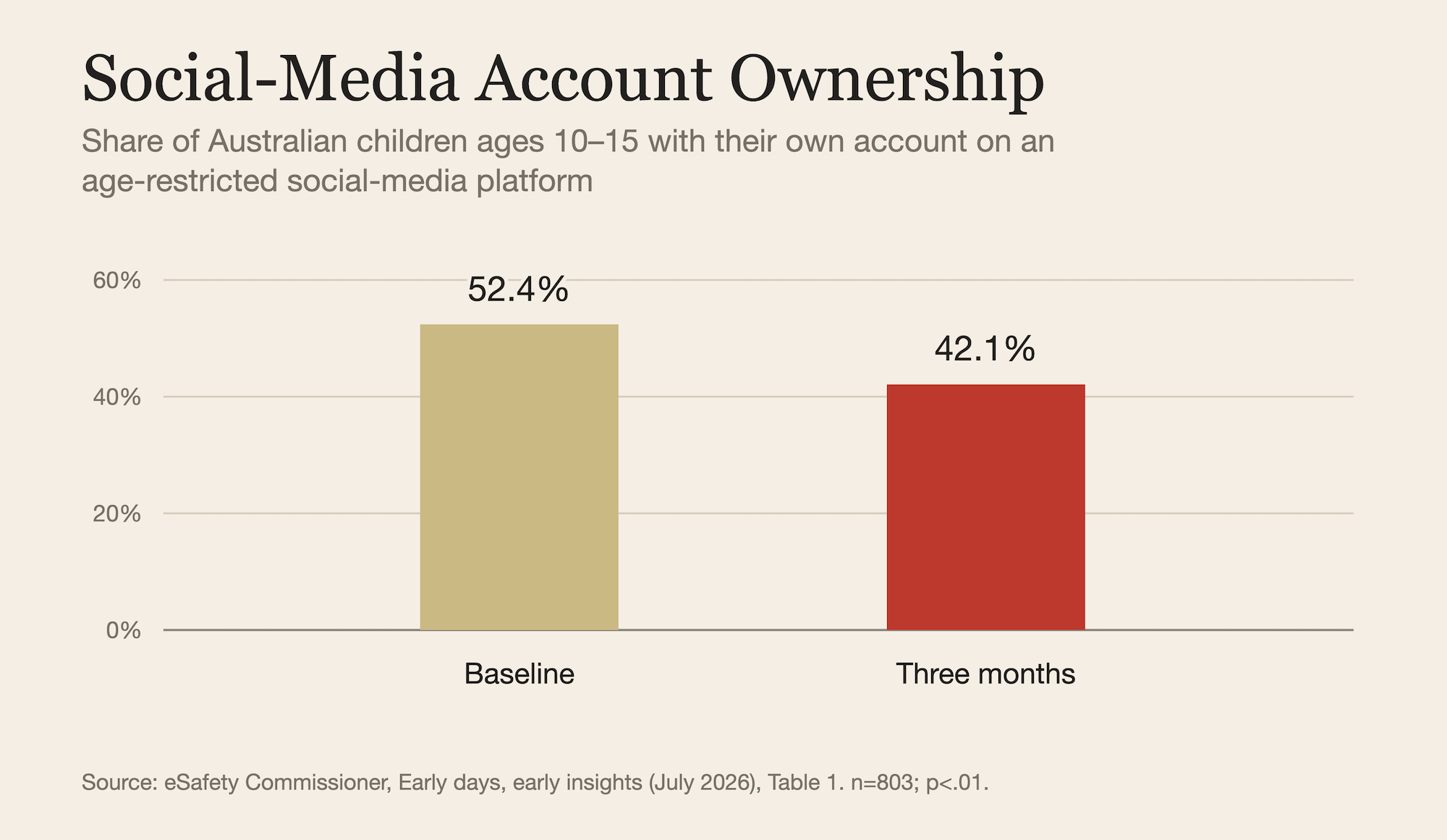
1. Are social media companies actually keeping kids from having their own social media accounts? We see a clear drop.
But whether this decline constitutes a “win” depends on your answer to quiz question 3 above.
Writing in Time, Jonathan Haidt, Ravi Iyer, and Zachary Rausch point out that platforms removed 4.7 million under-16 accounts belonging to an estimated 2.5 million Australian children. For Haidt, this shows that “the law made immediate progress and compelled platforms to take action on a massive scale.” Moreover, they argue that account ownership should continue to decline from the 42 percent shown above as enforcement tightens and “no account before 16” becomes the norm.
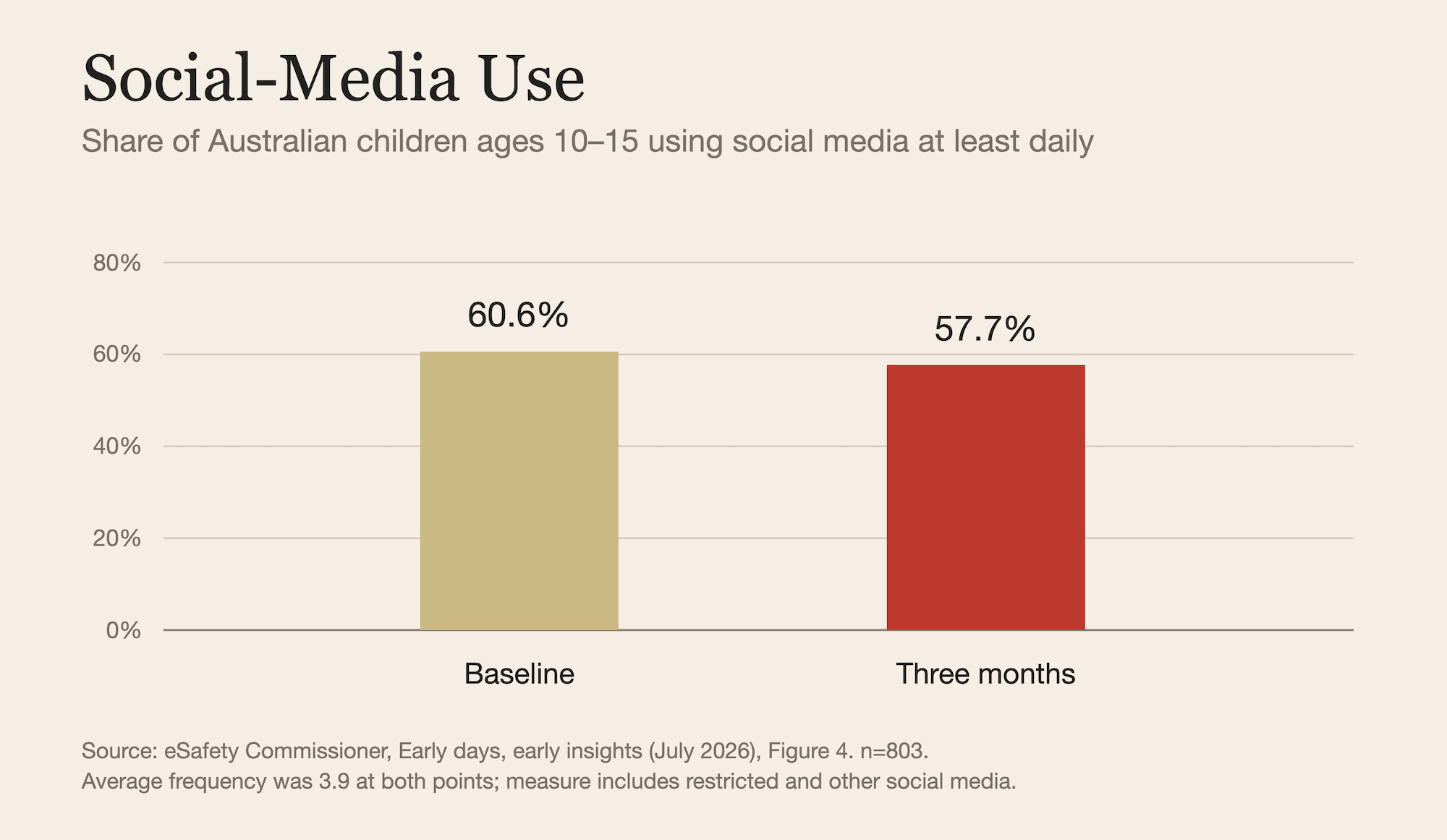
2. Did social media use—interaction with the platforms, not the number of accounts—decline? Not by much.
Sadly, the authors do not have baseline data on screentime or social media time per day. They did capture it at the three-month mark (3 hours, 58 minutes on Saturdays and Sundays; 2 hours, 9 minutes on weekdays), so we will be able to see what happens going forward.
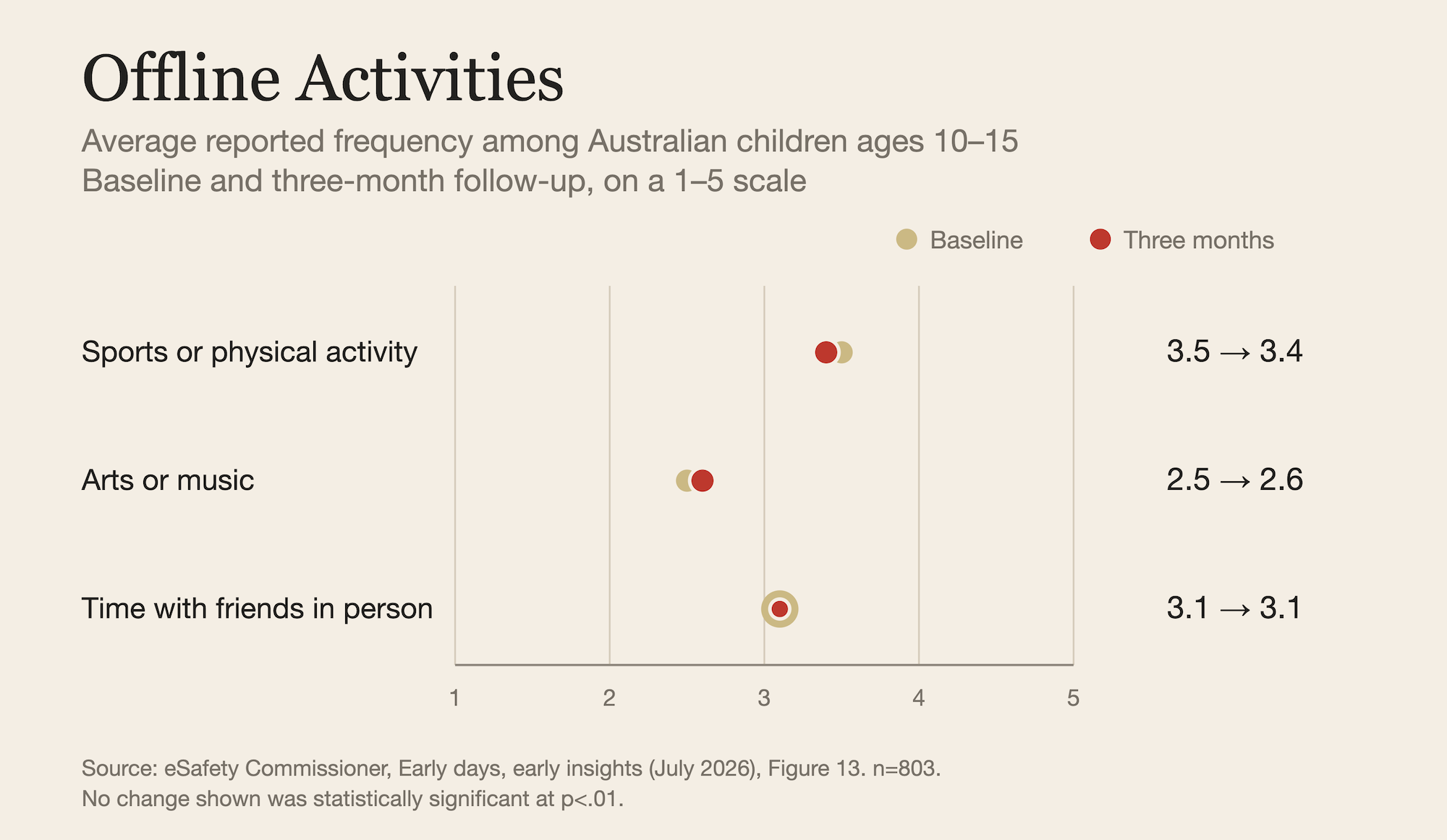
3. Do we see an increase in positive, real-life activities—the alternatives to screentime? Here we look at three metrics from the Stanford report, none of which shows meaningful change. Uh-oh.
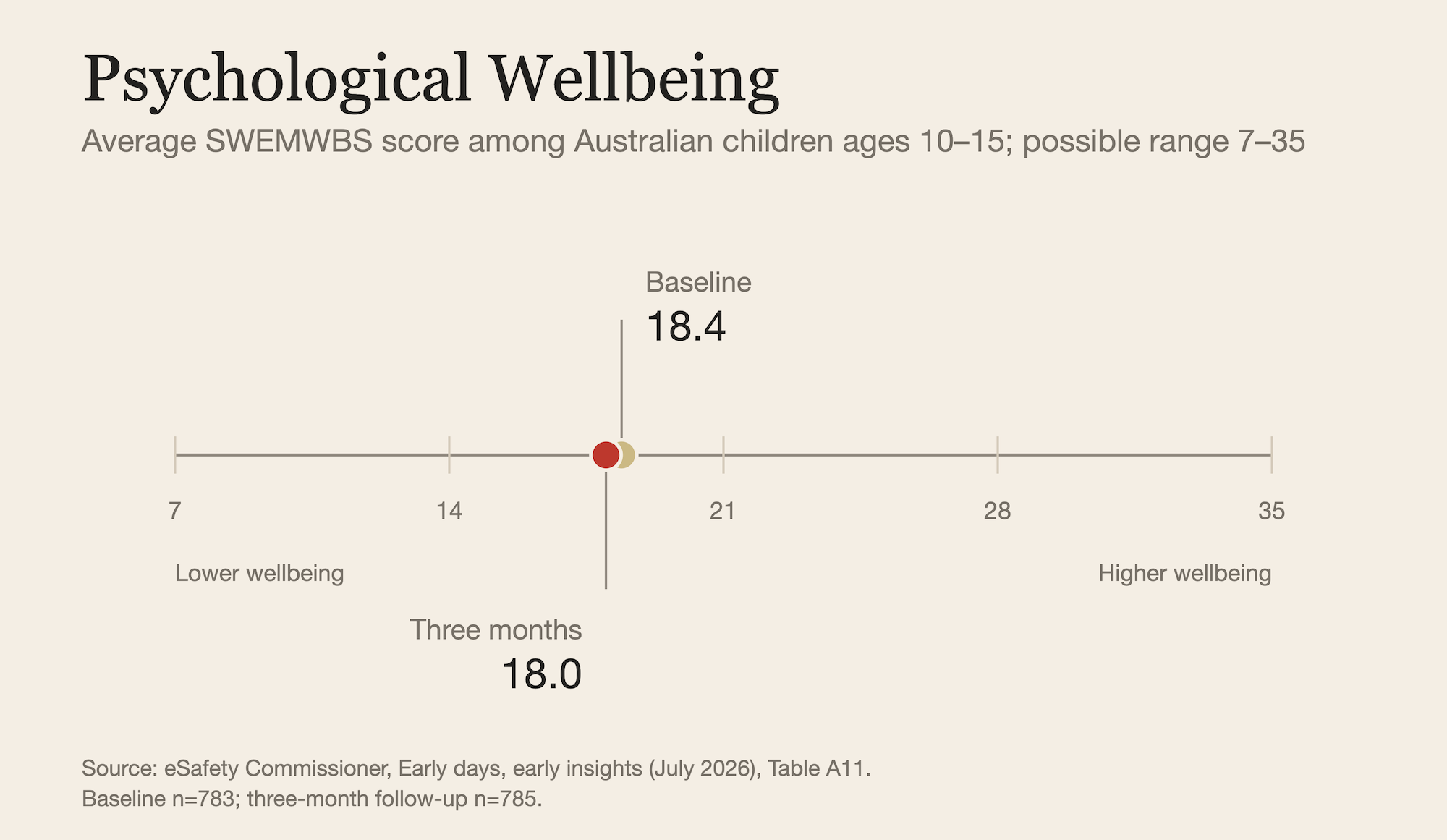
4. Finally, is mental health better? Given the lack of change in offline activities, it would seem implausible we’d see an improvement, and that’s precisely what Stanford found.
Where Does This Leave Us?
How can we square the three-month Stanford result with Haidt’s claims that the Australian law is a smashing success?
We’re sympathetic to his position. His book has swept the world, even as it has inevitably gotten some pushback—some in good faith, some in bad faith. Often this causes people to dig in, to never admit they’re wrong.
We hope our critique is of the good-faith variety. We’d say to Haidt: You have laudably identified a key problem: massive screentime among our youth.
Your earlier goals were and are the right ones for tweens and teens: less screentime, more real-life living.
EdNext in your inbox
Sign up for the EdNext Weekly newsletter, and stay up to date with the Daily Digest, delivered straight to your inbox.
Your current effort to shift the goal posts—using the Australia example to focus on the technicality of a decline in social media accounts—is counterproductive to your own goals!
These early indicators from Down Under should be troubling to you. What if these findings hold at six months, a year, two years? You’ll be constantly hammered with headlines that you were wrong. You risk losing the baby (your correct diagnosis of how smartphones worsened teen lives) with the bathwater (your well-intended prescription of laws that seek but fail to reduce 3 p.m. to 3 a.m. screentime).
Big picture: You’re winning. You’ve persuaded many people of the harm. You’ve got reasonable 8 a.m. to 3 p.m. school phone bans in place. Attorneys general are chasing Meta for their harms to teen mental health.
When you’re winning, you have room to correct course when you stumble! Lean in.
First, acknowledge that the Australia results are not what you hoped for but you think we need time, and articulate how much. It is reasonable to allow time for culture to change and the law to work.
Create a scorecard of what you’d hope to see continue in order to endorse the law. Here is an example we created for you.
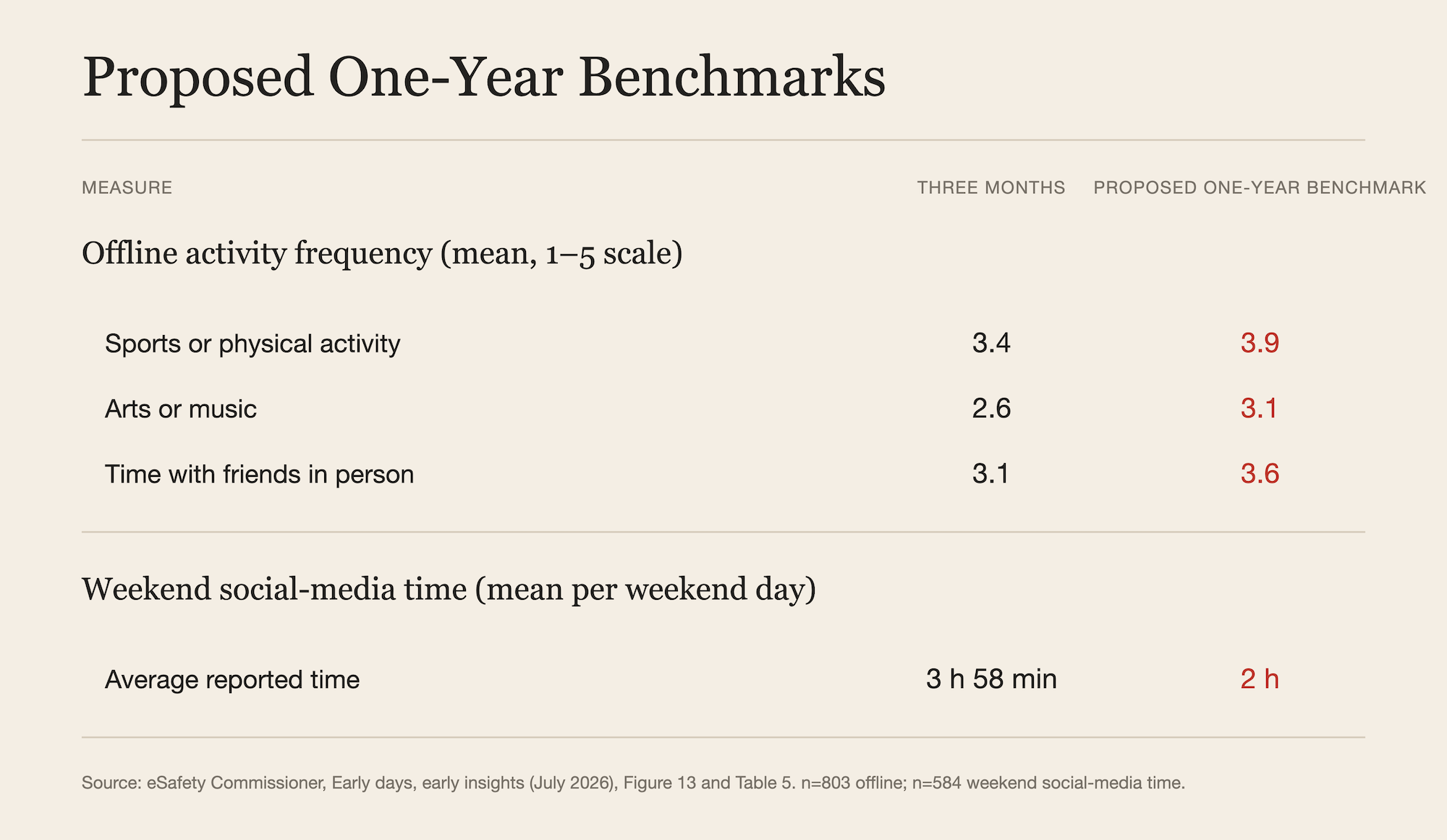
If that comes to pass—and there’s still time—then your idea will be persuasive. You can then make the case for similar laws you have cooking across the U.S. and around the world. If not, walk it back.
Remember Chicago’s soda tax passed in 2017? It was well-intended! They thought it would reduce consumption on something unhealthy. But the tax didn’t work, and the city repealed it four months later. Speed matters here.
Finally, you don’t have to be the owner of the Problem and the Solution. Invite more tribes into your tent—like us and many others—who share your goal of more real-life living for teens but have different mechanisms besides direct screen bans to achieve them. Work with PM Albanese to invite other experiments in Australia, where the measurement structure is already in place, to see if those might reduce actual screentime and increase hours spent each week doing “the good stuff.” Bring new people into the tent!
Sean Geraghty and Mike Goldstein are the co-founders of the Center for Teen Flourishing.