




What will teen life be like in 10 years?
As co-founders of a nonprofit that studies 3 p.m.-to-3 a.m. teen behavior, we often disagree a bit as we try to read the tea leaves.
First, to understand what teenagers are like today, we compiled the best available data on five indicators: screen time, teens with part-time jobs, sleep, in-person time with friends, and mood.
We’ve extended the trend lines with two sets of predictions—one from Sean and one from Mike—and find that we have cheerfully divergent views. Sean expects all five indicators to move incrementally in a pro-social direction. Mike’s bets are more mixed, though he’s cheering for Sean to be right.
Let’s look at each indicator, and where we think it is headed, in turn.
Screen Time
According to the National Survey of Children’s Health, parents report that about two in five teenagers ages 13 to 17 spend four or more hours on screens for recreation most weekdays. A CDC analysis finds associations between high screen use and anxiety and depression.
Recreational Screen Time, Ages 13–17 (Figure 1)
About two out of five teenagers spend four or more hours on screens recreationally during the week, as reported by their parents.
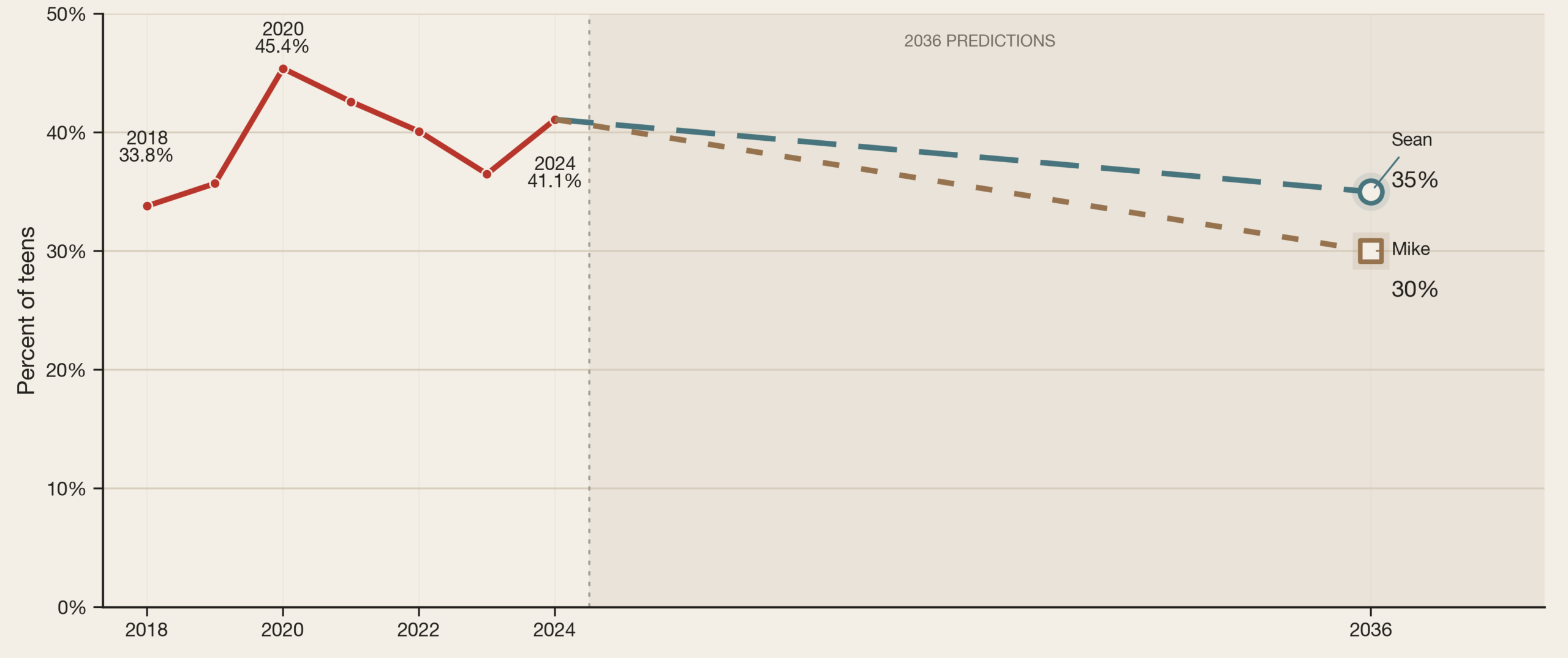
Note: Share of teens with 4+ hours of parent-reported non-school screen use on most weekdays, observed 2018–2024; 2036 values are author predictions.
Source: U.S. Census Bureau and HRSA, National Survey of Children’s Health, 2018–2024. Parent/caregiver reports for ages 13–17.
What happens over the next ten years?
Mike and Sean both predict a decline in teen screen time, though in slightly varying degrees (see Figure 1). There are two drivers. One is that new AI hardware may shift some digital activity away from conventional screens. OpenAI and Jony Ive’s design team, for example, are developing products intended to move beyond traditional interfaces. If teens begin interacting with AI through screenless or low-screen devices, reported screen time could fall without their overall digital engagement declining. That might not be a win for real life, but it will reduce screen hours. The more hopeful driver would be that the current societal energy to reduce teen screen time, as led by Jonathan Haidt and others, changes strategy in the next few years. So far that strategy has focused on passing new laws banning social media and other screens, which we view as a bad plan in pursuit of a good goal. But as the bans disappoint, parents and policymakers may move toward the “substitution, not suppression” strategy we have proposed: Instead of blocking screens, give teenagers better things to do, and solve the friction that leads languishing teens to reject the opportunities they already have.
Sean expects the share of teens whose parents report 4+ hours of recreational screen time to fall to 35 percent as norms around solo phone use shift and real-world experience becomes a form of rebellion against the virtual world. Mike expects that share to fall to 30 percent.
Teens with Part-Time Jobs
Teen labor force participation has declined significantly over the last several decades, as shown in Figure 2.
Labor Force Participation, Ages 16–19 (Figure 2)
Although the participation of teens in the labor force has declined since 1980, it has remained fairly stable since about 2010.
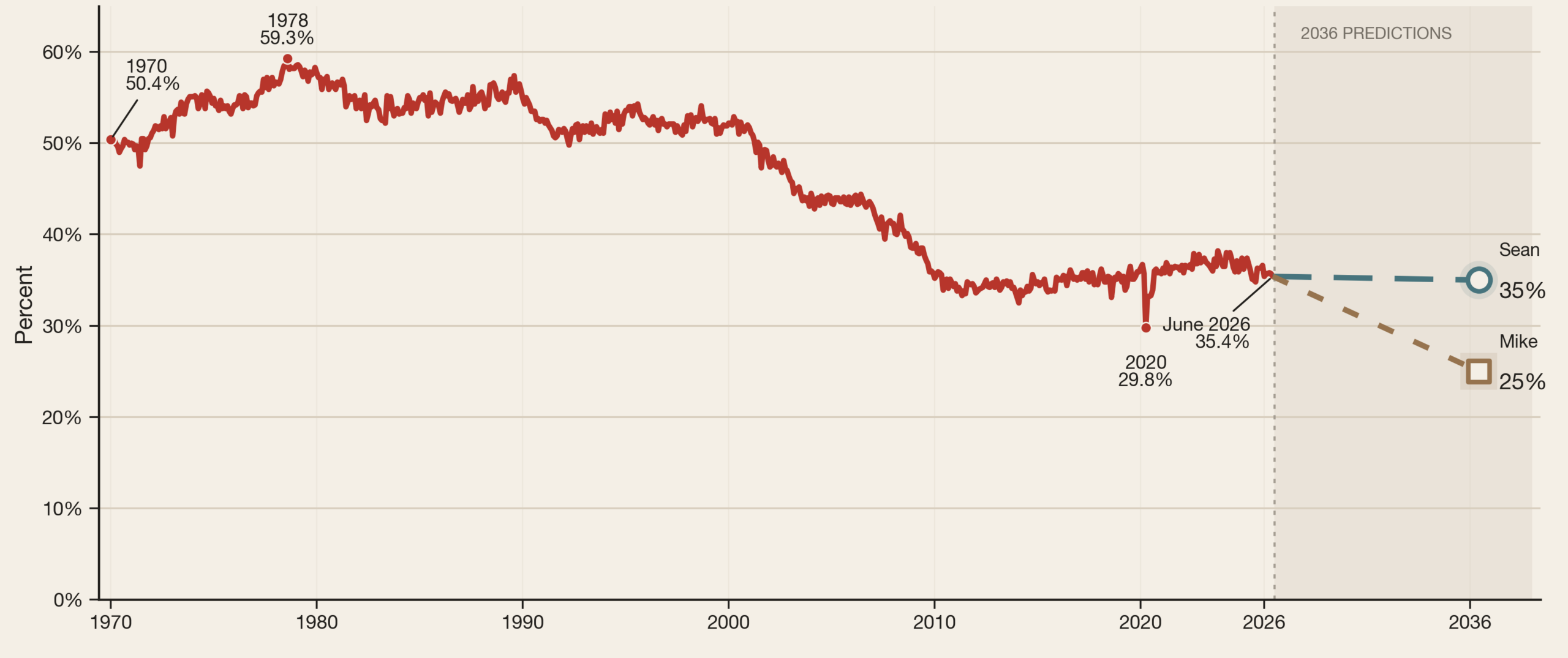
Note: Share of teens ages 16 to 19 in the labor force, observed through June 2026; 2036 values are author predictions.
Source: U.S. Bureau of Labor Statistics via FRED, series LNS11300012; seasonally adjusted.
Sean expects the plateau to continue through 2036, with teen labor-force participation holding at 35 percent.
Mike predicts the decades-long decline will resume, falling to just 25 percent by 2036. Two forces will push it down. First, as AI shrinks entry-level work overall, displaced adults will compete for jobs teenagers used to get. A similar displacement was documented after the Great Recession. Second, automation will replace some traditional teen jobs, through delivery robots and self-checkout.
Additional thoughts on the decline of teen jobs:
- This is more than a loss of labor. A part-time job teaches teens about “real life,” instills a work ethic, and gives practical experience in how to deal with people of many ages and backgrounds.
- What caused the big drop is up for debate. Did teens sacrifice part-time jobs to do more school work—tougher classes during the year, plus summer school? Did the minimum wage rise too much? Some say increased competition from other workers is the culprit. Perhaps a declining work ethic made the labor less valuable to employers? In any case, none of these trends are likely to reverse.
- One nerdy caveat: Mike wonders whether more teen work will migrate to informal, Venmo-paid activity, from reselling sneakers to other odd jobs. The Current Population Survey is supposed to count paid and self-employed work, but it is unclear how consistently households report this irregular activity. If reporting falls short, official participation could understate what teenagers are really doing.
Sleep
The share of 12th graders who say they get at least seven hours of sleep most days has fallen, as Figure 3 indicates.
Sleep Habits of 12th Graders (Figure 3)
Less than half of high school seniors get at least seven hours of sleep per night.
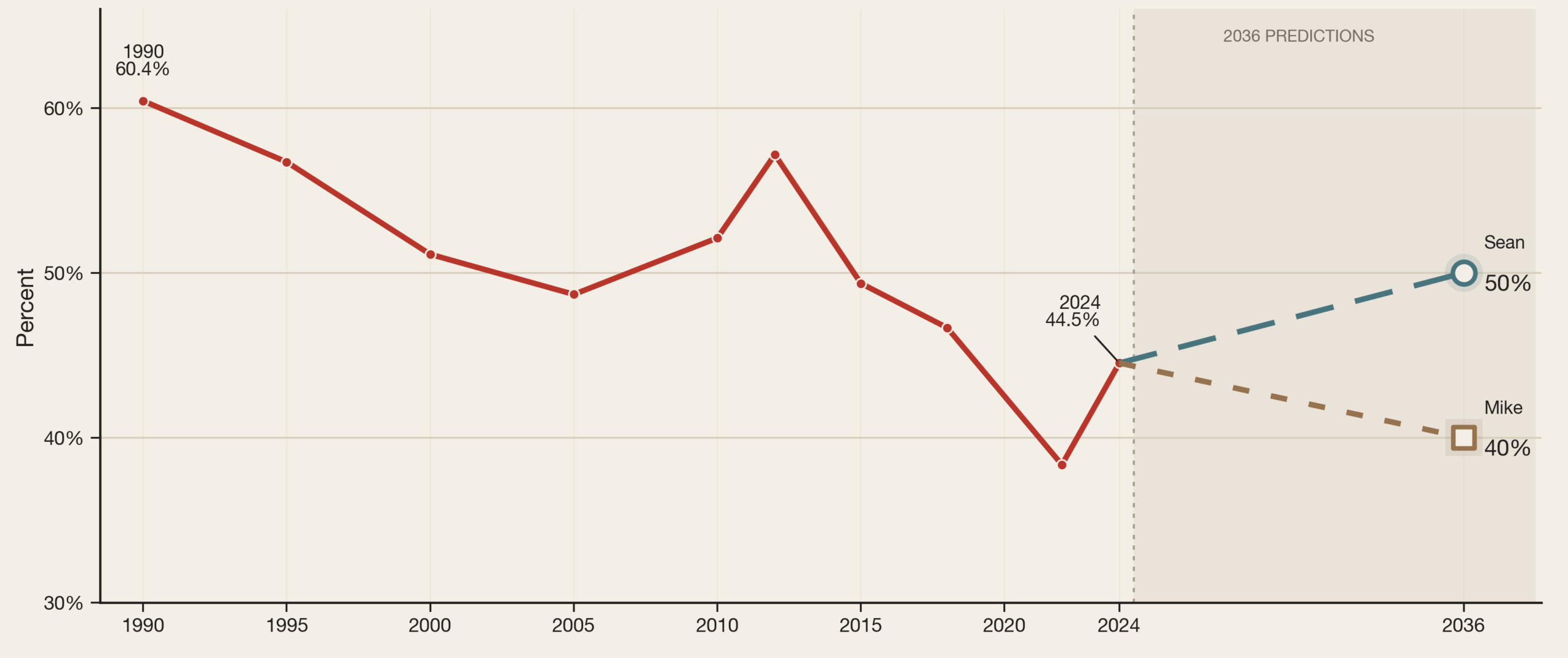
Note: Measure is the share answering “most days”, “nearly every day”, or “every day” to the question “How often do you get at least seven hours of sleep?” The 2036 values are author predictions.
Source: Monitoring the Future, 12th-grade Form 2 public-use files; weighted with V5 / ARCHIVE_WT.
Sean expects the share of high school seniors clocking seven hours of sleep to tick back up to 50 percent by 2036, mostly as a downstream effect of screen time going down. Excessive screen time is associated with getting to bed later and having trouble falling asleep. If screen use declines a bit, sleep should recover. The importance of sleep has also become much more culturally salient, which could cause norms around it to change.
Mike does not see the bull case for better sleep. As he argued above, teens are less likely to work jobs, and jobs make you tired. Teens are also becoming less likely to do sports, and playing sports makes you tired. Pleasure reading, once a great way to wind down before bed, has fallen by the wayside, too. Fewer kids are burning the midnight oil with homework, instead enjoying lax grading and tolerance of letting AI take on the cognitive load of some assignments. Meanwhile, AI companies make a lot of money keeping all of us, teenagers included, awake and using their products. On balance, Mike expects the share of 12th graders getting at least seven hours of sleep most nights to slip to 40 percent by 2036.
Time with Friends
As writers like Jonathan Haidt and Jean Twenge have observed, “time with friends” has gone down over time. The standard source for this observation is the American Time Use Survey (see Figure 4), which asks respondents to account for the previous day in a detailed time diary.
Time with Friends, Ages 15–19 (Figure 4)
The average amount of time teens spend with their friends daily has plummeted for 20 years. The authors believe there is reason to be skeptical of the recovery shown in 2025.
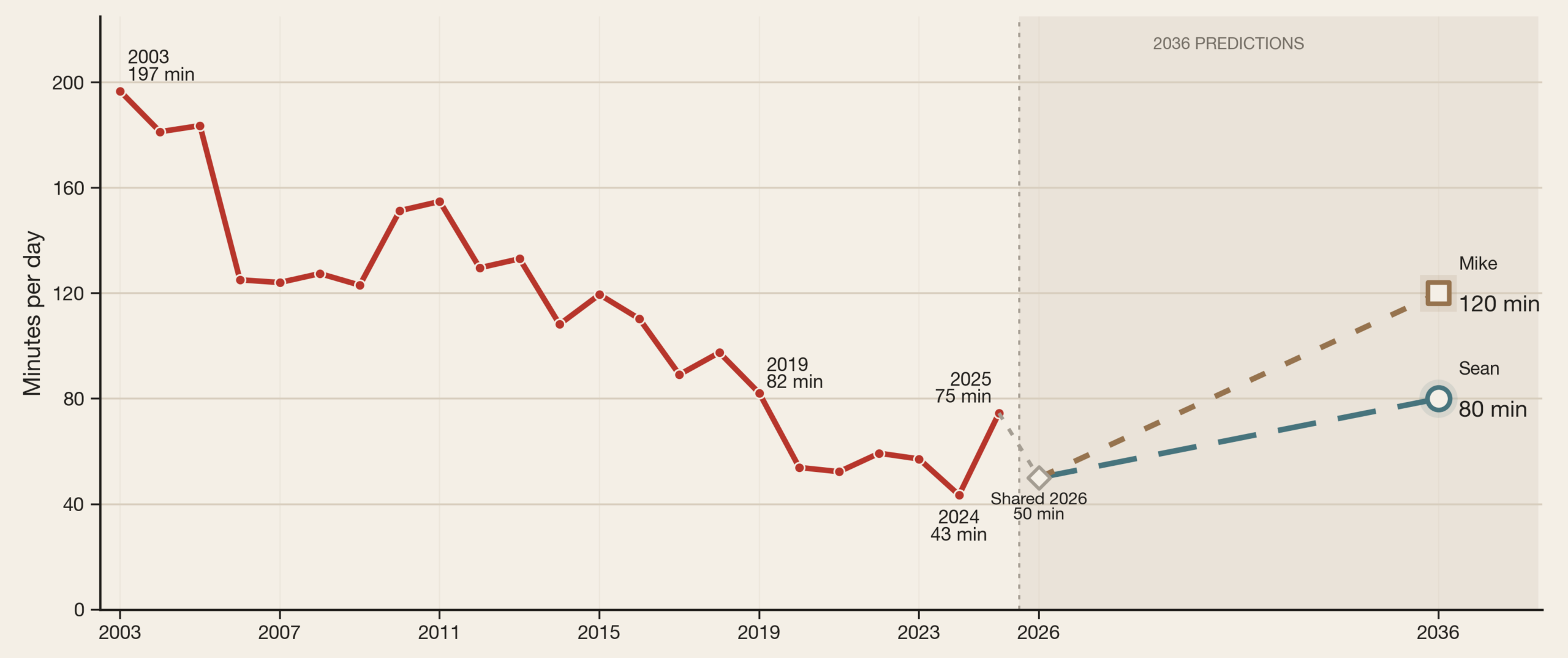
Note: The measure is the average minutes per day spent with friends. The 2025 estimate uses 188 respondents. The 2026 and 2036 values are author predictions.
Source: Author analysis of U.S. Bureau of Labor Statistics American Time use Survey public-use files; weighted using ATUS final weights.
Some argue that the observed decline is misleading because teenage socializing happens digitally now. We agree that digital interactions like texting or coordinated online gaming can be a form of socializing. But spending time together in person offers benefits that are harder to get online, giving teens practice reading other people’s cues and working toward shared goals, such as on a sports team or at a job.
In any case, teens don’t see each other in-person nearly as much as they used to. What to make of the data?
First, we are highly skeptical of the 2025 rebound shown in Figure 4. The sample that year was limited by the federal government shutdown, making it noisier than usual. On top of that, the Bureau of Labor Statistics reweighted the time diaries so that those collected between November 12 and December 30 represent the entire fourth quarter. Kids are on holiday break during much of that window, so allowing late November and December to serve as a proxy for an ordinary October likely inflated the estimate.
Thus, our mutual near-term prediction is that in-person time comes back down this year, in 2026, to roughly 50 minutes per day.
But then what?
Sean makes a cautious case for a partial rebound to 80 minutes a day by 2036. He thinks demand for “ordinary human experiences” will rise as more of life becomes mediated through AI. A kid born in 2021 will turn 15 in 2036, so there’s plenty of time for any new Haidt-inspired norms around solo phone use to take effect. Sean also expects the effects of Covid, which appear to have driven a further plunge in 2020, to fade. Even now, younger people are going to the movies more.
Mike expects a larger rebound than Sean, to 120 minutes a day by 2036. Maybe his optimism is due to his 18-year-old’s lovely five-day Vermont camping trip with four pals, only one of whom had ever camped, and therefore chopped all the firewood.
What’s more, if fewer teens have part-time jobs, some of that time will be spent with friends.
Mood
After holding roughly steady from 1999 through 2015, the share of high school students reporting persistent sadness or hopelessness climbed sharply in the mid-2010s (see Figure 5).
Even scholarly opponents like Jonathan Haidt and Candice Odgers agree that mental health has worsened (they just disagree about causes).
Felt Sad or Hopeless for Two Weeks or More (Figure 5)
More students reported persistent feelings of sadness or hopeless beginning around 2015.
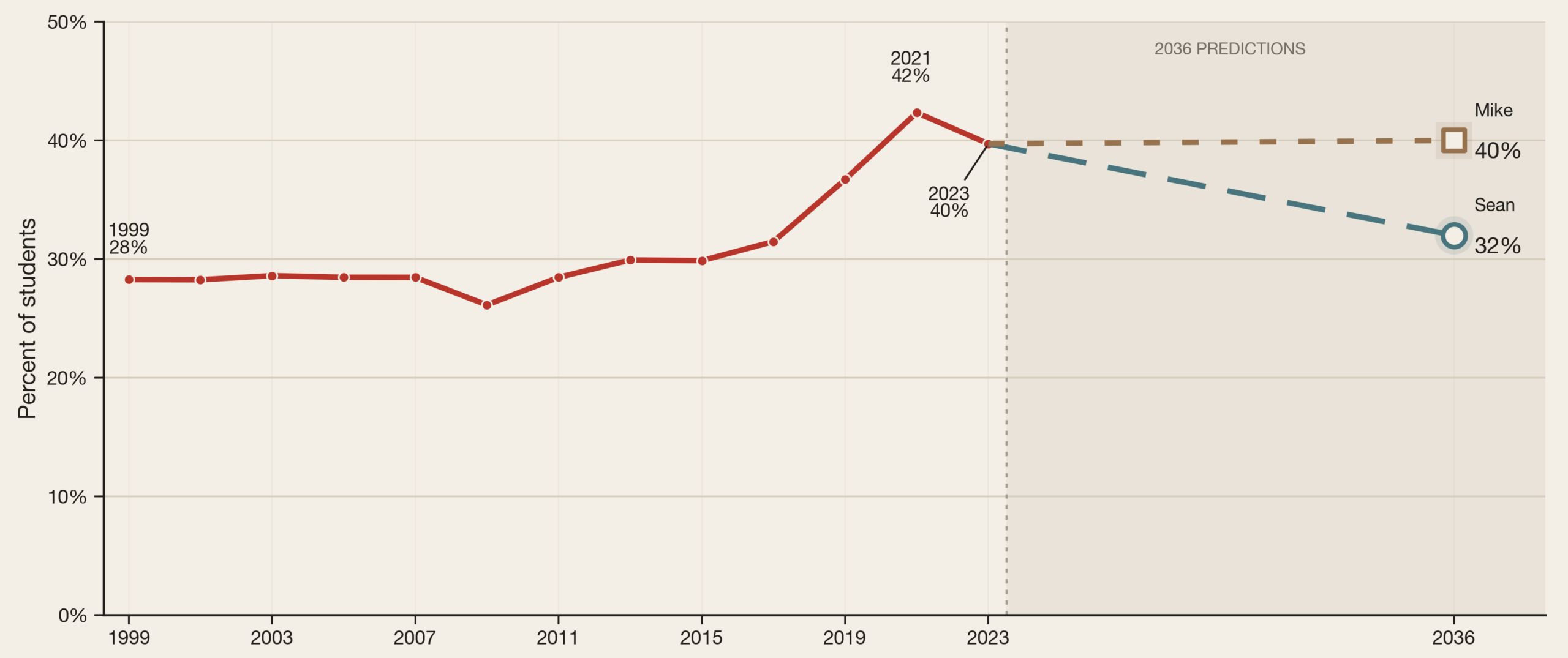
Note: The measure is the share answer “yes” to feeling sad or hopeless almost every day for two or more weeks in a row during the past 12 months; 2036 values are author predictions.
Source: Author analysis of national CDC Youth Risk Behavior Survey public-use file, weighted.
Sean expects the share of teens experiencing these prolonged depressive feelings to fall to 32 percent by 2036. Sleep and face-to-face interactions, which he predicts will increase, are both positively associated with wellbeing. Lucy Foulkes and colleagues have argued that mental-health language can shape how adolescents understand distress, sometimes reinforcing the symptoms it names. Foulkes’s other recent work finds signs of a backlash against teens diagnosing themselves. Sean sees that backlash deepening over the next decade and the cultural script to lose some of its force. Teens may remain fluent in the language of mental health while becoming less likely to treat ordinary distress as illness, leaving fewer who say they feel persistently sad.
EdNext in your inbox
Sign up for the EdNext Weekly newsletter, and stay up to date with the Daily Digest, delivered straight to your inbox.
Mike expects the share to hold steady at around 40 percent in 2036. Those advocating for more teen access to therapy will succeed, yet empirically it’s not clear this will move our trend line very much. One new driver of additional distress will be AI causing white-collar parents to lose their jobs. “Those are actually the people who might lose,” says economist Tyler Cowen. “When some people go up in status, and some go down in status, I will tell you, those who lose suffer more psychologically than those who gain.” The parental distress of unemployment will course through home life, affecting teens negatively.
We intend to revisit these five bets in 2036 and see who read the tea leaves better. Until then, we’ll keep working with today’s teens to make the more optimistic version of the future a little more likely.
Sean Geraghty and Mike Goldstein are the co-founders of the Center For Teen Flourishing.