


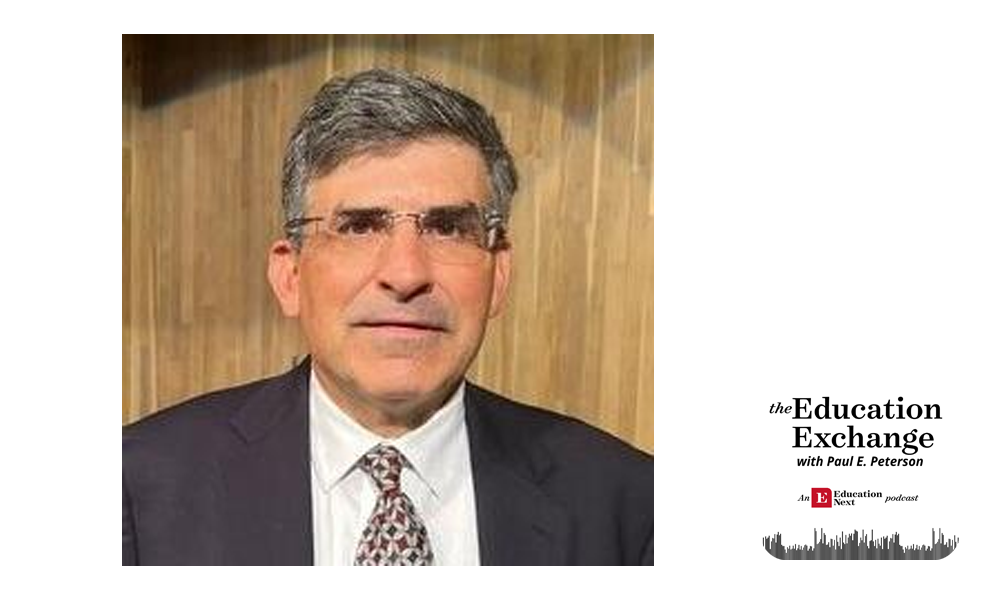
 Paul Carrese, the Director of the Center for American Civics and Professor at Arizona State University, joins Paul E. Peterson to discuss Carrese’s new book, Teaching America: Reflective Patriotism in Schools, College, and Culture.
Follow The Education Exchange on Soundcloud, Apple Podcasts, Spotify, YouTube, or here on Education Next.
— Education Next
Transcript
PAUL PETERSON, HOST:
This is the Education Exchange. I am Paul Peterson, Director of the Harvard Program on Education Policy and Governance. Thank you for joining us. As the echoes from the 4th of July fireworks explosions ring in our ears, many are asking whether our schools are teaching the next generation an honest kind of patriotism that’s manifested itself at the World Cup events and throughout the country on the 250th anniversary of the Declaration of Independence. Or are students learning something else in our schools? On that topic, Paul Carrese, a professor in the School of Civic and Economic Thought and Leadership at Arizona State University, has something important to say. His new book is entitled Teaching America: Reflective Patriotism in Schools, College, and Culture. I’m very pleased to have Paul Carrese with me on the Education Exchange today. So, Paul, thank you for joining me on the Education Exchange.
PAUL CARRESE: Thank you, Paul. It’s great to be back.
PETERSON: Paul, perhaps the key word in the title of your book is “reflective.” Well, what do you mean by reflective patriotism? Isn’t the old-fashioned, unconditional patriotism that declares the United States the greatest country in the world good enough?
CARRESE: Thank you. I am borrowing the phrase from Alexis de Tocqueville, who, when he visits America in the early 1830s, argues that the Americans have a new kind of patriotism he has not seen in the old world; France, from which he comes, and other European countries. Americans do have that old-fashioned, sentimental love of country, but they blend with it, says Tocqueville, a rational element. It could be translated as reflective or considered because America is about self-government to serve the equal natural rights of individuals. And so, the Americans think about and argue with others and argue with the government about whether the government is working for them, whether America is working for them. So, this rational considered element suggests to Tocqueville there’s a new blended hybrid kind of patriotism that the Americans have and I chose it as the subtitle of this book. You know Teaching America about America is I guess the title right teaching America the subtitle tries to address. I think the crisis we’re in right now that education about America in American schools in American higher education and also in American civic culture is not in good shape; that’s probably not terrific news, exciting headline news to anybody listening to your podcast. But what to do about it involves the question of motivation, the motivation for the teachers, for the professors, for the governing authorities of all the institutions, but also for civic culture. So it’s got a very de Tocquevillian approach. The three parts of the subtitle are Schools, College, and Culture.
PETERSON: Let’s dig into de Tocqueville a little bit more. You mentioned…I found your discussion of de Tocqueville especially enlightening. And you had sort of six keys or six elements to de Tocqueville’s thinking about reflective patriotism. Do you recall what you said on that?
CARRESE: Yes, thank you. I was struck a couple of years ago by noticing that de Tocqueville’s Democracy in America is 700-pages in recent translation, Harvey Mansfield’s translation with Delva Winthrop, that he talks about this idea of the new American patriotism throughout both volumes. So, it’s a thread running through the book and I guess I hadn’t noticed that before. So yes, there are these six elements. He does have the more narrowly rational elements he discerns, for example, that Americans think in terms of self-interest with relation to American patriotism. We might phrase it this way, Is America working for me? And then they have a kind of enlightened self-interest.
PETERSON: We’re a greedy people.
CARRESE: Well, he says it’s rational in a way that Americans have a kind of enlightened self-interest about civic duty and love of country. And that they have this view that they’ve got to be able to persuade themselves, this is worth my while to serve in local office, the city council, the school board, the dog catcher, whatever. de Tocqueville loves these local offices and townships. Or, you know, the duties you have to be an informed citizen and voter, right? This takes some investment. So, you have to say to yourself, because he says Americans are busy making money, Americans are busy showing that equality works. You know, you’ve got to prove that you have equal independent material status, and that can say to you, why should I bother with politics or with civic duty? So, there are all these kind of rational, narrow calculations, but he does insist there’s a moral foundation, a Christian element, the Christian political culture. Great American political scientist Jim Caesar called this de Tocqueville’s view of our first founding, the Puritans in New England. That’s an element. And then there also remains…
PETERSON: That’s a contentious sentence there.
CARRESE: Yeah, right.
PETERSON: You know, I hear our president, President Trump echoes that a bit in some of his… I mean, he says everything. And so I’m not sure I’m… He probably says the opposite somewhere, but he certainly has enunciated a commitment to… I’m not sure how religious he is himself, but he seems to think Christianity is important to America, wouldn’t you say?
CARRESE: Yes, and people who know de Tocqueville would know that this is a great strain of thinking throughout Democracy in America. I’ll invoke another great American, Lincoln. It’s an interesting fact that Lincoln’s first great address, arguably, in 1838, is about civic education. It’s known as the Lyceum Address. The topic is the perpetuation of our political institutions. So here’s Lincoln just over two decades before a great civil war breaks out, warning of American suicide. That’s the word he uses, because he’s worried about mob violence growing over a whole range of political controversies. Obviously, slavery and abolition are one, but it’s more than that. It’s about, you know, drinking and temperance. You know, what later becomes the prohibition movement. It’s about gambling. It’s about religious differences. And if Americans can’t stick to the rule of law and the Constitution and our complicated federalism, we will self-destruct. He says at one dramatic point, no Napoleon leading up armies of various nations could ever invade us and conquer us, take a drink out of the Ohio River, but we could destroy ourselves this way. So, it’s an unnoticed fact of that address that while he does emphatically state we need civic education in cold, sober reason, the laws, the Declaration, the Constitution, he concludes the address by invoking George Washington, and the Christian church. So right there, just a few years after de Tocqueville publishes first volume of Democracy in America in 1835, there’s Lincoln offering the de Tocqueville mix of a reflective patriotism. There are emotional elements to it, elements of a kind of national faith, and there are the rational elements.
PETERSON: Well, you yourself in your book talk about George Washington repeatedly, and you sort of say he is to be celebrated as a country’s founding father. You put a lot of emphasis on George rather than, say, James Madison or Alexander Hamilton, who wrote the Federalist Papers, or Thomas Jefferson, who wrote the Declaration of Independence. Why do you say George Washington deserves special celebration?
CARRESE: Well, it’s a great argument to have, Paul, right? Which of these great figures, Ben Franklin would be another, right? It’s a great argument for Americans to have. I guess the book is a hybrid crossover book from Cambridge University Press. It’s briefer than most academic books because it’s meant for a broad audience. So it does leave kind of, you know, I can’t follow every argument all the way through to academic. depth, let’s say so, fair question. I think there’s a reason why Americans referred to him as the founding father before his death and were celebrating his birthday before his death. There was just a sense, not just in war, but in the constitutional reform movement and then electing him unanimously twice as president, the only time that’s happened in the presidential elections, and then his completely voluntary retirement from the presidency. He was not going to be a Cromwell, who everyone in America knew as the figure who, in the name of liberty, had to hold on to absolute power, right? And then shortly thereafter, he’s not going to be a Napoleon. So there was a greatness about him, immense ambition, but in the service of founding this new constitutional order that could really work and really stick. Yes, the state constitutions were good, but the union was too weak, so we needed this new edifice. And he stuck around, you know, he came back into public life not only to lead the presidential convention as unanimously elected president of the Philadelphia Convention in 1787, but then accepted two terms as president. But he didn’t want..he wanted to resign after the first term, resign from public life. So, people who knew him recognized his greatness. And some of them were very great figures. I mentioned just one other, John Marshall. John Marshall writing kind of the official biography of George Washington at the request of the family. And Washington was such an immense figure to this educated lawyer, jurist, secretary of state that Marshall not only writes the first version, he writes a second version to make it a little shorter, but at the end of his life in the 1830s, he rewrites The Life of George Washington as a one-volume book. He gives it the subtitle For Schools. So it’s actually on our topic. For civic education. He’s worried in Jacksonian America that Americans aren’t understanding the founding and the constitutional republic of America. They’re just excited by democracy. And so he rewrites The Life of George Washington as a slimmer one volume.
PETERSON: Okay, so you put forth here this concept of democracy and the constitutional republic. Well, democracy is celebrated in the Declaration of Independence, and the Constitution is the place where a constitutional republic is established. Now, which do you think is more important? The Declaration of Independence or the Constitution?
CARRESE: Another great question…and this is—Our conversation is proving a point I try to make in the book that to be an American citizen or an aspiring citizen is not easy if you take it at all seriously. And of course, part of the crisis of our political moment is that a huge number of Americans, citizens have just checked out. They either are busy with making money, they’re absorbed by the Internet and quotidian affairs, they think politics is angry and ridiculous. For whatever reason, they have just checked out, and we have allowed our educational institutions to ignore these kinds of questions. Which is more important, the Declaration of the Constitution? That is a huge question, and you really can’t be a good American citizen unless you’ve given some thought and study to both of these documents and their legacies across 250 years. But we have allowed ourselves to just get away with thinking, oh, math is so important, it’s indispensable. Oh, reading and language arts is so important, it’s indispensable. And then anything related to science and technology, oh, that’s indispensable. Civics, citizenship education, oh, well, maybe, you know, we’ll talk pretty words about it or ignore it. But either way, it is not nearly as important as these top tier.
PETERSON: Well, Harvey Mansfield answered that question.
CARRESE: Yeah, you know, I don’t mean to evade it.
PETERSON: It was discussed in the Wall Street Journal over the weekend. And so in that discussion, Harvey is presented as saying that the Declaration is actually more important in the Constitution. And for me, that was a surprise.
CARRESE: Me too.
PETERSON: A lot of people would say, you know, in the Constitution is when we really get down to business about how should this government be governed. In the Declaration, all we’re wanting is to get rid of the king. So—
CARRESE: Yes. I was surprised. I was surprised as well because Mansfield, one of his many books was a collection of essays, came out in the 1990s, I want to say, entitled America’s Constitutional Soul. And his program in the government department at Harvard is the program on constitutional government. So this was a bit of a surprise for him to evoke Lincoln, right? Lincoln’s phrase from Proverbs, the Constitution is the frame of silver protecting and adorning the apple of gold, the really important thing, the Declaration of Independence. So I was a bit surprised. I think one way to approach this is, again, invoking Lincoln. The aim or ultimate end may be the principles of the Declaration of Independence, but they are mere words unless we can organize and sustain constitutional republican self-government. And we do have a more democratic form of republic and constitutional republic than say you know the ancient Romans had or some of the medieval Italian republics but we must have the constitutional government. I’ll just make this one other point the declaration if carefully studied which i hope this book Teaching America will inspire people to do. There is a constitutionalism implicit in the Declaration of Independence. The bulk of the charges against the king and Parliament, which is the bulk of the document as a whole, is like a lawyer’s bill of indictment. The English common law constitutionalism, which the Americans are claiming, this is ours, this is who we are, this is who we’ve always been since 1620. You, the king and the parliament are violating this legal constitutional culture and these quite specific elements of it. So, the state constitutions are being drafted even before the declaration is drafted by Jefferson and signed in July of 1776. So I would say, and here we have to, we should remember the great Gordon Wood, tragically just lost to us, but his…am I correct? It was his last book entitled Power and Liberty, which I cite in this book, was about the culture and tradition of constitutionalism that kind of predates the Declaration and then is sustained all throughout the founding period writing the state constitution.
PETERSON: What comes across to me though is that Lincoln actually infuses the declaration into the constitution of the people by the people for the people in the great Gettysburg address and which does in some way infuses the constitution with the spirit of the Declaration. And so I think Lincoln might say you can’t have the Constitution . . . The Constitution sort of says we’ll get along with slavery. It’s not so bad that we can’t live with it. But, you know, the Declaration says we can’t live with it. And in the end, it’s the Declaration that is the transformative quality of the American experience that we’re able to move beyond the limitations of our history.
CARRESE: Wonderful point, Paul. To invoke just Lincoln, it is a striking fact, I think I noted in the book that after 25 years of Lincoln arguing about the centrality of the Declaration of Independence and then the Declaration to support the Union and the Constitution and slavery, and he makes it to the Gettysburg Address and then you’re right, says a new birth of freedom. There is something defective about the Constitution as our first birth. And then even more astoundingly in the second inaugural, he doesn’t mention either the Declaration or the Constitution, but the spirit of it is closer to the Declaration because it’s the idea that we all have sinned as Americans against the idea of being equally God’s children. We are all God’s children. We have sinned in that way the north as well as the south and then that should be the basis you know with malice toward none with charity for all that’s how we should rebuild America. That’s closer to the spirit of equality in the declaration so fair point
PETERSON: Well, you mentioned Frederick Douglass, Susan B. Anthony, Elizabeth Stanton, as figures that should be featured in reflective patriotism. That’s part of the civic education you want. And so why do you pick out these particular individuals? I mean, there’s so many you could mention. You don’t actually even mention Lincoln. You could mention these three people, along with George Washington, as sort of the figures that…because children need some names to go with these concepts. And these are the names you want to associate with the concepts of liberty and equality.
CARRESE: Yes, it’s related to my choice for reflective patriotism as a focal concept. So the complexity of being free in America and being a citizen, the duties, but also the rights, should compel us towards civic education. But it’s hard work. So what inspires you to undertake it as an individual citizen or aspiring citizen, to push for it as a teacher, as a professor, to push for it as the director of a museum or a battlefield or any element of civic culture. So this challenge we have of motivating ourselves also brought to mind the idea we need civic exemplars to celebrate, who can inspire us. And I think they are exemplars of this reflective patriotism. They love America, but they argue about and with America that America is not living up to its own ideals. So Frederick Douglass and Lincoln working in this complicated tag team way to redress the problem of slavery and racism and inequality. Susan B. Anthony and before her, Elizabeth Cady Stanton, redressing the problem of inequality and the equal natural rights and civil rights of women. And then I do invoke in the 20th century Martin Luther King Jr., who has hope in America, just as these earlier 19th century figures do, because they all believe in the principles of the Declaration of the Constitution. Martin Luther King invokes that in his most famous address, 1963, “I Have a Dream” address standing on the steps of the Lincoln Memorial in Washington, D.C., a century after the Gettysburg Address, but also the night before he’s killed in Memphis, Tennessee. Five years later, after he’s had very bitter words about America because the Vietnam War and economic injustice and, the Voting Rights Act and the Civil Rights Act haven’t been enacted or changed things as quickly. But he invokes the Declaration and the Constitution by name. He invokes the greatness of the Founding Fathers in that extraordinary address. You know, I’ve been to the mountaintop. So I think my thought was we need…and that we are in a bad, bad way in terms of citizenship education. I think we’re in a fracturing moment in American civic culture. We need some moments of civic hope and some models, but it’s the characteristic American reflective patriotism. You love America, but that means you can still argue about it. You love America, but you can still say, I want America to be better. than what it is now, to be what it was promised to be.
PETERSON: Well, what is the way you teach slavery, segregation in a course in American history or American politics in high school that encourages reflective patriotism? What’s the right way to approach the topic?
CARRESE: Well, here I should mention, as I do in the book, your Harvard colleague, Danielle Allen from the government department, and then Harvard history professor Jane Kamensky, who’s now the president of Thomas Jefferson’s Monticello. They were my other colleagues in the Boston area, Peter Levine at Tufts, Louise Dubé, the head of iCivics. They invited me now, seven years ago, 2019, to be part of a national study of K–12 civic education. There’s seven of us in the end in the lead author group. It was released in 2021 as Educating for American Democracy. And I offer kind of my extension of the results of that report in this book. It’s saying we can do this kind of ideas-focused civic education starting in the K… kindergarten to two grade band and then you build in three to five and then six to eight and nine to twelve and you can mix these elements of question and debate that America is about ideas as well as place and people and sentiment and patriotism. And we used this term from de Tocqueville, reflective patriotism, in the Educating for American Democracy K–12 report. So I think certainly, you know, typically it’s 8th grade around the country. There’s American history civics course, and then hopefully more than one semester in high school devoted to this, two semesters, three semesters, four, you can introduce these elements of the reflective patriotism, the gratitude for America. And yet America is about ideas. And so this is going to be complicated. And we’ll take some study of both history and of civic principles and of debates and of arguments about, are we progressing, are we regressing? So I think, obviously, for high school students and for college students, do what we’ve been doing right now. Introduce them to the primary sources and figures. Don’t just talk about George Washington, read some of what he wrote, including about education and the other founders that you mentioned. And then the 19th century figures we discussed and then 20th century figures. So it’s, again, the patriotism point for me is motivation to remind yourself you ought to be grateful for America, even if you want to argue about it. And then that motivates some serious work that you have to do to take up all these topics and many others that we haven’t discussed.
PETERSON: Well, the New York Times sponsored a pamphlet that circulated widely in schools. I’m not sure if it’s still circulating widely. It could be. And it sort of says that 1619, that’s the title, that’s in the title of the document, that 1619 is the foundational moment in American history. It’s not the Declaration, it’s not the Constitution, it’s when the first slave arrived in Virginia in the early days of the colonial period. Is that another way of having reflective patriotism that’s more critical of the United States? But, can you include that in your understanding of reflective patriotism?
CARRESE: I do mention it, and I’m pretty critical of it, following eminently qualified, extraordinary historians like Gordon Wood, who criticized it immediately when he came out in 2019, but others and other historians. I think it’s not patriotism. It’s fooling itself if it thinks it is patriotism. It is a kind of cynicism toward America. I would go a little farther and say this is kind of a free rider error, this degree of critique and cynicism about America, that ideas of liberty, equality, equal natural rights, articulated from the 1760s, obviously, the imperial crisis, 1765, Stamp Act, articulated from that point forward into the Declaration, they’re all fraudulent. They’re either unwittingly, stupidly unaware of the contradiction of slavery and racism, or they know it and they’re openly hypocrites. And I think that’s historically not accurate. American states start abolishing slavery in 1777. And by the time of Thomas Jefferson’s election, I think all the states that we would call the northern states have abolished slavery; they know it’s a problem. Jefferson’s draft of the declaration has got the paragraph on the king and the slave trade. So, it’s a moral conundrum, a great a great contradiction they know, they can’t figure out in the framing founding generation how to resolve it. Washington, I write about in the book, makes this extraordinary effort, along with his wife Martha, to emancipate, manumit is the term, as many of his slaves as he can at the time of his death in 1799, which is an enormous loss of money to the estate. And no other major slaveholding American does it. No other slaveholding president ever does it, with the one exception of Ulysses S. Grant, who owned one slave for about a year in the 1850s, and Grant manumitted him. So it was an extraordinary effort Washington makes. He gets almost no credit among historians, but it was such a dilemma. How do we extract ourselves from this? So I think the 1619 Project is just historically wrong. Unfortunately, the U.S. is still in the schools. The Pulitzer Center has developed a curriculum and is pushing it out in the schools. And obviously Howard Zinn’s history textbook, you know, the People’s History of America was the proto version of this kind of cynicism about America. And I think it’s historically not accurate. And I think it’s free riderism, of the worst kind.
PETERSON: What do you mean by “free riderism”?
CARRESE: The extraordinary security and general equality, and prosperity that Americans have. I always want to remind people at this point, I lived abroad in Africa because my wife is a culture anthropologist, but I was a graduate student in Southern Africa in Lesotho, surrounded by South Africa. I’ve lived and taught in India, and I’ve traveled elsewhere. I’ve seen other parts of the world, which give me some advantage for seeing America as extraordinary for the degree of security, equality of rights, and possibility for prosperity and for liberty compared to other places in the world. This is why immigrants are still banging down our doors and wanting to get in. So, to use that security and safety as a professor, as a journalist, to only deride America as fraudulent and hypocritical is, I think, an abuse. It’s not good scholarship if you’ve got all this leisure and security. And it’s polemic to a damaging cynical degree that polarizes our politics. So, I mean, the last thing civic education needs right now in its very weakened condition is squabbling about which version of American history to teach and to have the sort of very strong traditional patriotic reaction to the 1619 Project, the 1776 Commission and other efforts. The middle ground, that’s part of another reason I chose reflective patriotism. Yes, to say America is not perfect, but where else would you want to live? And aren’t you grateful for being able…freedom, security, prosperity, to question America and say how it could be better? You can’t…if you can do that in other places in the world, it’s only because of the extraordinary role America has played in the world in the past century, right? The First World War, the Great War, the Second World, winning the Cold War, all these places around the world that have liberal democracy and some of these constitutional freedoms, it’s in great part because of America as well. So that’s why this reflective patriotism is this middle, this high middle ground, I think.
PETERSON: Well, you’re calling for a course on civics education or courses on civics education in our colleges and universities. But what you just told me was a reference to American history and world history and the place of the U.S. in the unfolding story of mankind. So isn’t that what needs to be taught in our colleges and universities? Not so much a course on patriotism per se, but a more general course on how did this country come to be viewed in a world context?
CARRESE: Yes, no, I should be careful. The concept of civics that I have includes American history as well as American constitutional civic principles. That was the spirit of that K–12 report I mentioned, Educating for American Democracy. It mentions both history and civics in the subtitle of it. And I just was very glad to have joined many fine scholars who endorsed what’s called the broadside from ACTA, the American Council of Trustees and Alumni. It put together a commission of people that included some center-left figures as well as center-right history, political science, and civic leaders calling for higher education to restore a leading role in ensuring every college, university graduate, whatever the institution, should get this kind of blended complex American history and civics education. And as you would know, Paul, there’s no way the k-12 schools are going to recover what 75 years ago or more was a fairly decent approach to civic education. There’s no way that’s going to be recovered unless the higher education institutions and professions and here it’s both the education schools or teachers colleges and its disciplines like mine and yours, political science, history, related disciplines. We have to make this, again, a central part of our individual departments and majors, but also we need to push for it to be required, this blended history and civics education. So the act of broadside makes a very articulate and measured argument for this kind of rich civic education.
PETERSON: Well, are you optimistic or are you pessimistic about the likelihood that that tendency is going to be reversed that we have so prevalent in our higher educational system today and it’s penetrated into our schools. Can you turn it around at this point in our experience?
CARRESE: Yes, I mentioned the distinction between hope and optimism. I think America has been through very dark and fracturing, fractured periods before. We’ve been through great challenges before. So, we should have hope if we understand our ideas, our history, our principles. But it’s not optimism because this is not going to be easy. I mentioned one other book. In 2021, the president of… Johns Hopkins University, Ron Daniels, very bravely wrote a book called What Universities Owe Democracy. And the premise was that his kind of institution, the first research university institution in the country found in 1876, had, albeit less diplomatic, had killed or undermined civic education and higher education because each of the research disciplines had increasingly narrow areas of focus and any role for perpetuating the republic, educating citizens and leaders, that was just unscientific. It was not research worthy. We’re scholars. We don’t do that. It’s either passively opposed to it or it’s actively critical, like the 1619 Project, sort of critical theory opposed. So the whole structure of higher education is opposed to restoring civic education. And that makes it hard for K–12 because all the teachers and all the school board members and the principals, they all come from universities and colleges. But there are some embers of hope. So I have been involved with a public university reform movement for the past 10 years. I call them schools or departments of civic thought and leadership. And those are now in 12 states, 17 university campuses. They’re mandated in some way by state government or a state board of regents or board of trustees. So that in just 10 years to be on 17 public university campuses. And in three of the campuses, they’re colleges. University of Texas at Austin, it’s a college with a dean. University of Florida in Gainesville, college with a dean. And now UNC Chapel Hill, the School of Civic Life and Leadership is a college, de facto college with a dean. And then Stanford has the Stanford Civics Initiative, which is an extraordinary sort of faculty bottom-up. movement, and there’s a citizenship course required of every first-year Stanford student now after five-plus years of toil and labor by Josh Ober and now Dan Edelstein and others at Stanford. Hopkins has the Civic Thought Project in relationship with AEI to work on bringing intellectual diversity and more traditional kind of civic thought and civic education to the Hopkins faculty. Yale now has the Center for Civic Thought under Brian Garston, and I hope they have eventually a broader footprint in courses and faculty. Harvard has issued some reports about this topic, and the recent one on intellectual diversity from the Radcliffe Institute, the White Paper Report, explicitly cited these new units of civic thought leadership, new departments, colleges, centers, as a reform worth considering in order to restore…Danielle Allen, your colleague, has referred to as restore the social contract between higher education and America by offering a broader civic education. So there’s some embers of hope out there.
PETERSON: Well, thank you for giving us some hope as well as for giving us a very thoughtful discussion of what it means to be a reflective patriot. So thank you very much, Paul, for joining me on the Education Exchange.
CARRESE: Thank you. And happy America 250 now and for the next two decades. We have a lot to learn about and a lot to commemorate across two decades. Thank you, Paul.
PETERSON: Thank you. I’ve been speaking with Paul Carrese. He’s a professor in the School of Civic and Economic Thought and Leadership at Arizona State University. His new book is entitled Teaching America, Reflective Patriotism in Schools, College and Culture. This is the Education Exchange. I’m Paul Peterson. Please join me every Monday when another Education Exchange podcast is released on the Education Next website at noon Eastern time.