


The policy debate over time in school has focused on the four-day school week. It is an arrangement formally adopted in approximately 850 districts, where schools operate for four slightly longer days per week instead of the traditional five, providing regular three-day weekends to students and teachers.
When a district makes the decision to shutter its school doors every Friday or Monday, everyone recognizes that a consequential choice has been made. Researchers study its effects. Parents debate its burdens. School boards are asked to justify the tradeoffs.
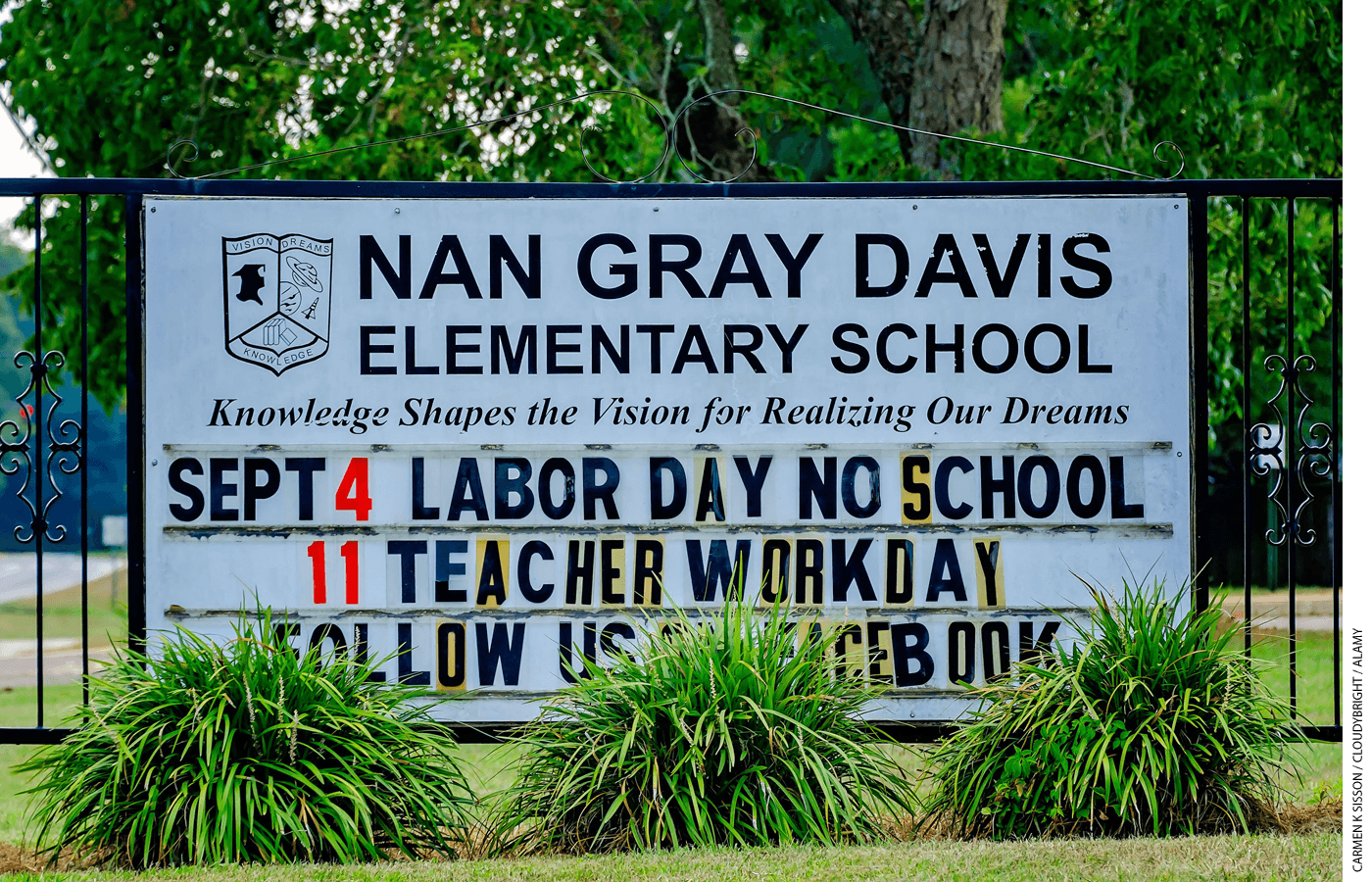
But there is another, quieter policy in play that is reducing students’ regular access to school. Districts keep the label of a traditional five-day calendar while repeatedly closing schools to students on otherwise ordinary weekdays. Districts use various terms to describe these closures, including teacher workdays, professional development days, and clerical days, among other terms of art. But they all mean the same thing for parents: a day their child won’t receive instruction and will instead need to be cared for outside of school.
Unlike the healthy debate that accompanies the switch to a four-day school week, this kind of school calendar fragmentation has received little national attention. It deserves more.
Time Matters
In the American Educational Research Journal, Matthew Kraft and Sarah Novicoff systematically review 74 rigorous studies on the role of time in student learning, concluding that additional time in school generally improves student achievement and that disparities in instructional time across public schools are an overlooked form of educational inequality.
Kraft and Novicoff document that the typical American public school is in session for about 179 days and 1,231 total hours each year. Yet students attending schools at the 90th percentile of annual time receive nearly 200 more hours of school per year than students at the 10th percentile—a difference equivalent to more than two additional years of school over the course of a child’s K–12 education (see “Time for School,” research, Winter 2025).
That variation is not merely a matter of when schools start and finish each day or whether districts formally adopt four-day school weeks. It can also arise through the less-visible accumulation of student-free weekdays inside calendars that are still labeled “traditional.”
School Weeks Interrupted
This concern over excessive weekday closures is not limited to one district or one state. In Fairfax County, Virginia, parents recently objected after the district added eight early-release days for elementary students for professional development and planning. According to Education Week, when those early-release days were included with holidays and other staff-development days, students were scheduled to receive full, five-day instructional weeks only a little more than half the time. The Fairfax County controversy reflects a broader reality: families increasingly experience the school week as fragmented, even in districts that are formally open five days a week.
North Carolina offers another useful case study. State law requires districts to provide either 185 instructional days or 1,025 instructional hours across at least nine calendar months. The hours-based option permits districts to schedule fewer than 185 school days, provided that instructional hours satisfy the state requirement.
Consider Wake County Public School System, the largest school district in North Carolina and the 14th largest in the United States. The 2026–27 traditional school calendar schedules 177 days when students will attend school and 17 teacher workdays. Five of those workdays occur before students arrive in August, and two are scheduled after students leave in June. The remaining 10 interrupt the instructional term, closing schools to students on six Mondays, three Tuesdays, and one Wednesday.
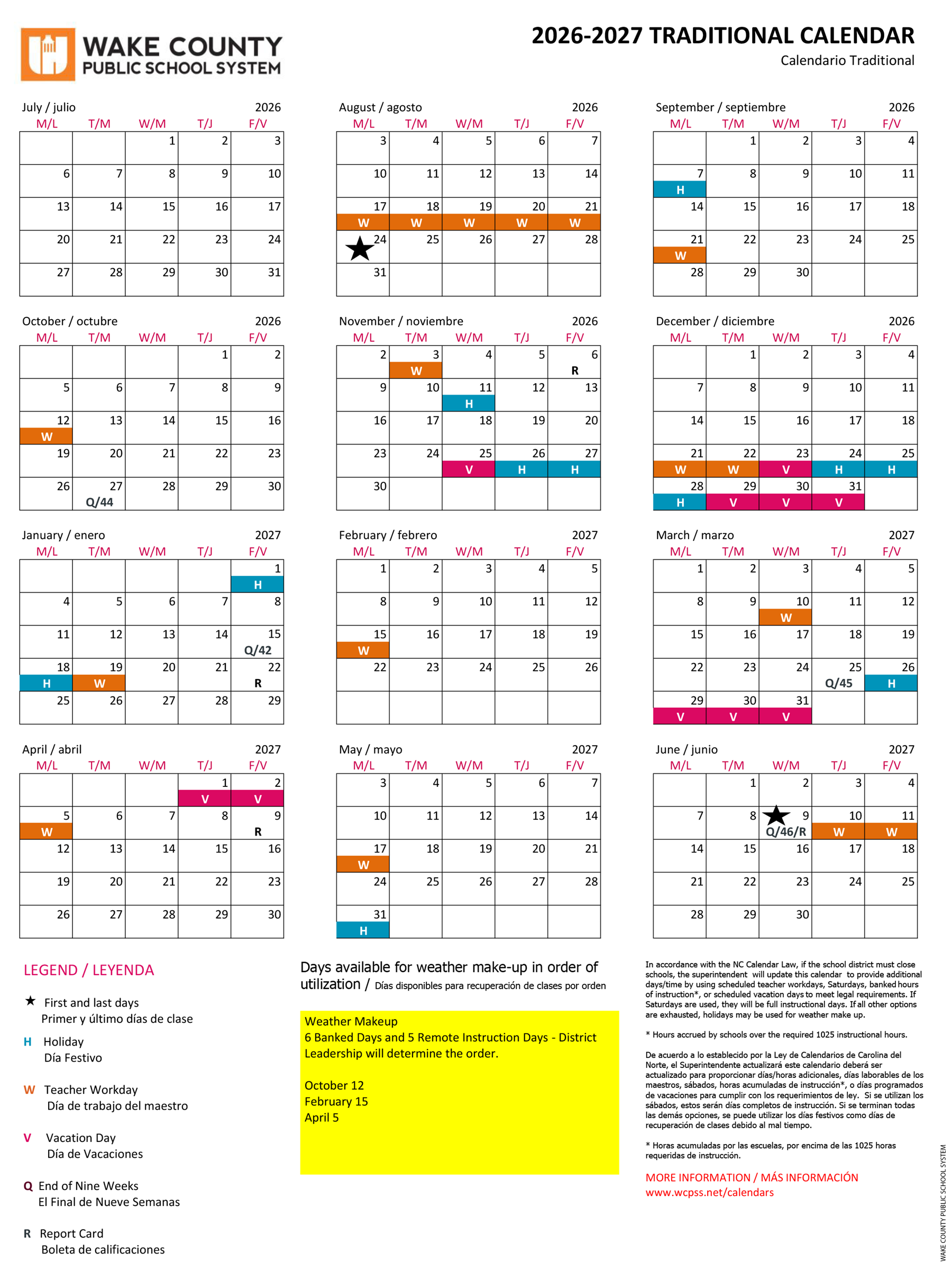
That structure is not accidental. When Wake moved from 180 to 177 student days in 2019–20, district leaders described the change as a way to create more full teacher workdays while still meeting the state’s minimum instructional-hours requirement. Reporting at the time indicated that teachers and members of the superintendent’s teacher advisory council had urged the district to replace early-release days with full workdays, which they saw as more useful for planning, collaboration, and grading. Whether that allocation represents a necessary investment in instructional quality or an avoidable reduction in students’ regular access to school is worth examining.
It is worth noting that three of Wake’s in-term teacher workdays coincide with major religious observances: Yom Kippur on September 21, Eid al-Fitr on March 10, and Eid al-Adha on May 17. School calendars in diverse communities may reasonably incorporate major religious observances, even when those days are not formally designated as holidays. But the overlap does not explain the broader pattern of repeated student-free weekdays. It remains a policy choice for which the families of Wake County Public School System deserve an accounting.
To put those numbers in perspective, I compared Wake’s calendar with the posted 2026–27 calendars of the five largest school districts in the country (see Table 1). The terminology and use of student-free days varies across districts—“teacher workday,” “professional development day,” “teacher planning day,” “clerical day,” and “pupil-free day” are not perfectly interchangeable. But each category captures a closely related choice: a full weekday set aside for staff purposes when students do not receive their regular instruction.
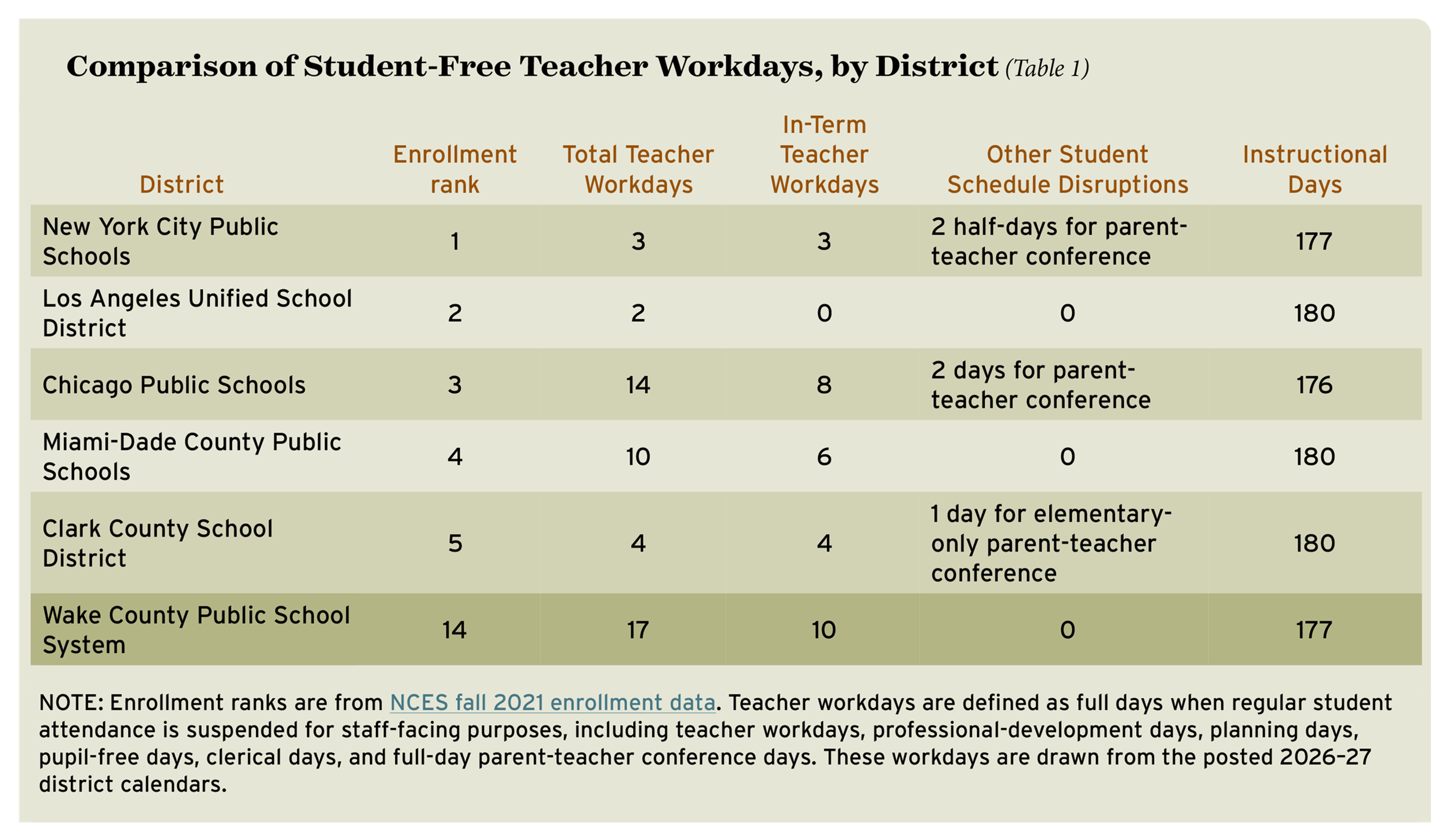
Wake’s 177 days of instruction are not what distinguishes the district; New York City and Chicago public schools provide comparable totals. The more revealing comparison is the number of full weekdays during the instructional term when Wake students are out of school for staff-facing purposes. On that measure, Wake stands apart.
Wake County itself tells families that when students attend school every day, they build “strong habits, relationships, and learning momentum,” and that missing just a few days each month can make it harder to keep up. The district is now reinforcing that message by launching an Attendance Task Force and planning a community campaign to promote regular attendance. These are worthwhile efforts. But instructional continuity should not be treated as essential when families make attendance decisions and incidental when school systems design calendars.
Closed Schools and Open Questions
Professional development is not incidental to school quality, and full-day in-service time is not uncommon. A recent nationally representative Education Week survey found that 72 percent of educators reported their district or school uses full-day in-service days during the school year; when asked when they would most prefer to receive professional development, educators selected that option more often than any other. But accepting the value of professional time does not settle how much student-free time should be scheduled, where it should fall on the calendar, or whether a district’s allocation is acceptable (much less optimal). Seventeen teacher workdays is a choice that merits debate. Like every education policy decision, there are trade-offs to be weighed, such as possible benefits to teacher practice exchanged for lost instructional continuity and disrupted family routines.
What exactly is accomplished on teacher workdays? How much is devoted to mandatory training, collaborative planning, grading, or parent communication? What evidence suggests that closing schools to students on 10 weekdays during the instructional term produces benefits sufficient to justify the lost continuity and family disruption? Why does Wake require substantially more such days than the five largest school systems in the country? These are the type of questions we routinely ask about other education policies that affect students’ opportunity to learn.
EdNext in your inbox
Sign up for the EdNext Weekly newsletter, and stay up to date with the Daily Digest, delivered straight to your inbox.
The burden these calendar choices place on families is not abstract. As of May 2026, Care.com reported the average starting wage of a babysitter in Raleigh, North Carolina, was about $19 per hour. For a seven-hour school day, that amounts to at least $134 per child. Accounting for Wake’s 10 in-term teacher workdays, a family relying on paid care could spend more than $1,300 per child. Many families simply cannot afford that expense. Instead, parents miss shifts, use scarce leave, rely on relatives, trade favors with neighbors, or seek out one-day camps, where prices range from $55 to $99 per day. Families with kindergarten-aged children or children with disabilities may find their options particularly limited.
An informal infrastructure has emerged to help families manage the mismatch between school calendars and work calendars. On WhatsApp, parents circulate links to spreadsheets of camps and one-day programs, while providers market coverage for scattered weekdays when school is closed but workplaces are open. These arrangements may solve a practical problem for individual families, but their necessity underscores the broader consequence of repeated student-free weekdays during the instructional term.
“School is not childcare” is the familiar response. Of course it is not. School is far more important than childcare. And its predictable operation is one of the public goods it provides. A reliable and predictable school week allows children to develop routines, parents to remain employed, and families to organize their lives around a stable institution. A calendar that repeatedly shuts out students from school on ordinary weekdays is not just an administrative decision. It is education policy, family policy, and labor-market policy, and it hasn’t been given the opportunity for public input that it merits.
About Time to Care About Time
This is an especially peculiar moment to be incurious about time in school. A recent analysis of pandemic recovery efforts notes North Carolina’s chronic absenteeism rate remains 10 percentage points above pre-pandemic levels. In 2025, a quarter of the state’s students were missing 10 percent of the school year. State leaders emphasize, correctly, that chronic absence threatens student learning and that schools must rebuild consistent attendance habits after the pandemic.
And North Carolina students remain behind academically. In math, the average student is performing about 0.41 grade equivalents below 2019 levels. In reading, the average student is 0.69 grade equivalents below 2019 levels.
An individual teacher workday is not the same as a student deciding to skip school. But Wake’s own argument about attendance rests on the cumulative value of ordinary school days: habits, relationships, and learning momentum. If those things matter when a family schedules a vacation, they should matter when a district constructs its calendar.
The cumulative loss and fragmentation of regular school access is rarely treated as a policy outcome in its own right. We count formal four-day-week districts. We track chronic absenteeism. We study pandemic learning loss. Individual district calendars may make student-free weekdays visible to families who know where to look. But states do not routinely compile and report comparable measures of how many full weekdays districts close schools to students for staff-facing purposes or how those numbers compare across districts. They should, and researchers should study this quieter form of calendar fragmentation and its implications for students and families.
The five-day school week is a commitment to regular access to instruction, teachers, routines, meals, peers, and opportunity. Yet in Wake County’s 2026–27 calendar, students will experience only two uninterrupted five-day instructional weeks in each of four months of the school year: September, November, December, and March. That inconsistency should raise a larger question for education policymakers everywhere: How much student learning is lost, one ordinary weekday at a time, by district policies that intentionally disrupt instruction?
Anna J. Egalite is a professor of educational evaluation and policy analysis at North Carolina State University and a visiting fellow at the Institute for Governance and Civics at Florida State University.