


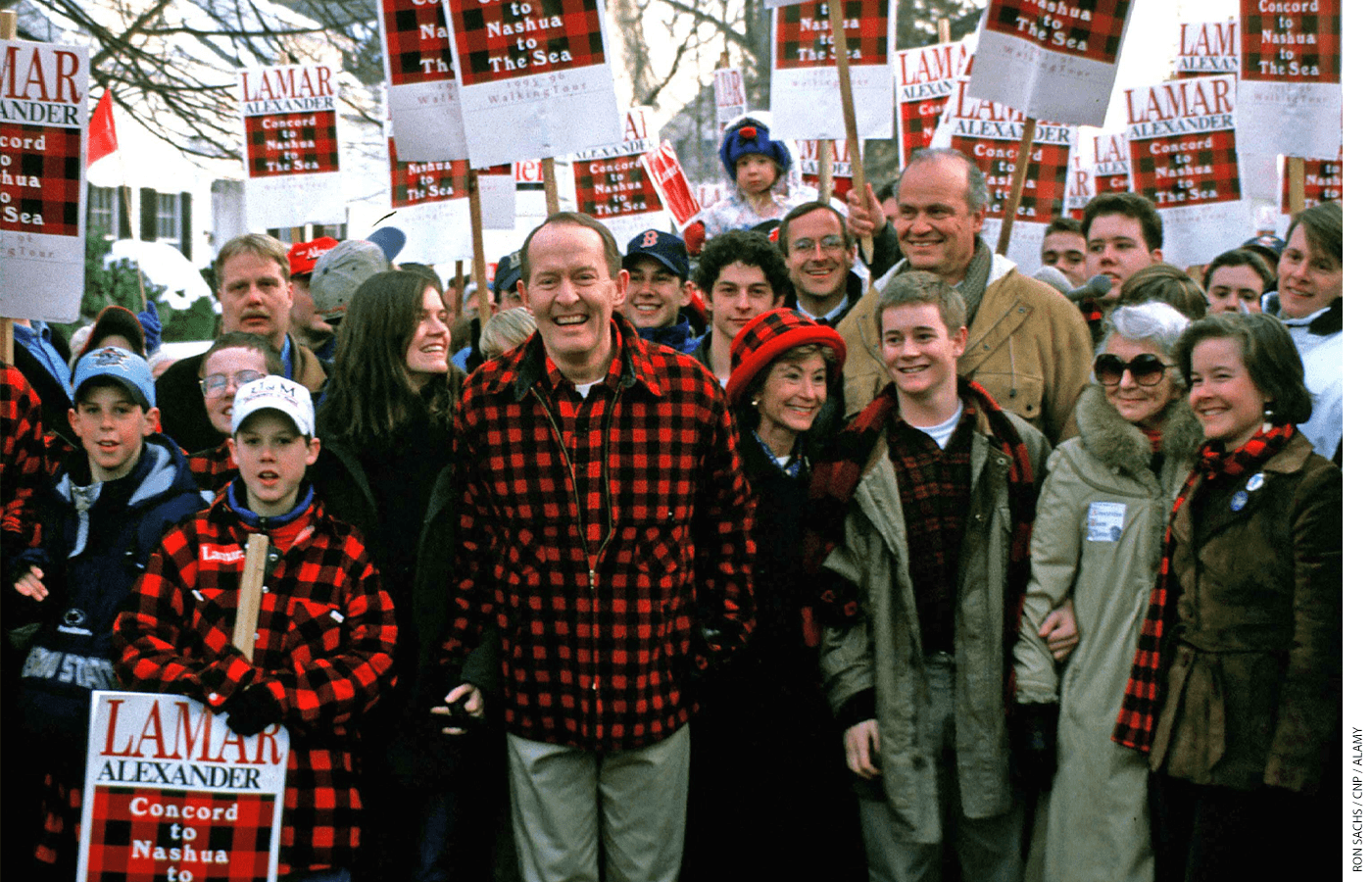
Most books about governing start with a theory of how the world works and how to solve its problems. Marxism. Capitalism. Communitarianism. Post-liberalism. The theory is the book’s throughline and takeaway. Works from the modern American right are no different. Since the 1980s, conservatives have mostly stuck to a familiar ideology, a suite of principles like limited government, free markets, law and order, federalism, and originalism. Whether the book is on the administrative state, schools, housing, or something else, you could count on the author’s focus on these principles.
Lamar Alexander’s compelling new memoir, The Education of a Senator: From JFK to Trump, is different. It is all but ideology-free. This is the book’s great strength and its occasional weakness. It was also Alexander’s great strength and occasional electoral weakness as a public servant. As a young congressional and White House aide, governor and education secretary, and three-term U.S. Senator, Alexander was pragmatic and results-oriented. He developed a disposition to match; he was understated, accommodating, and diligent. What seemed to drive him were not grand theories but traits regularly found in leaders of the pre-ideology era: Ambition, love of community, practical wisdom, and a sense of public duty.
That suite of characteristics is what ultimately serves as this book’s throughline and takeaway. It helps the reader understand why Alexander was so successful as a state leader and why his reflections on that time seem so smooth and charming. It helps the reader understand why he was so frustrated by his unsuccessful, decade-long pursuit of the presidency, why the Republican electorate chose not to nominate him, and why this part of the book has more than a whiff of bitterness. And it helps the reader appreciate why his final act as the consummate federal legislator was so productive and what the nation has lost with his retirement.
Lamar Alexander was the classic talented striver. From an early age he was sharp, conscientious, and personable—his mother once told a newspaper, “An exceptional IQ is not going to do you much good if you can’t get along with other people.” In 1957, he was elected Tennessee governor of Boys State, a kind of development league for aspiring politicians. But it’s not clear why he ran. Indeed, a pregnant, recurring theme of the book is his beloved, lively wife Honey’s asking him why exactly he wants to pursue the next thing. But seeking promotions was something he couldn’t seem to shake. When he got to the U.S. Senate at the end of his career, he quickly pursued party leadership posts, and after landing a big one, suffered through it until realizing it wasn’t for him.

by Lamar Alexander
Post Hill Press, 2026, 568 pages, $37.50
For many Republicans of later generations, the principles of modern conservatism were factory settings. If you were reared in the Reagan era, you knew what it meant to be conservative. But Alexander, born in 1940, was shaped by the more philosophically amorphous Eisenhower-Nixon-Ford era (he was sworn in as governor a year before Reagan became president). So while Alexander was patriotic and committed to service, he was neither genetically hardwired nor politically assimilated to a firm governing ideology. But he believed he should lead. He explored a run for the U.S. Senate at age 30 and ran unsuccessfully for governor at 34. Four years later, in 1978, despite still struggling to “say precisely why I wanted to be governor and what I hoped to accomplish,” Alexander ran again and won.
This is when we begin to see Alexander’s civic virtue in action. He worked closely with several Democratic leaders to figure out how he could assume the governorship early because his corrupt predecessor was abusing his authority on the way out. Alexander understood what the public interest demanded, but he wanted to find a lawful, procedurally sound way to carry it out. Rather than looking at the crisis as an opportunity to demonstrate brash, Napoleon-style, go-it-alone leadership, he teamed with others and got to a consensus solution.
This bent for collaboration is also a recurring theme. His most impressive gubernatorial accomplishments were made in conjunction with legislative, business, and local leaders. These included wooing foreign carmakers to Tennessee, modernizing the state’s highways, enacting K–12 education reforms, and the brilliant “Homecoming ’86” initiative (which encouraged towns to learn and share their histories and invite former residents to return for local celebrations). As notable as these wins were, none were particularly conservative. They seemed commonsense to Alexander and many others, and they were designed to help Tennesseans regain confidence and access better schools and better jobs.
The early sections of the book are as country lawyer as you can get—literally and figuratively. Alexander was raised in a rural area, went off to get a law degree, and eventually returned home to serve. But beneath his gentlemanliness and affability is shrewdness. Early on, his sentences and chapters are short, his language folksy, but lessons about judgment and tactics abound. Every page seems to have a quaint, aphoristic story; you think you’re being gently entertained until you realize you’ve been convinced of something. No overarching thesis is to be found, just punchy bits of wisdom. But the homespun style belies a subtle sophistication: No rube would begin a book with a story about the crimes of a corrupt Tennessee governor after suffering an election defeat and then end it with President Trump’s behavior on January 6.
I learned that Alexander deserves credit not just for leading but catalyzing the modern education-reform movement. His governorship (1979–1987) preceded the advent of charter schools and vouchers, the Charlotteville summit, and the nationwide spread of accountability systems. He pushed for programs for gifted high schoolers and was an early adopter of computers in schools. His efforts at teacher-evaluation reform and performance pay came decades before Race to the Top. (His education policy consigliere was a Vanderbilt professor he’d met a decade earlier in the Nixon White House: Checker Finn.)
Alexander’s education accomplishments span the book. He was a successful U.S. Secretary of Education under President George H. W. Bush, introducing state-level results from the Nation’s Report Card and pushing the “America 2000” agenda that featured standards, assessments, accountability, new schools, and more. K–12 reform was also his signature achievement in the U.S. Senate (more on that below). The only disappointment along these lines is the short shrift Alexander gives to his time as president of the University of Tennessee. This discussion is fewer than three pages and offers little insight beyond confirming the difficulty of leading a college when faculty have so much power.
As soon as Bill Clinton defeated Bush in 1992, Alexander set his sights on the White House. Though he was unquestionably qualified and, in my view, would’ve made an excellent president, he lost the nomination to Bob Dole in 1996 and to George W. Bush in 2000. Alexander’s assets as governor—a low-key manner, a penchant for finding consensus, a disinterest in ideology—became a liability in a national primary. He was hit for raising taxes, and a negative ad called him “liberal Lamar.” Elsewhere, he was labeled a “moderate”—a characterization he “detested.” But even Pat Buchanan, his colleague from the Nixon White House, told him, “Your trouble is that you’re not an ideologue.”
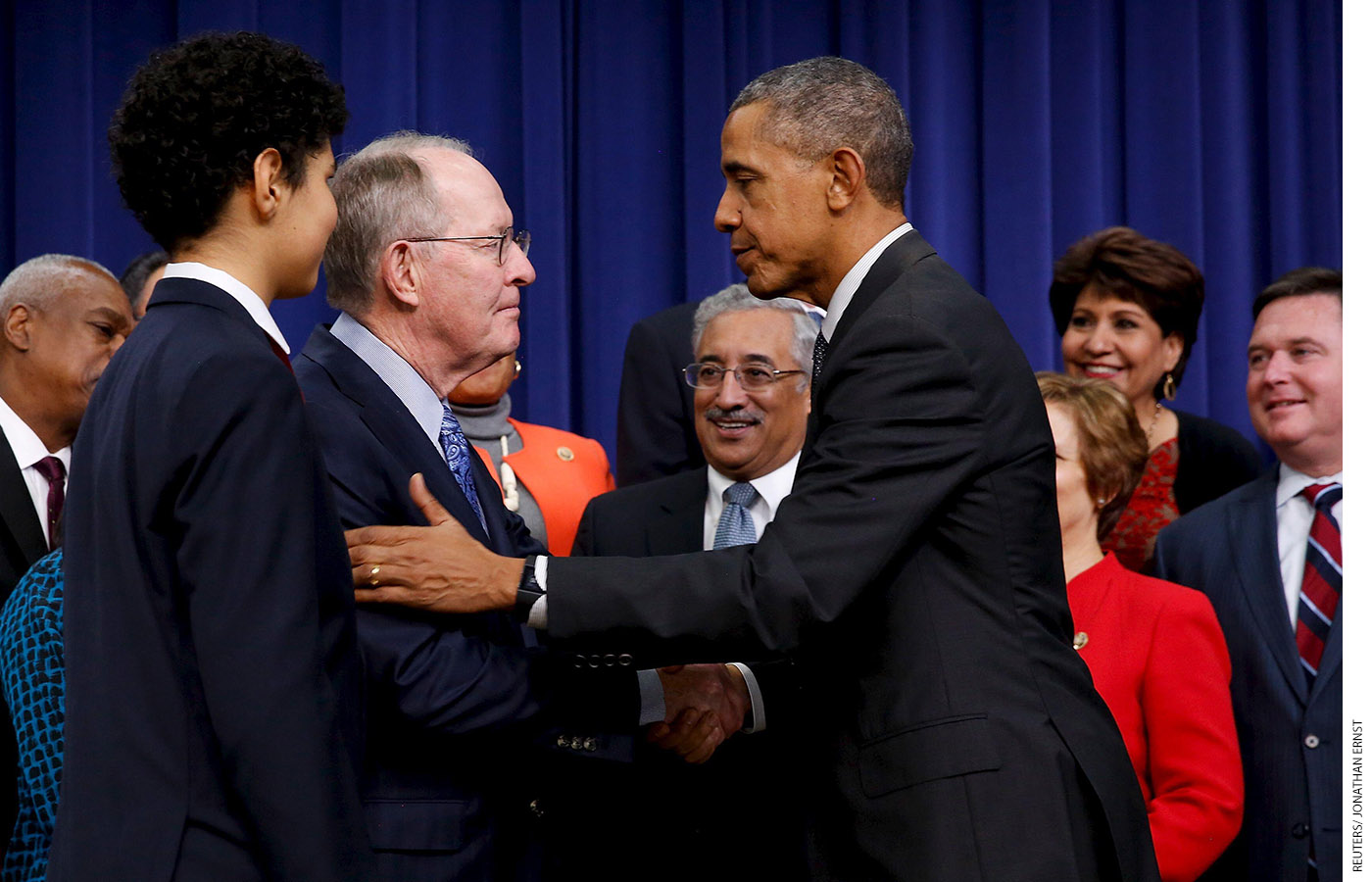
Alexander still seems bruised by these losses. His criticisms of H. W. Bush, Clinton, W. Bush, and Obama have an I-would’ve-done-better tinge to them. Three times he argues that the first Bush should’ve focused on the home front swiftly after the Gulf War and used education to explain the entire domestic agenda. Clinton’s “bimbo eruptions . . . soiled his legacy,” and his healthcare effort was a “complicated flop.” W. Bush was “born on third base,” and his “Spanish speaking was only slightly less butchered than his Texas English.” He describes Obama as a disinterested senator, haughty in meetings, and clumsy in interpersonal relations. Alexander’s wilderness phase continued, I’d say, through his first few years in the Senate (he was first elected in 2002). His conference leadership role required a level of partisanship that simply didn’t fit.
The book’s final section, when Alexander becomes chair of the Senate’s Health, Education, Labor, and Pensions Committee, is most consonant with other political memoirs. Alexander also returns to folksiness and generosity, for instance dedicating paragraphs to the virtues of specific Senate colleagues. This section is also a good read and historically valuable, thanks to long, revealing first-person accounts of important events. The reader becomes a fly on the wall as Alexander negotiates with other senators, takes calls from presidents, and grapples with Trump’s first impeachment trial. (He had retired by the time of the Senate vote in the second trial.)
EdNext in your inbox
Sign up for the EdNext Weekly newsletter, and stay up to date with the Daily Digest, delivered straight to your inbox.
Here we get to see Alexander at his best. Though he made his name as a state executive, he was arguably the best federal legislator of the 2010s. He could be by turns humble, accommodating, principled, curious, and tough. But he was always focused on getting a result. Indeed, he draws a distinction between “conservatives who think their job is finished when they make a speech and conservatives who want to govern.” Though his leadership in passing the “21st Century Cures Act” in 2016 was essential, the best example of his governing skills is his indispensable leadership of the long-delayed reauthorization and reform of the No Child Left Behind Act (NCLB) the year before.
By the 2010s, the American public, education stakeholders, and Washington leaders had all soured on this once promising K–12 education law. But nasty politics and inept leadership had prevented meaningful, comprehensive change. Alexander was out of office when NCLB became law in 2002, so he came at its reauthorization with relatively fresh eyes. His experience as a governor and education secretary gave him uncommon stature during policy formulation and negotiations. His collaborative but relentless style greased the legislative skids. And his expert management of the president got it across the finish line. Even President Obama called it a “Christmas miracle.”
Whether NCLB’s reauthorization—the Every Student Succeeds Act (ESSA)—was good for student achievement is an open debate. I for one had hoped that learning outcomes 10 years after ESSA would be higher across the board. They aren’t. But that could be due to forces beyond the law. Nevertheless, NCLB had to be replaced and Uncle Sam forced to take a step back. Neither of those things would have happened were it not for Lamar Alexander’s abilities and commitment to ending the era of federal “mother may I” education policy.
I’m hard-pressed to name an American in my lifetime who can rival Alexander’s record as a governor, cabinet member, and legislator. Though his courteous manner and non-ideological approach to governing were bugs as a presidential candidate, they were features of what might be the most statesmanlike career of our time.
Andy Smarick is a senior fellow at the Manhattan Institute and a writer for the Substack “Governing Right.”
Suggested citation format:
Smarick, A. (2026). “The Country Lawyer’s Guide to Governance: As governor, education secretary, and senator, Lamar Alexander left his mark on American Education.” Education Next, 26(2), 28 May 2026..