


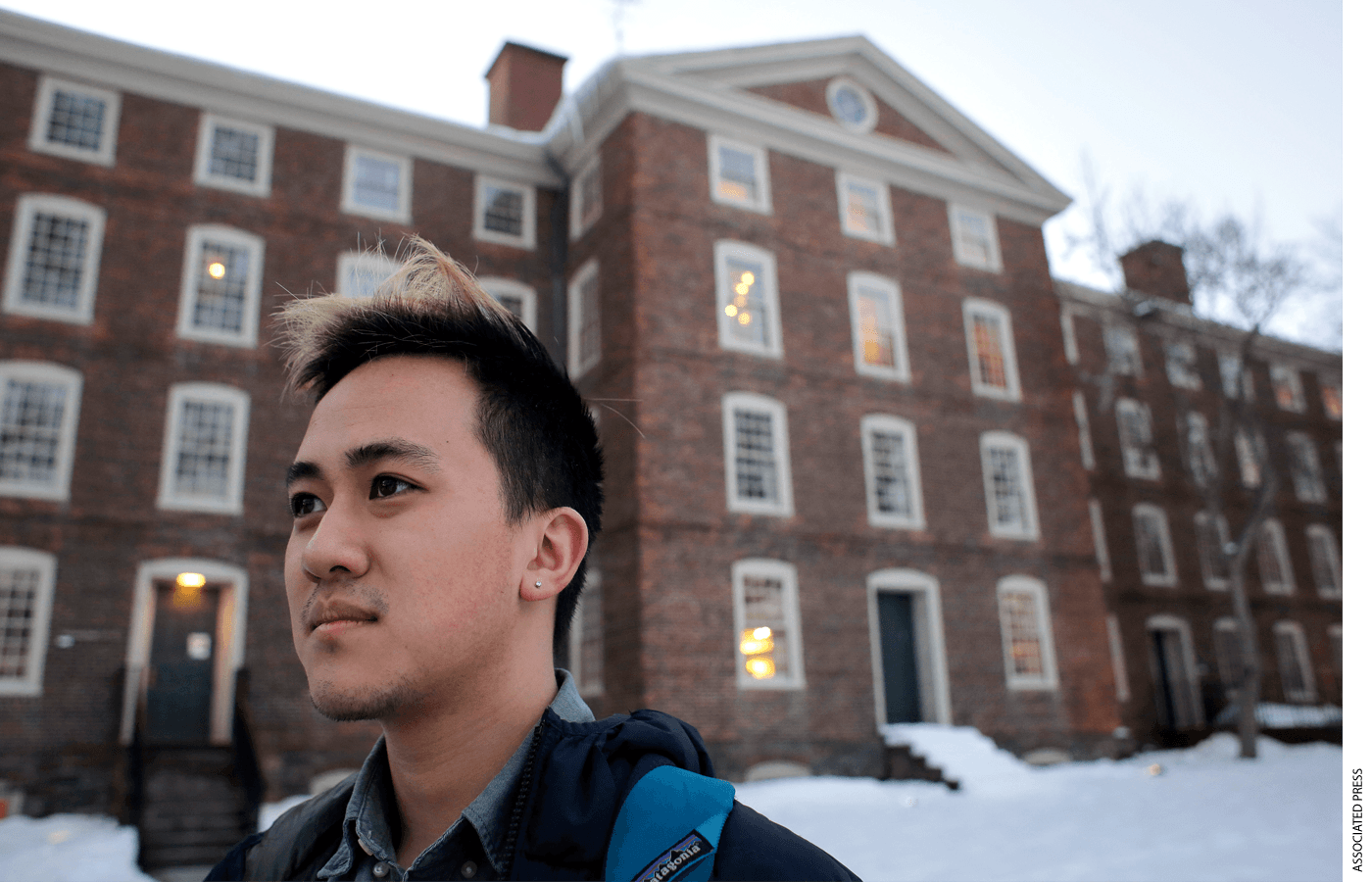
Harvard College freshmen Sophie Nguyen and Minh Nguyen look a lot like other first-year students at one of the most selective schools in the country: They work hard, achieve a lot, stay busy, and are usually pretty tired.
They are also typical in another way: As children of first-generation immigrants, they’ve had access to educational opportunities their parents didn’t. Stories like theirs appear on campuses all over the United States.
But as second-generation Vietnamese Americans, something more specific is shaping their experience. They come from a community where education—and especially getting into college—has long been seen as the clearest path to succeeding in America. In just one generation, Vietnamese Americans made a striking leap in education attainment, more than almost any other immigrant group.
And they did it mostly through the public school system.
What made that kind of mobility possible, especially for families who arrived as refugees with limited resources? Looking at the systems and social factors behind this progress reveals the conditions under which public education can create opportunity for disadvantaged communities in the U.S.
To understand how the Vietnamese community progressed from wartime combatants to postwar refugees to low-status immigrants to college-going Americans in just 50 years requires not only historical context but also an appreciation for the community’s cultural distinctiveness and intergenerational dynamics.
After the War: The First Generation
Following the fall of South Vietnam in 1975, approximately 125,000 Vietnamese refugees were resettled in the United States. Additional waves arrived through U.S.-led programs and family reunification. Before the war, Vietnamese immigration was minimal, with fewer than 1,000 residents in the country. By the early 21st century, the population had risen to over 1.6 million.
Many early refugees faced significant challenges: limited English proficiency, unfamiliarity with American culture and institutions, and economic hardship. They often resettled in working-class neighborhoods and enrolled their children in public schools.
Second-generation children like Sophie recognize the impact of these early conditions.
“My parents didn’t know any English coming in,” she says. “And then [there’s] a lack of knowledge or just awareness about what the environment’s like, because you’re coming into a completely unfamiliar territory.”
The first generation was also constrained in its education attainment. According to data from the Migration Policy Institute, first-generation Vietnamese immigrant adults are less likely than both U.S.-born Americans and the overall immigrant population to hold college degrees, with about 29 percent reporting a bachelor’s degree or higher. Concurrently, a sizable share of first-generation Vietnamese adults lacks a high school diploma, reflecting the education disruptions and economic circumstances that shaped their migration and resettlement.
Sophie additionally attributes the low education attainment of her parents’ generation to a commitment to their children.
“My parents did a lot of part-time work, and they went to community college, where they had to drop out because of family reasons,” she says. “I think growing up, my parents contributed so much to help me succeed and get to where I am today, so I wanted to give back to them, even though they didn’t expect me to do that in the first place.”
Driven to Learn: The Second Generation
Compared to their parents, the education achievements of the next generation have been remarkable. Analysis by the Pew Research Center shows that U.S.-born Vietnamese Americans demonstrate high academic achievement and college attendance relative to their families’ initial socioeconomic status. They are far more likely to pursue higher education than their foreign-born counterparts. Among adults aged 25 and older, only 19 percent of U.S.-born Vietnamese have a high school education or less, compared to 51 percent of the foreign-born. More than half of U.S.-born Vietnamese adults have attended college, and 55 percent hold at least a bachelor’s degree.
The academic success of second-generation Vietnamese Americans cannot be understood solely through statistics. Examining the broader systems and conditions that shaped their trajectories reveals several patterns.
One of the most prominent is a high level of education aspiration. Studies of Vietnamese American communities consistently find that education is viewed as the primary pathway to economic security and upward mobility. In fact, compared to Cambodian, Hmong, and Laotian Americans, “Vietnamese Americans stand out as having extraordinarily high average values” on education, wages, and managerial or professional employment. Achievement is a cultural value; in other words, many Vietnamese American students grow up with strong expectations to complete college and pursue professional careers.
The research is supported anecdotally. Minh recalls his family’s intergenerational emphasis on education. “College was basically assumed,” he says, even though his parents did not fully understand the U.S. education system. Sophie agrees, noting how her parents’ limited formal education shaped her own academic drive. “I think that’s why I put a lot of expectations and pressure on myself, especially in middle and high school, to get involved with clubs and do well in school,” she says. Their reflections illustrate how statistical patterns of mobility are often experienced as lived responsibility within families.
But sometimes responsibility veers into pressure.
“My parents were pretty harsh on me when it came to education,” Minh remembers. “They wanted pretty decent grades. They just wanted to try out everything. Moving to 7th and 8th grade, when they found out about the SAT, they made me do, like, five hours a day after school.” Whether experienced as obligation or pressure, intergenerational expectations among Vietnamese Americans serve as a powerful motivating force in education achievement.
Equally important are the dense social networks shaping students’ educational environments. Within Vietnamese enclaves, families are connected through churches, temples, businesses, and neighborhood organizations. As described in Growing Up American, an influential book by Min Zhou and Carl L. Bankston about the postwar Vietnamese American experience, these networks create a system of support and social accountability. Students receive encouragement and resources from peers and community members, while academic success is publicly celebrated and failure carries social stigma. This environment serves as informal social control, reinforcing norms that prioritize academic effort and achievement.
The education patterns produced by these dynamics translate into striking intergenerational mobility. Research shows that Vietnamese Americans experience some of the largest gains in education attainment between immigrant parents and their U.S.-born children. Sociologists Van C. Tran, Jennifer Lee, and Tiffany J. Huang find that, among major Asian immigrant groups, “second-generation Vietnamese report the most intergenerational mobility; they are more than twice as likely to have graduated from college than the first generation (62.4 versus 26.0 percent).”
A Preference for Public Education
A crucial element in the education achievement of Vietnamese Americans has been a robust engagement with public schools. In contrast to other immigrant populations that make heavy use of private tutoring and ethnic schools, the majority of Vietnamese American adolescents—about nine out of 10—are enrolled in public schools, establishing them as the primary environments for this community’s academic and social development.
For first-generation immigrants, public schools played a practical role in helping students adapt to American life. ESL and bilingual programs provided linguistic and cultural skills essential for academic success. Schools like Washington High School in New Orleans became critical sites for language instruction, cultural events, and student clubs, helping students navigate a new society while preparing for college and careers.
Historical parallels can be drawn with post–World War II Japanese Americans, who, despite facing discrimination and internment, largely attended public schools and achieved education outcomes comparable to or exceeding those of native-born whites by the 1960s. Both Japanese Americans and Vietnamese Americans had to confront racial discrimination and, as newly arrived immigrants, their challenges also included overcoming language barriers.
The prevalence of public schooling within the Vietnamese American community reflects wider structural and communal factors that diminish the appeal of private education. For many refugee families, particularly in the initial years following resettlement, the high costs of private schools often presented a financial burden.
EdNext in your inbox
Sign up for the EdNext Weekly newsletter, and stay up to date with the Daily Digest, delivered straight to your inbox.
Sophie and Minh both attended public schools and remember their parents’ respective choice of those schools as based on finances.
“I think my family just made [public school] a choice because of cost,” says Sophie.
“Why did I attend a rural public school?” Minh asks. “I guess my parents . . . originally moved to Texas because it [was] a farming opportunity.”
Many families used community-based methods to support their children’s success in public education. Jennifer Lee and Min Zhou discuss this practice in The Asian American Achievement Paradox, a widely cited book that examines how immigrant families navigate and leverage community and family resources to drive education success, creating ethnic capital that helps students succeed in existing public schools. This includes affordable after-school tutoring, community-based academic help, and information-sharing about school quality, academic programs, and college admissions. For students whose parents might not be familiar with the American education system, these networks help reduce inherent socioeconomic disadvantages and guided them in navigating public schools.
As a result of this community support, Vietnamese American education mobility has occurred more through public schools than through private-school choice. It is a pattern that distinguishes Vietnamese Americans from higher-income Asian American groups that make greater use of private or selective schooling options. For Vietnamese Americans, the combination of public institutions, ethnic support systems, and strong academic expectations has allowed students to achieve high education outcomes even without extensive participation in private schooling.
Education and the Vietnamese American
The experience of Vietnamese Americans carries important implications for K–12 education policy. First, it demonstrates how public schools can serve as powerful engines of upward mobility for immigrant communities. Even when first-generation immigrants faced limited financial resources and significant language barriers, public schools were the ideal vehicle for Vietnamese refugee families to gain English proficiency, academic credentials, and pathways to higher education. The success of the second generation suggests that well-functioning public schools can play a critical role in expanding opportunity for students from disadvantaged backgrounds.
Second, the Vietnamese American experience highlights the importance of college-preparatory structures within public schools. Research discussed in The Asian American Achievement Paradox shows that immigrant communities often rely on shared information about school quality, academic tracking, and the college admissions process to help students navigate the education system. When schools provide clear guidance, rigorous coursework, and effective counseling, students are better able to translate high education aspirations into concrete outcomes.
Finally, schools can benefit from stronger partnerships with immigrant communities themselves. Vietnamese American communities frequently create informal support systems, including religious groups, neighborhood organizations, and after-school tutoring programs. These help students succeed academically and provide resources that go beyond what they get in school.
At the same time, research on Vietnamese American education notes that many school programs still lack meaningful cultural support or engagement with immigrant families. Expanding culturally sensitive programs and strengthening collaboration between schools and immigrant communities could help create the supportive environments that have been important for Vietnamese American students’ education success.
Whether these patterns of community support and education attainment will persist into the third generation of Vietnamese Americans is uncertain. Minh, for one, worries that community cohesion is softening.
“In America, I think the Vietnamese community is weakening because they don’t feel oppressed like the first generation—they don’t feel like they belong back in Vietnam—and they can’t really voice it anymore.”
Changing family dynamics may also shift education pressures and supports. “I honestly think future generations might not have the same kind of pressure,” Minh continues, “because I think parents are more focused on what their kids actually need.”
This suggests a potential transition for the third generation of Vietnamese Americans toward support that balances autonomy with academic achievement.
Whatever the future holds, the foundational role public schools have played in the mobility of Vietnamese Americans for half a century remains a powerful example of how accessible, well-supported public education can transform the life chances of entire communities across generations.
Jen L. Phan is a sophomore at Harvard College concentrating in government and history.