




In the small town of Walden, in a high mountain park in northcentral Colorado, Superintendent Amy Ward knows her families.
She knows that 64 percent of children in Jackson County live below the poverty line. She knows which ones go home to trailers with no insulation and which parents work seasonal ranch jobs.
She knows all of this because of her on-the-ground experience.
But the Colorado Department of Education (CDE) requires her district, North Park, to use a GIS-based mapping tool to identify high-poverty areas so it can qualify for certain grants and funding streams.
The tool relies on street addresses, but many homes in Walden sit on rural routes, where streets are not labeled. The mapping software can’t find the houses.
Because only a third of families had filled out the free-and-reduced-lunch paperwork, and because the technology could not locate homes without street addresses, the tool classified North Park as less poor than it actually is. The district was locked out of funding for which its students would otherwise have qualified.
Ward’s experience epitomizes a structural mismatch between the state’s policy apparatus and the more than 80 percent of Colorado’s school districts classified as “rural” or “small rural.” These districts together serve only about 16 percent of the state’s students, but they anchor communities across the Eastern Plains, the Western Slope, and remote mountain valleys where the nearest town with services can be 90 minutes away.
Despite this extreme remoteness, these districts manage to produce results that meet or exceed statewide benchmarks in key areas. And they do it inside systems that were not designed for them, at costs that policymakers do not fully recognize.
A new report from the Denver-based Keystone Policy Center documents both the strengths of these schools and the policy barriers that undercut them. The picture that emerges is of institutions doing deeply relational work while fighting a regulatory architecture built for districts 10 to 50 times their size.
Rural and Small Rural Districts in Colorado
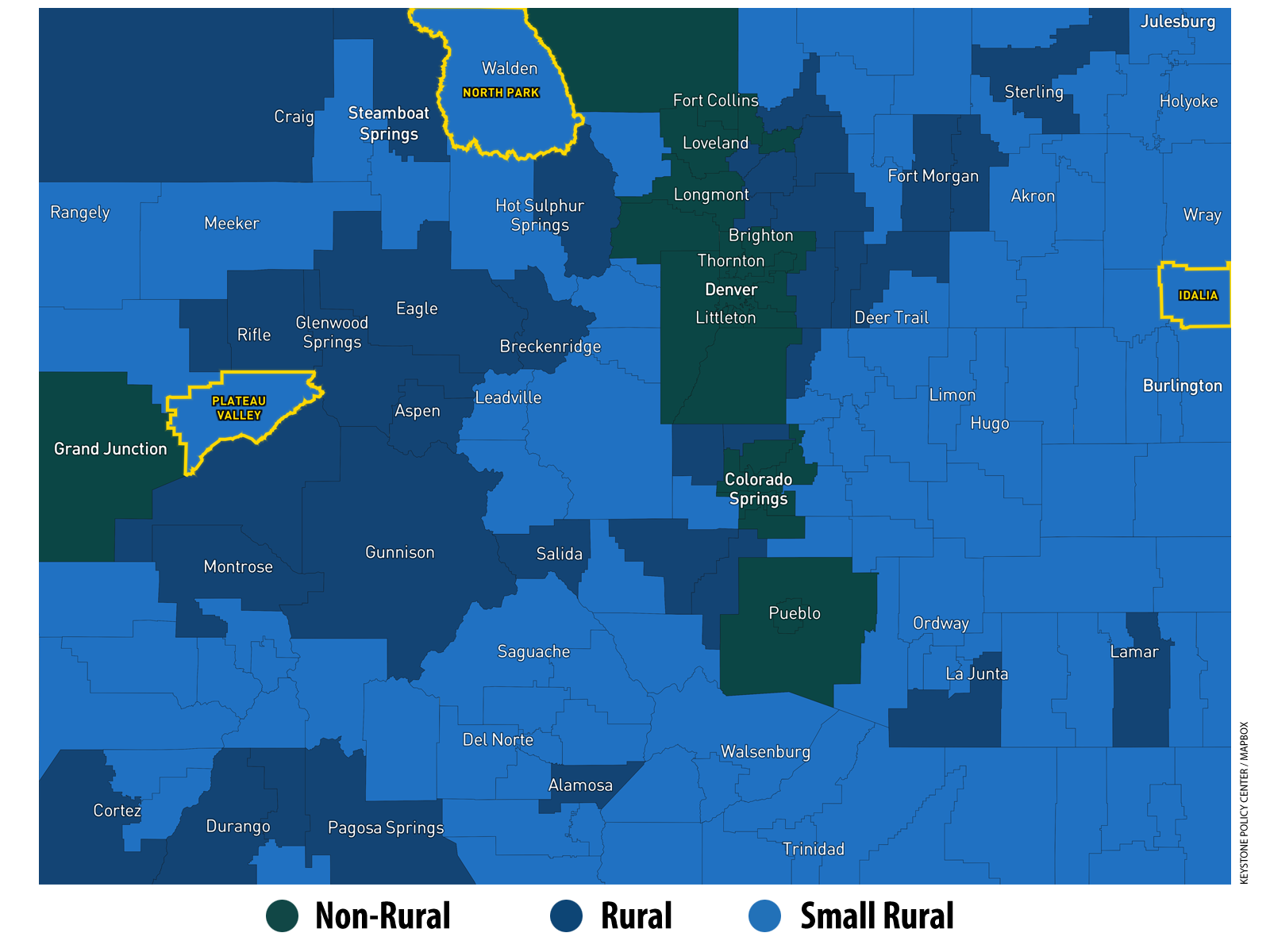
The three small rural districts profiled in the Keystone report are highlighted.
The Heart of the Community
In every interview conducted for the Keystone report, the same word surfaced within the first few minutes: relationships.
“It’s all about relationships,” said Trevor Long, superintendent of Plateau Valley School District 50, perched on the Grand Mesa east of Grand Junction, with roughly 260 students. “In a small school, we know our kids, they get to know us. No one falls through the cracks.”
Smallest of the Small (Table 1)
The three small rural Colorado school districts featured in the Keystone Policy Center’s report have staggeringly tiny enrollments compared to those of the urban centers that tend to dominate education policy conversations.
| Plateau Valley School District 50 | North Park School District | Idalia School District | |
| Number of Schools | 4 | 1 | 2 |
| 2024-25 Enrollment | 281 | 130 | 136 |
| 5 Year Enrollment Change (Statewide change -3%) |
-19% | -5% | -23% |
| Number of Full Time Employees | 23.8 | 12.7 | 15.7 |
| Average Teacher Salary (Statewide average $64,235) |
$53,319 | $53,126 | $46,149 |
Note: Statewide average teacher salary is $63,235.
Source: Colorado Department of Education
Long, who spent 15 years as a principal at an exurban high school before moving to the Western Slope, said he has watched rural students develop a confidence their suburban peers often lack. In a school where every student is needed for every activity, young people get pushed into leadership roles early.
“Kids sometimes find themselves standing on the stage with the microphone when they wouldn’t in a big suburban school,” Long said. “Everybody’s going to get a turn.”
Lenae Lengel, a kindergarten teacher in Idalia, a farming community of a few hundred people near the Kansas border, described the advantage of knowing most of her students from the time they were born. She taught their older siblings. She watched them as toddlers at Friday night basketball games. She observed them in the preschool room next door, where she shares an office with the preschool teacher.
“I know so much about my students before they ever even come to my classroom,” Lengel said, “which really sets me up to work with them in a way that’s going to be most effective.”
Her class sizes in Idalia are so small that her entire group is roughly the size of a pull-out intervention group at her previous big-district school on the Front Range. She can monitor every student’s progress in real time, pulling children for one-on-one instruction without neglecting the rest.
The data supports what these educators describe. Statewide, rural and small rural districts post higher average four-year graduation rates than non-rural districts. (Idalia maintains a 100 percent graduation rate, Lengel said.) They show higher rates of participation in dual enrollment and Career and Technical Education courses, and higher rates of CTE certificate completion. College matriculation rates are comparable to those of non-rural districts.
Average proficiency rates on state assessments are lower in rural districts than elsewhere. But many districts are too small to produce reportable data, and many use a CDE-approved local accountability system called S-CAP, which relies on peer-led reviews focused on the whole child.
These schools also serve as the civic and social hub of their towns. Ward described North Park’s 1949 gymnasium as a de facto community center: open to elderly residents for walking and pickleball during the day, an event space for everything from funerals to bingo at night. “There’s not any other place for it to happen,” she said.
Idalia superintendent Kristi Minor said driving through nearby towns that have lost their schools provides a stark visual warning. “I can’t imgine what would happen if the school was not here, because we can see it all along Highway 36, these towns that don’t have a school or a social hub,” she said. “They’re drying up.”
Dawn Thilmany, a professor of agricultural economics at Colorado State University, provided broader context. Schools and access to healthcare, she said, are the two most critical factors in whether a small town can sustain itself. On the Eastern Plains especially, the distances between towns are far greater than in states like Kansas and Iowa. The next community with services can be 90 minutes or more away, making the presence or absence of a local school that much more consequential.
The Reporting Burden
Every person interviewed for the Keystone report raised the same complaint with visible frustration: the volume of state-mandated reporting that small districts must complete.
Frank Reeves, director of operations at the Colorado Rural Schools Alliance and a longtime rural superintendent, said districts of all sizes must submit upwards of 200 annual reports to CDE. Many were created by individual pieces of legislation, some dating back decades, each living in a different statute.
“CDE doesn’t even look at a lot of those reports anymore,” Reeves said. “They don’t go anywhere. But it is required by legislation that districts submit them.”
The burden falls on every district, but its weight varies substantially by size. Large districts like Denver, Jeffco, or Cherry Creek can assign reporting duties to specialized staff. At North Park, with 113 students, two employees handle virtually all state reporting. Ward sometimes stepped in herself to lighten their load. At Idalia, Minor estimated that compliance work consumes at least 75 percent of her key staff members’ time. “We could hire another person just to do data reporting and keep them employed full time,” she said.
Minor described a particular frustration with the state’s data pipeline, which was supposed to serve as a clearinghouse, allowing districts to enter information once and letting CDE pull what it needed. Instead, she said, the pipeline has generated new requirements on top of the old ones.
CDE communications director Jeremy Meyer disputed Minor’s characterization. The pipeline, he said, does not itself create new reporting requirements; those come from state or federal law. He said the department meets regularly with district data staff to hear what is working and what is not.
Denille LePlatt, executive director of the Rural Schools Alliance and a former administrator at the Primero School District in southern Colorado, argued that the problem goes deeper than paperwork. She described the entire framework as a systems design issue.
“We’re continuing to do school the way that we’ve done school for the past 100 years,” she said. “We could work smarter, not harder, but because of the way that the system is designed, it doesn’t allow us to do that.”
The READ Act Irony
LePlatt offered a pointed example of this inefficiency. When Colorado’s READ Act, a standardized early-literacy assessment protocol, was implemented at her former district, it identified fewer struggling readers than the district’s own internal process had been catching.
“It was actually a disservice to those students,” LePlatt said. “Our standards were much higher; we were much more thorough.”
The irony is structural: A statewide policy designed to ensure no child’s reading deficiency goes undetected actually reduced detection in a district small enough to already know every child by name. In systems where teachers share an office wall with the preschool room and track student progress from birth, a standardized screening instrument can be a step backward.
Because each reporting requirement was created by a separate bill, LePlatt said, there is no simple mechanism for consolidating or eliminating them. An audit of all existing requirements would cost money the state has not been willing to spend. The Rural Schools Alliance has run bills in consecutive legislative sessions to reduce the burden, with only partial success.
Long, the Plateau Valley superintendent, described trying to insulate his teaching staff from the reporting grind. “Ultimately, when we submit, the question is, ‘Does it really connect with our kids and our community?’” he said. “Most of the time, absolutely it doesn’t. But you’ve got to do it.”
Sheldon Rosenkrance, CDE’s chief district operations officer and its de facto rural representative, said the department is aware of the burden. The State Board of Education, he said, has directed CDE to gather only what is required by state and federal law, and any new data request must be approved by a committee of practitioners from school districts.
But Rosenkrance acknowledged that the sheer volume of legislation creates a recurring problem: Every new bill can introduce a new data collection point that does not fit neatly into existing systems. Colorado’s tradition of local control, he said, compounds the complexity. Unlike Washington state, where he previously worked and where a statewide student information system automatically feeds data to the state, Colorado’s districts each use different systems.
“There’s a lot of advantages to local control,” Rosenkrance said. “But it does create some issues.”
Staffing, Housing, and the Fiscal Cliff
Finding and keeping qualified teachers is a perpetual challenge for districts that cannot match urban and suburban salaries and that sit hours from the nearest city. Rural and small rural districts have lower average salaries, higher teacher turnover rates, and a higher percentage of positions filled through shortage mechanisms such as alternative licensure and emergency authorizations.
Small But Stable Enrollment (Table 2)
Enrollment in Colorado’s small rural districts ranges from as few as 22 students to just under 1,000, while rural districts range from about 1,100 to nearly 6,800. Together, rural and small districts enroll approximately 16 percent of the state’s students, a share that has remained relatively stable over the past five years.
| Rural Districts | Small Rural Districts | |
| Number of Districts | 37 | 111 |
| 2024-25 Enrollment Range | 1,092-6,809 | 22-976 |
| Average 2024-25 Enrollment | 2,676 | 331 |
Source: Colorado Department of Education
Long described attending job fairs as a rural superintendent. Candidates try to walk past the small districts’ tables. Recruiters have to wave them over and sell the lifestyle: fishing, hunting, skiing, the four-day work week, the chance to be a head coach right away.
Ken Haptonstall, co-executive director of the Colorado BOCES (Boards of Cooperative Educational Services) Association and a former superintendent, said he used to recruit teachers from midwestern states. “Those kids like to mountain bike, so we’d tell them you have no mountains, and we’d show them pictures of mountains, and we’re on a four-day week, and you’ve got three days to go ride bikes,” he said. “The problem is, after about three or four years, if they didn’t find a significant other, they went home.”
Housing compounds the problem. Ward said North Park owns two trailers behind the school, always occupied by staff. She maintained a list of every available rental in the community, calling landlords each recruitment season. When she finally filled a school counselor position that had been vacant for seven years, she used leftover grant funds to pay for the counselor’s housing in a district-owned trailer and offered a large signing bonus.
“That’s what got her here,” Ward said. “You can’t really do that without grant funding.”
In 2023, when North Park lost a 4th-grade teacher mid-year, Ward taught the class herself rather than accept an unqualified substitute. Her principal took the remaining subjects, and the two of them finished out the semester.
At Idalia, nearly every teacher has a personal connection to the area through marriage, family ties, or upbringing. Minor credits the East Central BOCES alternative licensure program with developing homegrown talent. She herself earned her teaching and administrative credentials through alternative licensure after a first career as a state park ranger.
The financial pressures are simultaneously chronic and acute. Reeves described a fundamental instability in how Colorado funds its schools: The legislature is required by law to pass the school finance act by early April, before the overall state budget.
“They have not done either in probably 20 years,” Reeves said. “It’s always the last week of the session.” That uncertainty makes it nearly impossible for small districts to plan ahead.
LePlatt criticized the state’s growing reliance on competitive grant programs as a funding mechanism. Grants cannot sustain permanent programs, and the capacity to write and administer them is itself a luxury small districts often lack. Reeves said at one point, $420 million in state education funding was allocated through grants rather than the school finance act.
For small districts, the mathematics of enrollment decline is particularly punishing. Long said losing even 10 students represents a significant revenue loss, but the programs those students were enrolled in do not disappear. “You still have to run the same programs, even though you’ve dropped 10 kids,” he said.
The state’s enrollment averaging, which smooths year-to-year fluctuations, is being reduced from a five-year window to a shorter period, a change that could magnify the financial shock of even modest enrollment dips.
Haptonstall said the BOCES system is increasingly filling gaps that individual districts cannot manage alone. Local BOCES handle special education services, alternative licensure, and Career and Technical Education programming. His state association has set up a recruitment specialist to find speech-language pathologists, occupational therapists, and other hard-to-find specialists, cutting out private staffing companies that were charging districts as much as $180 an hour for virtual providers.
But he said many new superintendents do not even know what their local BOCES offers. “Two-thirds of these people are brand new, and they don’t even know what a BOCES does,” he said.
Haptonstall said he is urging small districts to cooperate before the state forces consolidation on them. “For the first time in my 33, 34 years, I’m actually worried that there is really a fiscal cliff,” he said. “A billion dollars this year, probably a billion dollars next year. I keep trying to tell superintendents, you really need to be proactive in your cooperative thinking.”
A Lack of Awareness
At the state level, there is a basic problem of visibility. LePlatt, who spent five years working at CDE, said department staff often lack a real understanding of how rural districts function. “When you’ve never been to a lot of the places that exist in our state, you can’t picture how it’s functioning when all you know is a [Denver Public Schools] or a Jeffco,” she said.
Reeves described a pervasive one-size-fits-all mentality in the legislature. “Everything has to fit everywhere,” he said. “And then most things don’t fit.”
Only about 15 of the 100 Colorado state legislators represent rural areas, and while those members are strong advocates, they are working against the sheer weight of numbers. Haptonstall said he experienced this firsthand while testifying before a house committee. “One of the new house members said, ‘Explain to me what a BOCES does.’,” he said. “And I said, ‘We’re here to save you all money.’”
The Folder Labeled “Vision”
Ward’s story may be the most instructive of the three. She returned to North Park in 2021 after watching the district cycle through five administrators in seven years, lose its counselor for seven years running, and see its systems collapse. The previous superintendent had worked eight days a month and did not live in the community. When Ward arrived, she opened a file cabinet and found a folder labeled “Vision, five-year plan.”
The folder was empty.
EdNext in your inbox
Sign up for the EdNext Weekly newsletter, and stay up to date with the Daily Digest, delivered straight to your inbox.
Over five years, she filled it. She rebuilt the district’s instructional framework, brought in $2 million in grants, hired qualified staff, and began seeing steady improvement in student achievement. This year, for the first time in her tenure, she did not anticipate significant staff turnover.
But she is retiring. Whether the systems she built will survive her departure is an open question, and a familiar one in districts where a single leader’s energy holds the whole operation together.
Thilmany, the CSU economist, said there are roughly 10 land-grant universities nationally with even one researcher focused on rural community issues, and perhaps 30 academics in the entire country who study them. The scarcity of research contributes to the scarcity of informed policy.
LePlatt said most people along the urban corridor, including policymakers, don’t recognize the magnitude of the problem. “When people talk about rural schools, they think they’re talking about a small, insignificant number of schools, but we’re really talking about over 80 percent of the state’s systems,” she said. “That doesn’t resonate, for whatever reason.”
Rosenkrance said CDE has tried to address this gap. Commissioner Susana Cordova attends the Rural Alliance’s weekly call of about 120 superintendents every Wednesday morning. The department has taken the state board on site visits to small communities on the Eastern Plains.
“It’s about listening, giving technical advice, and then making sure that the legislators or the governor’s office or whoever has the information they need before they make the decision,” Rosenkrance said.
In Walden, CDE’s mapping tool still cannot find the houses. In Idalia, Lengel still knows every child by name, by family, by temperament.
The question for Colorado’s policymakers is whether the systems they build can learn to see what the people inside them already know.

Alan Gottlieb is an education writer and communications consultant based in Denver. Maya Lagana is an education consultant based in Denver. Van Schoales is a senior policy director at Keystone Policy Center and a former teacher, school leader, and president of A+ Colorado.
This article was excerpted and adapted by the authors from the report “The Heart of a Rural Community: How to better support Colorado’s Rural School Districts” by the Keystone Policy Center.