


Nearly 15 years ago, I stepped into a classroom for the first time as a 3rd-grade teacher at a Catholic school in Tampa, Florida. I didn’t know it at the time, but I was beginning teaching in the midst of an ongoing experiment in Florida education policy.
Many of my students were only able to attend our school thanks to the Florida Tax Credit Scholarship, a private-school choice program designed to give lower-income families more education options. Located in a working-class suburb on the edge of Tampa, the parish church connected to our school had a thriving, diverse church-going community. But even a modest tuition of under $5,000 a year had put the school out of reach for many families. The scholarship program changed that. For the first time, families from across the parish and the surrounding community could afford to send their kids to our school if they chose. The result was a growing school that more fully reflected the spectrum of income levels and backgrounds of our community.
When I was a teacher, I mostly thought about how private-school choice affected the children in my classroom. Years later, as I went on to research voucher programs and work in education policy, I more often heard questions about programs like Florida’s from a different perspective: What about the kids in the public schools? Don’t choice programs take needed funding and hurt the students left behind? Why aren’t public dollars instead going to public schools that need them most?
Hearing these concerns about choice programs expressed so frequently, it is only reasonable to wonder what effect these programs have on public school students. In the context of Florida, was the scholarship program that served my students a good investment of scarce state funds? What have we learned from states that have tried this school choice experiment? How do they affect the students who remain in the public system? Sure, the scholarships provided opportunity to a small group of students, but at what cost?
In a research synthesis published today with the American Federation for Children, I examine these questions in the context of Florida. The analysis brings together two lines of research published in the last few years: (1) the effects of additional school spending on student achievement and (2) the effects of school choice–induced competition on public school students.
Using the highest quality research in both areas, I find that scaling Florida’s Tax Credit Scholarship Program over 15 years improved public school student achievement through competition much more than we’d expect had the same amount of new funding instead been spent directly through the public school system. In fact, the academic benefits for public school students in schools facing higher levels of competition were 11 times higher than what the best research on school spending would predict. In contrast to fearful predictions that this scholarship program would undermine public education, my apples-to-apples comparison demonstrates it proved to be a cost-effective method of raising public school achievement at scale.
Improving Schools by Spending More: High Cost, Modest Returns
Five years ago this month, President Biden signed the final Elementary and Secondary School Emergency Relief (ESSER) funding package into law as part of the American Rescue Plan Act. Distributed to K–12 school districts through the Title I formula, only 20 percent of the funding was specifically reserved for addressing the academic impact of lost instructional time from school closures related to Covid-19.
In 2024, a research team led by Professors Thomas Kane at Harvard and Sean Reardon at Stanford evaluated the impact of spending nearly $190 billion in ESSER funding on public schools. They found that every $1,000 of spending per student was associated with about 6 additional days of learning in math (0.0086 standard deviations) and 3 to 4 days of learning in reading (0.0049 standard deviations). Another research team—Dan Goldhaber of CALDER and Grace Falken from the University of Washington— found nearly identical impacts of spending on math scores but no detectable effect on reading scores. Strikingly, these findings are consistent with the results of a 2024 meta-analysis by Kirabo Jackson and Claire Mackevicius of 31 studies examining the effects of school spending on student achievement, which has become the standard reference in support of the consensus position among education researchers that boosting spending benefits students. To this point, in their July 2024 post-mortem on the success of ESSER funding, the Biden administration’s Council of Economic Advisors highlighted these three papers as evidence that federal pandemic aid contributed to academic recovery.
These findings are not surprising; we would expect that access to more resources will help students improve academically. However, the size of these gains are small in light of the cost. Using the results from one of the ESSER studies, it would take an additional $450 to $650 billion nationwide (or an extra $9,000 to $13,000 per student) just to return students to pre-pandemic levels of achievement by relying on school spending alone. This significant cost reinforces the point that Stanford economist Eric Hanushek has been making for decades: How money is spent matters a great deal more than how much. Pouring resources into a system without changing its incentives is unlikely to produce cost-efficient improvement.
The Competition Approach: Spillovers that Grow with Scale
A large body of research has also now examined the competitive effects of private-school choice programs. These studies test how public school student test scores change in response to the competitive pressures introduced by voucher and scholarship programs. Generally, they have found null to positive effects, which have often been characterized as small in magnitude. However, most have only focused on the early years of voucher programs due to data limitations and the relative youth of many initiatives. In contrast, in what is considered the most rigorous competitive effects study in the school choice research literature, David Figlio, Cassandra Hart, and Krzysztof Karbownik in 2023 examined the first 15 years of Florida’s tax credit scholarship program, covering its expansion from 15,000 students in 2003 to over 100,000 students in 2017. Their analysis compared students in schools facing comparatively higher levels of competition due to the presence of nearby private schools (55.8 percent of all students in the state) to those in schools facing less competition. To do this, the authors created a competitive pressure index which contains information on the proximity, density, enrollment, and diversity of options among private schools in the local area surrounding each public school prior to the scholarship program’s creation.
The research team found broad and growing benefits in the form of higher reading and math test scores, as well as lower rates of suspension and absences, for public school students in schools exposed to more competitive pressure. After 15 years, those students were an additional 120 days (0.166 standard deviations) of learning ahead of students in lower-competition areas. The effect was even larger (140 days, or 0.196 SD) for students from low-income families. In the education research literature, this is characterized as a medium-to-large effect. Perhaps most surprisingly, the competitive effects also grew as the voucher program scaled, a phenomenon rarely seen among education interventions. Typically, test-score gains tend to go down and costs go up as programs attempt to scale to even the size of large districts, which is the phenomenon frequently observed with one of the most effective educational interventions: tutoring.
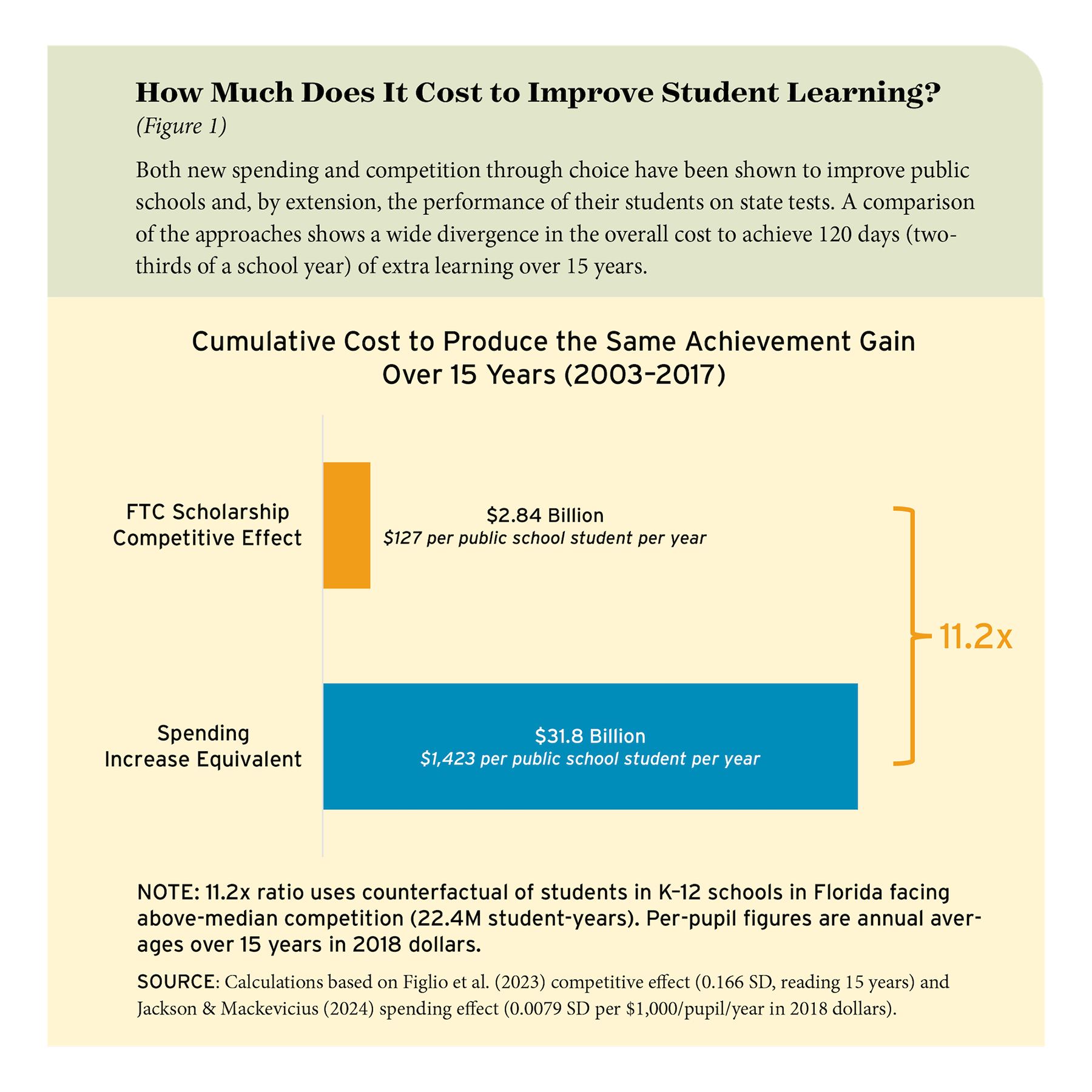
Over this 15-year period, Florida granted a total of $2.8 billion tax credits to fund the scholarship program, or $127 per public school student per year (in 2018 dollars) in those schools affected by more competition. Was that a good investment?
School Competition vs. More School Spending
Using the highest quality research in both areas, my research answers this question. To achieve the same 120-day test score gain, it would have cost Florida a total of $31.8 billion over that same fifteen years—greater than one order of magnitude more expensive (see Figure 1).
As a result of competition, the majority of Florida public school students saw academic achievement gains at least 11 times greater than we would expect from the counterfactual school spending approach. The underlying research I relied upon for this synthesis was produced by top researchers in the field and published in highly ranked, peer-reviewed economics journals. Building upon their results, my methods and calculations to create this apples-to-apples comparison are available and fully reproducible as a part of the full research synthesis release available online.
Could these results be overstated? In fact, my analysis makes a set of conservative assumptions that likely understate the effect of competition. For example, it does not include equilibrium effects (i.e., any effect of competition shared by public school students in both high- and low-competition areas), cost savings from students switching from public to private schools, or inefficiencies that are likely to emerge when attempting to spend additional funding at scale over 15 years, which would cause spending increases to produce smaller effects than the average reported by Jackson and Mackevicius. In contrast, the strength of the competitive effects produced by the scholarship program grew with program size. If anything, then, my results are a lower bound on the true return on investment.
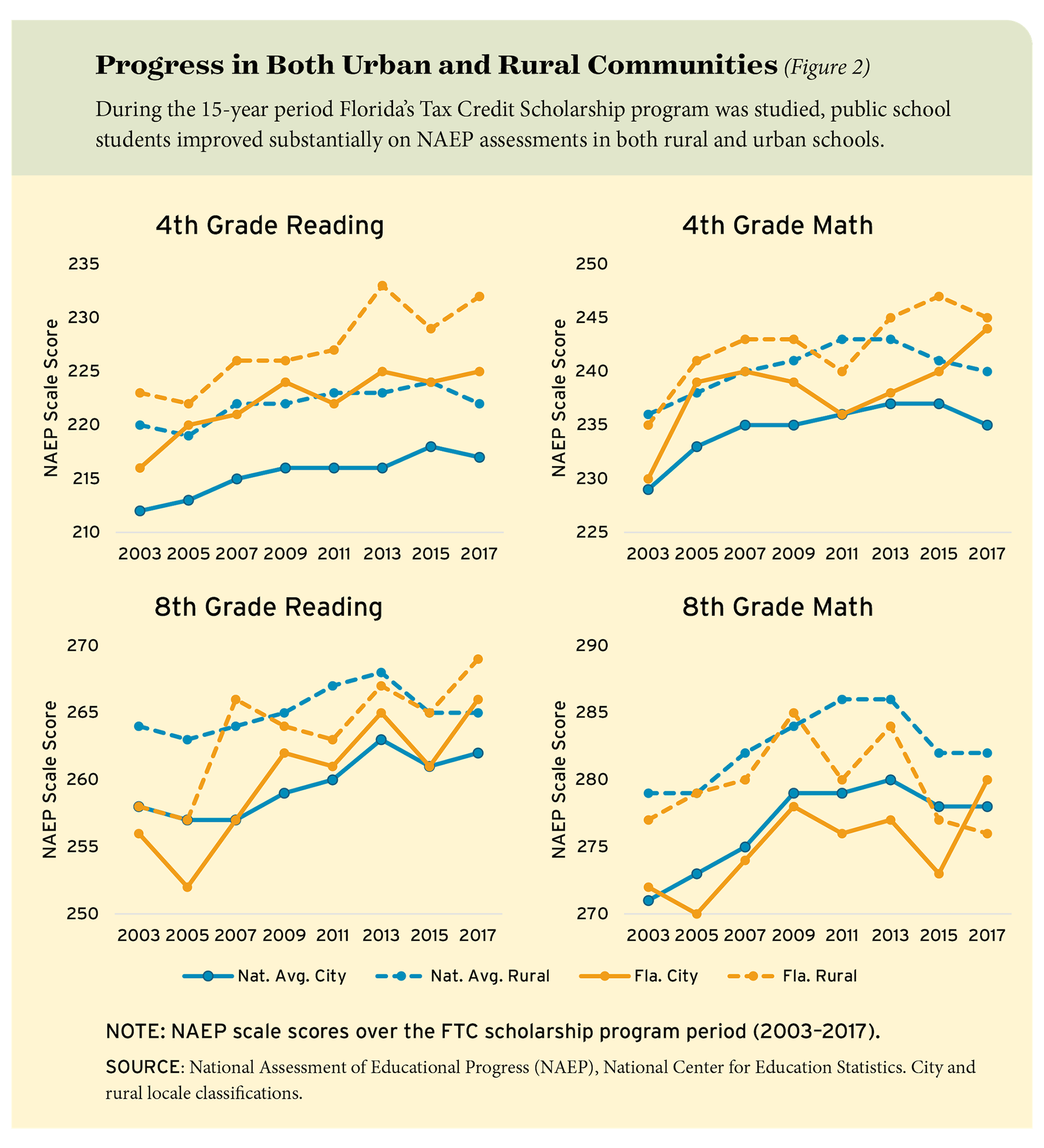
Can we be sure these effects are due to competition-driven improvement and not just students in schools facing less competition performing worse? For example, we would see positive effects of competition even if test scores stayed the same in urban areas, which tend to have higher levels of competition, but plummeted in rural areas. Using results from the National Assessment of Educational Progress (or NAEP) for 4th and 8th grade reading and math, I also test this possibility. I find that students in Florida’s rural schools made substantial progress over this same period, meaning the competitive effects found by Figlio and colleagues were in addition to the growth seen for rural public school students (see Figure 2).
School Choice Funding is Not Zero-Sum
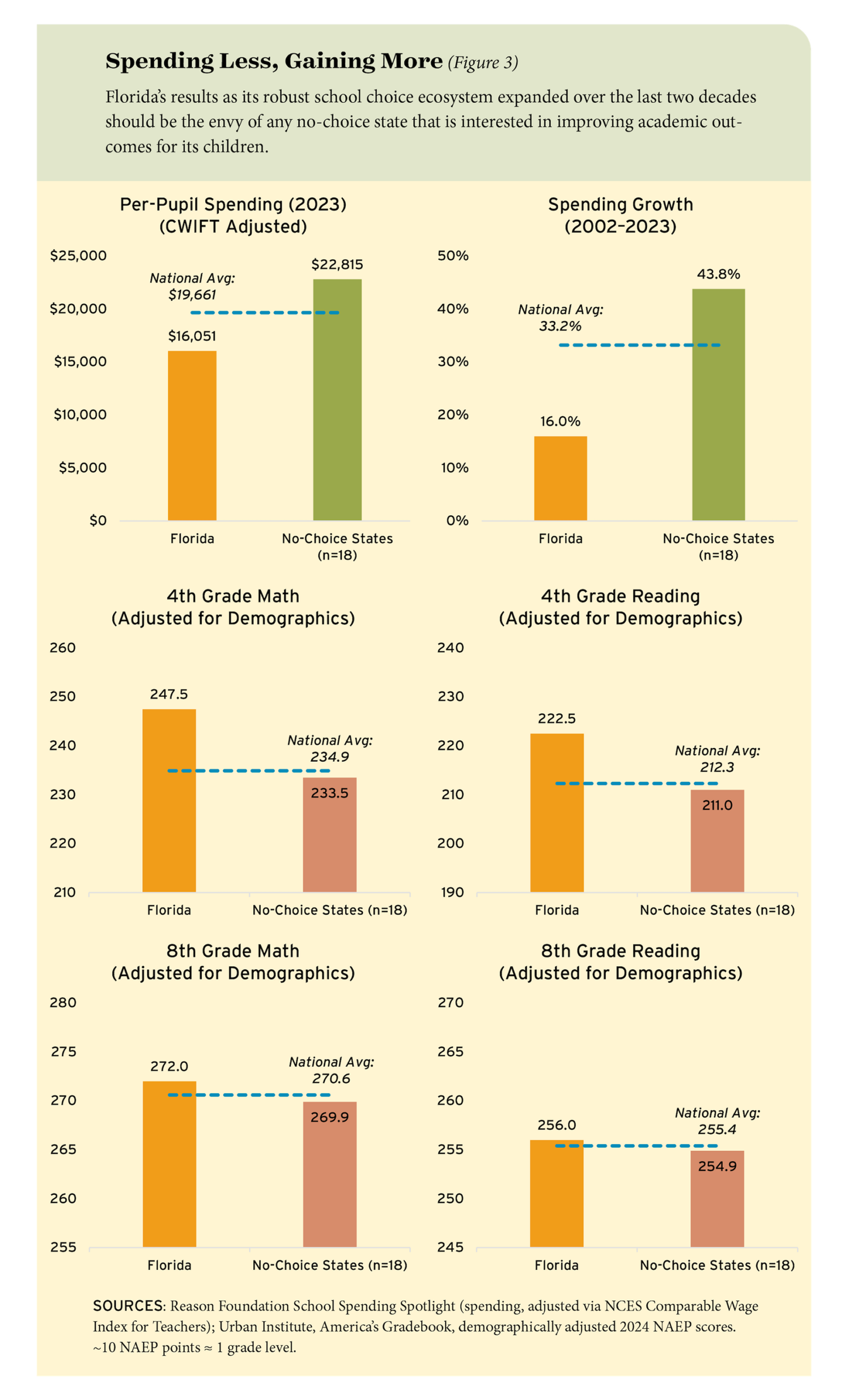
For anyone who values responsible education spending, Florida’s experience demonstrates that funding school choice was a win-win-win for students, families, and taxpayers. This need not be an either/or issue. Since 2017, Florida’s school choice ecosystem has continued to grow and now includes homeschool families through the Personalized Education Program and newly formed microschools in rural areas, providing options and competition-inducing alternatives even in less populated areas. As of 2024, even with half a million students enrolled across their several distinct private-school choice programs, Florida’s public school students continue to outperform states with no private-school choice while spending significantly less. Florida’s experience suggests that teacher union strongholds like New York, New Jersey, Illinois, Oregon, and my native California, which fervently resist measures to create competition for traditional public schools, are missing out on a cost-effective method of academic improvement (see Figure 3).
Fortunately, there is an opportunity for every state without private-school choice to do something about it in the next 10 months. The Education Freedom Tax Credit (EFTC), a little-known provision in the 2025 reconciliation bill, will become active on January 1, 2027. This new dollar-for-dollar federal tax credit will be available to taxpayers in every state whose governor has opted in. The EFTC should appeal to public school advocates, too. Public school students can receive scholarships for educational expenses like tutoring and special education services at no cost to the state budgets. Instead of sending those dollars out of state—either to scholarship granting organizations serving students in states that have opted in, or as taxes to the federal treasury—my research suggests that governors would be wise to keep that funding within state lines for the benefit of their public school students. It appears to be politically advantageous to do so, as the EFTC is overwhelmingly popular. National polling from Democrats for Education Reform finds that two-thirds of voters favor their governor opting in. The federal tax credit finds 61 percent support among Democrat voters and even higher support among Black and Hispanic voters. Our own polling at the American Federation for Children confirms this.
Does education funding work? Certainly, but how you use it and the incentives of the system within which you spend it matter tremendously. The good news is that funding private-school choice need not be a zero-sum game. In Florida, the funding meant more choice, greater competition, and significant improvement for public school students, all for a fraction of the typical cost.
EdNext in your inbox
Sign up for the EdNext Weekly newsletter, and stay up to date with the Daily Digest, delivered straight to your inbox.
The information in this post is based on the new American Federation for Children research report “School Choice Competition vs. New School Spending: Estimating the Academic Benefits for Public School Students.”
Patrick Graff is a senior fellow with the American Federation for Children.