


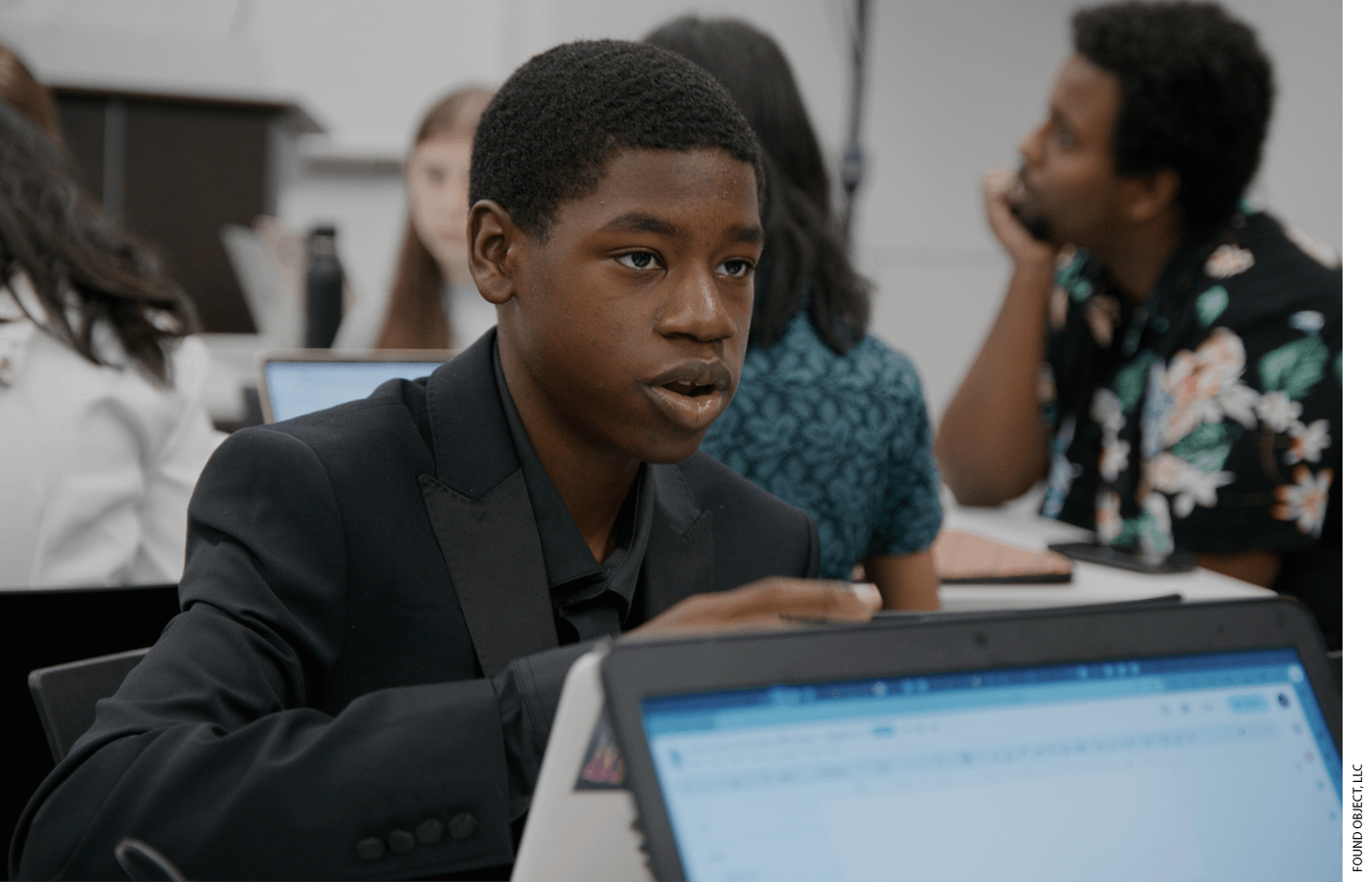
You may have seen a movie in which teenagers experience grave injustice and then enter a prestigious competition where they prove to the world that they are smart. The competition might be the AP math exam (Stand and Deliver, 1988), the National Spelling Bee (Akeelah and the Bee, 2006), robotics (Spare Parts, 2015), or chess (Queen of Katwe, 2016), to name just a few.
Typically, one charismatic adult believes in the kids, inspires them to confront their doubts and society’s stereotypes, and leads them—through setbacks—to an exciting victory that demonstrates their dignity and character as well as their skills.
Immutable, a new documentary film produced by Found Object and available for streaming at PBS on March 6, is much better. The protagonists are predominantly Black public school students from the Washington, D.C., area. They face a range of challenges and threats, from gang-controlled neighborhoods to autism to a mother who has metastatic cancer. As debaters, they are the underdogs in competitions against elite private schools, and we root for them to win.
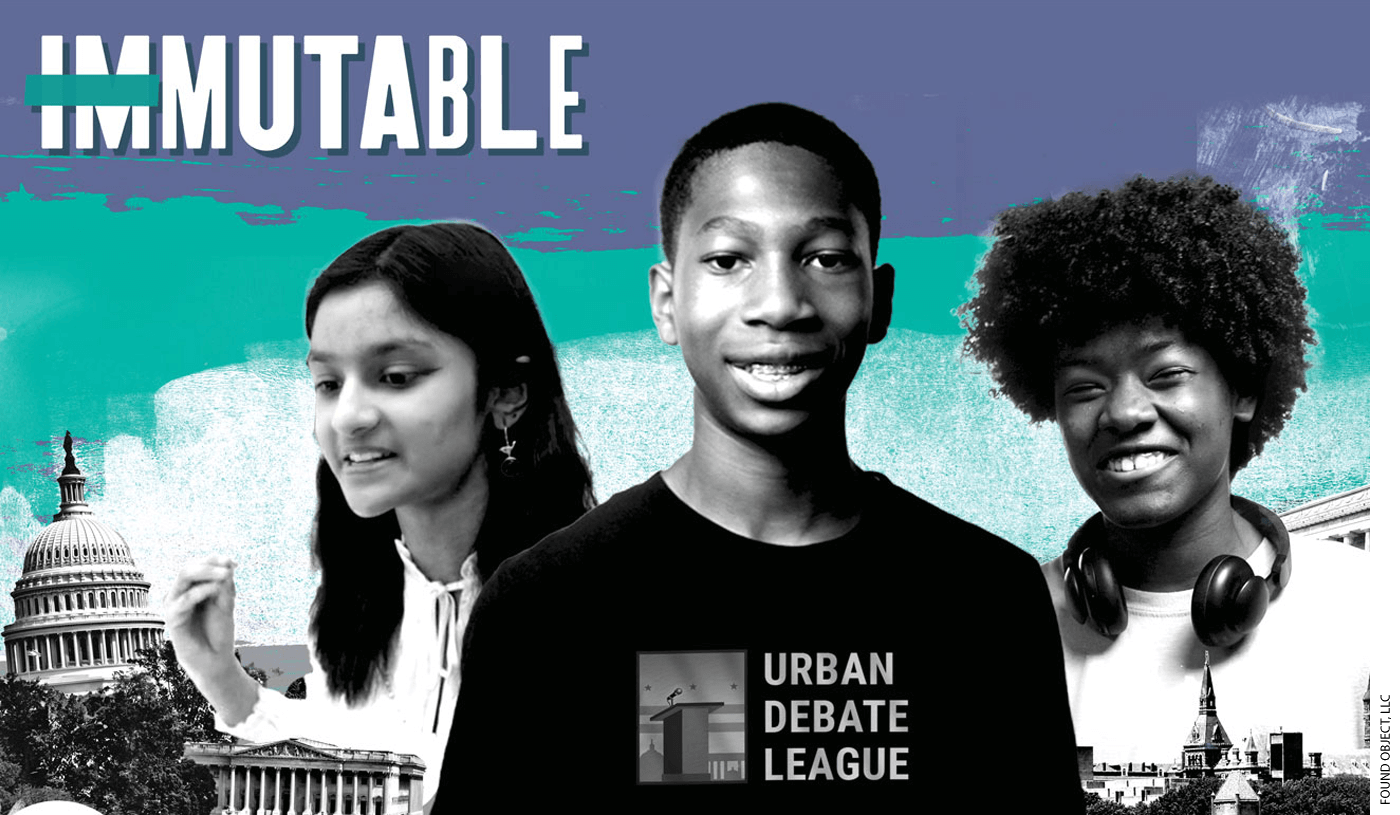
Documentary, Found Object, 2026, 95 minutes
So far, Immutable fits the trope. But these debaters didn’t have to wait for a charismatic coach to believe in them. Long before they took up debate, their parents had formed and imparted complex, sophisticated, and varied views on race and poverty. (Mothers are the only parents who have speaking roles in the film.) The kids join the Washington Urban Debate League (WUDL) to talk about issues they have also explored at home.
While helping him to prepare for a debate, Noah’s mom Delores advises her son, “When you’re telling me about capitalism, I need you to go deeper with it. Think how it relates to you. How does it impact . . . what’s happening with your grandmother or your dad’s parents or your dad or me?”
Later, she tells the interviewer, “I just made sure that he understood what he’s debating about. There are lives that are connected to what [they’re] debating about. And it’s real-world; it’s today.”
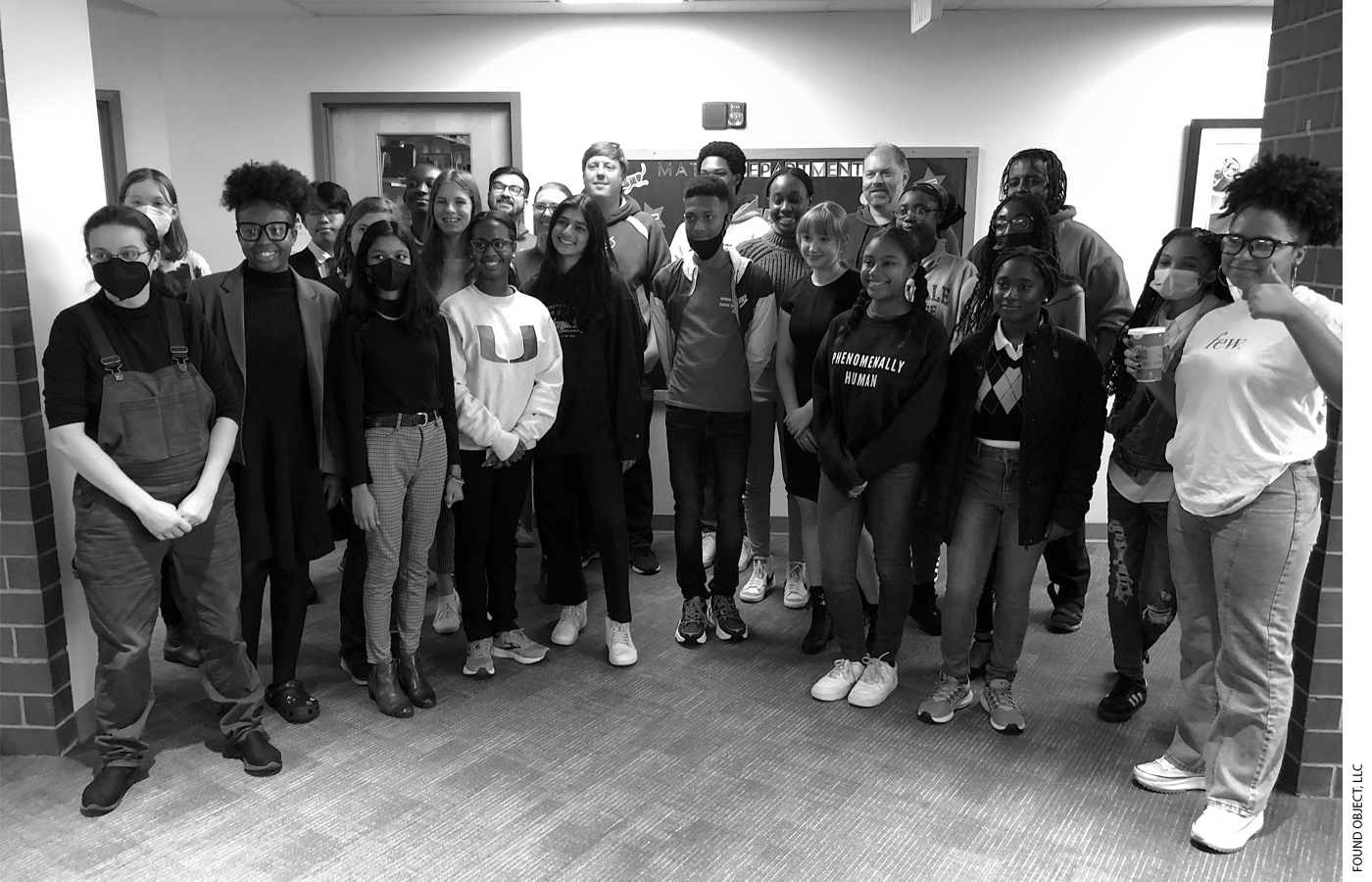
These students are becoming sophisticated analysts of the social world, supported by loving families. I have no doubt that WUDL’s executive director, David Trigaux, and the league’s other adult staff are superb educators, but it’s the teenagers who are the protagonists of the film. One adult says: “I feel that the best gift I can give them is to ensure that they are in the room with people that are free.” She wants students to have “agency to move through this world by choice versus by force of survival.”
Research shows that debate has substantial educational benefits, such as higher reading scores and better odds of completing high school and attending college (see “Resolved: Debate Programs Boost Literacy and College Enrollment,” research, Summer 2024). The programs that have been evaluated, such as the Boston Urban Debate League, are extracurricular and therefore voluntary. I suspect that debate is particularly beneficial for teenagers who are motivated by competition, drawn to oral performance (debaters must talk unnaturally fast), and interested in controversial social issues. Although some students flourish in a conventional classroom, many with these distinct characteristics may learn much better as debaters.
“In the beginning, he sucked,” Delores says of son Noah. “I mean, you can edit that if you want, but . . . it was torture watching him debate. I kept saying to him, ‘You want to keep going? Do you want to keep going?’” Noah insisted that he wanted to continue because, as he told his mother, “I’m going to figure this out.” She recalls, “He found his community, the space where he could be competitive as well as show his intellect, all at the same time.”
Immutable departs from the cinematic convention of oppressed kids defeating elite snobs by presenting the WUDL debaters in the tournaments as diverse in many respects, not as obviously disadvantaged. (Nor do they always win.) It is a nuanced and beautifully made film that introduces many lovable individuals and moving relationships.
Daniella, a passionate debater with a neurological disorder that sometimes causes debilitating panic attacks has a calm and centered partner, Sitara, whose face conveys pure compassion when an attack strikes her teammate during a tournament.
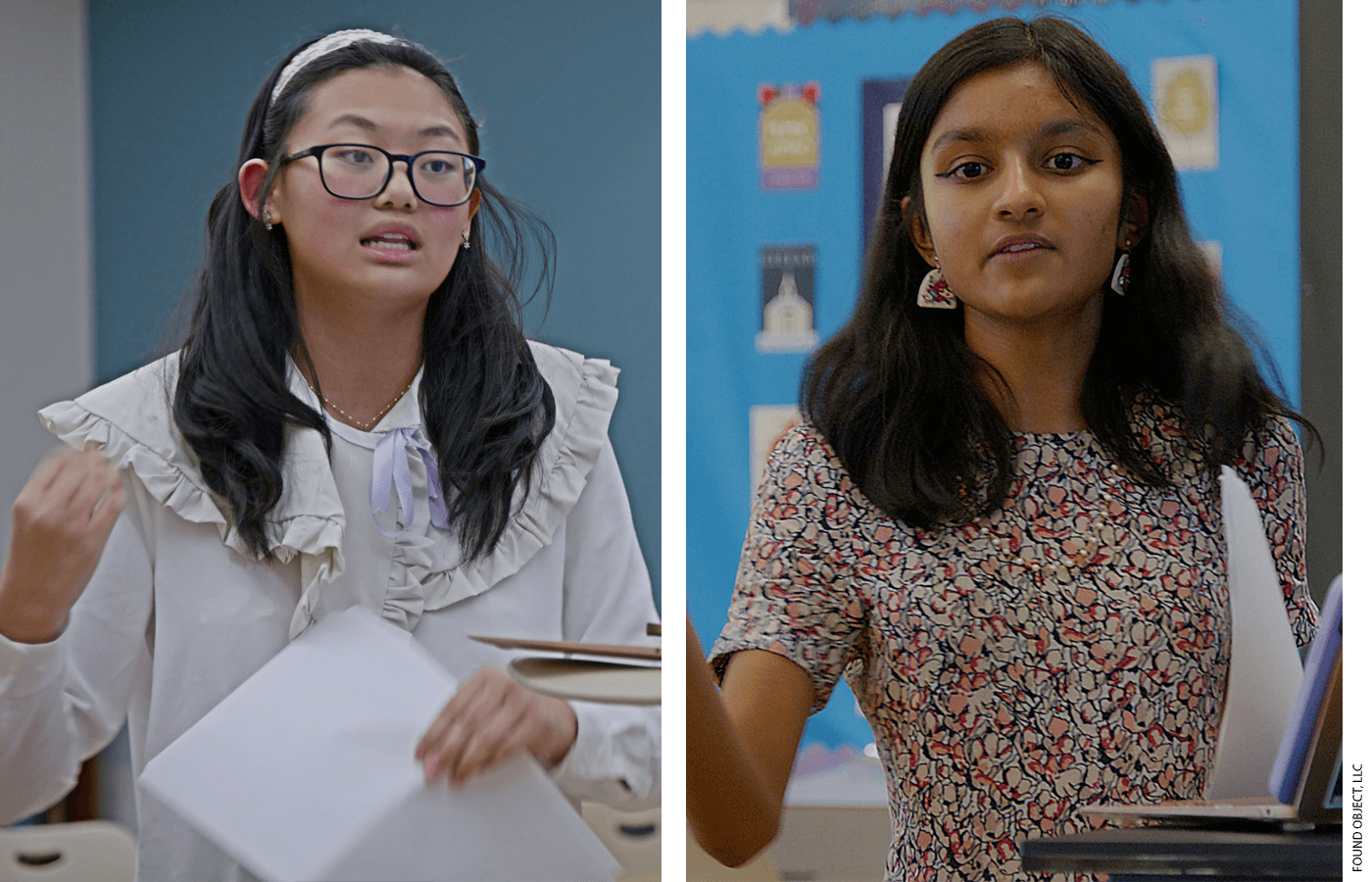
Then there’s the love and mutual respect on display between several boys and their mothers in Immutable, which for me is an antidote to despair. I also relish the cultural hybrid that emerges inside WUDL as the debaters study technical topics (like NATO’s cybersecurity policy), employ a homegrown lingo to analyze debating tactics, and draw on Black American vernacular.
Apart from its educational benefits, debate may also develop better citizens. This is an old idea. In 1788, Thomas Jefferson praised George Wythe, who then taught law at William & Mary. “He gives lectures regularly, and holds moot courts and parliaments wherein he presides and the young men debate regularly in law, and legislation, learn the rules of parliamentary proceeding, and acquire the habit of public speaking,” Jefferson wrote. “I know no place in the world, while the present professors remain, where I would so soon place a son.”
As one mom says in Immutable, “You know, we talk about critical thinkers that are going to be the citizens that we’ve been waiting for. How else are they going to get created if we don’t promote these spaces for them to nurture that work?”
Competitive debate motivates people to reason about complex public issues. Students must argue about substance, not attack each other. (In fact, debaters address a judge, not their opponents.) Debate strengthens skills for advocacy that graduates can use in other contexts.
In many competitions, debaters are assigned the positions they must argue, which is an exercise in understanding both sides of an issue. Emmanuel Makinde, a former WUDL debater and now a debate coach and NYU undergraduate, speaks to this expansion in thinking in the film. “Debate has allowed me to explore, not only critical perspectives about my own position as a Black person in America but also other people’s critical perspectives,” he says. “It’s actually scary the extent to which things that I believed in firmly before debate I’ve like criticized now myself.”
EdNext in your inbox
Sign up for the EdNext Weekly newsletter, and stay up to date with the Daily Digest, delivered straight to your inbox.
These are outcomes with civic implications, directly countering the deficits we see today in American discourse, like ad hominem attacks, arguments without substance, and widespread disdain for contrary opinions. I would be biased toward voting for any WUDL graduate who runs for public office.
That said, I am not convinced that debate is a panacea for all our civic maladies. Debate presents issues as binary, when often there are many potential solutions. It selects winners and losers, when we might also want to teach collaboration and consensus-building.
Just to expand the menu, I will mention another student competition focused on wrestling with issues: the Ethics Bowl. Teams must comment constructively on their opponents’ arguments and then respond to the comments they receive. Judges assess whether “each team [is] committed to the central values of the competition—collaboration and the pursuit of truth, rather than, say, combativeness or belittling rhetoric.”
Students can also learn civic skills by discussing texts that convey challenging perspectives and ideas, or by collaboratively designing solutions for public problems. These approaches emphasize dialogue or deliberation rather than debate. They address different deficits in America’s public life.
Citizenship can be expressed in a variety of ways, from kindly service or collaborative problem-solving to competitive debate, depending on one’s predilections. To achieve more civic engagement, we need more opportunities for students to experience and participate in its various forms so they can discover what excites them.
Immutable lets us watch urban public school students grow into exemplary citizens. They compete fiercely, but respectfully, and they care for each other and their families. If students like these grow up to lead our country, we’ll be just fine.
Peter Levine is the Associate Dean of Academic Affairs and Lincoln Filene Professor of Citizenship & Public Affairs in Tufts University’s Jonathan Tisch College of Civic Life.