



Passion project. Spike. These terms have infiltrated the lingo of Generation Z, emerging out of the increasingly competitive landscape of college admissions. What they point to is a new and growing phenomenon among high school students: the youth-led nonprofit organization.
Since the 1970s, the United States has seen a sharp decline in college acceptance rates that has coincided with a higher demand for quality education. Although the enrollment capacities of highly selective colleges haven’t changed much in the last half century, the number of applicants to those institutions has doubled.
Harvard is a case in point. The premier Ivy League school received 56,937 total applications for its Class of 2027 and accepted 1,965 students, or just 3.5 percent of them. Compare that to 1971, when Harvard received a mere 7,150 applications and accepted 1,360 students, or 19 percent of applicants. Universities across the country have experienced similar demand for seats that far surpasses the pace of institutional growth.
This shift is reflected in the emergence and proliferation of the role of college consultant. In 2024, education consultants—whose sole purpose is to help high school students get into the top colleges—had a reported market size of $3.3 billion. Despite families’ heavy investment in this specialty service, consultants’ advice to aspiring collegians is frequently the same: stand out. High school seniors are left feeling crushed by the pressure to prove their worth among a sea of applicants with almost identical academic profiles. How can a high-achieving student who applies to Harvard or any of the nation’s top schools hope to stand out from the crowd?
One obvious answer is community service, which has long held a prominent place in college admissions. Students who volunteer their time to worthwhile service projects demonstrate concern for the greater good, and admissions officers take notice. In The Harvard Crimson’s Class of 2027 survey, community service ranked as the top extracurricular for 70.3 percent of admitted students, trouncing second-place athletics by 17.3 percentage points.
In the last decade, the community service archetype has morphed into something more consequential: the student founder. High school students are increasingly establishing nonprofit organizations, contributing to an explosion in the sector over the last two decades. From 2002 to 2023, approximately 700,000 new 501(c)(3) organizations registered in the United States, an increase of 85 percent.
More than simply giving back to the community, founding and leading a nonprofit organization elevates the profile of a student by giving them a title, status, and the perception of an enterprising spirit on college applications. The student nonprofit founder has now become the new standard for exceptionalism among college applicants. And college consultants have gotten in on the act, laying out step-by-step plans for students to create nonprofit organizations early in high school.
What does this type of student entrepreneurship look like in practice? While the phenomenon began years before the crucible Covid year of 2020, the height of the pandemic left students stuck at home with ample time to seek meaningful volunteer work. State laws vary in their age restrictions for nonprofit executives and board members, and many do not articulate them explicitly, leaving open the possibility of high schoolers becoming involved in such organizations. Quarantine restrictions during the pandemic left students with limited opportunities for interpersonal engagement, so many took to building online platforms and networks that focused on outreach. Some students formally incorporated their passion projects as 501(c)(3) nonprofits, while others took the same initiative simply to generate a distinguishing “spike” for their portfolio. These two avenues precipitated a new wave of youth nonprofits.
Two distinct examples, both founded in 2020, are illustrative of the good and the bad of this rising tide.
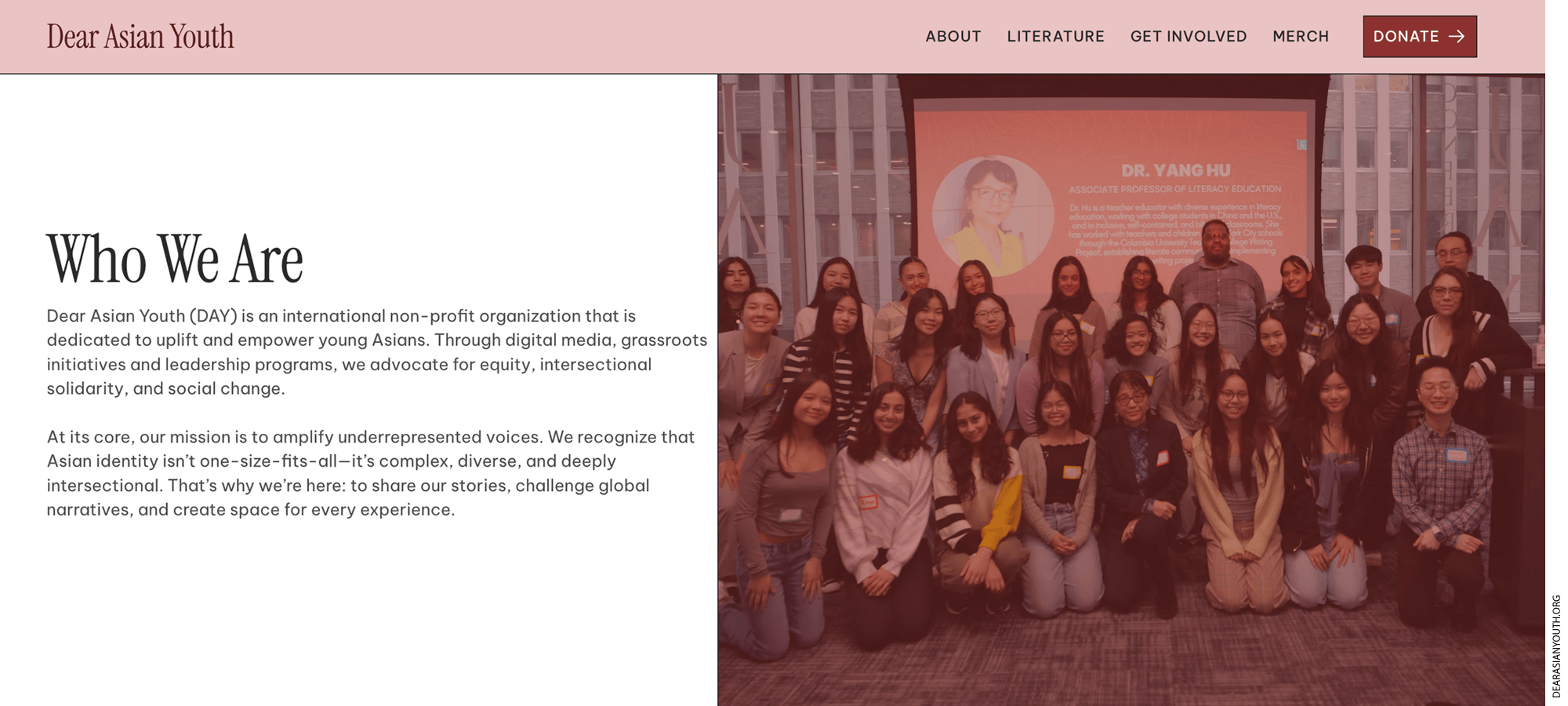
Dear Asian Youth (DAY) is an international nonprofit whose mission is to “uplift and empower young Asians”. Originally created by Stephanie Hu (now a Harvard senior) as a personal blog for her to publish her poetry and pieces exploring her Chinese-American identity, it later evolved into a literary magazine. DAY quickly grew into a multi-departmental organization that now boasts over 70 chapters around the world. Hu’s organization sparked changes among the Asian youth diaspora, who resonated with DAY’s foundational mission. Structurally, it runs under an executive-director and vice-president model, while its day-to-day operations include publishing a steady stream of infographics and articles, hosting webinars, running a youth book club, and more. DAY demonstrates the potential of a youth-led nonprofit organization when it is nurtured by a student’s passion and desire to improve their community and the world in a meaningful way.
Yet for every example of a student nonprofit established with an intentional mission, there are countless others that seem to flash and fade, leaving only a ghostly social media footprint.
Started in the fall of 2020, Gen Z: We Are the Future identifies as a nonprofit organization “inspiring and educating Gen Z-ers to work towards a more united future.” Its Instagram profile contains infographic-style posts on topics ranging from pop culture to politics. The organization seems to have been driven to purvey information and opinion, with three Gen Z–focused articles on its website and 353 Instagram posts, the last of which appeared on January 2, 2023. Although Gen Z: We Are the Future’s web presence remains accessible, the content generators behind it have been inactive for almost three years—an indication that it had no long-term vision, a churn in leadership, or minimal organizational infrastructure.
The youth nonprofit space, especially in the high school context, resembles the proverbial American west, with many people seeking their fortunes and few rules governing them. Unlike school-sponsored student organizations and athletic teams that operate within a closed system supervised by school personnel, student-created nonprofits often have little oversight, leaving open the question of how they measure progress and define success. With no objective framework to evaluate the quality of work produced by student-created organizations, what distinguishes a substantive nonprofit from its unproductive counterparts?
One byproduct of this trend is an oversaturation of nonprofits. With so many competitors in the field, even organizations with a defined vision and clear plan risk being choked out by less genuine endeavors. This latter group has the potential to cause more harm than good; nonprofit organizations require immense resources and suffer from high turnover rates in personnel. The time and resources needed for consistent recruitment efforts are not only a burden to the organization itself but also can poach human capital from more established nonprofits.
However, not all upstart youth nonprofits are doomed to fail. At one community service–based nonprofit founded by a student in Texas, the structure has seemingly fostered an environment conducive to continuity, as demonstrated by the smooth succession of its last three presidents. Student-led nonprofits often struggle with continuity, especially when founders leave for college and necessarily shift their attention to other pursuits. But the Texas nonprofit seems to have bucked that trend, despite not having specific measures in place to promote continued participation. The founder credits individuals’ ongoing interest in the organization’s evolving mission—originally focused on housing insecurity but now supporting under-resourced communities—for its success with leadership transitions. This flexibility has allowed student board members the freedom to adjust programming annually, but such latitude is not always feasible for organizations. It is rare to have mission drift actually contribute to a nonprofit’s success.
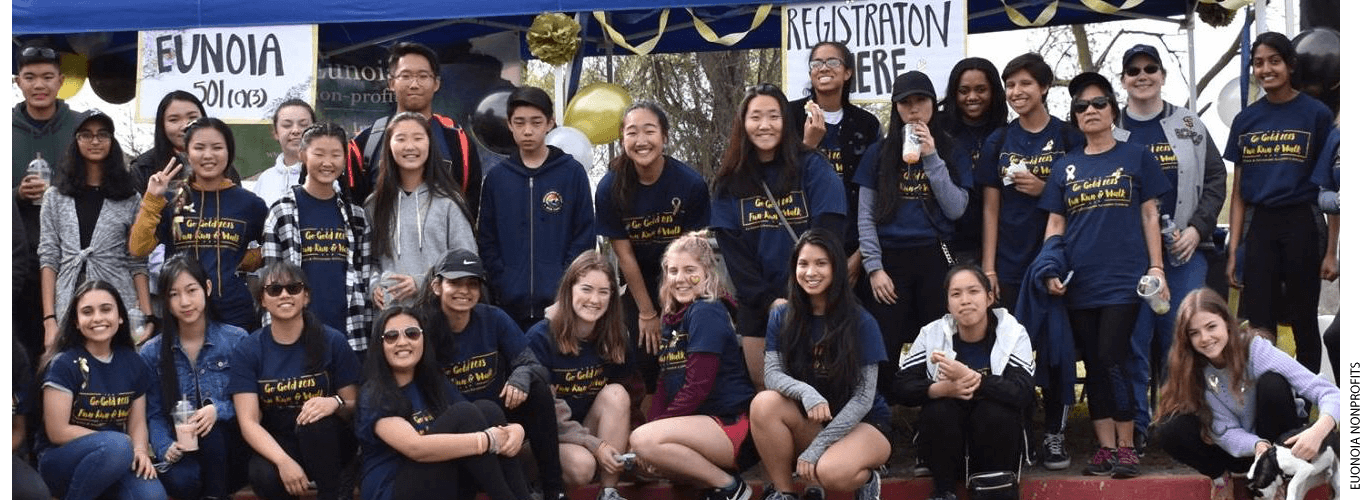
Janelle Choi, a junior at the University of North Carolina Chapel Hill, identifies perhaps the biggest challenge with youth nonprofit startups: a lack of training. As the branch and event coordinator for Eunoia Nonprofits, a nearly decade-old group that helps underserved youth in Sacramento, Choi knows a thing or two about sustaining a successful nonprofit organization. She highlights the need for high school students to engage with the concept of “service learning” in their curriculum. Service learning incorporates community service into academic coursework for a more formalized approach to practical philanthropy.
“Requiring community service in high schools without teaching service learning and deeper potential impacts of community service is very harmful,” Choi says. “[Eunoia] wants to make sure that we have long term partnerships, and we are actually helping organizations.”
Service learning is more likely to be incorporated into higher ed courses than secondary education curricula. Northeastern University, for example, gives special priority to the field by offering a variety of service learning courses—including Cornerstone of Engineering (“develop creative problem-solving skills used in engineering design, to structure software, and to cultivate effective written and oral communication skills”) and Advertising Practices (“explores planning, research, production, and other elements that go into successful advertising”). Northeastern’s courses center “service or project-based work,” followed by structured reflections. Service learning is slower to reach high schools, where it is arguably most needed but where there is less guidance for students to apply the same ethical framework to their work. Without training in the best practices of community service before nonprofits even get off the ground, there is no incentive to invest in youth-created organizations. The result is that many high school nonprofits simply stop producing content, stop organizing, or end operations altogether.
EdNext in your inbox
Sign up for the EdNext Weekly newsletter, and stay up to date with the Daily Digest, delivered straight to your inbox.
If creating nonprofit organizations is now the norm as the type of extra-curricular activity that admissions officers will notice in high schoolers’ college applications, how can the practice continue while ensuring sustainable service and minimizing the potential for collateral damage?
One option is for high schools and college admissions officers to steer students toward contributing meaningfully to established organizations with incentives. Schools can provide students with lists of reputable nonprofit organizations looking for volunteers, while colleges can weigh applicants based on their participation with these groups. Rather than giving priority to ingenuity, education institutions should emphasize building relationships with community organizations and renowned service programs.
But it may be unrealistic to expect all high schoolers to abandon their dreams of entrepreneurship, particularly with projects they’re passionate about. For those motivated few, they would benefit from public education that incorporates service learning into its curriculum. Students are already required to take courses in U.S. government or civics, and service learning would simply be an expansion on the theme of civic engagement and service.
Regardless of the nonprofit path students choose, schools and programs that require them to tally community service hours could consider implementing an introductory service learning curriculum as early as middle school. Coursework that teaches the importance of supporting and responding to the needs of their local community, while exploring alternatives to independent nonprofit initiatives, could better equip students to make informed decisions as volunteers and leaders.
Whether a student volunteers at their local library or starts the largest youth-created and -operated nonprofit in their state, the best type of community service is approached with an intentional purpose guided by empathy for others, not driven by the self-interest of looking good on a college application.
Emma Pham-Tran is a student at Harvard College concentrating in government.