




Last year, Timothy Shanahan published Leveled Reading, Leveled Lives to broad acclaim in education circles (including in this publication). His book’s central argument is that confining students to prescribed reading levels in school has contributed to slow progress—and lately, deterioration—in students’ reading comprehension, as demonstrated in national reading assessments. What students need, Shanahan asserts, is challenging texts paired with dedicated teacher support, which together provide exposure to rigorous language and promote skill development.
Shanahan’s book challenges the approach to reading instruction that has prevailed for decades: assigning texts according to a student’s current reading level. Those who advocate for giving students reading material they can readily access argue that doing so empowers older struggling readers to strengthen their literacy skills while also forging a path to rigorous grade-level content.
Did leveled reading cause our current literacy crisis? Or is there still a place for accessible texts in pursuit of rigor for students who are learning to read, especially beyond 3rd grade?
Louise Baigelman, founder of the literacy organization Storyshares, wrote a response to Shanahan’s book, highlighting the ways she feels it does not address the reality of today’s classrooms. She defends access for the millions of older students who struggle to read, arguing that growth and mastery depend on both the right level and the right challenge. Education Next invited Tim Shanahan to respond to Baigelman’s critique and explain why she has misconstrued his book.
Even Leveled Reading, Leveled Lives Agrees Students Need Leveled Reading
by Louise Baigelman

Tim Shanahan’s Leveled Reading, Leveled Lives, a systematic analysis and critique of the role of leveled reading in student learning, has been widely discussed and cited since its release in 2025, leading many to endorse a blanket rejection of leveled reading for any purpose. As I dug into the book myself, I was surprised to see that Shanahan does not dismiss leveled reading outright; he notes many exceptions that acknowledge its value. I want to shed light on those nuances here so we don’t resort to the dangerous game of rejecting entire instructional approaches through oversimplification of both the pedagogical challenges at stake and their solutions.
If one reads Shanahan’s historical analysis and research synthesis in full, a few crucial points become clear:
- The author seems to define “leveled reading” rather narrowly. More broadly described, leveled texts have associated levels of difficulty, which—while hard to capture perfectly—can be measured in a range of ways.
- Shanahan makes a significant exception for “beginning readers”—those who are still developing their foundational literacy skills. But in today’s schools, beginning readers are not only early elementary students. Many older students continue to struggle with decoding, a point that the book seems to discount.
- Shanahan argues that leveled books should not be used for core, whole-group instruction—that teachers should use complex grade-level texts in this kind of setting. But the crucial role leveled texts play in other learning contexts—in conjunction with a challenging “anchor text”—deserves more space and clarity. Framing the issue as a choice between rigor and accessibility creates a false dichotomy; effective instruction should offer both.
- Shanahan overlooks the challenges of implementation and educator capacity in what he expects teachers to do to scaffold a single complex text. These challenges are magnified when teachers are working with a classroom of students with a wide range of literacy skills and gaps. His recommendations, while theoretically powerful, often defy the practical realities of today’s schools.
- Shanahan repeatedly mentions the importance of independent reading without addressing the barriers that access, engagement, and self-efficacy pose for sustained reading practice in the upper grades.
Defining Leveled Texts
Shanahan appears to define leveled texts according to the once widely adopted Fountas & Pinnell leveling system, writing: “What began with a book for each grade level, now has metastasized into twenty-six supposedly distinct text levels. Classrooms—and school libraries—are replete with level-labeled book bins, books branded with color-coded dots, and shelving systems aimed at ensuring that no child strays into books beyond their prescribed challenge level.”
As the Science of Reading movement began to take hold, the Fountas & Pinnell approach was debunked for its lack of validating research evidence, as critics highlighted the flaws in the measures the system used to differentiate between texts assigned to each of these 26 levels. But the prominence of the Fountas & Pinnell approach does not mean that it encapsulates the entire concept of levels.
Levels are a fundamental part of all learning. In fact, we readily accept the concept of levels in other contexts: You don’t take calculus unless you’ve completed algebra 2; you don’t earn a black belt in karate before you earn a blue belt. You don’t start learning piano with a Chopin piece but with a simple song. In reading, too, levels play a crucial role. Within structured literacy, phonics development itself relies on scaffolded levels as students progress through decodable texts according to a scope and sequence that increases in complexity. (Decodable texts, used with beginning readers, contain words based on the phonetic patterns that students have learned, enabling readers to sound out words in a structured way.)
When leveling systems get debunked or disproven by research, it is often because they are arbitrary and not tied to concrete skills students need to read proficiently. As Hollis Scarborough first proposed in her 2001 paper, “Connecting Early Language to Later Reading (Dis)abilities,” skilled reading requires language comprehension and word recognition to work together. Both require students to have a proficient understanding of background knowledge, vocabulary, language structure, verbal reasoning, literacy knowledge, phonological awareness, decoding, and sight recognition of familiar words. These are the “strands woven into skilled reading,” as illustrated by Scarborough in her Reading Rope, a visual model that portrays how language comprehension and word recognition are interwoven in the complex process of learning to read. A leveling system based on skill development and mastery (for example, a scope and sequence for decodable books) must be treated differently than lettered levels informed by subjective metrics. Conflating multiple measures of student proficiency into one overarching leveling system can undermine a mastery-based approach to reading success. One of the challenges with the leveling systems that Shanahan accurately references is that they rely on subjective “strategies” (for instance, finding the main idea or identifying the author’s purpose) rather than “skills” (for example, decoding multisyllabic words or analyzing an informational text based on its text features) in order to assess and assign complexity levels.
Reading comprehension can be impeded by things like complex sentence structures, vocabulary deficits, or a dearth of background knowledge. The interaction of these strands of literacy varies across students, subjects, and texts. While educators must attend to the important role of knowledge in students’ understanding of texts, they must also pay attention to a text’s accessibility in terms of decodability, word recognition, and syntax.
Consider this example: “Life on the farm changes with the seasons. Farmers work each day to plant seeds and grow crops.” If you have lived your whole life in the city, you likely do not have enough background knowledge to visualize this scene very well, or even to decipher what a crop is. Your teacher, however, can show you a quick picture or video clip to contextualize farm life and pre-teach the word “crop.” Meanwhile, the phonics and syntax of this sentence are relatively accessible. Equipped with those additional scaffolds, a “low-level” reader could both decode and comprehend the sentence.
Now, let’s look at this sentence: “Life on the farm follows the rhythms of the seasons, where long hours of labor are balanced by the quiet satisfaction of watching crops grow from seed to harvest.” Here, the teacher could provide similar previewing activities—addressing words like “harvest” and “labor” up front. And yet, even with those same knowledge scaffolds, this sentence is still much more challenging for a struggling reader to access because of its complexity in terms of decoding (“rhythms”), its vocabulary (“satisfaction”), and its length and structure.
Both sentences require background knowledge. But, if we momentarily remove background knowledge from this equation, don’t we also feel comfortable acknowledging that these two sentences are written at different text levels?
We must be cautious about trying to erase the complexity of reading proficiency by perceiving the literacy strands as though they exist in silos. Instead, we can consider how each strand interacts—and how we can leverage a range of text levels to remove key barriers for our students.
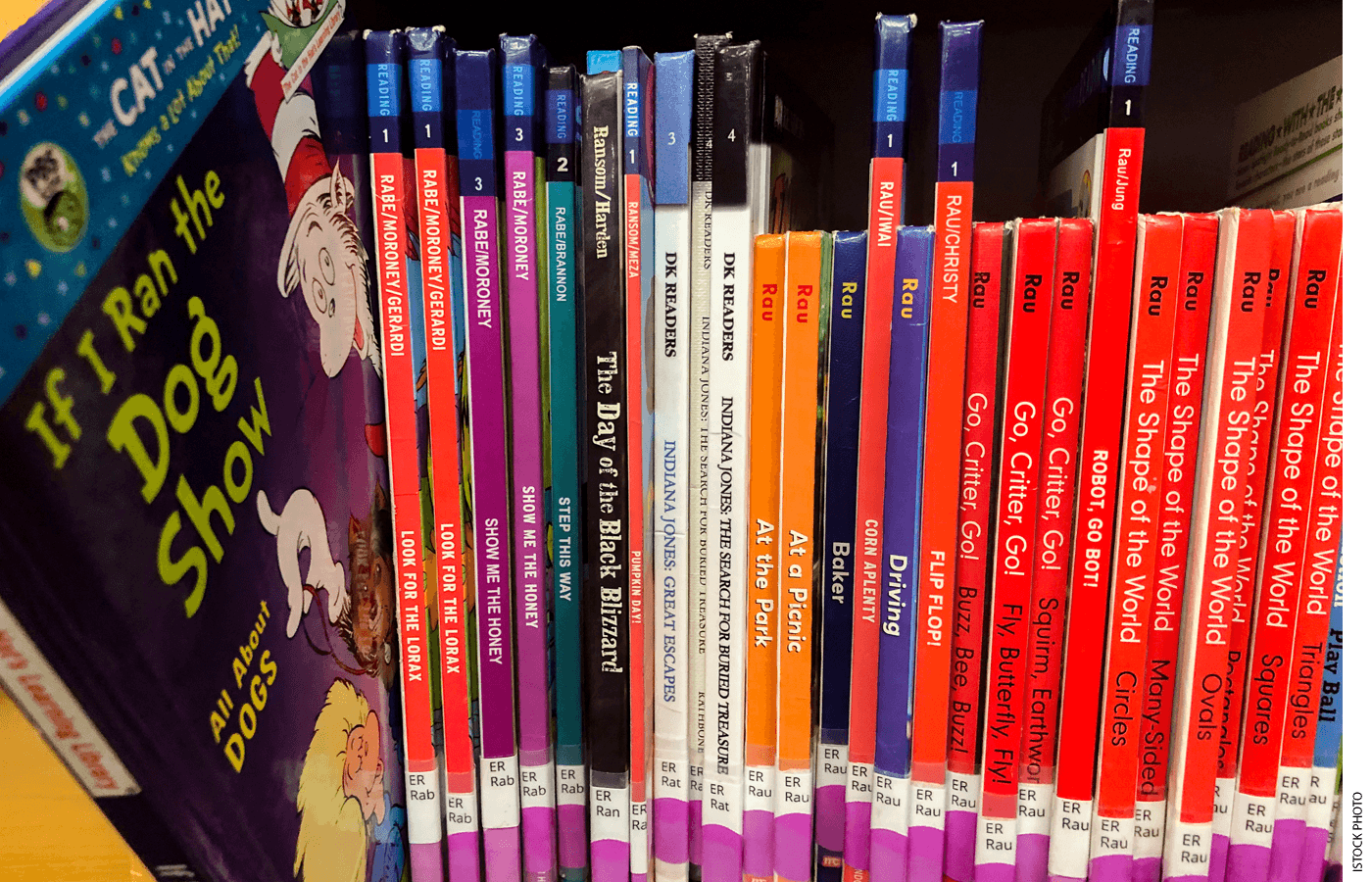
Decodables for Beginning Readers
Shanahan speaks to the role of decodable texts for beginning readers in his book, noting that they are a key exception to his argument against leveled reading. He states, “First, I will explain why it would be imprudent to try teaching beginning readers with more challenging texts and will explore the types of texts that will advantage learners in kindergarten and grade 1.” The nuance that Shanahan misses is the astounding number of older students who are in fact beginning readers as he defines them. Much of the assessment data around reading proficiency for older students does not differentiate the skills of reading (such as decoding, fluency, and word recognition) from the content knowledge required to read (vocabulary, background, and schema). This is partly due to the scarce research on adolescent literacy, where assessment often does not measure foundational decoding skills. To address this, the Educational Testing Services Research Institute set out to measure the roots of older students’ reading difficulties, partnering with the Advanced Education Research & Development Fund to produce the 2024 report The Decoding Threshold. In the words of co-author Rebecca Sutherland, the study found that “if a student is unable to decode longer, more complicated text, all their attention will be devoted to decoding text, and they won’t be able to comprehend what they’re trying to read. The findings give us a clearer understanding of what supports many older students need to read on grade-level.”
According to 2024 NAEP data, 40 percent of the nation’s 4th graders and 33 percent of 8th graders scored “below basic” in reading. While NAEP measures primarily comprehension, research shows us that comprehension scores may well mask a lack of the foundational skills (such as decoding) that are required to access, and therefore comprehend, more complex texts.
For students still learning to decode—whether they are in 1st grade, 4th grade, or 8th grade—we know that decodables play a powerful role in reading instruction and practice. Aren’t decodables just another form of “leveled” texts? Shanahan comes to this conclusion himself, writing that, “older students who lack foundational decoding skills will need to receive the same instructional regimen recommended for K–1 classrooms—explicit phonics instruction supported by decodable and vocabulary-controlled texts.” His support of lower-level texts for beginning readers underscores the crucial role of foundational skills in giving readers access to a text—something that is no longer just an early-elementary problem. Given the alarming number of secondary students today lacking even the most basic skills, we must rethink our definition of leveled reading—and when, how, and why we use it in the classroom.
Implementation in the Classroom
To thoroughly understand and respond to Shanahan’s key thesis, we must look at what he is recommending in practice, using an example scenario pulled from an actual classroom that my organization, Storyshares, has supported.
 Imagine this: You are a relatively new educator, teaching 9th-grade ELA in the Bronx. You have 30 14-year-old students, and, reflecting national averages, about 9 of them are still working to master phonics and decoding, another 11 of them are reading below a 7th-grade level, 8 of them are at grade level, and 2 are above grade level. The complex grade-level text you intend to teach is the 1932 dystopian novel Brave New World, which introduces multifaceted themes and requires about a 9th- or 10th-grade reading level (870 Lexile). As you prepare your lessons for whole-group instruction, you are tasked with supporting not just students’ literary analysis of the book but also overcoming the fact that two-thirds of your students lack the foundational literacy skills to access the book itself.
Shanahan argues that the teacher must develop and provide thorough scaffolds to enable students to engage with challenging texts. He disparages alternatives that “simplify” language or provide entry points to the topics and themes using more-familiar vocabulary and straightforward structure. Instead, he tasks teachers with providing all the real-time instruction, scaffolding, and differentiation to teach these 30 dramatically different students with one single complex text, which at least a third of them cannot even decode. Most startlingly, he asserts that teachers have opted to use “easy” texts for whole-class instruction against the mandates placed on them: “As grade level books increased in difficulty, teachers undercut the requirements by teaching with below grade level texts,” he writes, concluding, “The plan fails when teachers protect kids from the new requirements rather than trying to meet them.”
These claims are not only mildly offensive, but they also seem to miss the point entirely. Leveled texts are not typically intended for full-class direct instruction. I’ve spent the past two decades in schools across the country, and I have yet to encounter a single teacher who is trying to “undercut the requirements” by choosing an easy text for core instruction. Leveled texts are meant to extend, enable, and enhance core learning by providing opportunities for access and practice to the students who cannot read grade-level texts independently. If we reject leveled texts entirely, when do these students read? Actually read? When do they have opportunities to develop and strengthen their foundational literacy skills if their skills are far below grade level? How will the teacher’s instruction using that complex text support their ability to decode proficiently, read fluently, build background knowledge, and make meaning when they need to access new content on their own? Why can’t leveled texts be something that bolsters this learning and deepens student knowledge alongside the more challenging core text? This is in fact required to create true coherence between core curriculum and intervention in the upper grades: Access enables rigor when implemented thoughtfully. Providing supplemental content at a range of levels offers striving readers opportunities to engage meaningfully with grade-level standards, texts, and topics despite the significant literacy gaps of these readers.
Shanahan tells a story of an educational psychologist who works one on one with a 13-year-old nonreader. The student chooses to read an encyclopedia, and the educator takes on the challenge of teaching him with this large and complex book. Shanahan concludes this anecdote by saying, “I can’t remember how many years she worked with this student, but at the end of some length of time he could read the whole doggone book. Now that’s scaffolding!”
When I read this miraculous example of student growth, I was struck by how impractical and improbable it is to consider what one teacher can do with one student over the course of several years. This is not a representative example. It simply illustrates that Shanahan’s expectations for teachers are unrealistic and unfair. Teachers are rarely afforded the luxury of multiple years with one single student and should not be judged accordingly.
Text Sets
A text set is a collection of diverse content centered around a given theme or topic; an abundance of research documents their powerful role in reading instruction. Text sets offer students the opportunity to build background knowledge, deepen content understanding, experience different perspectives, and develop critical thinking skills. They often feature an “anchor text” for close reading, supplemented by other content types that cater to different learning modalities and levels. Research shows that text sets can be highly effective for student learning—especially for struggling readers—because they help scaffold understanding and enable text connections across multiple formats, levels, and access points. What Shanahan is arguing, it seems, is that the anchor text should be rigorous and complex. With this, I completely agree. At the same time, leveled texts offer an incredibly valuable tool for supplementing, reinforcing, and deepening the core themes and knowledge presented in that challenging anchor text. This enables students to both develop stronger literacy skills and to access more complex content and text structures in parallel, which is required for instructional coherence at the secondary level. Leveled texts should not replace the texts used for direct whole-class instruction. But in my experience, this is not their primary purpose.
Leveled Texts for Intervention and Independent Reading
On first glance, Shanahan’s book appears to reject leveled reading for all intents and purposes. Its title clearly communicates this. But in between the pages, one discovers that he is in fact only rejecting leveled reading within one specific context: core whole-class instruction. When addressing the pushback on the role of leveled texts in independent reading, Shanahan writes, “but independent reading is not the major focus of this book. My concerns are more with the limitations on what students are allowed to learn within instruction.” Unfortunately, his blanket indictment of leveled reading carries dangerous implications for well-meaning educators, school leaders, and policymakers.
Shanahan’s argument, which is certainly well intentioned, lacks an understanding of today’s classrooms and the reality of implementation when theory meets practice. He writes, “My proposal is to replace the student-book matching fetish with instruction aimed at enabling kids to read harder books successfully.” This is a lovely ideal, but the question is how to achieve it. Given the size of the foundational skill gaps among today’s students, we cannot accomplish this by discarding more accessible, or leveled, texts entirely. We must leverage those for student practice, because direct explicit instruction without independent practice will never lead to mastery. This does not need to be an “either-or” discussion. It should be one of “both and.” Why must the reading wars persist as an endless pendulum swing, where one person’s brilliant thoughts require “replacing” other constructs entirely? Why can’t multiple effective practices coherently coexist? And why can’t students have the choice of finding books they can (and want to) read independently, while also engaging with complex grade-level texts during core instruction?
Shanahan highlights the importance of reading practice in passing, acknowledging the role it plays in strengthening students’ skills. When discussing decoding, for example, he cites a study by Heidi Anne Mesmer in which two groups of 1st graders received phonics instruction, with only one of the groups also getting paired decodable texts to read. The study produced the following results: “At the end of fourteen days of lessons, the students in the decodable group read highly decodable texts more accurately and they were more likely to apply their knowledge of sound-symbol relationships than the comparison group. Both groups were learning decoding, but the opportunity to practice applying those skills had a positive effect on the ability to apply them.”
I am always struck by even having to make an argument in favor of reading practice, given the widely accepted notion that practice improves skills across absolutely every learning endeavor. But, because the role of leveled texts for student reading practice is left out of Shanahan’s core thesis, it bears restating here. Today, leveled texts are most often leveraged for practice and intervention—to support and empower student access and learning in their core classes.
While Shanahan fails to acknowledge the role leveled texts play in struggling readers’ practice, he inadvertently makes an argument in support of them: advocating strongly for the power of varied text levels and difficulty. First, he addresses this in his chapter on decoding, referencing a study by Alia Pugh and colleagues: “When it came to gains in decoding ability, the students who had the opportunity to work with both decodable and nondecodable texts outperformed those whose reading was limited to decodables alone.” This speaks to the way complex texts and accessible (aka leveled) texts can work together to have a cumulatively stronger effect on learning gains. He then addresses this same concept several more times, citing, “These research reviews also concur that students are best served by working with a combination of texts that includes a range of decodability. . . . It is essential that young readers develop ‘mental sets for variability’ rather than ‘for consistency.’” And later: “Varying the difficulty or intensity level of training has positive impacts on some cognitive learning and on memory tasks more generally. . . . Text should also differ in degree of challenge. If every text is super hard, training will be monotonous, and enthusiasm will flag.”
You can imagine my surprise in reading these lines toward the very end of Shanahan’s systematic attack on texts at a range of difficulty levels (that is, leveled texts). While he acknowledges many of the nuances around the role of leveled reading in the body of his book, I fear that his own subtleties have been wiped out in subsequent conversations, which assume a blanket rejection of leveled reading for any purpose.
Waging Peace
In sum, Shanahan highlights several scenarios and perspectives in his book that support the role of leveled reading in literacy instruction: 1) He makes an exception for beginning readers, and the role decodables play in supporting skill development; 2) he articulates several times the importance of texts at a range of difficulty levels (which is precisely the purpose leveled texts are intended to serve).
To me, there is no reason we should ever associate the word “war” with the word “reading.” In the complex world of literacy, we must be cautious about oversimplification. Rigor and access are not inherently opposed. Methods are oftentimes undefined or ambiguously articulated. Instead of starting yet another pendulum swing in the field of reading, we should be looking closely at the definition of leveled reading and identifying practical strategies to support older students in both strengthening their literacy skills and increasing the rigor of what they can achieve. By shifting how we define learning for striving readers beyond elementary school, we can make room for much-needed progress and innovation. We can begin moving toward a coherent approach to secondary instruction—one that addresses both the reality of what we want kids to achieve and the reality of where they currently are.
If we accept that both targeted instruction and authentic practice are required for true mastery—and that the lack of sustained reading is a key driver of the literacy crisis—then can’t we agree that all engaged reading is good reading?
When it comes to literacy, Shanahan acknowledges the crucial role of foundational skills, background knowledge, and text complexity. But when we look at the crucial role of practice for true mastery, we must also acknowledge that students need opportunities to practice with texts written in ways that they can access.
Shanahan plays down the number of students who lack key literacy skills beyond 3rd grade. His argument is based on reading instruction for students who are not already several years behind. But given that millions of students in grades 3–12 today lack foundational reading skills, we cannot use a one-size-fits-all approach to secondary literacy. For those students, we should not overlook access in pursuit of rigor, but instead, figure out how to leverage access to empower rigor.
With all learning, we must look at the intent—or the purpose—of our instructional approaches. Ultimately, we want students to be able to read independently and to achieve at grade level. To accomplish both goals, we cannot resort to an either-or approach. Some learning activities have clear knowledge-building objectives, while others have clear skill-building objectives. If a 9th grader can’t read, shouldn’t they have the tools and instruction to develop both foundational literacy skills and complex content area knowledge? Leveled reading is not about advocating for students staying at a lower reading level. A scaffold is only as powerful as our ability to remove it.
At the end of the day, Shanahan and I agree that leveled texts should not be used for core instruction at the expense of complex grade-level content. But if we are thoughtful about the intent of leveled reading—as with any learning activity—we won’t reject it entirely. Instead, we can view it as a bridge for practice and access, ultimately empowering students to achieve their full potential.

Louise Baigelman is the founder and CEO of Storyshares, a literacy organization dedicated to supporting and empowering striving readers in grades 3–12.
Proficiency Requires that Students Be Challenged by What They Read
by Timothy Shanahan

The publication of The Great Gatsby generated a raft of reviews, both admiring and reproving. The response bewildered its author, F. Scott Fitzgerald, who later complained, “Of all the reviews, even the most enthusiastic, not one had the slightest idea what the book was about.” No wonder he drank.
A negative review that seriously engages the issues raised by a book can be worth its weight in gold, but one that misses the point altogether can only distract or muddle a debate. I fear that to be the case here. After reading Louise Baigelman’s response to my book, Leveled Reading, Leveled Lives, I’m disappointed in her failure to grasp the main idea of my book and hope her confused and confusing review won’t obscure the important issues it addresses.
Given that, I think it worth briefly restating some of my book’s major points. The book challenges the widely held belief that reading is best taught with books whose levels of difficulty corresponds to students’ reading levels. For generations, reading educators espoused the idea that students should be tested to determine their reading levels. The teacher would then group students according to their reading proficiency and assign each group a text whose level matched their ability. Fourth graders deemed to read at a 2nd-grade level would be taught with 2nd-grade texts, rather than texts aimed at 4th graders.
In my book, I concede that this instructional approach works. That is, students can learn to read from such a regimen—and, in fact, most of us learned to read that way. Teachers have been advised to teach reading at students’ supposed reading levels for more than a century. The problem isn’t that this approach doesn’t teach, it’s that it doesn’t teach well enough. Assessments show that American kids are not illiterate but under-literate. Too many of them leave school able to read, but unable to handle the demands of the complex material they will need to understand to succeed in the workplace, participate in democracy as informed citizens, and thrive in contemporary society.
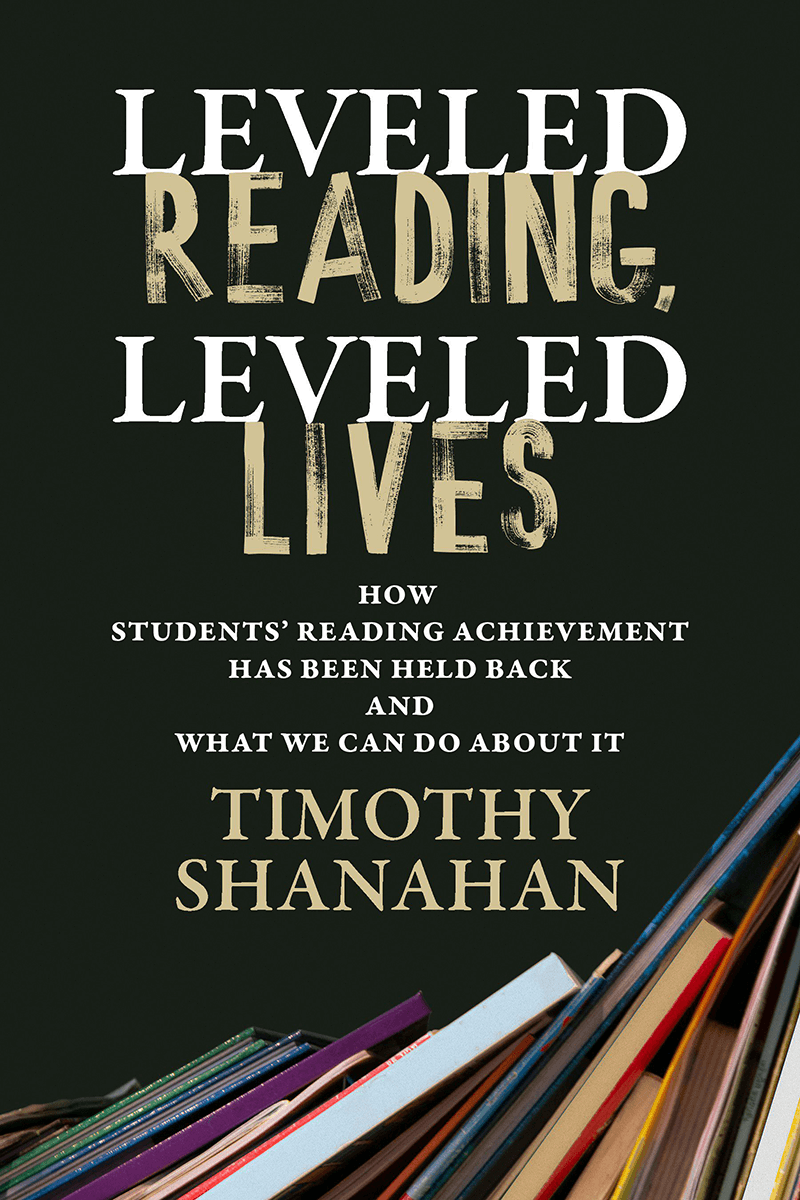
by Timothy Shanahan
Harvard Education Press, 2025, $28.00; 232 pages
Research shows that the leveled-reading approach severely limits students’ success in learning to read. When 5th graders, for instance, are taught to read with 3rd-grade books, they miss out on opportunities to encounter the depth of content and sophistication of language found in 5th-grade books. That would be acceptable if the below-grade placements somehow accelerated students’ progress but, alas, research has shown that not to be the case. Most kids make greater gains with more-challenging texts, so restricting them to more-elementary books holds them back.
Given that, my book provides a historical account of how we got here—why the leveled- reading approach has gained such wide popularity. It thoroughly analyzes the research that reveals the serious shortcomings of the approach: Students learn less when taught this way. The book even explains why this is so by exploring the limitations of accurately and reliably identifying the levels of readers and books and describing the costs—in instructional time and social segregation—of teaching multiple groups of students organized by their reading ability.
This research record spans 2nd grade through high school. Accordingly, I identify beginning readers as an exception to the notion that students are best taught with more-challenging texts. Recognizing that beginners must develop the foundations of decoding, I lay out the benefits—and limitations—of decodable texts and controlled-vocabulary readers.
Finally, I devote several chapters to how we can effectively teach students using more-challenging texts. This material focuses on how to support students who are still struggling to read words and texts fluently as well as on supports for reading comprehension (vocabulary, syntax, cohesion, discourse structure, background knowledge, and so on) and for sustaining motivation.
Someone reading Baigelman’s critique and my response might think we are talking about different books. I think in her zeal to dissect the book she failed to invite it to the autopsy. Her essay reads like a compilation of long-held beliefs and grievances she has wanted to express publicly, and my book, no matter how ill-fitted to the role, provided an excuse for doing so.
Inconsistency Versus Nuance
Baigelman’s aversion to the “reading wars”—those longstanding arguments over whether phonics should be taught or not—comes through loud and clear. Nothing wrong with that. However, she tries to link my book to those disputes by labeling it as dogmatic or doctrinaire. She dismisses its “blanket indictment of leveled reading” and complains that it “discard[s] more accessible, or leveled, texts entirely.” She asserts that “there is no reason we should ever associate the word ‘war’ with the word ‘reading.’ In the complex world of literacy, we must be cautious about oversimplification.”
She repeats these kinds of things so often that even I started to wonder if the book actually is the ill-considered, one-sided screed she characterizes. Fortunately, Baigelman’s muddled account itself absolves me of all charges.
Throughout the article, she notes exceptions the book makes to its supposed “blanket indictment,” pointing out, for instance, that it discourages the idea of using demanding texts to teach beginning readers because of their need to gain the foundations of decoding. She also notes that I recommend a pedagogy that allows a wide range of texts, not just those that students will find challenging.
She notes other “exceptions,” though misinterpreting some of them. She is right, for instance, that the book focuses on teaching and not students’ independent reading choices, but she seems to take that to mean that the books students read independently should match their current proficiency levels. Her review makes it sound as if students are seeking books at their instructional levels and that I would somehow forbid this. Research and personal experience show that students on their own often choose to read more challenging books, and that teachers and librarians often do what they can to keep kids from trying to read such texts—restricting their choices to certain color-coded bins or shelves. I recommend against such limits on kids’ independent reading. Research shows students usually can handle texts well beyond their supposed reading levels because of the power of background knowledge and the freedom to choose what to read. My book suggests how teachers and librarians may respectfully steer students to easier choices when kids find themselves overmatched by a book.
Baigelman’s account misses much of the nuance, seeing these various exceptions as being due to my failure to understand my own dogma or just to ignorant inconsistency. What she sees as inconsistencies are in fact a range of solutions the book recommends for maximizing reading achievement. This seems to be a problem of perspective. Baigelman sees the book as espousing a one-sided thesis but suffering from lots of inconsistency. I see it as a well-considered treatment of a serious problem, with lots of nuance and sensitivity to the range of student needs and instructional contexts.

The Issue Is Leveled Reading, Not Leveled Books
At the root of this difference in perspective is Baigelman’s unfortunate misinterpretation of the book’s thesis. She fails to distinguish leveled books from leveled reading. Baigelman, along with any school principals who have ordered their book rooms sealed and the leveled books destroyed, are missing the point.
Baigelman does a good job of explaining that all texts have levels, that there are different approaches to assigning levels to books, and that much instruction is aimed at promoting progress along some continuum of difficulty. She also gets it right with her examples of the complexity of text, emphasizing the multiplicity of factors that come into play and the difference between complexity and difficulty. Determining the former requires an objective evaluation of text features, while the latter calls for a consideration of readers and what impedes their comprehension. She even gets it right when she argues that we can think of learning as a progression through a continuum of levels.
What surprises me is that she presents these accurate points as if they somehow contradict the thesis or content of my book. She should have mentioned that I acknowledge and discuss these points explicitly and in detail.
What’s more, her good points tend to become garbled—for example, her claim that “Shanahan appears to define leveled texts according to the once widely adopted Fountas & Pinnell leveling system.” The book does nothing of the kind—it deals with quantitative approaches to determining readability levels as well as subjective methods such as Fountas & Pinnell’s. More importantly, Baigelman apparently believes that the level of a text—regardless of its complexity—can be determined easily and accurately.
The copious research on this problem (which I review in the book) shows this not to be the case. One can determine text levels accurately if one attributes each level to a band of school grades. For instance, a text deemed appropriate for 3rd graders might also make sense in 2nd grade, and perhaps in 4th and 5th grade too. For confirmation of this principle, look no further than the text-level standards established by the Common Core. No one in over a century of research has devised a system capable of the fine distinctions that Baigelman and other leveled-reading advocates imagine.
EdNext in your inbox
Sign up for the EdNext Weekly newsletter, and stay up to date with the Daily Digest, delivered straight to your inbox.
She seems astonishingly unaware of the efforts that teachers make to avoid text complexity when they’re trying to teach students at their supposed reading levels. She doesn’t seem to know that many, perhaps most, teacher preparation programs provide training in how to determine reading levels to facilitate matching kids to books for instruction. Programs like Fountas & Pinnell’s Classroom Literacy, Lucy Calkin’s Units of Study, the computer-based literacy tool Accelerated Reader, and all major core textbook programs provide supports for placing kids in instructional books at their reading levels—and these, despite her claim, are not proposed only for beginning readers. She is correct that some of these programs have a grade-level anchor text, along with multiple related texts at varied reading levels. She fails to mention that in most classes teachers read these anchor texts to students, and the leveled books are the ones that the students get to read.
Baigelman asserts that I was mildly insulting teachers by stating that it is common practice to teach reading with texts below grade level. She has spent the past 20 years in schools, she says, and has never seen this practice. I’ve been in classrooms for almost 60 years, and my experience says that they do. More to the point, however, nationwide surveys consistently reveal that most teachers of reading say they do teach with below-grade-level texts when students’ proficiency levels warrant that practice.
The argument isn’t about whether leveled books have value. That would be a useless squabble, since all books have levels, even if we can only roughly estimate them. The argument centers on what levels of books students should be taught with. Not only does Baigelman ignore the scientific evidence that shows that text-level estimates are nothing more than approximations, but she also fails to mention the difficulty of determining students’ reading levels with the needed precision. A plethora of studies show that reading tests only provide rough estimates, nothing like what is needed to match books to kids successfully in the prescribed way.
Even if these designations of book and student levels were precise, we’d still have to identify which student-text matches will best facilitate learning. Leveled-reading schemes claim to have the answer to that. A growing body of empirical evidence says they do not. For most students—not all—teaching reading with grade-level texts should be the standard. But as my book explains, unlike what has been recommended by leveled-reading advocates, reading instruction is best delivered using texts with a range of difficulties—through a schedule of grade-level texts punctuated with somewhat easier ones.

Decoding and Text Complexity
Baigelman mischaracterizes how well American students can read and what their reading problems may be. She notes the “astounding number of older students who are in fact beginning readers.” Her claim is based upon a combination of results drawn from the National Assessment of Educational Progress (NAEP) and those of a 2019 study of reading conducted for Educational Testing Services (ETS) by Zuowei Wang and colleagues. NAEP reports that, based on its 2024 assessment results, about a third of American students across various grade levels exhibit very low (below basic) reading ability. The ETS study examined the reading of middle and high school students in one mid-size school district where 90 percent of the students were members of racial, ethnic, and linguistic minorities and where most attended low-income schools. It reported that students who fell below a “decoding threshold” failed to make reading gains during their middle and high school years.
Baigelman’s interpretation and combination of these studies is seriously misleading. She correctly explains that the NAEP results reveal how well American students comprehend what they read and that these results cannot identify the skills deficits that explain those results. Then she tries to do just that with the results of the ETS study. She fails to mention that the scientists who conducted that study explicitly rejected such generalizing since the student sample was in no way representative of the nation.
Her claim that these older students were “beginning readers” who lack “the most basic skills” is especially disturbing. She seems to be under the misapprehension that the students in the study had missed out on beginning decoding skills. However, the assessment used in the ETS study did not evaluate beginning decoding skills. Students who fell below the “decoding threshold” did so because of difficulties they had with multisyllabic words, morphological elements, and uncommon spellings of words such as “whistle.”
This distinction is important because it highlights a serious problem with teaching students to read with below-grade-level texts. Students whose reading has been limited to primary grade texts because of their low reading levels would be prevented from confronting multisyllabic words, morphological complexity, or words with uncommon spelling patterns. There is no need for these advanced decoding skills with the types of texts to which leveled-reading instruction relegates such students, and once so relegated, there is little opportunity for learning to deal with these more complex elements.
Baigelman indicates that leveled books are necessary for anyone “still learning to decode,” but then fails to note that this belief is repeatedly contradicted by the research studies reviewed in my book. As that ETS study shows, decoding ability continues to develop long after 1st grade. But study after study of students in 2nd grade and higher shows that students make learning gains that are equivalent or better when taught with texts above the criteria typically used to determine their reading levels. My book provides practical, research-based advice on how to support the reading of those students who have basic decoding skills (such as those usually learned in kindergarten and 1st grade) but who still struggle with those more advanced decoding skills identified in the decoding threshold study.
Her argument ultimately fails to distinguish reading comprehension from learning to read. It’s true that low decoding ability can undermine reading comprehension. But the purpose of reading instruction is not to give students practice comprehending books they can already read. No, the purpose is to enable them to read increasingly challenging texts—books the difficulty of which the students need to learn to surmount. Limiting instructional texts to ones that students can already read reasonably well—leveled reading—restricts their progress by limiting their opportunity to learn.
In Sum
Schools have not managed to increase American reading proficiency in more than 50 years. Whatever initial benefits may have been gained from teaching kids to read at their reading levels are no longer visible in the rearview mirror. It is time to make a serious effort to ensure that our children and grandchildren attain the literacy levels that will allow them full participation in our society and the full benefits of that participation. Unless we can enable our children to read the levels of text required in higher education, the workplace, and the military, that will not happen.
Teaching students to read with below-grade-level texts does just the opposite; it places a ceiling on student learning, guaranteeing that these students will never catch up. Research shows that the “leveled reading” theory does not hold up to empirical test, and that it is particularly onerous for racial minorities. For those concerned that our students are not gaining sufficient world knowledge to comprehend well, it should be obvious that limiting students to below-grade-level texts can only exacerbate that problem.
I sympathize with Baigelman and others who may become defensive, perhaps feeling blamed for following an instructional regime they thought logical. My book’s purpose, however, is not to cast blame. It is to explain how we got here and what it will take to enable more of our students to reach higher levels of literacy. I hope you’ll read it and judge its value for yourself.

Timothy Shanahan is Distinguished Professor Emeritus at the University of Illinois at Chicago and the author of Leveled Reading, Leveled Lives: How Students’ Reading Achievement Has Been Held Back and What We Can Do About It.
Suggested citation format:
Baigelman, L., and Shanahan, T. (2026). “The Right Reading Level—or the Right Reading Challenge?” Education Next, 26(3), 25 August 2026.