


In the fall of 2017, over 50 education researchers gathered to discuss their projects authorized under the auspices of a Regional Education Lab (REL) funded by the Institute of Education Sciences (IES). The convener interrupted the proceedings by stating, “Congress is considering a student privacy bill so draconian that it would render education research impossible. Who has good contacts with Republicans on Capitol Hill?” I, rather sheepishly, raised my hand. No other hand went up. I thought to myself, IES has a big problem.
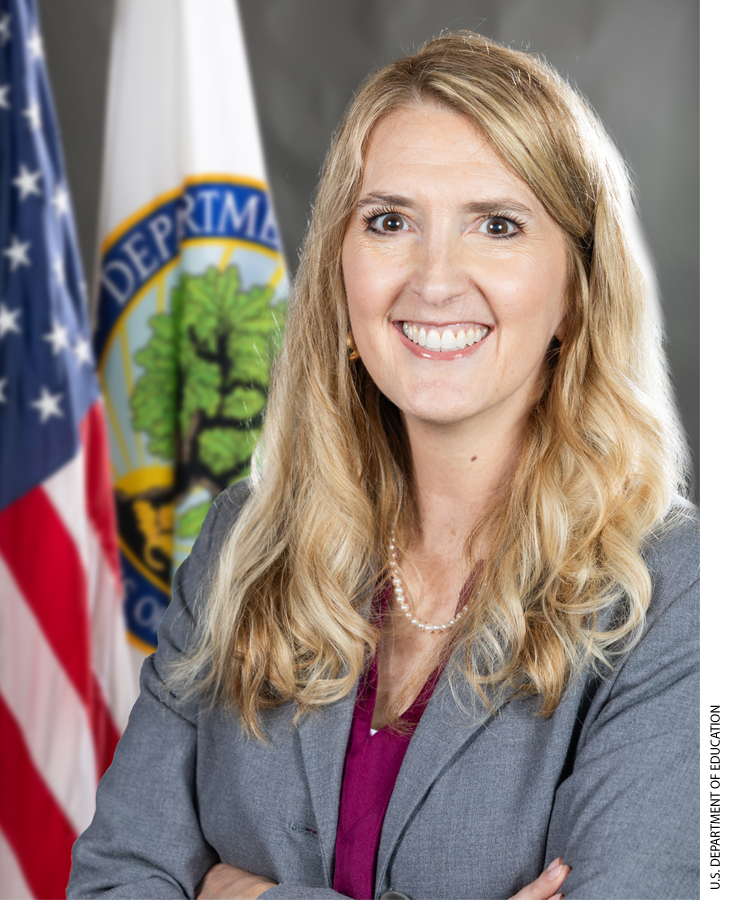
Flash forward to late February of 2026, when the report Reimagining the Institute of Education Sciences: A Strategy for Relevance and Renewal was released at 4:59 pm. on a Friday. The report was authored by Amber M. Northern, on leave from the Thomas B. Fordham Institute to serve temporarily as a senior advisor to Education Secretary Linda McMahon. Northern’s job was to propose a rebuild of IES after the Department of Government Efficiency, in the first few months of the second Trump Administration, cut the IES staff by 88 percent and canceled just about every IES contract with an exit proviso. President Trump’s budget proposal for the next fiscal year, released two months after Northern’s report, would cut IES funding by 67 percent, mostly in research projects.
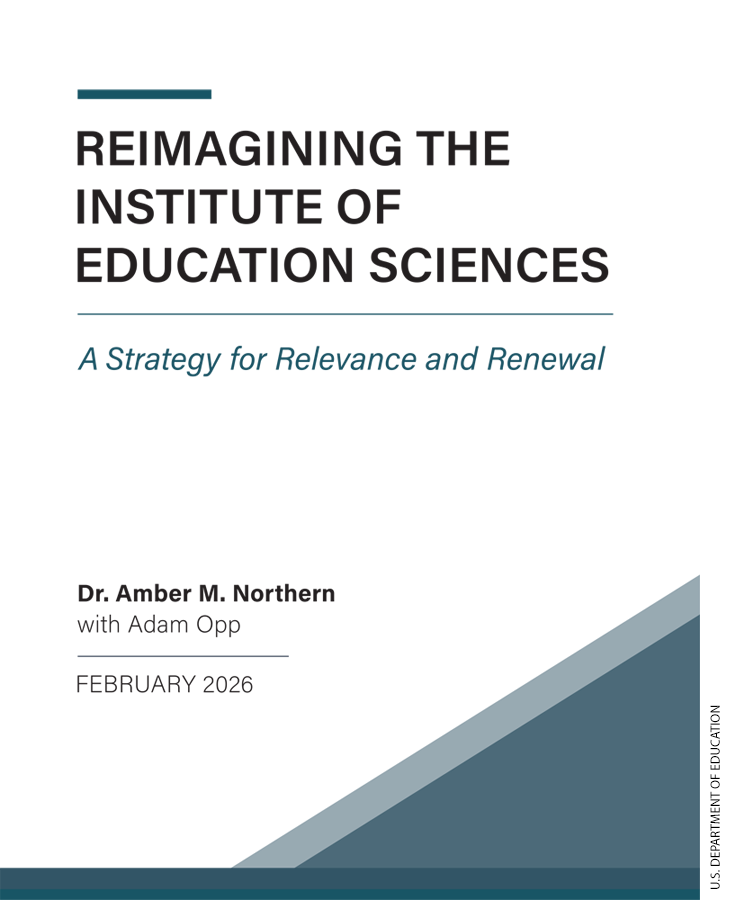
by Amber M. Northern, with Adam Opp
U.S. Department of Education, 2026, 84 pages
Like an emergency room physician performing triage after a mass casualty event, Northern consulted widely and moved energetically from program to program, determining what should and could be salvaged, reformed, or repurposed. I thank her for her yeoman’s service.
In the interest of full disclosure, I have worked with and for Northern and consider her a friend. I have also worked with and for IES in various capacities, for nearly its entire existence. I support the rigorous scientific evaluation of K–12 education interventions and the collection and posting of complete and accurate descriptive data on students, teachers, and schools. I have made a successful career out of doing so. I was among the dozens of experts consulted by Northern during the thorough evidence-gathering stage of her project. I think I am an informed judge of where IES has been, where it should go, and what it should be.
Northern’s core diagnosis is that IES is afflicted with “[a]n outdated research infrastructure and organization that limits quick insights, coordination across data sets, and innovative, non-traditional research models.” To cure IES, Northern recommends six “Big Shifts” that involve:
- changing its scattershot approach to instead focus resources on a few big, urgent problems
- standing up a single “super panel” to generate longitudinal survey data on multiple topics in place of the nearly dozen smaller panels, each focused on particular questions and subpopulations and proudly sporting its own obscure acronym
- encouraging states with shared regional interests in an education research topic to join in Tocquevillian voluntaristic groups to petition IES to study their thing
- directing “the focus of the research work towards practicality, innovation, and relevance”
- creating a “research hub” to render the 10 RELs more responsive, timely, and better coordinated
- re-orienting the What Works Clearinghouse from its current function as an arbiter of which studies are scientifically rigorous and which interventions are “evidence-based” to a producer of highly accessible guides to sound educational practice
Northern further highlights the “bedrocks of IES”: its political independence, scientific integrity, statistical data-gathering infrastructure, and sponsorship of rigorous research across diverse settings. The bulk of the 84-page report reviews a parade of horribles, organized by the divisions of IES: the National Center for Education Statistics, the National Center for Education Research, the National Center for Education Evaluation and Regional Assistance, and the National Center for Special Education Research. For each problem Northern highlights, she helpfully offers a variety of potential solutions.
There is much to applaud in Northern’s report. The Shift 2 suggestion of a “super panel” and the Shift 6 re-orientation of the much-maligned What Works Clearinghouse (WWC)—often sneeringly called “the nothing works clearinghouse,” make sense. Still, WWC would offer practice guides on only a modest number of topics, if compelling evidence were required to justify such directives. If not, if weak bodies of evidence sufficed to justify a practice guide, then the guides would seem to be no better than encouraging educators to go with their gut. This is just one of the many tradeoffs inherent in Northern’s recommendations.
Currently, there are a few big questions in K–12 education policy, involving chronic absenteeism, early and adolescent literacy, civic knowledge and skills, school choice, and the promise and perils of artificial intelligence in the classroom. It would be beneficial for the federal government’s education sciences agency to focus its limited resources on those big questions, as proposed in Shift 1. But Shift 3, allowing states to band together and petition for studies on the education issues that concern them, has the potential to undermine the laser focus of Shift 1, given inevitable dissensus among states regarding the education issues that require urgent attention.
A key question that is, shall we say, “finessed” in Northern’s report is who, ultimately, decides what IES funds? She describes a process whereby policymakers in individual states request studies of questions salient to them. What happens when that process yields 15–20 different topics? Who narrows that list down to the five or six focus areas called for by Shift 1? I suspect political imperatives would require that IES address all the questions requested by the states, thereby continuing the scattershot approach Northern rightfully bemoans.
Directing research towards a north star of “practicality, innovation, and relevance” (Shift 4) undoubtedly will come at some cost to scientific rigor, IES’s previous north star. These two priorities inevitably need to be balanced. Rigorous findings that are irrelevant are, well, irrelevant, but relevant findings that are not grounded in solid evidence can be downright harmful, as we have seen with the tremendous damage done by the education field’s uncritical embrace of the “balanced literacy” and “three cuing” approaches to (not) teaching literacy.
It is not clear how the research hub (Shift 5) would discipline the RELS to be timelier and more responsive, especially since the improved coordination also called for from the RELs slows down production processes. Innovation and AI are offered as solutions to much that ails IES, though the federal government isn’t known for being especially innovative, and the vast promise of AI remains unproven.
EdNext in your inbox
Sign up for the EdNext Weekly newsletter, and stay up to date with the Daily Digest, delivered straight to your inbox.
Northern admits that congressional action would be required to enact many key fixes. Such action seems unlikely, given that “congressional action” has become an oxymoron. Which brings me to my main point. The IES may have a plethora of operational problems, as cataloged in the Northern Report, but it has a fundamental political problem: it has cultivated a constituency mainly of Democrats, and that party is out of power.
It wasn’t always that way. IES was birthed by the Education Sciences Act of 2002, a bipartisan law enacted in the wake of the No Child Left Behind reforms to the Elementary and Secondary Education Act. Its founding Director, Grover “Russ” Whitehurst, strove for non-partisan scientific operations at the new agency. It instilled self-confidence that collectively we education researchers could identify conclusively the education policies and practices that would make the pledge of No Child Left Behind a reality. Thus, the What Works Clearinghouse. It would not be long before politics crashed the party.
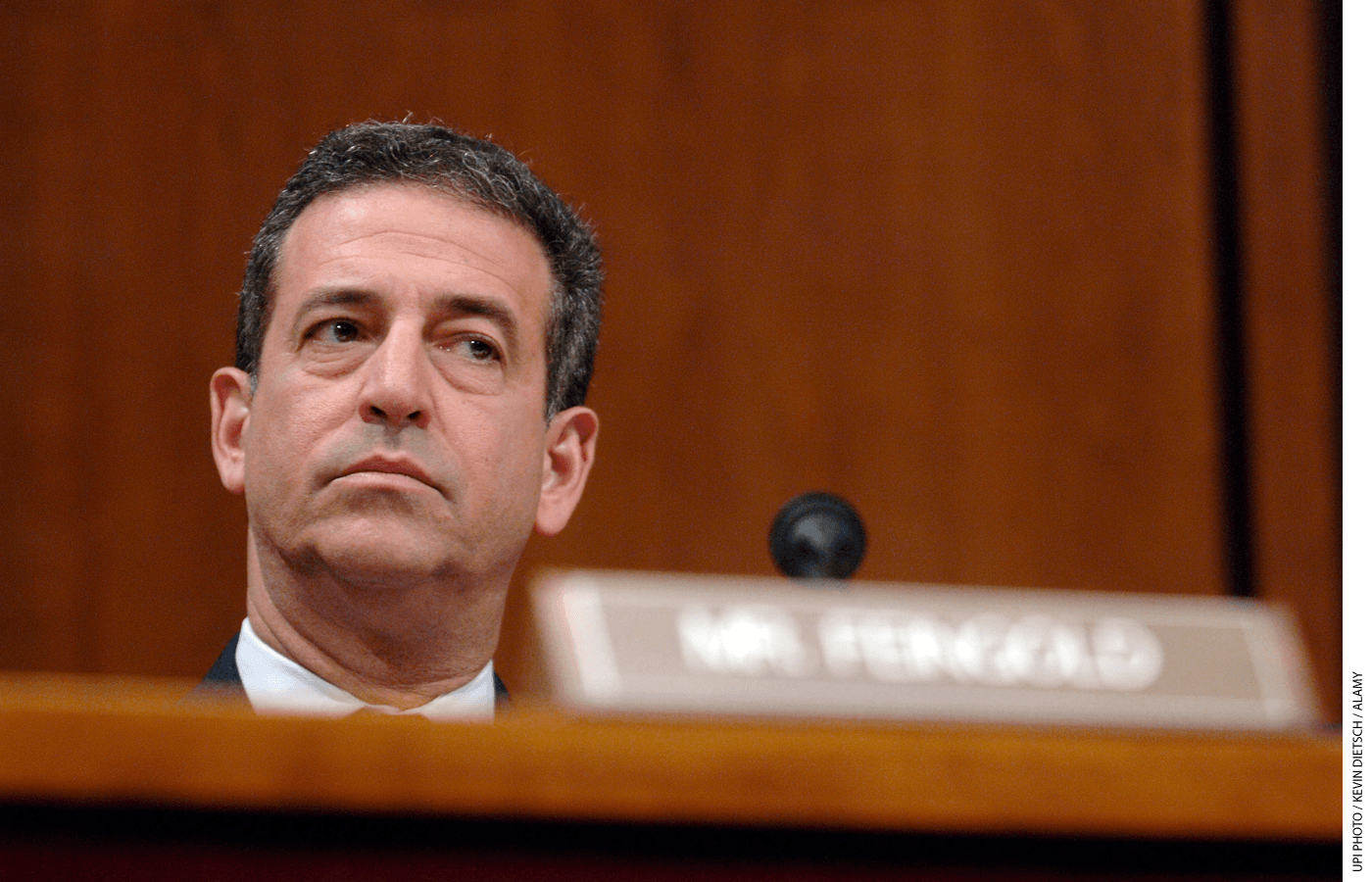
In the summer of 2008, three positions became vacant on the National Board of Education Sciences, the official governing body of IES. The openings were part of the scheduled turnover of positions on the nonpartisan scientific board. I was nominated, along with Paul Peterson and Caroline Hoxby, to fill the vacant seats. We were told that Senate confirmation would be a mere formality. Democrat Senator Russ Feingold, then the senior senator from Wisconsin, saw things differently. He put a hold on the nominations, preventing them from being discussed or voted on in committee or on the Senate floor. The seats on the Board remained vacant until President Obama assumed office and filled them with Democrats. It may seem like a small thing, but a line had been crossed. IES was no longer independent from partisan politics.
You might dismiss my blaming Senator Feingold for the politicization of IES as sour grapes. That’s fine. The Board position was unpaid with limited authority. I was willing to serve but was not crushed when that opportunity was denied to me. If anything, the fact that our nominations were torpedoed by politics meant fewer headaches for me and probably for Paul and Caroline as well. Still, I felt that something important was lost. After all, I had been there at the beginning. That is why I hope that IES can reclaim its reputation as a discoverer of truths that are helpful to a broad swath of Americans, in red states and blue states, now and into the future. I hope that many of the sensible reforms in Northern’s report are adopted and implemented. I hope that IES rises again.
But hope is not a strategy.
Here are some additional ideas to improve the political status and operations of IES. The agency should sponsor studies and research centers on K–12 education topics of special interest to Republican officeholders. These might include civic education, patriotism, and, my favorite, school choice.
The IES should continue to lean on the RELs as channels for evaluating educational interventions relevant to different regions of the country. The Northern, Southern, Eastern, and Western RELs collectively represent all U.S. states and territories. They should dare to be different in customizing their research agendas to fit the distinctive interests and needs of their respective communities and political leaders. Another approach would be to junk the RELs and Comprehensive Centers entirely and block-grant the funds to individual states to establish their own education labs. That reform would be fully consistent with the Trump administration commitment to returning primary control over education to the states. These two changes would help to rebuild bipartisan support for IES and its mission.
I have two suggestions for operational improvements at IES. The agency assigns extra points to contract and grant proposals that include minority-owned and women-owned businesses, consistent with federal contracting law. I recommend that IES also assign extra points to research teams with demonstrated viewpoint diversity. Teams of scholars with different political and ideological perspectives are more likely to uncover the truth in their studies, as they are less susceptible to confirmation bias and other foibles generated by ideological echo chambers. An ideologically diverse research team is a better research team, all else equal, and should be rewarded as such in the IES contracting process. Second, the staff assigned to oversee the implementation of IES contracts and studies need to resist the temptation to micromanage. I could tell you stories, but those will have to wait for another day.
The Northern Report demonstrates the great difficulty of designing and operating an effective federal agency with the authority, tools, and autonomy to achieve its mission-related goals. Public administration is difficult, especially in our time of political polarization. There is little political support for an expanded federal bureaucracy. Protesters aren’t flocking to the streets in call-and-response chants of “What do we want?” “More causal studies of K–12 education policies!!!” “When do we want them?” “Now!!!” Absent such political pressure, it will be difficult for IES to receive the level of support and the statutory and operational reforms it needs to be our country’s education research agency. For the Trump administration, that may be the point. I certainly hope not.
Patrick J. Wolf is a Distinguished Professor of Education Policy at the University of Arkansas.
Suggested citation format:
Wolf, P. J. (2026). “Imagine There’s No Politics – A Review of the Northern Report: The proposals for overhauling the Institute of Education Sciences could address its operational inefficiencies but are unlikely to break throughout our ideological stalemate.” Education Next, 26(2), 23 April 2026.