





Public debate over gifted education tends to focus on fairness. Who gets to be called “gifted” and what sort of extras do they receive? Nationwide, more than 12 percent of Asian students and almost 8 percent of white students are enrolled in gifted programs compared to 3 percent of Black students and 4 percent of Hispanic students—differences that have prompted several large districts to rethink their gifted offerings. Seattle Public Schools is weighing plans to sunset its gifted and talented programs in coming years, citing concerns about equity. New York City Mayor Zohran Mamdani’s campaign platform prominently featured scaling back early elementary gifted offerings in the nation’s largest school district, responding to concerns that they exacerbate economic inequality.
Underlying these debates are fundamental questions about the impacts of gifted services. Could gifted programs address, rather than amplify, these gaps? When disadvantaged students are identified for gifted services, do they benefit from participation? Which students benefit the most?
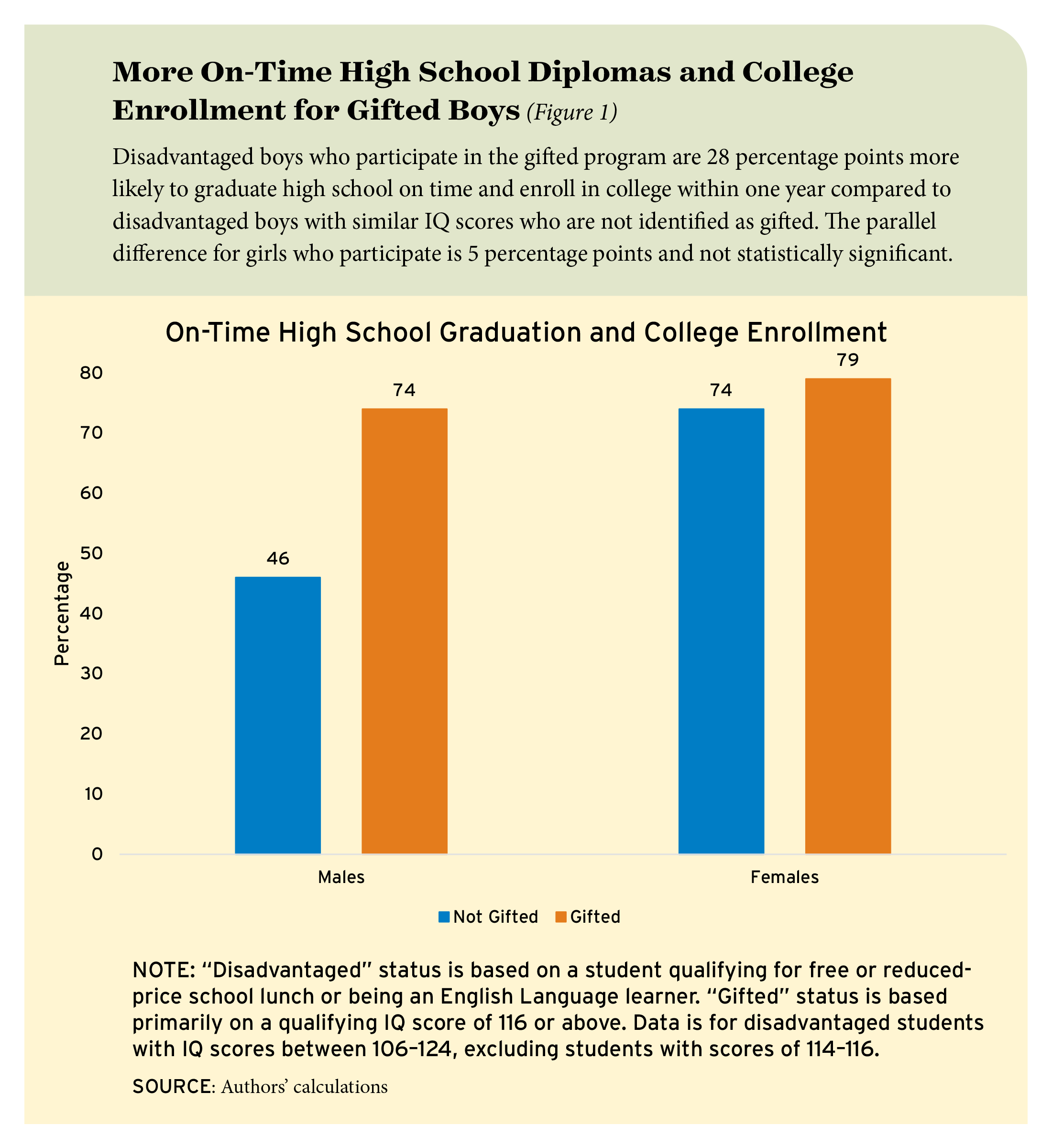
To find out, we studied these questions in a large, urban district in Florida whose gifted program uses broad screening and IQ-based eligibility to identify and serve disadvantaged students. We focus our analysis on students with similarly high IQs who are from low-income families or are English language learners and compare a range of outcomes for those who score just above and below the qualifying score. We find that disadvantaged boys in the gifted program are 60 percent more likely to enroll in college compared to disadvantaged boys with similar IQs who miss the cutoff and do not receive gifted services. Disadvantaged girls in the gifted program are 6 percent more likely to graduate on time and enroll in college than their peers who do not receive gifted services, though this difference is not statistically significant.
What accounts for these differences? Interestingly, being in the gifted program has no effect on measures of cognitive skills such as standardized tests in grades 6–8 or PSAT scores in high school, even though students are placed in separate gifted classes in elementary school and receive extra support and guidance throughout middle and high school. Rather, the program’s largest impacts are on markers of “non-cognitive skills”—measures that capture student behavior, like enrolling in rigorous classes and getting good grades. Disadvantaged boys in the gifted program are about 30 percentage points more likely to complete algebra 1 before 9th grade and take twice as many AP classes in high school as their non-participating peers with similar IQs. More generally, throughout middle and high school, they select classes that place them with higher-performing peers. Moreover, despite having a more challenging curriculum and higher-achieving classmates, these boys often earn better grades than boys who just miss the cutoff for eligibility. Math GPAs for disadvantaged boys in the gifted program are roughly 0.4 points higher on a 4.0 scale, rising from roughly a B-minus to a B-plus.
To better understand these effects, we compare students’ outcomes based on a marker of “non-cognitive skills” in 3rd grade—their self-reported enjoyment of learning in school. Here, we find the program’s largest impacts among children who reported the lowest enjoyment of learning. Disadvantaged boys who report low enjoyment of learning in 3rd grade are more than seven times as likely to graduate high school on time and enroll in college if they participate in the gifted program. Disadvantaged girls with low reported enjoyment of learning are 50 percent more likely to graduate on time and go to college if they are in the gifted program.
Our study highlights aspects of a gifted program that benefit socioeconomically disadvantaged students. While prior research has focused on whether gifted programs affect cognitive measures like test scores, we show the importance of supporting non-cognitive development. We also show that this has outsized positive effects for boys, though outcomes for all students improve. Establishing eligibility for gifted programs with IQ testing, rather than relying solely on behavior-based metrics like grades or teacher recommendations, appears to be a powerful way to identify and support less-engaged boys with strong academic potential.
An Inclusive Gifted Program
The district we study offers a useful example of what a more inclusive gifted program can look like in practice. It is one of the largest school districts nationwide and uses a “universal screening” program designed to promote equal access. Overall, district enrollment is 32 percent white, 35 percent Black, and 26 percent Hispanic, and 8 percent of students are English language learners as of 5th grade. About half of all students qualify for free or reduced-price school lunch.
Rather than relying on parent or teacher referrals for gifted testing, all elementary students are given an in-class, non-verbal ability test in 2nd grade. Students who meet minimum cutoffs are automatically referred for IQ testing, which is used to establish gifted status. The primary qualifying IQ score is 130 points; however, students who receive free or reduced-price school lunch or who are English language learners can qualify as gifted under “Plan B” with a score of at least 116 (around the 84th percentile). Previous research has shown that introducing the universal screening program led to an immediate jump in the share of “Plan B-eligible” children who received an IQ test, from 13 percent to 24 percent, and tripled the share of “Plan B” students who were identified as gifted by the end of 3rd grade, from 1.4 percent to 4.3 percent.
After a student is found to meet the IQ threshold, an Exceptional Student Education (ESE) specialist meets with the student, parents, and teachers to determine whether additional gifted criteria are met, including the “need for a special instructional program.” Notably, the district’s policy is intentionally flexible with respect to traditional criteria like leadership, creativity, and motivation, so as not to eliminate gifted “underachievers” from the gifted program. Once identified, students are eligible for gifted services through the end of high school.
Each gifted student receives an Education Plan that specifies needs, services, and goals related to curriculum or social and emotional development. They are placed in separate gifted or gifted/high-achiever classrooms in grades 4 and 5 and may receive priority access to a three-year accelerated math program in middle school. Most middle schools also offer separate language arts classes for gifted and high-achieving students. In addition to biannual meetings about individual educational goals, gifted students meet with ESE specialists at the transitions to middle and high school, to help them choose courses that match their abilities.
Data and Method
We focus our analysis on students who were enrolled in 5th grade between 2003–04 and 2011–12, based on district data that includes each student’s gender, race and/or ethnicity, IQ scores, gifted status, and whether they are English language learners or qualify for free or reduced-price school lunch.
We construct our sample of about 3,500 students in three steps. First, we limit our analysis to students who are enrolled in the district by 4th grade, took their first IQ test by 5th grade, and were either from low-income families or English language learners at the time of the test—making them eligible for gifted status if they meet the “Plan B” IQ threshold of 116. Second, we only look at students who stay in the district for at least seven years after 5th grade and have complete data for test scores in grades 5–8 and course selection and grades in middle and high school. Third, we focus on students with IQ scores between 106 and 124 points, or within 8 points of the gifted cutoff score (but excluding those who score 114–116, to account for bunching). This group of students is relatively high achieving, with average test scores in grades 2 and 3 that are 50 percent to 60 percent of a standard deviation higher than the district average.
We then use what’s known as a regression discontinuity approach—comparing outcomes of students with IQ scores just above and below the gifted threshold—to estimate the causal effects of program participation. The outcomes we examine include scores on statewide reading and math tests in grades 6–8, PSAT scores, disciplinary records, course selections, grades in middle and high school, and on-time high school graduation. We also use data from the National Student Clearinghouse to track college enrollment.
Impacts on High School Performance and College-Going
The comparison around the IQ cutoff reveals the pattern previewed above: Gifted participation boosts disadvantaged students’ on-time high school graduation and college enrollment, with boys experiencing the largest gains. Some 74 percent of gifted disadvantaged boys enroll in college within one year of high school graduation compared to 46 percent of their peers who tested just below the program eligibility cutoff—a 61 percent increase that brings gifted boys’ rate of college enrollment in line with that of non-gifted girls (see Figure 1). Among disadvantaged girls with similar IQs, gifted participation increases college enrollment to 79 percent, a 6 percent (but statistically insignificant) jump.
To understand why the college-going gains are larger for boys, we next examine the academic pathways that lead up to college enrollment. We do not find evidence that participating in the gifted program improves students’ cognitive skills for either boys or girls. There are only small and statistically insignificant effects on standardized test scores in grades 6–8 and PSAT scores in high school.
However, we find broad differences in markers of non-cognitive skills—behavior-based outcomes like course selection and grades. We examine these outcomes by gifted status and gender and, as with the overall college enrollment estimate, we find that gifted participation has larger effects for boys than for girls. Disadvantaged boys who participate in the gifted program essentially catch up (or nearly catch up) to disadvantaged girls with similar IQs.
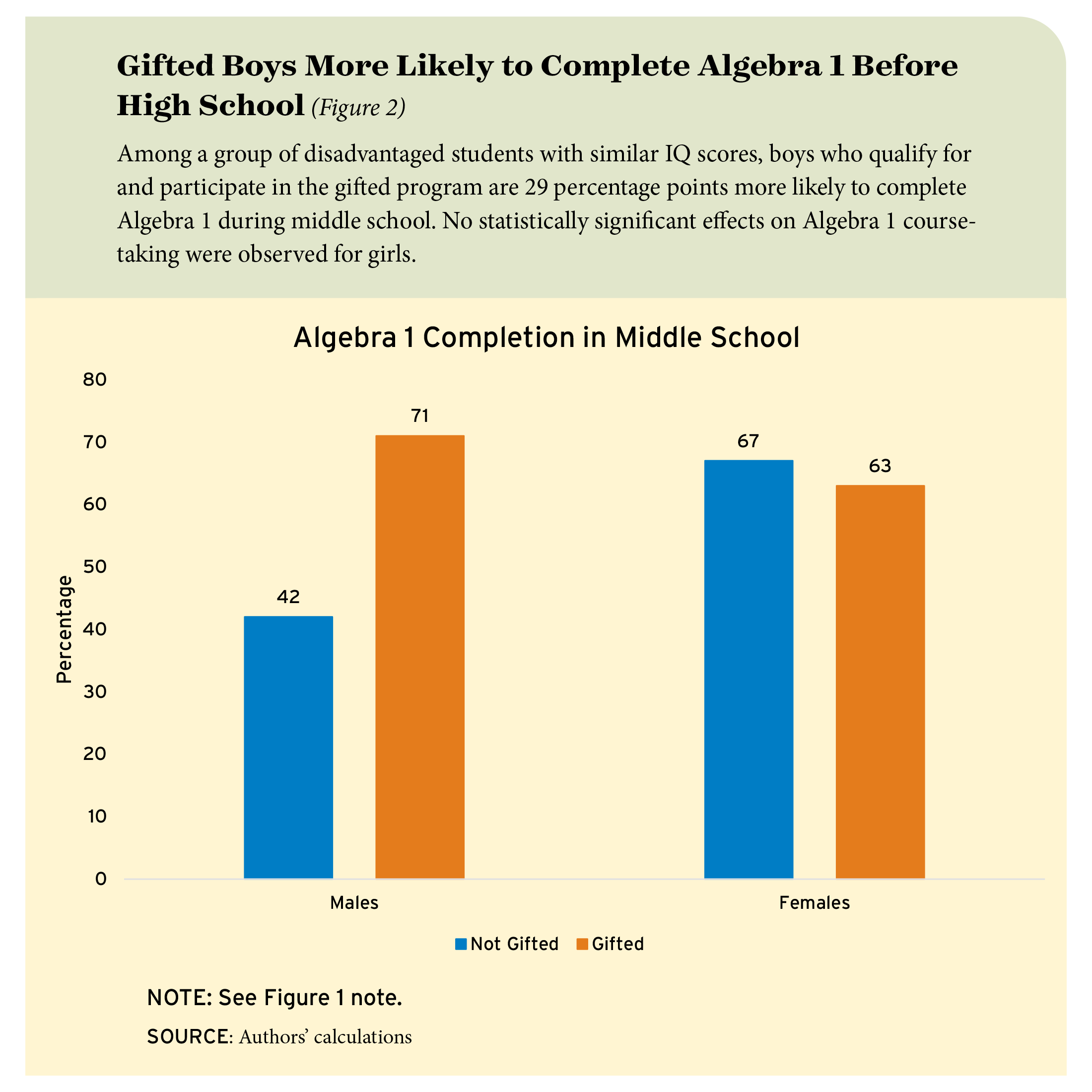
The clearest early difference appears in advanced course-taking. Some 71 percent of disadvantaged gifted boys finish algebra 1 in middle school compared to 42 percent of disadvantaged boys just below the program cutoff, an increase of 69 percent (see Figure 2). Among girls, there is a small but statistically insignificant decline in this outcome. The same pattern continues in high school. Disadvantaged boys in the gifted program take more than four AP classes in high school, on average, compared to two AP classes for similar boys not in the gifted program. Disadvantaged girls take an average of four AP classes in high school regardless of whether they participate. Again, gifted participation appears to raise AP-taking among marginally eligible boys to roughly the level of marginally eligible girls.
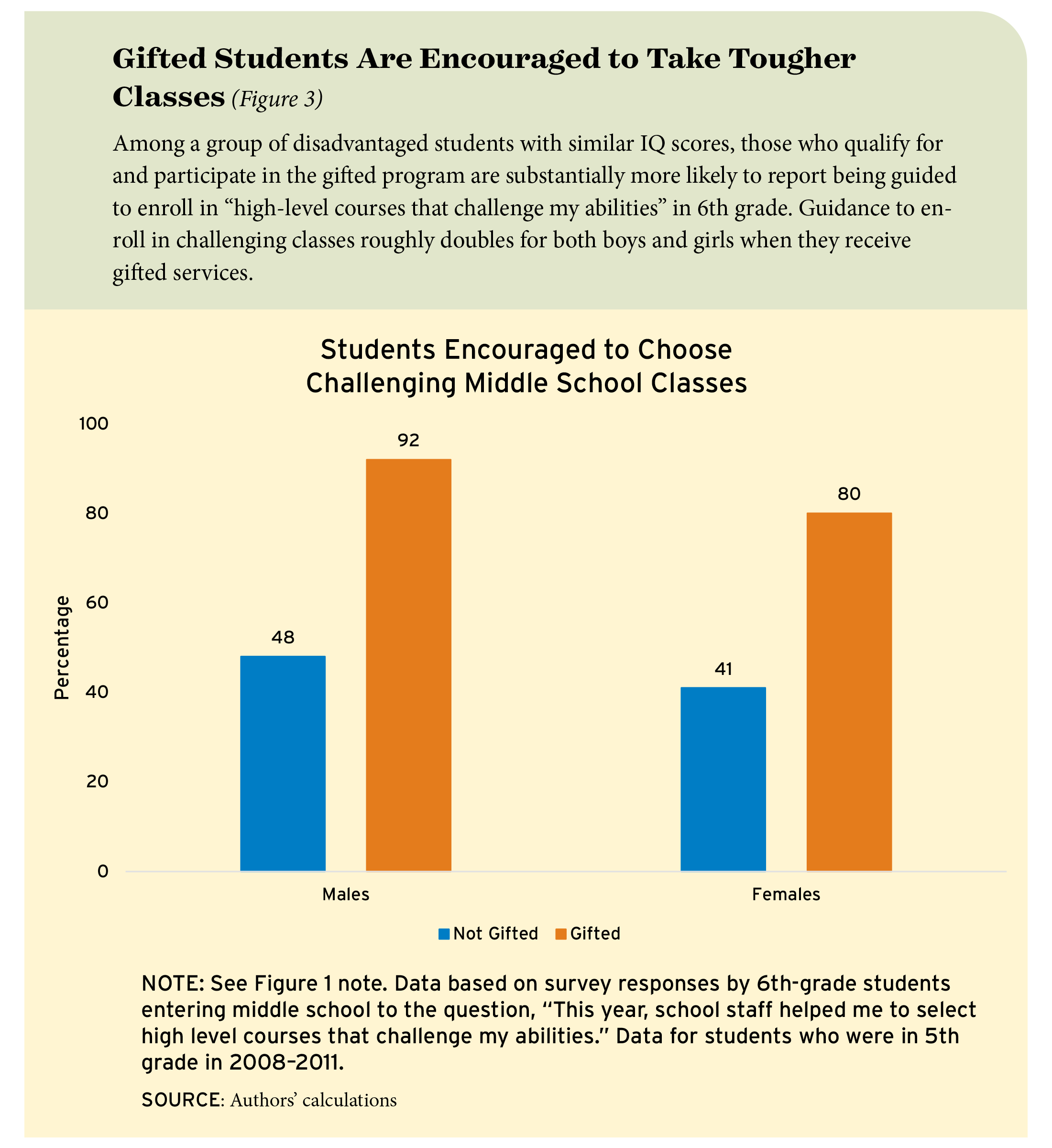
One of the unique features of the program we study is gifted-specific guidance counseling for individual students, which occurs every other year and when they are entering middle and high school. District survey data show that gifted students are more likely to be encouraged to take challenging classes: 92 percent of boys and 80 percent of girls report being guided to difficult coursework compared to 48 percent of similar non-gifted boys and 41 percent of similar non-gifted girls (see Figure 3).
These more challenging course enrollments do not appear to come at the expense of student grades. The overall average high-school GPA for all students in our sample is around 3.2 for boys and 3.5 for girls on a 4.0 scale, regardless of program participation. However, we do find impacts from gifted participation on students’ math grades. For boys, math GPAs improve by about half a grade point to about 3.2, compared to 2.8, on a 4.0 scale. Girls’ math GPAs drop slightly, from about 3.4 to about 3.3 on a 4.0 scale. There is no corresponding effect on students’ language arts grades.
Exploring Effects on Non-Cognitive Skills
Taken together, these patterns are consistent with a simple explanation: Gifted services appear to strengthen the non-cognitive skills of students, while having little to no effect on cognitive skills. Our interpretation is that, in the absence of such services, many disadvantaged boys with IQs near the program eligibility threshold have a non-cognitive skill deficit—for example, they may lack engagement or motivation to exert effort in school—that limits their academic success. Most girls, on the other hand, have non-cognitive skills that are aligned with their cognitive skills. This explanation implies that if we were to compare girls and boys with low levels of non-cognitive skills prior to program entry, we would find that children benefit regardless of gender.
EdNext in your inbox
Sign up for the EdNext Weekly newsletter, and stay up to date with the Daily Digest, delivered straight to your inbox.
We explore this hypothesis using a survey-based measure of engagement in 3rd grade: students’ self-reported enjoyment of learning. Specifically, students are classified as having a high level of enjoyment if they “strongly agreed” with the statement “I enjoy learning at my school.” Students who indicated less agreement are considered to have lower enjoyment and less engagement in school. Based on this measure, 67 percent of the girls in our sample have a high enjoyment of learning compared to 59 percent of boys and 60 percent of students districtwide.
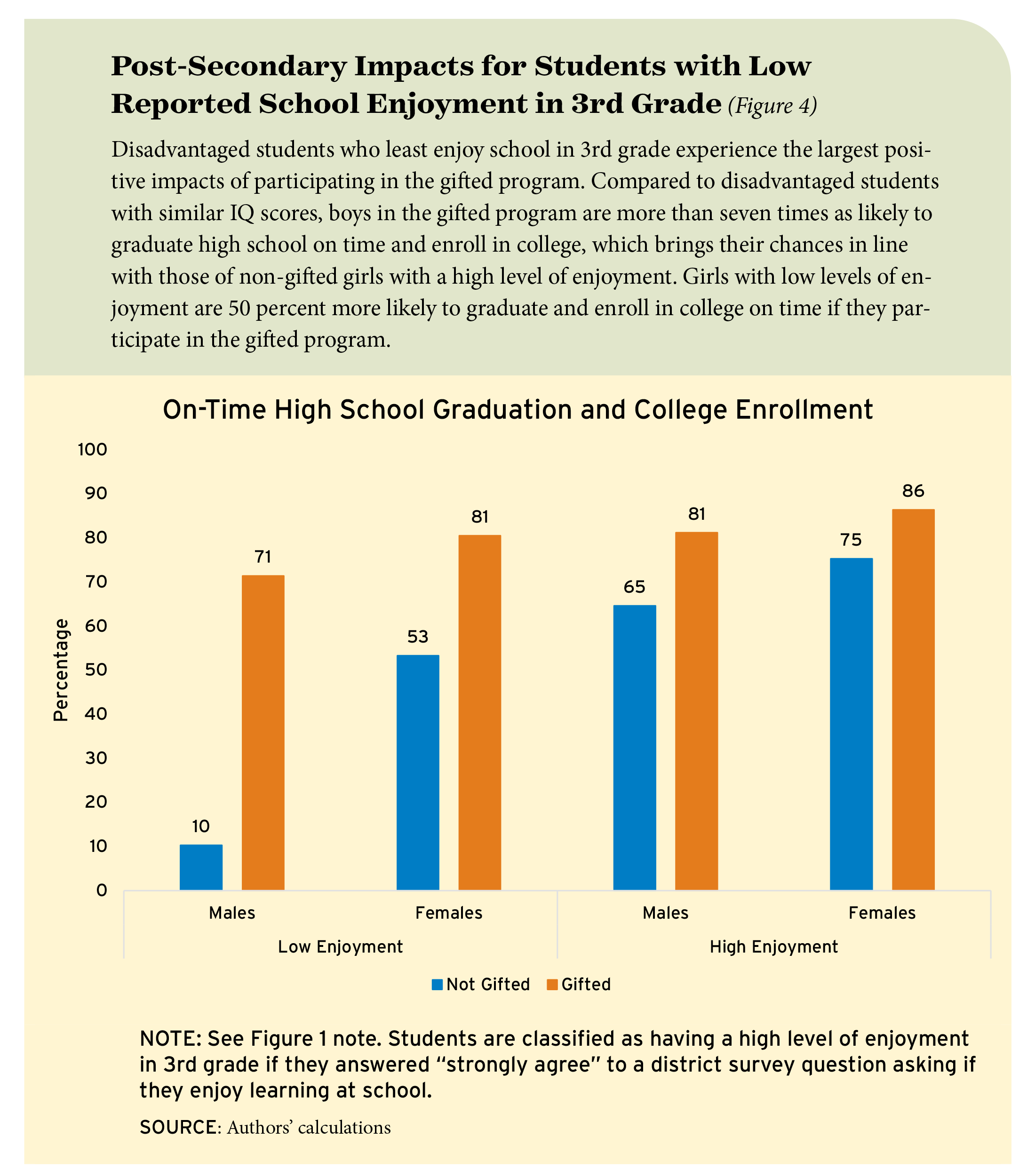
When we compare students by their enjoyment of learning in 3rd grade, the largest benefits appear among those who were least engaged with school at an early age. In particular, boys in this category are more than seven times as likely to enroll in college if they are in the gifted program: Three out of four participating boys ultimately go to college compared to one in 10 boys with similar IQs who miss the gifted cutoff (see Figure 4). College enrollment for girls in the low-enjoyment group jumps by around 50 percent, from a rate of 53 percent for those not in the program to 80 percent if they participate. We also find increases in on-time graduation and college entry among students with high levels of enjoyment, but they are much smaller. The rate of college enrollment for boys increases to 81 percent from 65 percent, and the rate for girls grows to 86 percent from 75 percent.
Implications
With respect to the gifted education literature, our findings provide the first rigorous evidence from a U.S. setting that gifted programming can have long-term effects on disadvantaged students. While previous evaluations focused on standardized test scores and found limited impact, our findings suggest that it is important to look beyond this metric to understand the value of advanced academic programming. This adds to the growing evidence that long-run schooling outcomes depend on more than just cognitive ability, and that “non-cognitive” determinants of school success like motivation, engagement, and aspirations may be just as critical.
The results suggest that gifted programs can improve disadvantaged students’ long-run outcomes through changes in engagement, course-taking, and grades—effects that standardized tests may miss. This complements prior research showing that teachers’ estimated impact on non-cognitive skills is 10 times more predictive of students’ long-term success than their estimated impact on test scores (see “The Full Measure of a Teacher,” research, Winter 2019). Further, our analysis shows that students with low engagement in elementary school reap the biggest rewards from participating in a gifted program, which explains why we see larger benefits for boys. The gifted program nurtures success-oriented behaviors, like taking tougher classes and getting better grades in math.
Gifted education programs deserve continued study. Disadvantaged boys have very low rates of college entry—even those with high cognitive abilities are far less likely to enroll in college than girls and non-disadvantaged boys. These are the students that gifted programs are intended to serve: those with high potential who require special support to remain engaged in school and progress to college. The district we study uses universal screening for giftedness, an inclusive two-tier qualification system based on IQ scores, and individual, holistic reviews. These types of policies and programs can benefit students whose low non-cognitive skills may mask their true academic potential—with positive implications that may well persist into adulthood.

David Card is professor emeritus at the University of California, Berkeley. Eric Chyn is associate professor at the University of Texas–Austin. Laura Giuliano is professor at the University of California, Santa Cruz.
Suggested citation format:
Card, D., Chyn, E., and Giuliano, L. (2026). “How a Gifted Program Impacts Disadvantaged Students: Non-cognitive skills, college attainment boosted for high-ability boys.” Education Next, 26(2), 16 June 2026.