


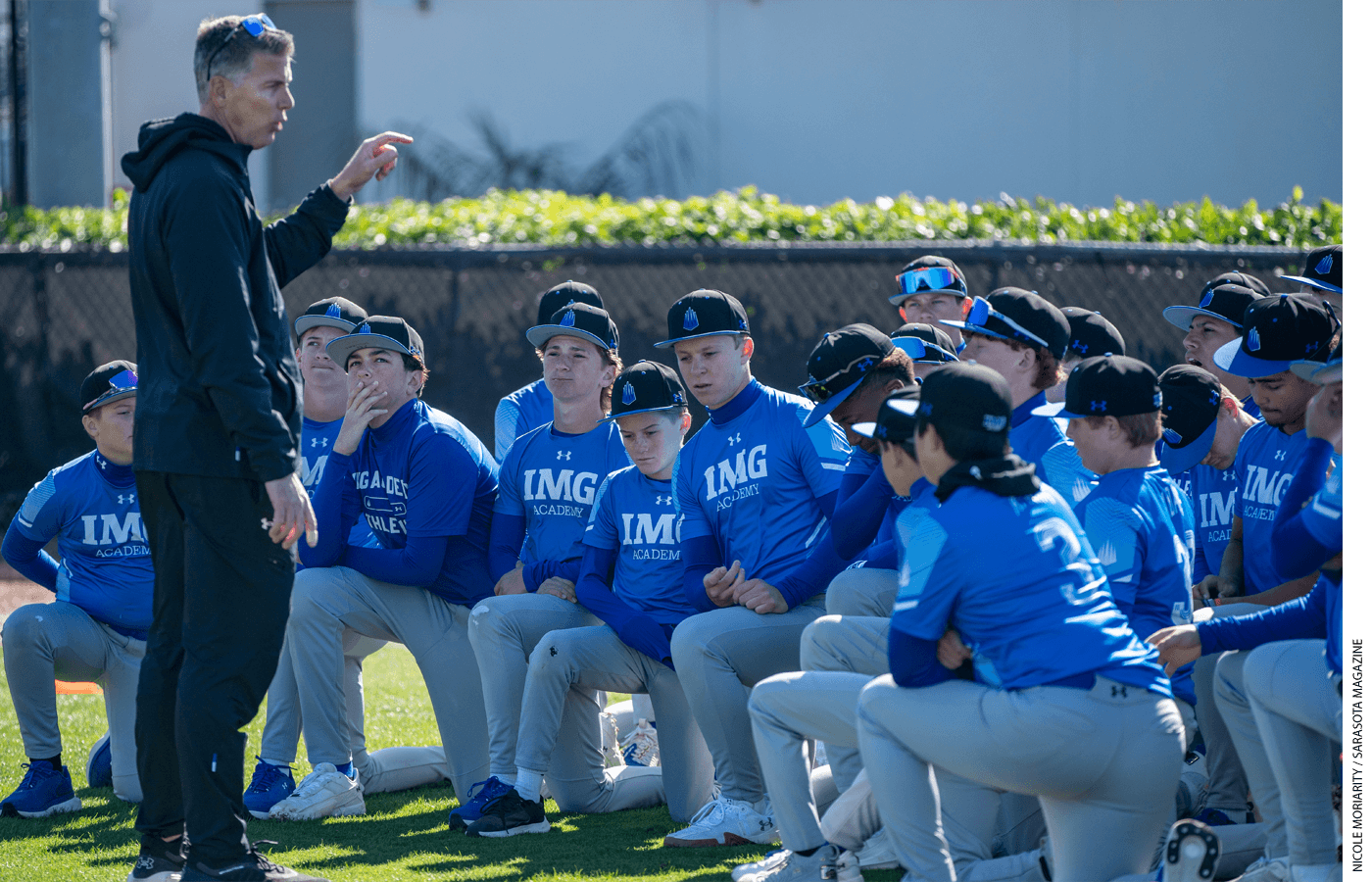
On an unusually cold late January morning in Bradenton, Florida, a group of 35 middle schoolers in full uniform and cleats arrives at one of IMG Academy’s six baseball fields. While most kids their age are settling into desks for math or English, these 7th- and 8th-grade boys are training in Coach Pete’s “classroom.”
They break into two groups: one to play “blind dodgeball,” the other to tackle the “36-cone drill.”
Pete Paciorek, IMG Academy’s head of leadership and character development, is teaching a lesson about communication. In the first group, boys work in pairs—one wears a blindfold while a “wingman” shouts directions to help him avoid getting pelted. Nearby, the second group navigates a labyrinth of cones, studying each other’s failures to memorize the pattern.
“You’re giving signals to your teammates all the time,” Paciorek explains as the boys repeatedly get stuck in the maze. “You guys play a hard game. If you strike out, you walk into the dugout mad because your batting average just dropped from .500 to .438. You walk right by your on-deck guy and the guy in the hole. You sit down and pout. I’m not saying you do this—we don’t do this at IMG—but I see it often at your age. You think it’s all about you. But you just saw eight pitches. You have a lot of information to share.”
Paciorek, 49, spent a decade playing professional baseball for the Dodgers and Padres organizations before earning an Ed.D. in character education. He pauses to ask how many of the kids want to play college ball. Nearly every hand shoots up—save for a few who likely believe they’ll skip college and go straight to the Major Leagues.
“I was a college coach,” he tells them. “And I promise you, college coaches are watching how you respond in the dugout. Are you a good teammate or a lousy one? Are you paying attention? Are you communicating?”
Character education—effective communication, leadership, mental performance, support for teammates, and healthful living—is woven into the student experience at IMG Academy, a preparatory boarding school that aims to combine intensive athletic training with rigorous academics. With 29 multi-use fields, 58 tennis courts, an 18-hole golf course, double-sided driving range, 3 weight rooms, and a 5,000-seat stadium spread out over 478 acres, IMG is the most prominent and well-established American sports academy. Enrolling about 1,600 students, IMG serves as the prototype for a model gaining traction nationally—schools that structure their day to merge academics and athletics.
The Department of Education does not require private schools to register as sports-focused, so the total number of these academies is difficult to pin down. The Washington Post noted the growth in the D.C. area alone in an August 2025 story headlined, “Once reserved for the elite, sports academies are now everywhere for everyone.”
The quality of sports academies varies greatly. Some, such as IMG or Spire Academy in Geneva, Ohio, are elite programs with high-end facilities. Some, like the long-established ski program at Burke Mountain Academy in Maine, serve niche markets. Others are “storefront” schools that pair a sport—often basketball—with fully online education. And a few are fly-by-night operations run by unscrupulous opportunists. Families are eager to earn college scholarships and take advantage of new income opportunities in athletics, so understanding the benefits of these academies and their unique approach to education—along with challenges they present—is worthwhile.
Topnotch Training, Academic Rigor
A few fields over from the morning baseball drills at IMG Academy, more than 100 high school and middle school football players work on position-specific offseason drills. One of them, Jayden Wade, is ranked the No. 1 quarterback in the nation for the class of 2028 by the recruiting website 247 Sports. The 6-foot-3 sophomore throws with an easy motion under the watchful eye of assistant coach Jeff Blake, a 13-year NFL veteran who played primarily with the Cincinnati Bengals.
The football standout left his hometown of Compton, California, to study and train at the academy. “I knew IMG gave me the best chance to reach my potential,” says Wade, wearing a “Playerdata” vest that holds sensors for coaches to gather GPS tracking data. “The coaches saw me at an all-star camp and invited me and my family for a visit. We sacrificed a lot to come here. I was just 14. But I’ve learned so much on and off the field. I learned how to take care of myself. I feel like I’m already ready for college.”
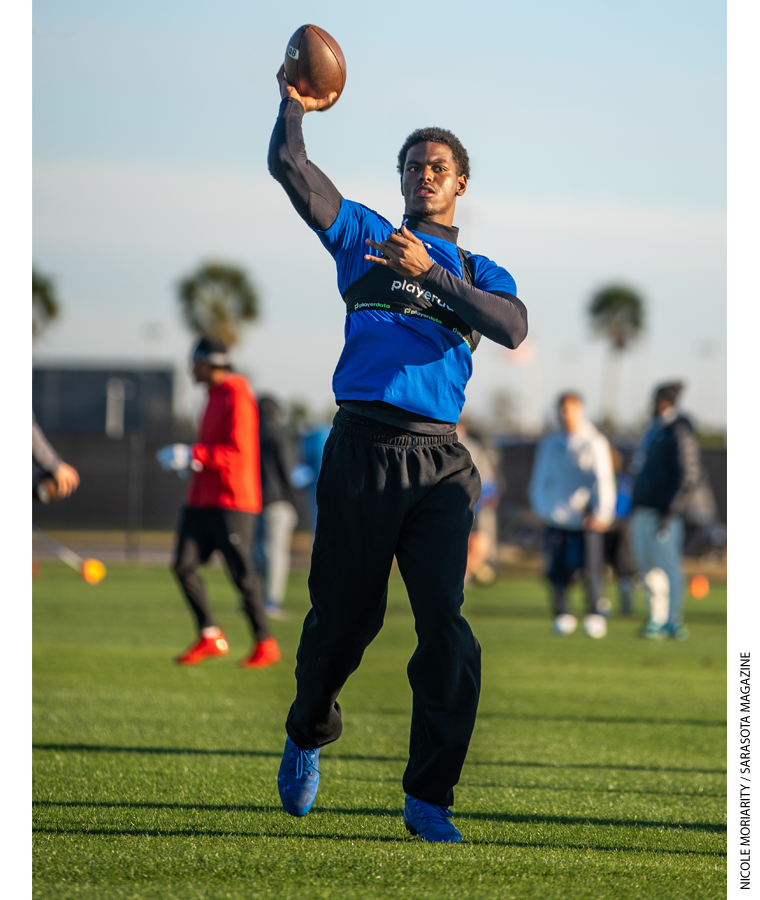
Wade, who has committed to the University of Georgia and is represented by the marketing agency Vayner Sports, would normally be a big man on any campus. At IMG Academy, it’s harder to stand out. “That’s one of the funny things about this place,” head of school Dan McKee says. “Athletes that would be superstars at home don’t even get noticed here. We have possibly the best high school lacrosse player in the country. . . . He’s already committed to Princeton. No one here is that impressed. He’s just another person working really hard.”
While 800 athletes strive to perfect their skills, the rest of the student body is in the 102,500-square-foot academic center. In Robert Young’s Law in Society class, two students participating in a mock trial have nowhere to hide. A girls’ volleyball player takes the floor to make a case for Stella Liebeck, the 79-year-old woman awarded $2.7 million after scalding herself with a McDonald’s coffee. The student’s adversary, a boys’ lacrosse player, mounts a defense for the corporation. The rest of the class leans forward, peppering the duo with questions. The energy here mimics the practice fields—competitive and focused.
When the volleyball player scores a point by noting that McDonald’s had ignored previous coffee-burn complaints, the room reacts as they would at a sporting event. “Ooh, she’s got him,” a student whispers from the back row.
IMG Academy has a 12:1 student-teacher ratio and according to the school, 470 of its student-athletes enrolled in multiple AP courses during the 2024–25 academic year. In the hallway, a massive map tracks the destination of graduating seniors, a visual reminder that for most, the “next level” is college, not the pros.
IMG Academy started in 1978 as the Nick Bollettieri Tennis Academy. Superstars like Andre Agassi, Jim Courier, and Maria Sharapova trained under Bollettieri. He sold the school to IMG (originally International Management Group) in 1987 and eventually that company added a wide variety of sports. In 2023, Endeavor, which had acquired IMG, sold the academy to the Swedish private equity firm BPEA EQT for $1.25 billion.
“There’s this dynamic in the United States where people say education, but they mean academics,” says IMG Academy CEO Brent Richard. “Especially in the educational world. They view those two things as synonymous. And I think what you’re seeing from lots of parents is the desire for their kids to be more serious about sports because sports teach some of the most critical life skills. What happens on the field every day is a lab.”
The privilege to attend IMG Academy is expensive—tuition rates for boarding students vary by sport and grade level but begin at $95,000 for 2026–27 before additional costs. For parents, some of that cost is offset by the fees they no longer have to pay to enroll their kids in elite sports programs back home. According to its website, IMG Academy also grants $47 million in scholarships and financial aid to students.
When IMG Academy was sold to BPEA, one of the goals was to expand its influence internationally. Currently, 32 percent of the school’s students hail from other countries. But IMG has experienced some growing pains. This February the U.S. Treasury Department ordered the school to pay a $1.72 million fine for accepting fees up to $800,000 for two students linked to Mexican drug cartels, starting in 2019. The Office of Foreign Assets (OFAC) issued a report stating that IMG Academy “lacked actual knowledge that the individuals with whom it dealt with were sanctioned,” but still “demonstrated reckless disregard for U.S. sanctions requirements.”
OFAC did credit the academy for addressing the situation, writing: “IMG Academy took immediate remedial steps after learning of the apparent violations and has since developed and implemented an OFAC sanctions compliance program.”
Despite this setback, IMG Academy hopes to expand and provide elements of its educational and performance philosophy to other schools at home and overseas. In March, it announced the launch of Elevate, a digital and onsite provider of its personal development program that it makes accessible to any K–12 school or college for a fee.

Buyer Beware
IMG Academy’s success has tempted aspiring coaches and educators, some with little or no experience, to jump into the field—and sometimes perpetrate scams. On August 29, 2021, IMG Academy’s top football program lined up against Bishop Sycamore, a relatively new school from Ohio, for a game that would shine a spotlight on fraud and negligence in sports-focused schools.
“If you think of an academy’s academic rigor as a sliding scale and IMG Academy is somewhere near 100,” says Ben Ferree, co-author of Friday Night Lies: The Bishop Sycamore Story, “then Bishop Sycamore is at zero. They had no academics.”
Ferree spent nearly eight years as the assistant director of officiating and sport management at the Ohio High School Athletic Association. In that capacity he led an investigation into Bishop Sycamore and its football coach, Roy Johnson. In 2018, a school run by Johnson called Christians of Faith from Columbus, Ohio, started showing up on other high schools’ football schedules. Ferree had never heard of it, so he called the school and was told it had 750 students. Ferree went to the listed address and there were no students and no school.
The OHSAA declared COF was not a real school and soon the Ohio State Department of Education revoked its charter. But the following year, Johnson successfully formed Bishop Sycamore. The football team went 4–5 in 2019 and managed to stay under the radar. Then, according to Ferree, the Covid-19 pandemic provided an opportunity for Johnson. Legitimate football teams could not find enough open schools to schedule, and Bishop Sycamore filled the vacuum.
One former student told Complex.com that Bishop Sycamore recruiters promised him the school would become the “IMG of the Midwest.” Instead, students stayed in hotel rooms or apartments and were forced to steal food from Walmart and grocery stores. Their only academic experience was one visit to a public library. They played multiple games a week with little medical supervision, and the school couldn’t maintain adequate staffing to run the program.
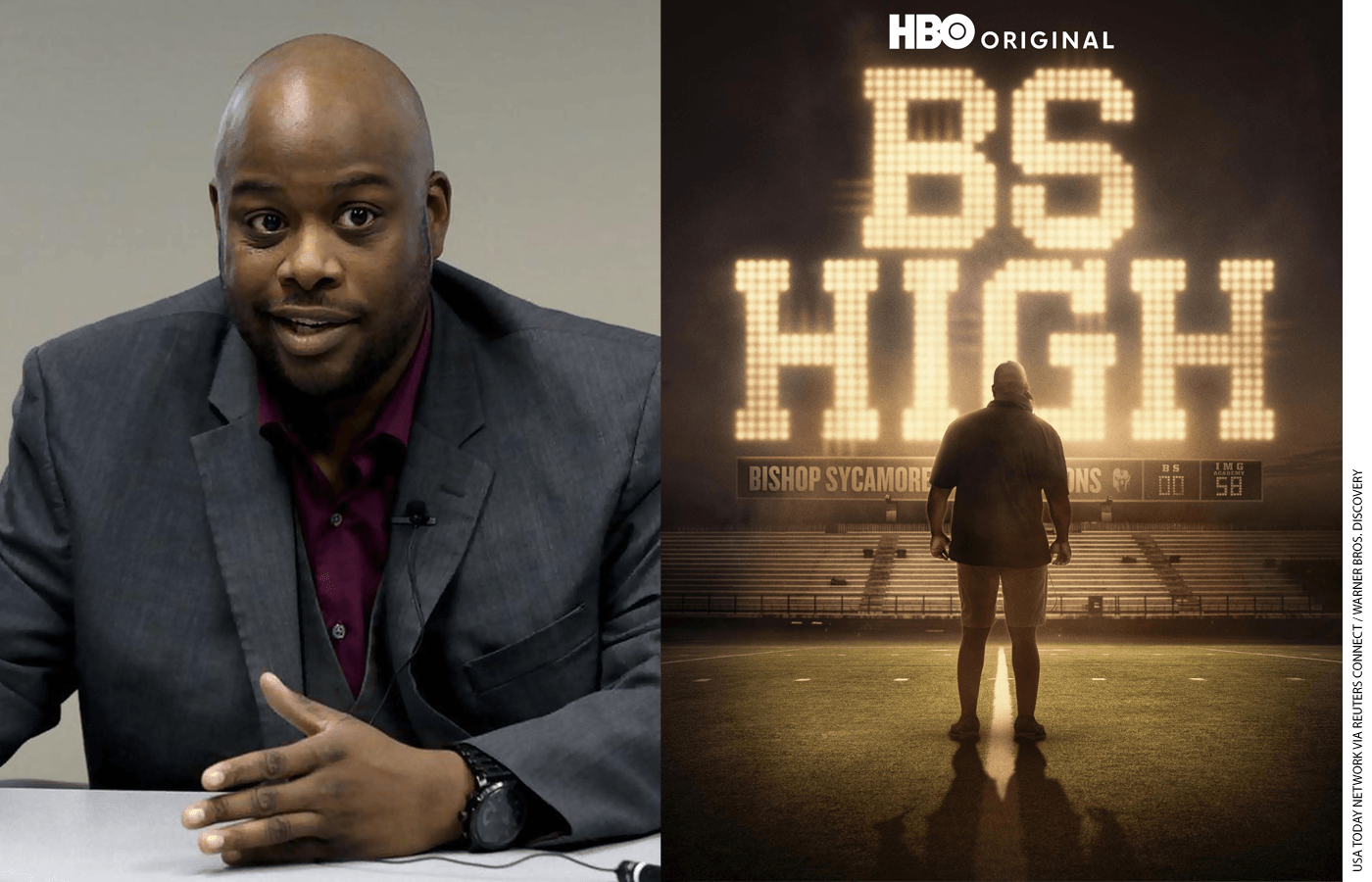
Bishop Sycamore went 0–6 in 2020, but somehow Johnson was able to convince ESPN its talent was on par with elite programs and get the network to air its 2021 game against IMG Academy. Anyone watching could see the two teams did not belong on the same field. IMG Academy won 58–0, prompting a social media outcry of concern for the Bishop Sycamore players’ wellbeing. The state quickly investigated and decided the school was a “scam.” Governor Mike DeWine declared: “Ohio families should be able to count on the fact that our schools educate students and don’t exist in name only as a vehicle to play high school sports.”
Multiple media outlets pursued the Bishop Sycamore story and later that fall HBO announced that NFL Hall of Famer Michael Strahan’s company would produce a documentary, which became 2023’s BS High. The NCAA had been investigating “diploma mills”—high schools with fraudulent academic programs—for nearly two decades. But Bishop Sycamore’s loss to IMG Academy showed how far some schools would go in taking advantage of aspiring athletes.
Ferree hoped the Bishop Sycamore fiasco would usher in a new era of oversight, but that did not happen. “When the Bishop Sycamore fraud finally went mainstream, there were a lot of steps that I initially thought would be positive,” he says. In December 2021 the Ohio Department of Education released a report on its investigation of Bishop Sycamore, recommending seven measures for the regulation of non-chartered, non-tax-supported schools. None of the measures have been implemented by the state legislature. The state education department has little leverage when there’s no charter to revoke and no funding to be blocked.
“Ohio law remains unchanged,” Ferree says. “There’s nothing preventing this sort of thing from happening again. If you wanted to start a non-chartered non-tax-supported school in the state of Ohio, you can still do so with zero oversight from the Ohio Department of Education.”
NCAA director of high school review Sarah Overpeck heads a group that ensures high schools meet the association’s academic standards: To be eligible to play their sport as college freshmen at a Division 1 institution, high school athletes must complete 16 core courses with a minimum GPA of 2.3 in those courses. Overpeck says her team, which consists of seven full-time employees, evaluates “about 400” new schools a year and has an online portal anyone can access to see whether a high school is in good standing.
“If there are oddities,” Overpeck says, “like the requirements for students are so strange that you think this doesn’t seem like school, then you might want to look it up on the eligibility center website. We make room for a lot of varying models. There’s plenty of space for innovation and asynchronous learning. But if [a parent] is like, ‘Wow, my student doesn’t have to contact their teacher more than once a semester,’ they might want to double-check the site to make sure they’re a cleared school.”
Ferree believes that his home state, Ohio, is hesitant to investigate non-chartered, non-tax-supported schools because public officials do not want to interfere with ultra-religious schools. The State Board of Education’s Ohio Administrative Code allows “schools with truly held religious beliefs to be established without a charter from the State Board of Education.”
Ferree says that tracking the less-reputable sports academies can be difficult because the operators often move quickly from one school name to another.
But he acknowledges that Bishop Sycamore was exceptional. “The reason this became so big and so national,” Ferree says, “is because they did such a bad job. Football is hard. You need a lot of equipment. You want to actually run a scam like this, do it in basketball.”
Corey Heitz runs Prep Athletics, a placement service for high school basketball players. “Right now, we could start a basketball academy,” Heitz says. “All we would need is a van, a house, and a gym. There’s no accreditation. You don’t have to build the infrastructure that a brick-and-mortar prep school would. There’s a very low barrier to entry.”
Heitz believes the number of sports academies trying to attract students has grown since the pandemic. “During Covid, a lot of the prep schools—typically boarding schools—were so successful because they created their own bubbles and could play other prep schools,” Heitz says. “A lot of private schools and public schools were shut down. So the demand went up for prep schools, but there’s only a limited amount of roster spots. The demand grew faster than the supply. These academies, specifically for basketball, started popping up all over the country.”
Heitz says that he will not place an athlete at a new sports academy unless he has seen it operate successfully for at least a few years. “A simple event can shut these things down overnight,” Heitz says. “Every single year in November, families reach out to me to say we just spent $20,000 for this academy. It just shut down. The coach is gone. Can you help us?
“A financier could walk away,” Heitz continues. “Or it could be like Kanye [West’s Donda Academy] and after one anti-Semitic rant, everyone left the basketball team.” (Donda, which collapsed in 2022, was in part known for its elite basketball program but did not follow the typical sports academy model of four hours of academics and four hours of athletics per day.) “You have guardrails in place at a brick-and-mortar prep school that you just don’t have at those academies.”
Villanova sociology professor Rick Eckstein, a critic of the commercialization of youth sports, believes the financial incentives of excelling at sports create opportunities for bad actors. “When you have customers who are in a lot of ways blind to what’s going on,” Eckstein said, “and are just so obsessed with getting their kids and their own families to that so-called next level, they miss things. They ignore things that are right in front of their noses.”
The Soccer Academy
Only a handful of students are playing chess or working on their laptops in the YSC Academy common space on a Wednesday afternoon in early February. Typically, the school, which is a partner of Major League Soccer’s Philadelphia Union team, is only quiet when students are traveling for tournaments. But today, everyone is on campus. They are just excused from class to play or cheer on their friends on the other side of the complex the school shares with the pro team.
The Union’s Under-16 team—composed entirely of YSC students—is squaring off against the U-16 team from the German professional franchise Borussia Dortmund. Junior teams from all over the world—including those affiliated with England’s Manchester United and Mexico’s C. F. Monterrey—descended on YSC’s hometown of Chester, Pennsylvania, for the inaugural “Snow Bowl,” an international tournament hosted by YSC Academy and the Union.
“We take a holistic approach,” head of school Nooha Ahmed-Lee says from a conference room overlooking a soccer match on the indoor playing field. “With everything going on this week, I talked to the coaches and they said they didn’t want to impose on the teachers. But the teachers said they wanted their students to come and cheer for their classmates. We have strategies for making up for that lost time in class—one-on-one opportunities with teachers or small groups to make sure their learning is on track.”
Founder Richie Graham toured overseas soccer programs before forming YSC Academy in 2013. European teams have had their own academies for decades, although grooming kids to play professionally was the end goal. Graham, a graduate of Burke Mountain Academy, wanted to complement athletic ambition with more focus on school. He recruited an experienced principal, Ahmed-Lee, to build the academic program.
“I knew nothing about soccer,” Ahmed-Lee says. “But I was excited about implementing a structure for the school that involved physical activity. Before educating a child, you need movement. You need nutrition, you need hydration, and you need sleep. This idea of kickstarting their brain with soccer is incredibly important to their development.”
Classes at YSC Academy run from 10:50 a.m. to 3:10 p.m., bookended by soccer in the morning and afternoon. Students travel frequently and are often called up to Major League Soccer or the U.S. national teams. Ahmed-Lee and her team rely on online learning to accommodate their students’ constantly changing schedules. “I tell kids, you have to be able to be an online learner and an in-person learner,” she says. “It’s like playing on two different conditions, grass and turf.”
Julie Young founded Florida Virtual Schools in 1997 and is currently serving as vice president of education outreach and student services at Arizona State University, which houses Barca Academy, a boarding school affiliated with the Spanish soccer team FC Barcelona. Young believes a school day split evenly between academics and sports provides ample time for education. “One of the outcomes of Covid was that parents were able to watch their students in their learning environment outside of the traditional classroom,” Young says. “They got to see the amount of waste in the day. There is no more than four hours of learning in a six-and-a-half- to seven-hour classroom day. You have to factor in recess, lunch, non-academic activities, fire drills, etc. Homeschool families do not spend more than four hours a day on academics. If those four hours are spent with intention, they can be very effective.”
At Spire Academy, a growing multi-sport program in Geneva, Ohio, CEO Steve Sanders must address both travel and practice schedules for elite teams. With a student body of 250 this year and 300 expected next year, Spire has 10 teachers and fully embraces digital learning. The basketball team, led by eight-time national coach of the year Kevin Boyle, is sometimes on the road for nearly a week at a time. But Sanders asserts that, on the whole, sports academies provide a more reasonable schedule for student-athletes.
“It’s the only model that takes everything that is fragmented in youth sports, and vertically integrates it into one platform,” Sanders says. “In a typical high school, students are there 7:30 to 3:30 and then go to practice until 5:30. Then they do homework until 7 and eat at some point in there.” Add in recovery time, nutrition, and mental skills training, he says, and “these kids are looking at 12- to 15-hour days.”
Spire students take courses from the online program ICL Academy, which is used in several sports-related schools, to complement in-person learning. And the school is now “leaning into” AI products like Studient and Edmentum to help assess student progress, Sanders says.
While sports academies have made strides academically using digital tools, students do lose some of the social aspects they would enjoy at traditional schools. “Our kids and our families sacrifice a lot,” says Gretchen D’Angelo, YSC director of college counseling. “They do things your average 16- or 17-year-olds don’t do. That means missing social interactions most kids have. They don’t have homecoming or dances. Maybe they can’t go snowboarding with their friends because they can’t risk an injury. Families have to move to the area or send their kids away to our boarding program. We understand they have a dream in mind.”
Pennants representing all the colleges at which YSC graduates have played are prominently displayed in the academy’s main hall. D’Angelo says that most students enter the program with professional aspirations. According to its website, of 158 graduates, 129 played college soccer, 27 played professionally, and just 2 chose other paths. “We understand that they all want to go pro,” D’Angelo says. “Nobody’s like, ‘I really want to be a DI college player,’ . . . which is actually a very cool thing. Statistically, it’s still very, very hard to do.”

The Bigger Picture
Andrew Petcash is a partner at Profluence Capital, a sports investment firm, and author of a popular sports-business Substack. “As sports academies evolve,” Petcash says, “they won’t just talk about how many pro athletes they produced” but also “how many CEOs came out of their schools.”
Petcash compares sports academies to military academies. “Before, a lot of people would send their kid to military school to become what you could describe as an ‘optimal human being,’” he says. He posits that as defense technology advances, fewer people will be needed in the military. “Where will you get that kind of training? . . . I played basketball at Boston University. My good friend was in ROTC. Our schedules were almost identical.”
Taryn Morgan joined the staff of IMG Academy in 2006 and is now the vice president of athletic and personal development. After she earned a doctorate in education with a focus on sports psychology from the University of Tennessee, she began working with Trevor Moawad, the late mental-conditioning coach who worked closely with big-name athletes including NFL quarterback Russell Wilson. “We were way ahead of the curve,” Morgan says. “What we do is not mental health. . . . It’s mental performance. One of Trevor’s sayings was, ‘You don’t have to be sick to get better.’”
At IMG, Morgan says her team’s approach varies for each student-athlete. With some, they work on visualization techniques; for others, the focus is on breathing. Often, she says, the message is just to get out of your own way. “We do worse when we think too much,” she says. “Or we are thinking about the wrong things. If I’m thinking about hitting a home run, I’m going to strike out. If I’m telling myself, ‘Don’t strike out,’ I’m going to strike out. So what will help me hit? Maybe it’s my stride. Maybe it’s something in my wrists. We teach them what to do when they step in the batter’s box. Take a deep breath, maybe look at a spot on the bat, have one focus word, and then go. . . . That routine should be done every time they bat, in practice or a game—so that if you’re batting in the World Series in the bottom of the ninth, you’re still going to do the exact same thing. Nothing changes about that situation unless you let it.”
EdNext in your inbox
Sign up for the EdNext Weekly newsletter, and stay up to date with the Daily Digest, delivered straight to your inbox.
Morgan’s role has expanded to oversee groups that focus on physical conditioning, sports medicine, sports science, nutrition, cognitive perceptual skills, and leadership. While she says IMG Academy excels in all these areas, she gets particularly excited about kids’ opportunities to receive mental coaching. “The fact that 1,600 kids get this is a normal part of their day, it’s like nowhere else in the world,” she says. “It’s not normal still at most colleges. And pro teams are just getting on board. But the skills are transferable well beyond sports. . . . Relaxing under pressure when you’re taking a test. Setting goals, focus, confidence . . . that will help them academically, socially, and even career-wise. No surprise the mental coaching we do in sports has crossed over into the corporate world.”
Doug Bernstein, co-founder of the toy company Melissa & Doug, sent his daughter, a lacrosse player, and his son, a basketball player, to IMG Academy. Bernstein is a champion of the school. He says both kids had options to play at a lower-division level in college but chose to give up their sports to attend Clemson and Southern Methodist University instead.
“When you say your kid is going to IMG,” Bernstein says, “the first thing everyone thinks is that they want to go pro or play Division I sports. That’s far from the truth. That’s not what the school is about at all. It’s about all the other stuff preparing you for life. Learning the discipline to be in the weight room at 6 a.m. Eating the right way. Being with kids from all over the world. Going there was a huge inflection point for both my kids.”
James Patrick Lynch, executive athletic director of the Philadelphia Public Schools, speaks the same language about the value of sports in educating young people. But Lynch believes keeping sports tied to traditional schools—especially public schools—has a significant societal benefit. “The work they’re doing at [sports academies] is very interesting,” Lynch says. “But keep in mind sports also has tremendous value in our public school system.” Strong athletics programs even have the potential to boost math and reading scores and increase graduation rates, he says. In his district, student-athletes “outperform their non-athlete peers by large margins. I’m talking about 20-percent margins. It’s impossible to teach a kid who doesn’t come to school.” Sports is often “that hook that gets the kid to keep coming.”
Lynch says that while the Philadelphia public league remains highly competitive, the national landscape has changed. One of the most important trends in youth sports is the ascendence of the club system, which operates wholly independently from schools. The concept has burgeoned in part because it allows college coaches to see the best players in one place rather than having to visit multiple local schools. Longstanding models of scholastic sports have been shattered. According to Villanova’s Eckstein, America is now looking more like the rest of the world.
“The unique part of the United States is that formal sports and formal education traditionally occupy a lot of the same spaces,” Eckstein says, “the actual physical space and the ideological or conceptual space . . . from K–12 through higher education. But that relationship doesn’t exist in most of the world, where formal sports and formal education are separate.
Sports academies are proliferating, he says, “because you can create a whole separate kind of elite atmosphere for that relationship between school and sports. Parents are already spending so much money on sports. And then there’s the promise of NIL [name, image, and likeness] money or a scholarship at the next level.” Sports academies “are taking advantage of a phenomenon in the marketplace. You get high-class training, plus you get to go to school at one price—a very large price.”
For families that do not receive financial aid, the cost of attending an elite sports boarding school can bar the door to entry. Petcash believes that could change as the model evolves. “We’re in the early innings” of sports academies, Petcash says. “They’re not easy to build. They take time to develop. But as they continue to have success, others will enter the market space. While IMG could become the Duke or Harvard” of the industry, other academies will occupy different market tiers.
IMG Academy’s physical facilities will be hard to match, but the school is hoping to scale its model through its Elevate program and other digital products. Meanwhile, Spire Academy and other programs are expanding their facilities to meet demand. Smaller basketball and soccer schools relying primarily on online education tools continue to open throughout the country. While student-athletes often aim for college scholarships, NIL earnings, and possibly making the pros, believers in sports education focus on a different set of outcomes.
“As the machines have more of the answers, the human skills will become more important,” Richard says. “When you go and ask any CEO, manager, hiring manager, somebody in a hiring position at just about any Fortune 500 company in this country, and you say, ‘What do you think about student-athletes relative to other applicants?’ . . . We all know the answer to that.”

Andrew Perloff is a freelance writer.
Suggested citation format:
Perloff, A. (2026). “Game Changer: The Rise of Sports Academies: The market for sports-focused private schools is growing, but quality varies.” Education Next, 26(2), 23 June 2026.