


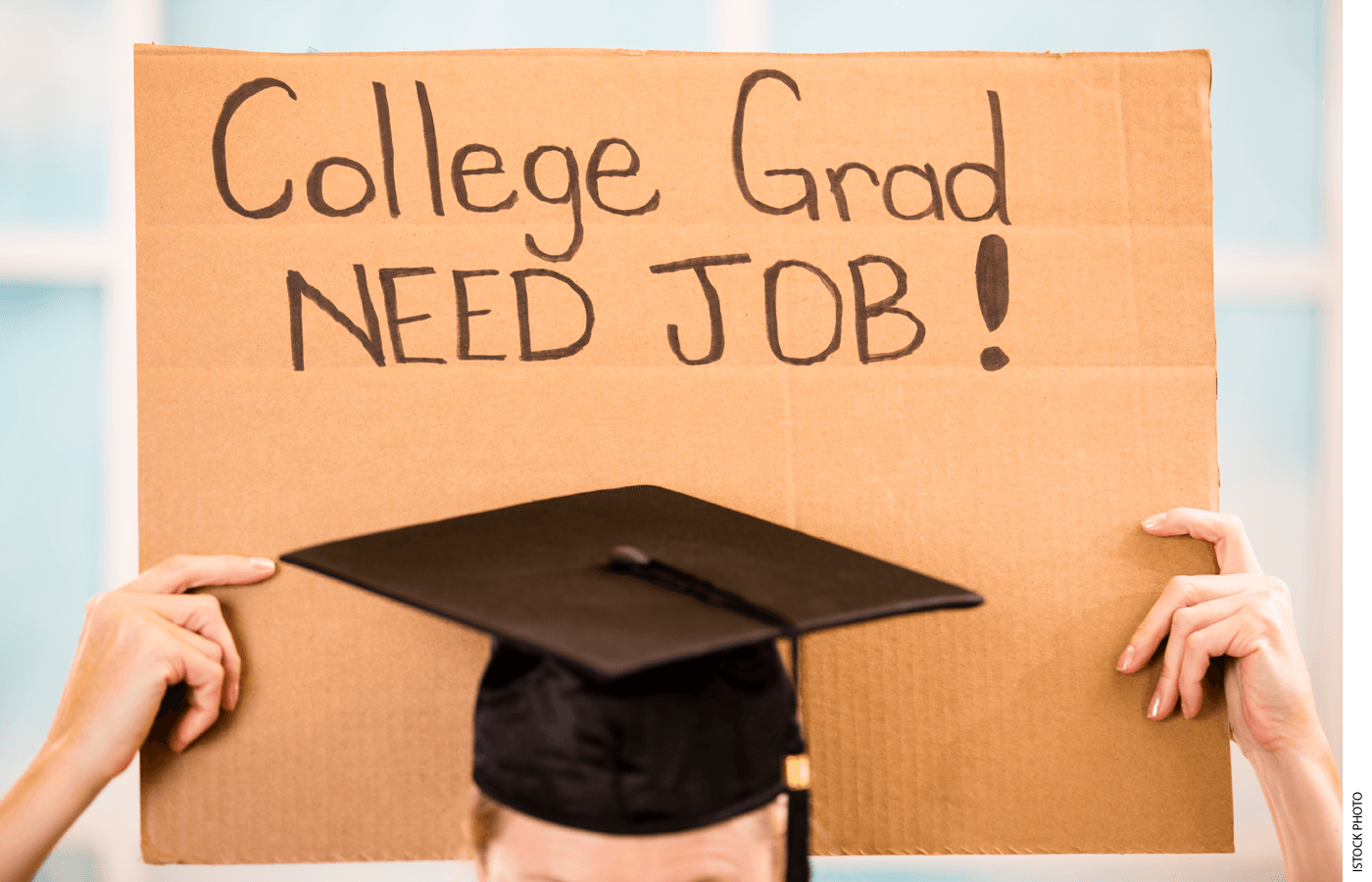
It’s not hard to link the economic anxiety and youth disaffection that played substantial roles in the midterm elections to an early October Gallup poll that found a record-low 31 percent of Americans consider a college education “very important.” Growing skepticism about the relationship between education and opportunity has been fueled by a key data point from 2024 with remarkable staying power: the claim that 52 percent of recent graduates are underemployed—holding jobs that don’t require a college degree.
Just this fall, Fortune and ConsumerAffairs cited that striking statistic in articles on the challenges of today’s labor market. And in August, I heard the lead speaker at an international conference highlight the figure to show the shortcomings of universities, adding this clincher from the same study: even a decade after graduation, 45 percent of bachelor’s degree holders remain underemployed.
The concerns flagged by that memorable metric run deep. A June 2026 Lumina Foundation–Gallup survey found one of the top reasons for rapidly declining public confidence in higher education is the perception that colleges don’t prepare students well for the workforce. Campus leaders struggle to persuade prospective students, who are bombarded with messages about the dubious value of college, that a degree will be worth their time, effort, and tuition dollars.
The idea that large numbers of college graduates spend time and money on a credential that lands them in jobs that only require a high school diploma sounds like a damning commentary on the value of bachelor’s degrees. Yet the underemployment figures behind this simple storyline don’t stand up to close scrutiny. In reality, the broader economic case for college remains strong, even in the age of AI.
There’s no denying the widespread worry about the career prospects of new college graduates. Unemployment among recent grads was 5.6 percent in the second quarter of 2026. That’s still lower than the 7.2 percent rate for workers ages 22 to 27 without college degrees, but the gap is close to its narrowest historical level. The rise of generative AI, along with the earlier shift to remote work, has prompted a rush of questions about the changing job market, what skills employers will value in the future, and how higher education can stay relevant. Critics of the push to expand college access (which they dubbed the “college for all” movement) say it was always guilty of utopian overreach and point to the underemployment data, and uneven graduate earnings, as vindication. They’re doubling down on calls for more college alternatives, from apprenticeships and trade schools to short-term credentials.
In fact, the magnitude and significance of underemployment are vastly overstated. The Strada Education Foundation/Burning Glass Institute study’s conclusion that 52 percent of new bachelor’s degree earners are underemployed—and 45 percent remain so a decade out—has a glaring, mostly overlooked gap. It limits its analysis to college graduates who stopped their education after earning an undergraduate credential; it doesn’t include any bachelor’s degree holders who went on to earn graduate or professional degrees.
As it turns out, that’s a huge number of individuals: 38 percent of all college grads. In other words, the dramatic 10-year underemployment figures leave out nearly four in 10 undergraduate degree earners, including the lawyers, doctors, and MBAs whose bachelor’s degrees opened the door to their careers. Part of the value of an undergraduate degree is that it serves as a building block, a prerequisite for advanced study that often leads to sought-after professions. The omission of this large group was disclosed but given little emphasis in the Strada/Burning Glass study. Its executive summary states, without caveats: “Even a decade after graduation, 45 percent of graduates are underemployed.”
Major media coverage, in outlets from Bloomberg and the Wall Street Journal to Inside Higher Ed, often echoed this framing, either overlooking the study’s limitations entirely or burying the caveats as a passing reference many paragraphs into what was apparently an irresistible narrative. It wasn’t until earlier this year that a competing analysis challenged the report’s conclusions, leading to what the Chronicle of Higher Education called “a very gentlemanly, very wonky squabble” about the methodology and meaning behind the data.
Actually, standard underemployment statistics, such as frequently cited measures from the Federal Reserve Bank of New York, include all college graduates. They find somewhat lower underemployment rates—42 percent for recent graduates in June 2026 and 34 percent for college grads ages 22 to 65 in the same period.
Even those figures, however, don’t give us a clear understanding of how much underemployment should alarm us. That’s because the definition of underemployment is squishier and more hotly debated by economists than core workforce statistics like full-time employment rates or average annual earnings.
Consider this: More than a quarter of occupations categorized as high school level by the federal Bureau of Labor Statistics actually employ more 25-to-54-year-old workers with a bachelor’s degree than with only a high school diploma. That vivid finding comes from a detailed February 2026 report by the Georgetown University Center on Education and the Workforce. For example, 70 percent of advertising sales agents—classified by BLS as a high school–level job—hold a bachelor’s degree or higher, and those with a BA earn 78 percent more than their colleagues with just a high school diploma. It seems a stretch to maintain that all those degree holders are “underemployed,” since they presumably gained skills in college that help them do their job particularly well. It’s a good illustration of how it isn’t so simple to generalize about which employees are overqualified for a particular kind of occupation.
The BLS categorizes occupations based on typical entry-level education requirements. Analysts use either these categories or survey data on job requirements to classify college graduates as underemployed if they have more education than is typically required in the field they enter. But the range of job functions can vary within an occupational category, and entry qualifications can change over time.
EdNext in your inbox
Sign up for the EdNext Weekly newsletter, and stay up to date with the Daily Digest, delivered straight to your inbox.
What’s more, that wage premium in advertising sales is high but not a complete outlier. On average, across all occupations the BLS classifies as high school level, employees with a bachelor’s degree earn 38 percent more than their colleagues with only high school diplomas, per the Georgetown report.
To account for the diversity in the education and earnings of workers in the same occupations, the Georgetown study’s authors made new calculations, which had the effect of drastically reducing the underemployment estimate: about 25 percent for recent grads and 22 percent for all prime-age, full-time workers. To create an apples-to-apples comparison with the Strada/Burning Glass analysis, the Georgetown report also excludes from its analysis college graduates who earned advanced degrees. Had they been included, its underemployment estimates would be even lower.
Matt Sigelman, president of the Burning Glass Institute, told the Chronicle of Higher Education that although underemployed college graduates do receive a wage premium, that premium is much higher when they are in jobs classified as requiring degrees. When I asked him about the Strada/Burning Glass study’s exclusion of college grads who earn graduate credentials in their underemployment data, he said not all graduate degrees have a strong return on investment, and that in any case it shouldn’t be necessary for a BA-holder to attend graduate school to escape underemployment.
Yet Harvard labor economist Lawrence Katz flatly dismisses the usefulness of underemployment as an analytical tool. First, a methodology that doesn’t count outcomes for bachelor’s recipients who earn graduate credentials is “throwing away much of the return to college,” he told me. More broadly, Katz says, measures like earnings, employment stability, and job satisfaction are “very helpful” for understanding college value. By contrast, measuring success by whether a degree-holder’s credentials match the typical requirements of their occupation is, Katz concludes, “fundamentally flawed.”
Even if we get the underemployment figures right, will college still pay off in the AI age? Earnings and employment data on degree holders are among the most robust findings in labor economics. As Harvard economist David Deming has argued, an AI-infused economy will likely make a broad education more valuable, not less, because college helps graduates navigate change.
For now, the economic case for college remains strong. Bachelor’s degree holders earn roughly $30,000 more annually than high school–only workers, according to BLS data on full-time workers 25 and older. Even using Strada and Burning Glass’s own figures, recent college grads earned a median $50,000 in 2022, compared to $32,000 for 22- to 27-year-old workers with only a high school diploma. Meanwhile, alternatives like short-term certificates produce more mixed and modest earnings gains than associate or bachelor’s degrees.
None of this means we shouldn’t scrutinize underemployment. It is worth asking if any given college is providing the skills its students need to land the jobs they want. Before we panic about subpar outcomes, however, we should bear in mind what the scariest figures leave out.
We do need more effective alternatives to traditional four-year degrees. We should also redouble efforts to raise dismal degree-completion rates. And we should ensure credentials help graduates navigate an AI-driven job market. But let’s not confuse an overblown crisis with the very real need to make postsecondary options better and available to more Americans. Focusing on underemployment data that doesn’t show much of what critics claim it does distracts us from the important work ahead.
Ben Wildavsky is a senior advisor at the Harvard Project on Workforce. He is the author of the forthcoming book Know-How: The Global Rise of Hands-On Higher Education (Johns Hopkins University Press, September 2027).