



Princeton University sociologist Jennifer Jennings has a new book drawing upon a decade-long study of the process by which students in New York City public schools identify and rank preferred schools in the district and are then assigned to those schools by a centralized algorithm. She and her colleagues interviewed 452 New York students, parents, counselors, and school administrators to capture a picture of how that process works and is experienced by its participants.
In The Scarcity Loop, Jennings characterizes this process in New York City as school choice and presents the difficulties as emblematic of school choice nationwide. Although she claims her aim “isn’t to render a verdict on school choice,” her criticisms clearly stand as an indictment even if they do not constitute a conviction. The heart of Jennings’s argument is that school choice fails to address the scarcity of good school options while shifting the responsibility for finding those good schools—and blame for not doing so—onto parents in inequitable and non-transparent ways.
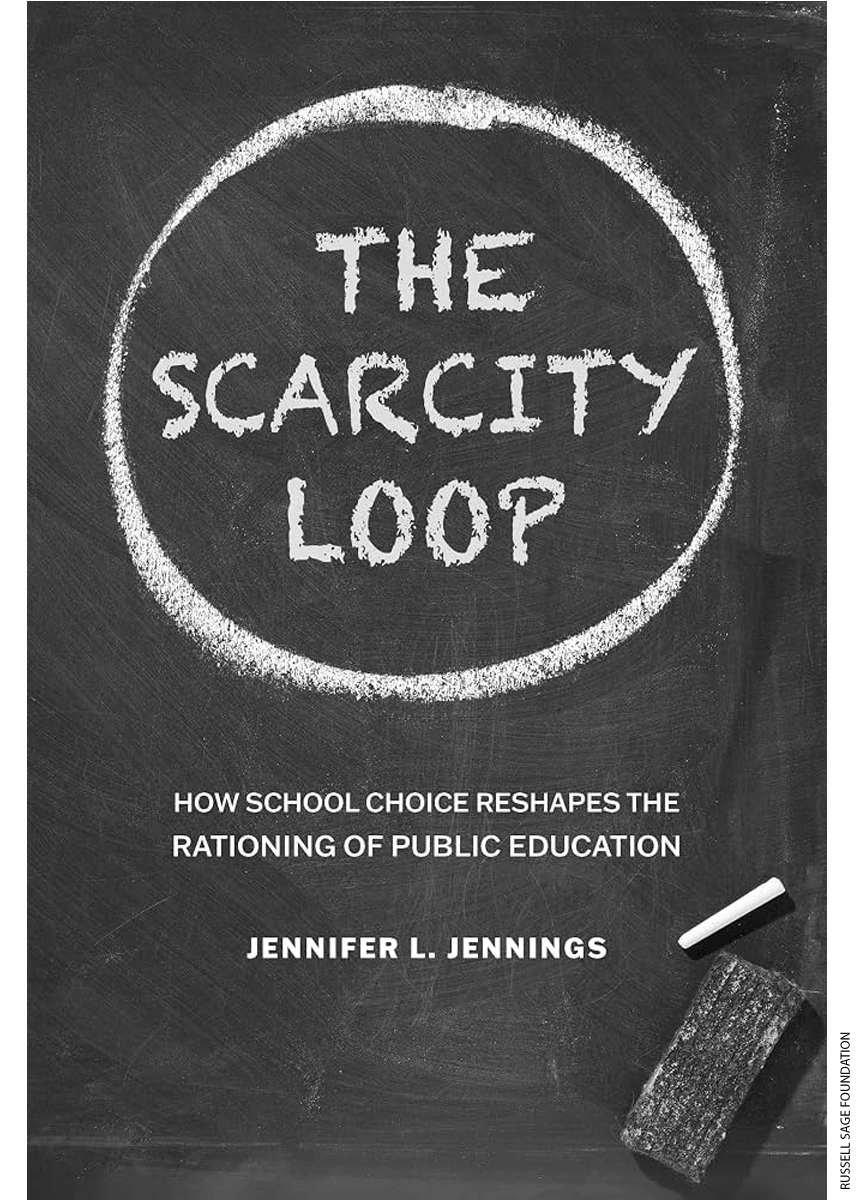
by Jennifer L. Jennings
Russell Sage Foundation, 2026, $35.00; 309 pages
In her view, when New York City ended default assignment to neighborhood high schools by requiring families to rank-order their preferences, “what changed most was not scarcity itself, but where the work of managing scarcity landed, and how families read the result less as a public allocation decision than as an outcome of their own navigation.” Jennings focuses on these allocation decisions because “school choice policy governs assignment, not the supply of schools.”
School choice produces inequitable allocation of quality educational options, she argues, because some families are more likely to be disadvantaged by the formal rules of choice (such as test-based admissions criteria for selective magnet schools), geographic differences in proximity to those quality options, differential ability to navigate the application process, signals from schools about who belongs there, and varying family perceptions about who is likely to belong in those schools. As Jennings puts it, “what sets school choice apart from other rationing systems is that seats at high-quality schools are not distributed according to a clear principle of need.”
The result is that choice does not address the scarcity of good schools, allocates those good schools inequitably, and—worst of all in her mind—perpetuates this scarcity and inequality by obscuring public responsibility for addressing these problems. She writes, “When rationing is publicly owned, the state cannot avoid responsibility for scarcity, because the criteria of allocation are publicly debated and the supply of good schools kept in the foreground.” The New York City system instead shifts responsibility for finding good schools onto families and limits the government’s role to administering the choice process. Jennings argues that this creates “the scarcity loop,” which she describes as “a self-reinforcing cycle in which scarcity justifies reform, reform generates new rules of access, and those rules can preserve the very inequalities they aim to remedy.”
Jennings presents a well-crafted, even if jargon-laded, argument. The biggest problem with that argument is that her focus on New York City’s system of assigning students to schools means she is not addressing school choice at all—at least not as it is commonly presented as a policy reform by its main advocates. The idea of school choice as developed by Milton Freidman and adopted in dozens of states is that families could select schools operated by multiple providers and resources would follow children who move from one provider to another. In the New York City system Jennings studies, it’s true that families can choose among the schools operated by the district, but resources do not leave that district and enter a competing organization when they do so. The phrase “school choice” as used by Friedman and implemented in dozens of states is a shorthand to mean school choice and competition. Without competition you aren’t really looking at the policy movement widely known as school choice.
The absence of competition in the New York City case Jennings features is a central weakness of her argument, because competition is the mechanism by which scarcity of good schools could be significantly alleviated over time. Without competition, there is no reason to expect scarcity to be meaningfully reduced.

New York City’s system of district school choice is like menu choice at McDonalds. When you go to McDonalds you can choose to have a Big Mac, a quarter-pounder, a filet-o-fish, and sometimes even a McRib. But your money goes to McDonalds no matter which menu item you choose, so McDonalds feels no competitive pressure from your choice to improve the overall quality of its food. The same is true for the New York City school district. Whether you attend one of their high schools or another does not alter their revenue and provides them with no incentive to improve the number of high-quality options.
The “scarcity loop” Jennings laments assumes that school choice (and competition) has no effect on how scarce good schools are. All choice does, in her view, is shift the burden of allocating the same set of scarce good schools in an inequitable and non-transparent way that relieves public authority of the responsibility of creating quality options and ensuring equitable allocation. That is in theory possible as school choice has been designed and implemented in New York City. But if choice (with competition) significantly alters the supply of good schools, then scarcity is not a closed loop, and her argument collapses. It’s strange that Jennings’s entire book hinges on examining a case that does not resemble the national school choice movement in this key respect.
EdNext in your inbox
Sign up for the EdNext Weekly newsletter, and stay up to date with the Daily Digest, delivered straight to your inbox.
The Scarcity Loop also suffers from the absence of appropriate comparisons between the inequalities that result from school choice to those produced by assignment to schools based on where families live. Some families may have greater difficulty than others obtaining good schools under choice systems, but is that differential burden greater than the barrier of changing residences to obtain a better school? To her credit, Jennings acknowledges that there are problems with assigning schools based on housing and declares that she does not intend to “romanticize residential zoning.” But she devotes no attention to cataloging the inequality and non-transparency that flow from residential assignment, nor does she make any empirical comparisons that would inform the reader about whether choice has at least partially alleviated those problems.
Instead, Jennings shifts her argument to one of political process. With residential assignment, she argues, inequalities are not disguised as private choices and can be seen more clearly as the result of public policy, placing pressure on officials to remedy the problems. But Jennings never examines whether the theory of placing blame for inequality squarely on public policy actually results in meaningful reforms to fix the problems. It seems uncaring to suggest disadvantaged people shouldn’t have choices so that it will be obvious they need to lobby public officials for reforms even if their prospects of success are remote.
This emphasis on theoretical arguments over concrete evidence pervades the book. While the middle chapters are filled with rich descriptions of how individual families and school officials handle the New York City district system, that information is oddly disconnected from the normative arguments presented in the opening and closing chapters. Consider Jennings’s core argument that, under choice systems, blame for failing to find good schools is shifted to families: “The school system puts the burden of claiming access on the individual, leaving them to narrate failure as a matter of effort or care.”
That’s theoretically possible, but Jennings never bothers to demonstrate that families in fact often blame themselves for being unable to access good schools. Nor does she provide evidence that discussions among policymakers and those who influence them cease to be concerned with the scarcity and allocation of quality schools under New York City’s assignment system. The evidence in the middle section of the book documents the problems with New York City’s system, but it does not provide support for the broader claims about the “scarcity loop” in which blame is shifted, problems are masked, and progress is stalled. That’s just a story she is spinning, one she misleadingly presents as established fact.
Jay P. Greene is a senior fellow at the Defense of Freedom Institute.
Suggested citation format:
Greene, J. P. (2026). “The Book About School Choice That Isn’t About School Choice: Studying scarcity in NYC’s school assignment system is akin to studying menu choice at McDonald’s.” Education Next, 26(4), 17 November 2026.