



The late Rabbi Jonathan Sacks liked to distinguish between optimism and hope. Optimism, he argued, was a passive virtue. Hope, on the other hand, was active. “It needs no courage to be an optimist,” he wrote in To Heal a Fractured World, “but it takes a great deal of courage to hope.” To hope is to recognize that we can make the world better, but it is going to take work.
The hope-versus-optimism distinction comes to the fore in Jeanne Allen’s The Education Avengers, a collection of biographical sketches of 12 education reformers from across the United States. Together, these individuals embody hope in action. In different places and in different ways, they have committed to trying to make the world better. Their stories make an inspiring read.
There is Mary Jo Fairhead, who operates a small private school on the Pine Ridge Reservation in South Dakota. There is Aaron Frumin, who founded the workforce development nonprofit unCommon Construction in New Orleans that allows high school students to earn credits through building houses. There is Cris Gulacy-Worrel, who overcame a heartbreakingly traumatic childhood to help found Oakmont Education in Ohio, a network of now 21 workforce-development focused schools that serve students who have become disconnected from the traditional education system.
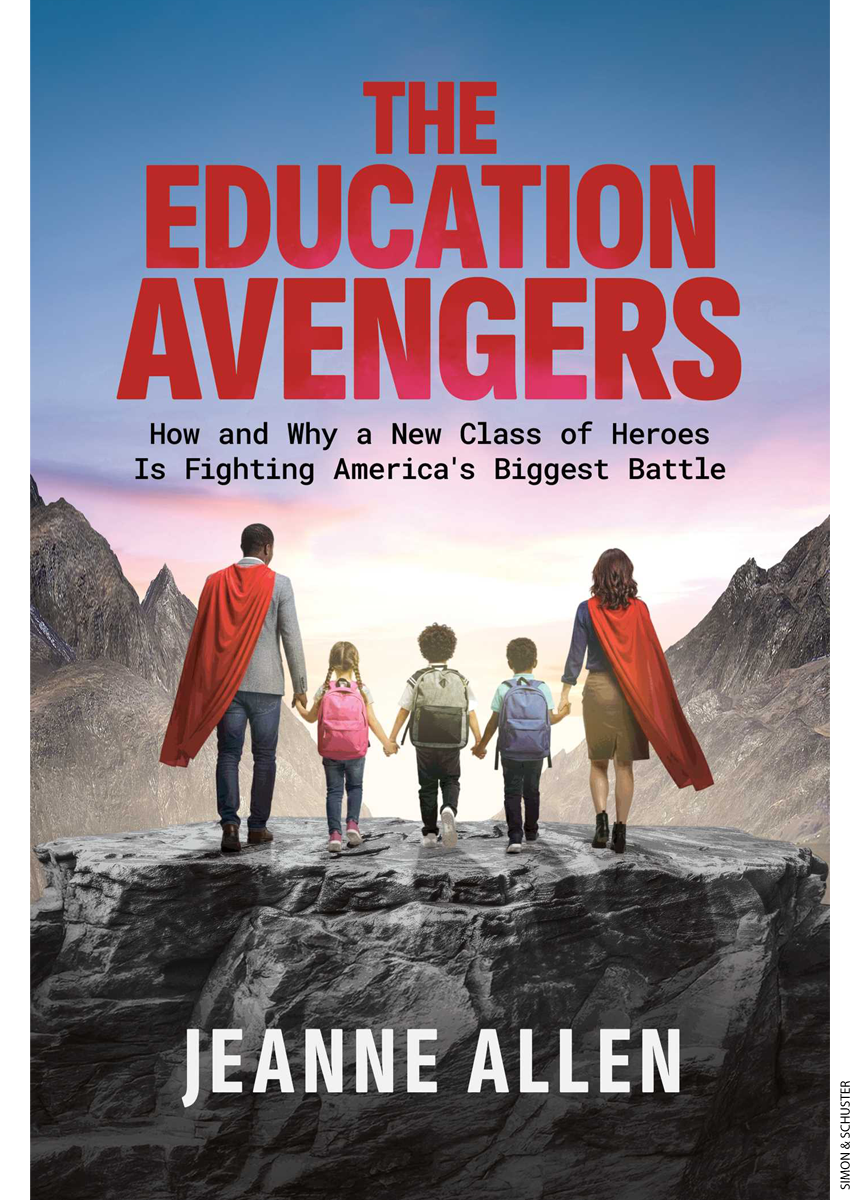
by Jeanne Allen
Simon & Schuster, 2026, $28.99; 256 pages
Like the superheroes from which the book draws its title, several of the people profiled have taken genuinely courageous stands.
Eugene Slocum founded the charter school Alpha Academy in Fayetteville, North Carolina. To keep it alive he refused to accept a paycheck, took out a second mortgage on his house, and cleaned the building in addition to teaching classes. José and Ampy Suárez became foster parents before founding Hope Ranch in Pasco County, Florida. What started as a program for foster children grew into services for autistic children and then transitional services for autistic young adults. JoAnn Mitchell, in her own words “burned the ships at the shore,” throwing herself entirely into starting Mission Achievement and Success Charter School in New Mexico.
Many of these people had comfortable lives that they purposely left behind to serve children. Others clearly would have had an easier life doing just about anything else. But they decided to forgo affluence and comfort in order to do something important. It is genuinely admirable.
The book does not offer a specific suite of policy proposals that might nurture more “Education Avengers.” But reading between the lines, one discerns that the author is clearly pro–school choice. She also argues for creating space in the traditional system to allow for outside-the-box educators to create new and better learning environments.
Allen calls the Avengers’ enemy the Hydra—the amalgam of people, organizations, rules, and bureaucracy that maintains stasis in the education system and works to thwart the efforts of the Avengers at every turn.
While she offers no specific policy recommendations, she does develop some distinct themes. One of them centers on overcoming adversity. Many of the people profiled in this volume overcame serious life challenges. From abuse to neglect to poor education options, they faced a gamut of adverse experiences as children. But the adversity didn’t stop there. Many, when starting their education enterprises, found that those in the traditional education sector sought to impede them. The Hydra was spawning heads and trying to devour them.
But Allen, through the stories of the people she profiles, argues that adversity can strengthen people, driving personal and professional growth. Had these Education Avengers not experienced adversity in their lives, many, if not all, of them would probably not have become the people they are nor have created the schools they envisioned. Because of the struggles they have overcome, they can not only relate better to their students and understand the needs of their schools’ families and communities, but they can also draw on their resilience when faced with roadblocks from a recalcitrant system.

Perhaps my favorite theme of the book, however, is joy. The Education Avengers time and again explain that they want their schools to be places of joy. Joyful places can still have serious purpose and high expectations for students, but when oriented toward encouraging true flourishing, such schools can lead to the kind of satisfaction and accomplishment that remains with students long after they leave. Any school can be a “happy” school: Don’t ask anything of students, pass them along, tell them everything they are doing is right. That will make them happy, at least for now. But over the long term, that is setting them up for misery. To encourage joy tomorrow, there is work to be done today.
By the way, I’ve only seen one Avengers movie (the one where Thanos kills half of them, where I sat in the theater feeling nothing—because I didn’t know the characters’ backstories—while my fellow movie watchers gasped and groaned), so I’m not the best judge as to whether the Avengers make for a good analogue.
By the way, I’ve only seen one Avengers movie (the one where Thanos kills half of them, where I sat in the theater feeling nothing—because I didn’t know the characters’ backstories—while my fellow movie watchers gasped and groaned), so I’m not the best judge as to whether the Avengers make for a good analogue.
EdNext in your inbox
Sign up for the EdNext Weekly newsletter, and stay up to date with the Daily Digest, delivered straight to your inbox.
But if you compare the book’s narrative thrust to that of a movie, the Avengers films provide a good preview for what you’re getting here: a relatively straightforward tale of good guys (and gals) fighting against a generally amorphous web of bad guys. You want the good guys to win, and they do—and that imparts a sense of satisfaction. Just about anyone could pick up The Education Avengers and enjoy it.
That said, the book would have benefited from some independent verification of what these heroes have truly accomplished. Have the Avengers created schools that are achieving what they say they are? Unfortunately, the history of education reform is rife with people who could tell great stories but couldn’t consistently deliver on their promises. It would have been nice to see more external evidence validating these new education models.
To continue the movie analogy, I noted a few disorienting continuity errors. Mentioning debunked “learning styles,” taking a swipe at tracking, talking about moving our system out of the 18th century (isn’t that what Horace Mann did?), or making offhand comments about student discipline that border on “misbehavior is a form of communication” all seem like they probably should have been excised during editing.
But pointing out such flaws is a little like asking “Why didn’t Thanos just double the universe’s resources instead of cutting the population in half?” It misses the point. This book is about celebration and inspiration. It is about hope. The book shines a light on these 12 Education Avengers and encourages readers to go out and emulate them.
If you’re looking for a hopeful, feel-good read, The Education Avengers is likely up your alley. And if you want the education book equivalent of 110 minutes of rock-’em-sock-’em thumping of wrong ’uns, this is your book. If you’re interested in the education book equivalent of deeply engaging with Norse mythology or thinking through the intertemporal implications of interdimensional travel, you might want to look elsewhere.
Michael Q. McShane is director of national research at EdChoice and an adjunct fellow in education policy studies at the American Enterprise Institute.
Suggested citation format:
McShane, M. Q. (2026). “Hope, Not Optimism from the Education Avengers: Profiles of 12 reformers making a difference show it takes hard work to be a hero.” Education Next, 26(4), 11 November 2026.