




Looking back at your childhood times playing with friends, with no adult in sight, what do you remember? Did these unsupervised times provide a haven from adult expectations and demands, a chance to explore and take risks, or a time to design your own games and rules—to create your own world—to feel free and powerful? Or do you recall worrying about being demeaned or bullied, struggling to fit in, or butting heads senselessly with other kids? Or was it some complex combination of these experiences?
In Restoring Childhood, Peter Gray, a research professor of psychology and neuroscience at Boston College, argues that the loss of this unstructured, unsupervised play and autonomy over the last several decades has had dire consequences, including largely driving the increase in teen anxiety, depression, and suicide during these years. His conviction that adult-free play is essential to children’s flourishing is deep and unwavering. Social media has become the main culprit in the story of teens’ mental health challenges, an idea turbocharged by Jonathan Haidt’s book The Anxious Generation. But because teens freely roam the internet and social media without hovering adults, Gray views this story as dangerously wrong and blames Haidt for misrepresenting the research. Similarly, he favors video games and the widespread use of computers largely because they give kids agency and freedom to interact on their own terms. He attributes improvements in teens’ mental health from 1990–2010 to increased computer and video game use. Mental health challenges ticked up again around 2010, this time, according to Gray, chiefly because of escalating achievement pressure—specifically the introduction of the Common Core State Standards, which he argues saddled students with onerous, life-squashing school tasks and shrunk opportunities for play.
Gray’s writing is fluid, agile, and engaging. He has a rare capacity to enter the worlds of children, and he is deeply learned and thoughtful about the many developmental benefits of play. He also marshals data that strongly suggest the loss of play is indeed a factor in the decline in teens’ mental health, and he rightly calls attention to the corrosive impact of achievement pressure on children’s wellbeing. Our research and a great deal of other evidence, some of which Gray cites, documents the harms caused by excessive achievement pressure, especially when children view their parents’ appreciation and love as contingent on their achievements and when achievement is disconnected from meaningful purpose. But on much else Gray stands on shaky ground.
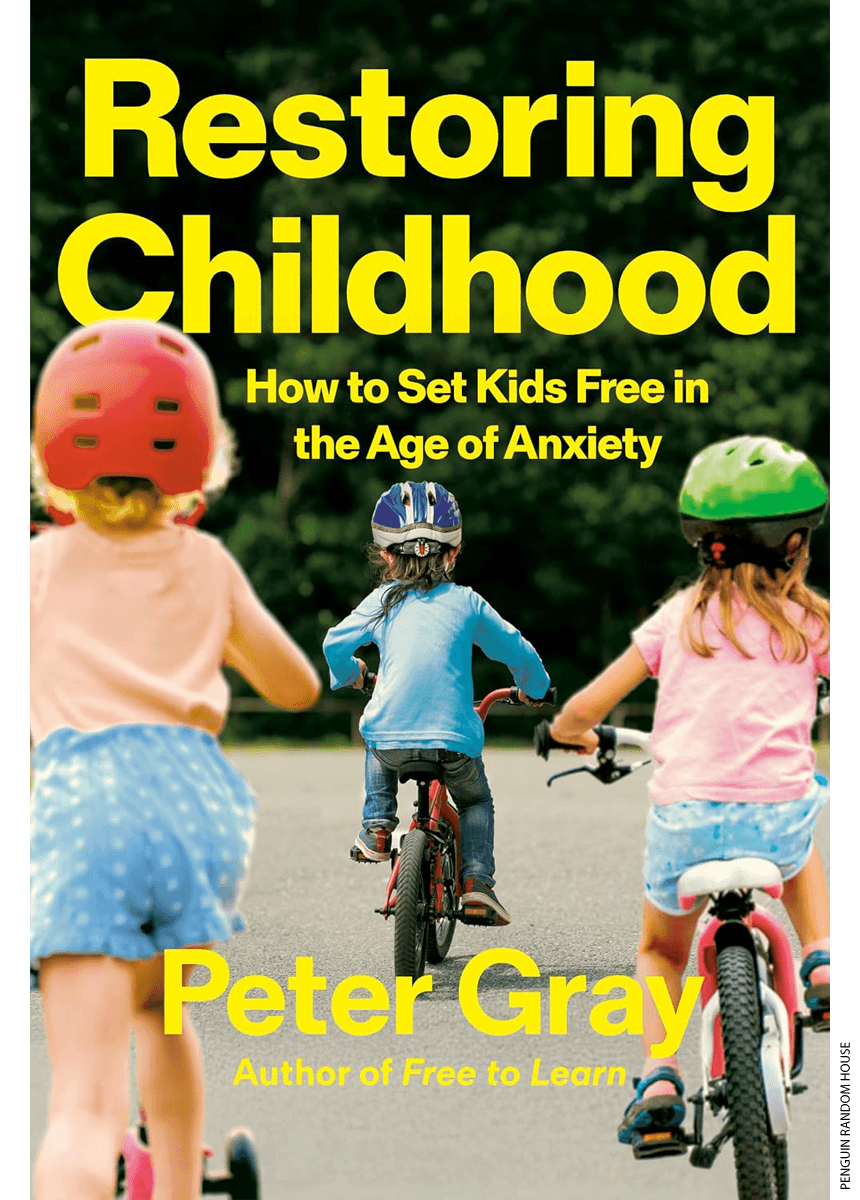
by Peter Gray
Penguin Random House, 2026, $32.00; 352 pages.
We’re guessing that when many of you think about unsupervised play in your own childhoods, it was a great deal more complicated than what Gray portrays. Outside the range of adults, children can be unfair, thoughtless, and at times cruel to each other. Research suggests that bullying happens more commonly when adults aren’t around. Gray claims that one benefit of children’s play is that children treat each other as “equals,” but children, and especially teens, can be brutally hierarchical and status conscious. Conversely, organized sports and other structured activities with adults can have many benefits, including instruction, vital connections to adults other than parents, consistency, a sense of belonging, accountability to a team, and a sustaining goal larger than oneself.
It’s also one thing to argue that the loss of free play contributes to rising anxiety and depression, but quite another to call it the prime cause of this increase. Gray criticizes researchers for both relying on correlational studies and failing to include effect sizes. But he often makes the same missteps. And he doesn’t discuss how different mixes of structured and unstructured play might be optimal for many kids at various points in childhood or how variations in benefits and harms depend on a particular child’s vulnerabilities, interests, dispositions, and strengths. Gray rightly argues that more unstructured play would generally do children good. But most children would likely benefit most from some mixture of organized activities and informal play—with the right balance depending on their individual dispositions and developmental stage.
Gray cites compelling data indicating that children are far more likely to suffer mental health challenges during the months they attend school than when they do not, and he blames the introduction of the Common Core in 2010 for ushering in high-stakes, test-based accountability that greatly aggravated students’ and teachers’ stress, ramped up pressure on them to perform, and forced teachers to drill students oppressively on a narrow range of content. High-stakes tests certainly did increase stress for many teachers and students, and the impact of such tests on learning has been mixed. Gray reasonably argues that pressing concerns about test performance compromised many teachers’ relationships with students.
But test-based accountability did not begin in 2010. It began in many states in the 1980s and ’90s and became federal policy in 2002, with No Child Left Behind. Nor does Gray acknowledge that the combination of Common Core and high-stakes testing was intended to address a very serious problem—that many teachers were not teaching crucial analytical and conceptual skills or being held accountable for high-quality instruction on meaningful content. Instead, Gray simply vilifies the Common Core, calling it “government mandated abuse.”
More concerning, Gray fails to present persuasive evidence for his main claim—that the Common Core was the chief cause of a large increase in anxiety disorders, depression, and even suicide during these years. He neglects the fact that, although most states formally adopted Common Core around 2010, several years passed before states updated their instructional materials, and tests aligned to the new standards weren’t in place until 2015. Causing stress and causing serious disorders or suicide are also nowhere near the same thing, and again he pays scant attention to effect sizes. Ironically, Gray is inciting the type of moral panic he bemoans in the context of smartphones and social media, urging parents to seek alternative education or homeschool their children, options that are neither accessible nor practical for most families.
EdNext in your inbox
Sign up for the EdNext Weekly newsletter, and stay up to date with the Daily Digest, delivered straight to your inbox.
Both Gray’s and Haidt’s books suffer from deeper problems, including the basic assumption that teens are suffering a mental health crisis. According to our national surveys and other research, teens aged 12 to 17 are less likely to suffer anxiety and depression than adults in their 20s and 30s, and young adults aged 18 to 29 are more than twice as likely as teens to suffer these challenges. We’d be much more accurate sounding the alarm about a young adult mental health crisis than a teen one. Further, our data suggest that many interacting factors, not one or two, are driving teens’ mental health challenges.

Teens themselves point to these factors. In a recent survey, we gave teens a list of 20 possible adversities and asked them which ones negatively impact their mental health. Achievement pressure came in first (30 percent), followed closely by the sense that “things are falling apart” (28 percent), that they lacked necessary skills (28 percent), and that they had financial worries (27 percent), all of which have plausibly increased since 2010. Thirty-four percent of teens report lacking meaning or purpose or both in their lives—vital cornerstones of resilience and mental health. Children’s family lives are the largest determinant of their mental health, and maternal depression has been high and appears to be rising over the last 15 years. Depressed teens are about five times more likely to have a depressed parent. Research points to other possible causes such as lack of sleep due to early school start times, children and families’ weaker ties to extended families and communities, and family economic stress.
Making matters more complex, the factors driving mental health challenges vary markedly by race, culture, and class. Compare the challenges faced by a low-income teen struggling with untreated health problems, lack of access to afterschool programs, few visible paths to a meaningful job, and a parent working two or three jobs and experiencing enormous stress, with those of an affluent teen who is tied up in knots about getting into a selective college because their parents’ self-worth seems to depend on it. Gray ignores these variations.
When it comes to solutions, Gray offers a host of sound, wise recommendations for how city planners, communities, schools, and parents can increase opportunities for play, such as keeping school playgrounds open later and making cities and suburbs more child friendly by, for example, creating more play spaces and sidewalks. He also advocates revamping libraries to provide engaging resources such as video labs, recording equipment, and art supplies. But this country urgently needs a comprehensive, rigorous prevention agenda that goes far beyond his suggestions, Haidt’s recommended restrictions on cell phones, or the current push for more mental health providers, important as these are. We will never therapize or medicate our way out of this problem, and it doesn’t make sense to simply try to treat suffering that we know how to prevent.
At the heart of a prevention agenda should be a systematic focus on ensuring that children and young people have sturdy, caring relationships with at least one adult and peer, that they are engaging in activities that provide meaning and purpose, are appreciated for at least one area of competence, and feel like they’re contributing—and mattering—to others. The capacities cultivated by these consistent experiences are central to our individual and collective thriving, and they will help children manage a wide range of adversities in childhood and adulthood. Building these experiences into children’s lives is not easy work, but doing it will get us much further toward where we need to go.
Richard Weissbourd is a senior lecturer at the Harvard Graduate School of Education and faculty director of the Making Caring Common Project, where Kiran Bhai is executive director.
Suggested citation format:
Weissbourd, R., and Bhai, K. (2026). “Beyond Play and Phones: What it really takes to improve teen mental health.” Education Next, 26(4), 28 October 2026.