


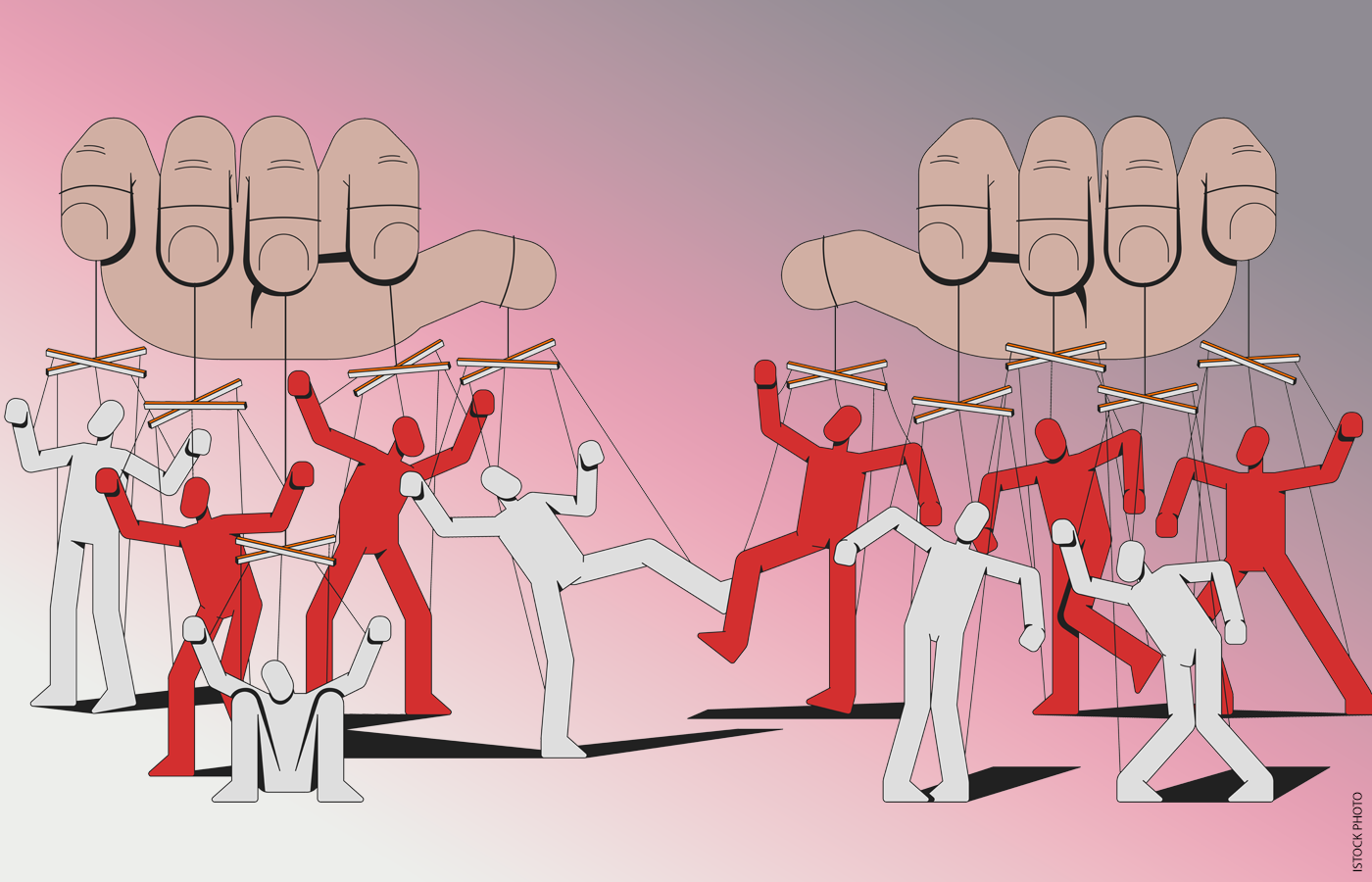
Academe is a good gig, especially if you’re keen to dress ideological screeds up in the trappings of learned expertise. A MAGA kook who posts long Substack articles insisting the 2020 election was stolen by Venezuelan ghostware is more likely to attract ridicule than research grants. But conspiracists with the proper politics can get tenured at taxpayer-supported universities and published by prestigious academic presses.
Consider the handiwork of the four authors—Elena Aydarova, T. Jameson Brewer, Emily M. Hodge, and Serena J. Salloum—who collaborated to pen Manufactured Outrage: The Conservative Industrial Complex’s War on Education and How to Fight Back. All professors of education at public research universities, the four set out to solve the not-so-mysterious mystery of why, in the early 2020s, many states moved to combat CRT, dismantle DEI, adopt the “science of reading,” and ban cell phones in schools. The result is their long, winding, and frequently laughable complaint about a nefarious “Conservative Industrial Complex” (CIC) and its “highly coordinated campaigns” to destroy American education. Ultimately, the authors do little to expose a conspiracy but an admirable job of revealing the frailties that disfigure so much of education research today.
The CIC really does sound awful. It’s a fascist, fear-mongering enterprise that promotes “privileges for white, conservative, and Evangelical Christians,” protects “predatory capitalism,” pursues “authoritarian populism,” and strives to “weaken democracy.” It seeks the kind of “privatization, corporatization, and resource extraction” usually seen only in “colonial” or “occupied” lands. It’s even contributing to “the impending climate catastrophe.”
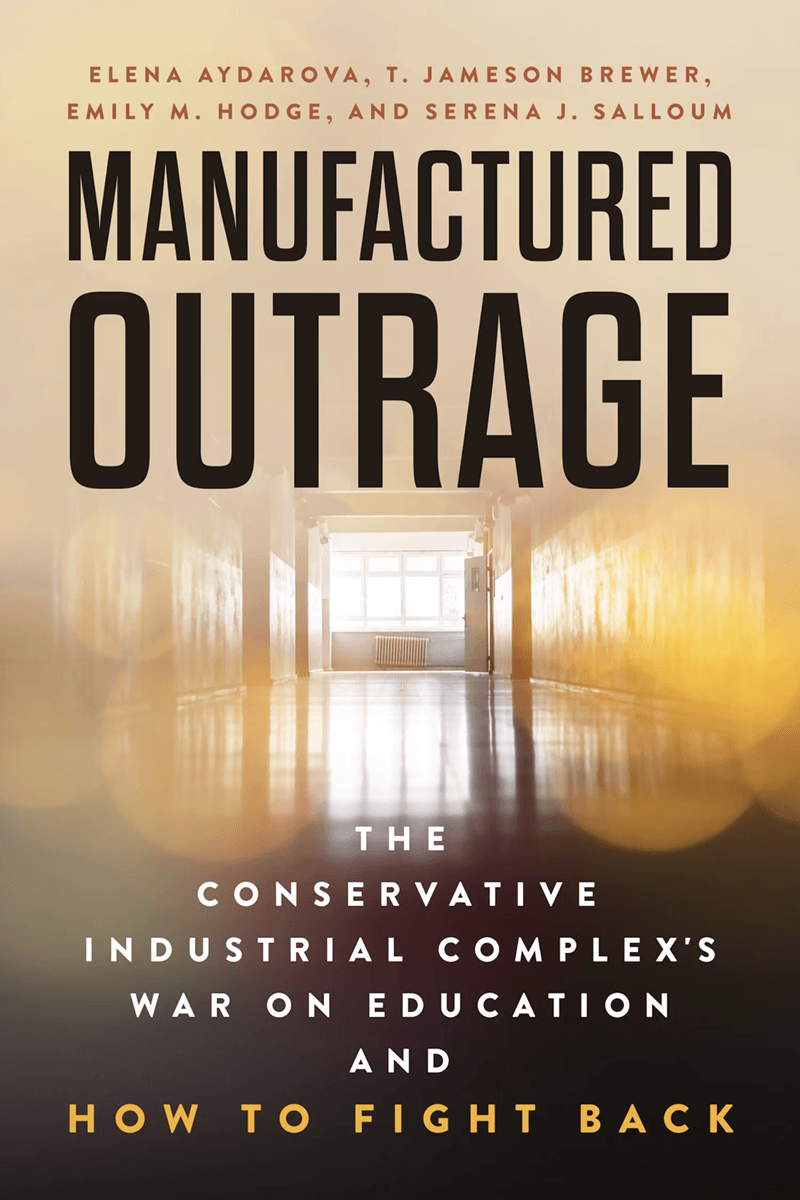
by Elena Aydarova, T. Jameson Brewer, Emily M. Hodge, and Serena J. Salloum
Harvard Education Press, 2026, $36.00; 264 pages
The CIC’s education agenda is quite the grab bag. It seeks to “dismantle public education” and erase “protections for vulnerable groups.” It wants schools to adopt “overt Christian nationalist curricula” and advance “anti-democratic,” “neoconservative,” and “far-right values.” It supports the science of reading in order to “deprofessionaliz[e] the teaching force” and school choice in the service of illiberalism and discrimination.
While the name trades on Eisenhower’s notion of a “military-industrial complex,” CIC is really just a generic tag for the supposed right-wing cabal that has become a trope in a cottage industry of left-wing education diatribes (see The Privateers, A Wolf at the Schoolhouse Door, Slaying Goliath, The Education Wars, The Death of Public School, or They Came for the Schools). Like their tin-foil-hatted peers, Aydarova et al. imagine an interlocking directorate of countless foundations, advocacy groups, think tanks, nonprofits, and more—though it’s never clear why so many would wish to be part of this sprawling, evil enterprise. (One amusing aside does claim that a card-carrying member of the CIC tricked “two Democratic legislators” into thinking they were “reasonable people with good ideas” by awarding the politicos scholarships to join them at a national gathering in “scenic” San Diego.)
That kind of dime-store villainy is of a piece with the authors’ cartoonish view of coalitional politics and political mobilization. I know plenty of Democrats who’d be, by turns, amused and offended to hear that science of reading laws and cell phone bans are the work of a right-wing conspiracy. But Aydarova and her coauthors wantonly mash together right-leaning, centrist, and center-left entities as partners in this malevolent enterprise. At various points in the narrative, the American Enterprise Institute (where I’ve directed education policy studies for 20-plus years) pops up. I smiled at seeing AEI, which routinely gets slammed in MAGA circles for being overly bookish and insufficiently partisan, lumped in as an interchangeable cog in the CIC machine alongside an eclectic host of name-checked collaborators, including the Heritage Foundation, Cato Institute, Washington Examiner, Koch Foundation, Daily Wire, State Policy Network, 50CAN, National Parents Union, Walton Family Foundation, Fordham Institute, ExcelinEd, Education Next, and The Federalist.
This is the leftist equivalent of a MAGA podcaster insisting that Bernie Sanders, Barack Obama, Democrats for Ed Reform, Bill Clinton, AOC, Ralph Nader, Randi Weingarten, George Soros, Joe Manchin, Josh Shapiro, and Kamala Harris have all been partners in a shadowy conspiracy to collectivize the U.S. and hand control over to deep-state communist agents. For those who operate in reality, there’s no convincing way to put the lie to any of this when a fearmonger is so obviously lost in a miasma of agit-slop. All one can really do is back away slowly, try to avoid sudden movements, and hope that normies recognize how silly this is.
In service to their caricatures, the authors ignore disputes on the real-world right, such as the ferocious disagreements between Reaganites, populist culture warriors, and libertarians. On issues like the design or regulation of school choice programs, there’s nothing to suggest they are even aware of bitter disagreements among conservatives. Indeed, one sometimes gets the sense that the authors have never actually talked with Republicans. They tend to sound less like analysts explaining domestic debates than anthropologists describing an odd tribe they’ve stumbled upon in the South Pacific.
A hallmark of accounts like Manufactured Outrage is that they have trouble keeping their conspiracies straight. Last year, Harvard Education Press published Josh Cowen’s screed The Privateers, which credited the evil Council for National Policy (CNP) with masterminding a vast right-wing education conspiracy to push school vouchers. In his review of Cowen’s book for Education Next, Jay Greene noted that the index catalogued 93 mentions of the secretive CNP, while admitting he had never before heard of this nefarious outfit during decades spent in the thickets of conservative education policy.
You might think that Manufactured Outrage would be shot through with the CNP’s continuing machinations. But, boy, would you be wrong. This time, the CNP is conspicuous only for its near absence, appearing in the index precisely twice, and never after page 12. One gets the sense that those two mentions are nothing more than an obligatory nod to their mutual publisher. Why doesn’t this nefarious council loom larger? Are the authors blind to what’s really going on? Or are both books just make-it-up-as-you-go tripe spun into fantastic stories of right-wing boogeymen?
I suspect it’s the latter.
Manufactured Outrage gives short shrift to genuinely interesting questions. The authors could have explored how the past three decades of education policy—which includes Common Core, de-tracking, test-optional admissions, whole language instruction, and class size reduction, among other developments—have shaped today’s conservative coalition. They might’ve asked whether the anti-DEI pushback was an inevitable response to the excesses of 2020 and 2021 or explored the intriguing coalitional politics behind phone bans and the science of reading. They don’t do any of that. Instead, it’s all just a right-wing conspiracy all the time (spelled out in sections with titles like “Educational Reforms and Social Fascism” or “Culture War Fodder and Fear-Mongering”).

It’s a missed opportunity, because there is much to explore in the right’s evolving education ecosystem. This includes what to make of the rise of new entrants like Defending Education, Moms for Liberty, or the America First Policy Institute. The authors might have asked why efforts to promote the science of reading, restrict DEI practices and curricula, or curb cell phones in schools have leaned so heavily on legislation—whereas the adoption of whole language instruction, embrace of DEI, and passive acceptance of phones were more often a matter of informal practice and local discretion. There are potentially important insights about how the levers that shape schooling are used asymmetrically by the left and right, ones with big implications for politics, policy, and practice. But such an exploration would require the authors to lay down their conspiratorial arms and take up the mantle of scholarly inquiry.
The volume does have its charms as a study in ed school quackery. Some of the stuff is such a callback to the excesses of “Woke 1.0” that I found myself laughing out loud. Readers are advised to reject “superficial niceness that maintains systems of white supremacy.” The authors insist that it is “frequently” not the case that teachers pursue political agendas in class (gee, what a relief). Talk of “empowering parents” is apparently code for an “overt commitment” to “Whiteness” and “Christianity.” Charter schooling supposedly reflects the CIC’s “blind faith in the market” (boy, will charter advocates be surprised!). One author took a field trip to a State Policy Network conference, yielding an extended anthropological account of the full hotel bars, free breakfasts, and “unspoken gender binaries” (i.e., women wore dresses and the men wore suits). The future of education is apparently to be found in the “Gesturing Towards Decolonial Futures” collective, which rejects Western modernity in favor of a “collective capacity to re-imagine/re-create existence.”
EdNext in your inbox
Sign up for the EdNext Weekly newsletter, and stay up to date with the Daily Digest, delivered straight to your inbox.
I wondered if any of the authors appreciated the irony of urging readers to reject “echo chambers full of fictions” and rather engage “with those who are different from them.” Heck, normally I might invite one of them to AEI to join us for a Working Group or Common Ground dinner—where you’ll find union leaders, Biden administration vets, Democratic Hill staff, campus leaders, hard-core progressives, and data nerds mingling with CICers and centrists—so that they might escape their own echo chamber. But the authors make clear that such an invite would simply be another of the sleazy tricks we CIC types use to manipulate “front rooms” and “back rooms” to obscure our fascist designs and thwart the brave truth-tellers of the academy.
The authors find it apparently suspect and spooky that entities like Jeb Bush’s ExcelinEd or the State Policy Network hold convenings, cultivate networks, propose legislation, strategize about messaging, and pursue bipartisan coalitions. It’s odd that they don’t perceive these activities as the sort of democratic participation which they repeatedly endorse. What’s especially strange, though, is that “progressive coalition-building to pressure legislators” by groups like the African American Policy Forum, the American Federation of Teachers, the Wisconsin Public Education Network, or Diane Ravitch’s Network for Public Education is celebrated as crucial—even heroic. Aydarova et al. never acknowledge (much less attempt to justify) this laughable double standard.
You know, I’ve long been told that data showing there are 20 or 30 Democratic faculty in academia for each Republican don’t matter—because partisanship has nothing to do with scholarship. I’m told that ed school faculty may be uniformly progressive but that they’re professionals who can appreciate and articulate perspectives with which they might personally disagree. Well, this sort of book gives lie to all that.
Conspiracy-minded podcasters like Tucker Carlson and Hasan Piker already have mindless tribalism covered; we don’t need academics patrolling the same turf. That’s doubly true when it comes to professors toiling at public, taxpayer-subsidized institutions. I just don’t believe that state lawmakers thought they’d be funding second-rate conspiracy kooks when they voted to steer millions in taxpayer funds to Hodge’s Virginia Commonwealth University, Brewer’s University of North Georgia, Salloum’s Ball State University, or Aydarova’s University of Wisconsin.
It’s a sad commentary on the credibility of education scholarship when a book from an esteemed university press exhibits less appreciation for human complexity than the latest Marvel blockbuster.
Frederick Hess is director of education policy studies at the American Enterprise Institute and an executive editor of Education Next.
Suggested citation format:
Hess, F. M. (2026). “Can You Tell the Education Scholar from the Conspiracy Kook? Aiming to expose the “Conservative Industrial Complex’s War on Education,” a new book instead reveals the problems with education scholarship.” Education Next, 26(4), 15 October 2026.