


“Did you know my school was bad like this when you decided to put me here?” Najya asked her mother, Nikole Hannah-Jones, the New York Times reporter and creator of the bestselling book and television series The 1619 Project. Najya was enrolled in the Urban Assembly Unison School, a low-performing New York City middle school. “You know what I am talking about. We looked up our school! We saw the test scores. We saw the ratings,” Najya continued, growing agitated. “So you had money to send me to one of the best schools, and you chose not to?”
In a searing essay this month, Hannah-Jones wrestles with her decision twelve years earlier to place her daughter in P. S. 307, a New York City elementary school educating primarily Black and Latino children from low-income families, and then Unison. To enroll Najya in middle-class, predominately white schools would have betrayed Hannah-Jones’s values. But had she betrayed her child?
Najya, now 16, struggles academically in high school. One day, after Najya failed an algebra exam she was sure she’d pass, her mother found her crumpled on her bed. “I studied so hard. I just feel so dumb,” she said. Hannah-Jones is overcome with regret. She writes: “This girl, my only child, looked to me to protect her, to give her what she needed to thrive. And I had not chosen her.”
The Other Option
Hannah-Jones had a third choice for Najya that, if considered, she never mentioned: a charter school.
She recounts a tearful exchange with the principal of Unison, Emily Paige. Together they lamented the challenges the school faced, including the knowledge gaps of incoming students and the inexperience of the school’s teachers. To honor her commitment to antiracism, Paige had eliminated homework; too many of her students were so behind academically that they could not do the work on their own. But that lowered academic expectations and harmed her students, she painfully acknowledged. “It’s very, very hard,” Paige said. “There’s no model out there for holding all of these truths, these complex truths, all at once. We are working within the system that we know is not working, while trying to recreate and reimagine a new system, while working with young people who have all this potential, who’ve not been given the opportunities for that potential to thrive and be unleashed. And they understand all of it, and they understand none of it, all at once.”
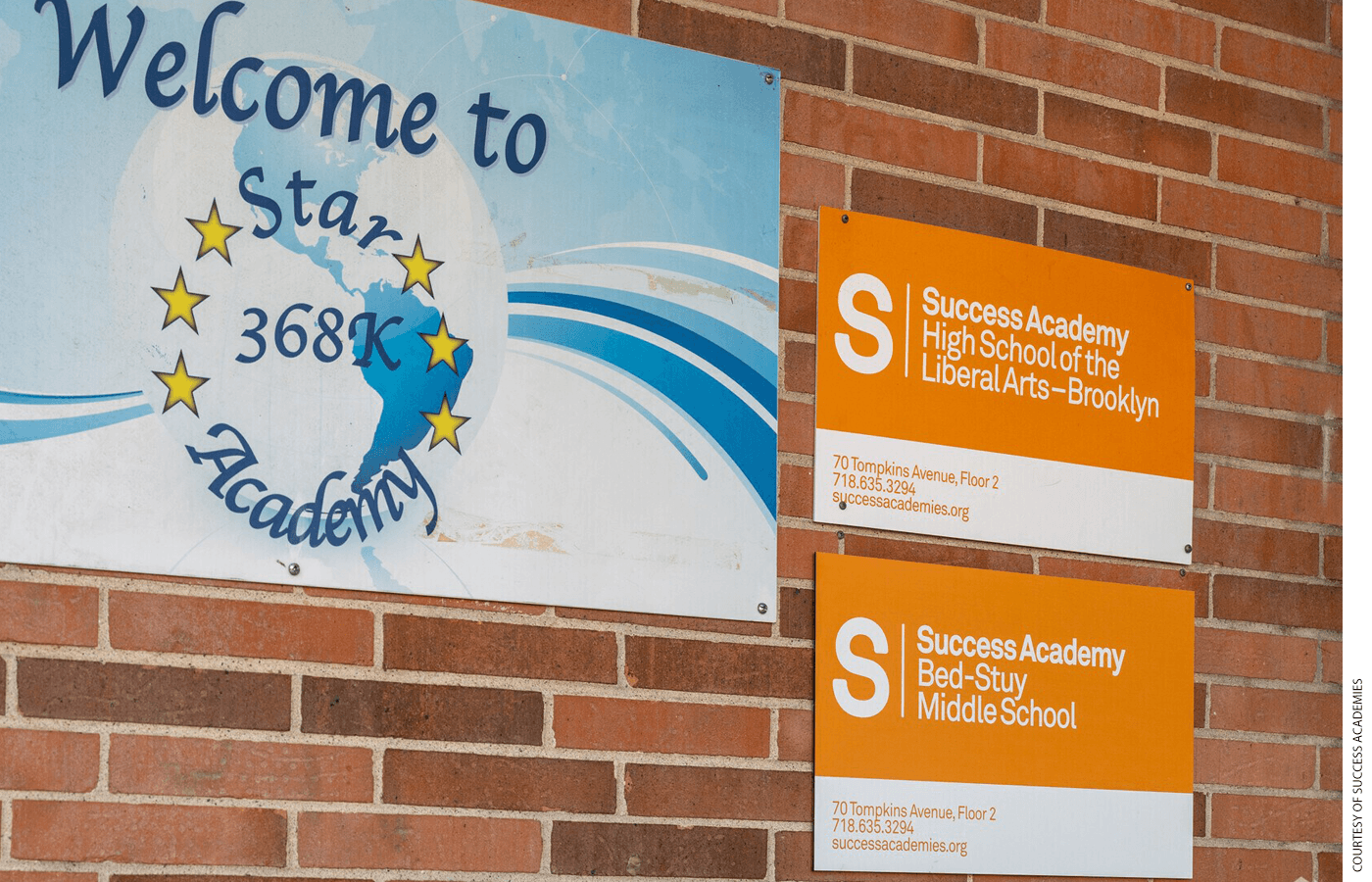
But there is a model. Paige need only to have made a short walk in any direction from her school in Bedford Stuyvesant to see it in action. She might have walked northeast to Success Academy Bed-Stuy, which in the 2024–25 school year enrolled nearly a thousand students (only 26 of whom were white). Seven in 10 were economically disadvantaged. Ninety-seven percent performed at or above grade level in English and 99 percent in math (with 77 percent scoring at the state’s highest level).
Paige had many other places in the city to find excellence in action. Concentrated in New York’s poorest communities, scores of high-performing charter schools enroll the neighborhood’s children. They are Black and Latino and, in the main, from low-income families. Unlike the New York City Public Schools, where fewer than half of Black and Latino students perform on grade level in English and math, a growing number of the city’s charters now boast near universal student proficiency. At Classical Charter Schools in the South Bronx, 98 percent of students tested proficient in math and 96 percent in English in 2025. Four of the network’s five schools are in the country’s poorest congressional district. Success Academy, the city’s largest charter network with 57 schools and 22,000 students, performed nearly as well.
Nearly three decades since New York State passed its charter school law, misconceptions about the schools abound—namely, that they select their students and are more generously funded than traditional public schools. In fact, the city’s charters are open to all children, regardless of ability or prior academic achievement, are publicly funded (at levels lower than the district), are prohibited from charging tuition or fees, and—crucially—are held accountable for their students’ outcomes under threat of state closure.
Some critics see charters skimming off the most motivated parents. Research discredits this. Studies compare the performance of students who won a seat in a charter school’s admissions lottery to those who did not; both benefited from parents motivated to apply. Moreover, charter skeptics conceive of parents who are motivated to ensure their children are educated as a finite commodity, extracted and hoarded by charters like gold in the ground. In truth, motivation is forged in part by a school’s culture, an infinitely expandable asset that effective schools produce as much as tap.
A Contrast in Commitment
The conditions Hannah-Jones decries in her child’s schools are precisely those that motivated New York charter school founders—many progressive Democrats—to launch their new schools. In middle school, Najya complained of chaotic conditions at lunch hour and said she didn’t want to go to school. Visiting the elementary school lunchroom, Hannah-Jones saw children running wild, pushing and hitting one another, as cafeteria staff looked on with “callous disregard.” Inexperienced teachers struggled to manage their classrooms; a few students acting out consumed their attention as the rest treaded water. Her teachers missed days of school; if substitutes were on hand, they rarely taught. In their absence, Najya and her classmates were sent back to kindergarten classrooms. Her math assignments went ungraded, her grammar and punctuation uncorrected, and a crucial reading assessment was likely never administered. Academic standards were nonexistent. At Unison Najya got an A in algebra but knew hardly any of it. The school’s children, Hannah-Jones writes, “were languishing in classrooms with educators who did not take their academic potential seriously and largely refused to teach.”
She is describing a culture of indifference and—in an organization with a staff of 141,000 and a budget of $45 billion—a culture nearly impervious to reform. Far easier to start over, with a new school marked by a relentless drive to do right by every child.
Charter founders knew there would be no silver bullet. Staff would need to attend to everything sedulously: from a safe and nurturing community, where every child was known and heard, to rigorous and engaging lessons; from weeks of professional development for the school’s faculty before the doors opened, to regular phone calls to brief parents on their children’s progress. Most important, these new schools would be marked by a pledge: never to make excuses for the school’s failures. No longer would staff invoke racism, insufficient resources, or broken communities. Within the school’s four walls, the founders said, they had everything they needed to succeed with every child.
Hannah-Jones, in contrast, sees in failed urban schools not broken institutions in need of remaking but the bitter fruit of systemic inequality and enduring racial segregation. Yet her daughter’s schools were not lacking in resources; the city spends $52,349 for every child at P. S. 307, and the average class size is ten. Residential segregation is rooted in a complex and ugly history but perpetuated by failed schools that reproduce poverty. And a Black child does not need to sit next to a white classmate to learn. In schools like Success, students’ test scores and acceptance to (and persistence in) four-year colleges attest to that. For Hannah-Jones, the solution to racial inequity is integration. For charter founders, it is a new generation of public schools that work.
Charters’ Wrong Turn
Support for charter schools among Black and Latino parents remains strong, with nearly three-quarters of Black parents of school-age children supporting them. Yet in recent years, charters have fallen out of favor with philanthropic funders and elected officials of both parties. That’s because test scores in many large urban networks (New York, Boston, Chicago, Denver, and Memphis) tumbled at the close of the last decade and have not rebounded. Some networks like Classical and Success stayed true to their academic commitments. But in others, mandatory antiracist trainings roiled school faculties and took aim at the charters’ longstanding beliefs and practices.
EdNext in your inbox
Sign up for the EdNext Weekly newsletter, and stay up to date with the Daily Digest, delivered straight to your inbox.
Teachers learned that America was “structurally” racist (which facilitators distinguished from personal racial animus, despite prescribing implicit bias training as the remedy) and that the eradication of racism was a precondition for expanding educational opportunity. White charter founders were said to be suffering from “white savior complex.” High expectations for student conduct, which Hannah-Jones lamented was absent from her daughter’s school, had been upheld in charters by merit and demerit systems, but these were now condemned by equity trainers as “controlling Black and Brown bodies” and “carceral education.” Restorative justice and student counseling that substituted proved impracticable and ineffective. Discipline collapsed. Most important, the veneration of effective teaching and the drive for academic excellence were lost.
Today, leaders in charter and district schools alike privately acknowledge their wrong turn and its harm to students. “In not giving homework, we didn’t honor their academic selves. And that’s where I could cry, because it’s just awful,” Paige painfully admits to Hannah-Jones. “It is important to not, in our pursuit of being antiracist, lower expectations. Because this is what happens, right? It’s racism under the guise of antiracism.”
Few charter school and network leaders will yet speak publicly about this wrong turn for fear of censure. But until they do, can the charter sector recover?
* * *
In New York City, an arbitrary statutory cap on the number of charters citywide prohibits any new schools from opening. The teachers union, New York State United Teachers, arguably the most powerful interest in the state, is determined the cap not be raised. Hannah-Jones had hoped her presence and that of other middle-class parents in her child’s district schools could improve them for all students. By her own account, she had connections and time and status. “But what did it do?” Najya asked her mother repeatedly. Hannah-Jones could instead have used her “power and privilege” to call out the educational neglect to which “antiracism” gave shelter. She could still use it to demand the charter cap be lifted. For if “structural racism” has meaning in education, the cap is its apotheosis.
Steven F. Wilson is a senior fellow at Pioneer Institute for Public Policy Research and the author of The Lost Decade: Returning to the Fight for Better Schools in America.