



Whole shelves of edu-books promise, “If you just DO THIS, students will learn!” From growth mindset to inquiry-based learning, methods claiming to be the secret ingredient of successful schools have been peddled by a slew of authors. Yet, while the strategies often impress on paper, the promised results rarely materialize in practice. Why is that?
I’ve long thought that education volumes are most useful when they shed light on that question. On that count, Harvard’s Jal Mehta and five colleagues have delivered a useful new entry. In A Chance to Solve Their Own Problems: Inside the New Methods Seeking to Remake Public Schools (Harvard University Press, 2026), they explore how “continuous improvement and design” (CID) strategies have played out in K–12 schooling. Their sympathetic analysis of these low-key, under-the-radar efforts is a study in organizational change—though it’s most useful and revealing when they delve into the forces that frustrate reform.
Just what are “continuous improvement and design” strategies? The authors trace their origins to W. Edwards Deming’s pioneering work on total quality management (TQM) and his insights into data, coordination, and strategic management. When it comes to education, Mehta et al. describe CID as a teacher-centered “new process—a different way of working” in which educators learn to “examine data,” “build systems,” and “organize for improvement.”

Early on, the authors profile several of education’s best-known CID efforts—including Instructional Rounds, Data Wise, Networked Improvement Communities, Lesson Study, and Design-Based Implementation Research. Although they are clearly CID enthusiasts, they observe that these acclaimed strategies have received little scrutiny. No one has spent much time or energy figuring out if they actually work.
That’s the task that Mehta et al. set out for themselves. The bulk of the book consists of in-depth case studies of four long-running CID initiatives aimed at tackling challenges ranging from early literacy to high school biology. Along the way, the authors conducted more than 350 interviews and observed hundreds of meetings, trainings, and classrooms between 2016 and 2019. (If you think a book that draws on research that wrapped seven years ago should’ve been out sooner, I’m with you. Academe, man.)
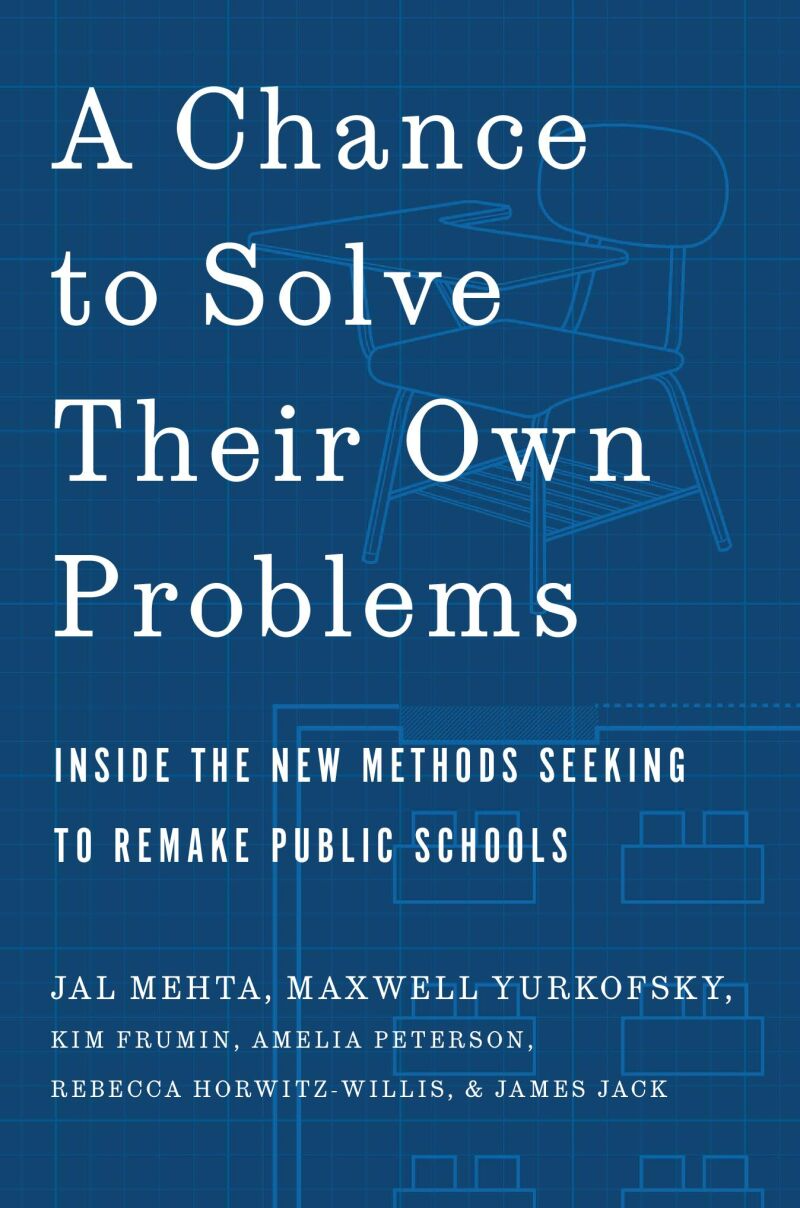
By Jal Mehta, Maxwell Yurkofsky, Kim Frumin, Amelia Peterson, Rebecca Horwitz-Willis, James Jack
Harvard University Press, 2026, $29.95; 368 pages
The authors do a skillful job of explaining why TQM and its heirs have yielded uneven results, and how they depend on things like the clarity of goals, the predictability of workflows, and the precise measurement of outcomes. Even sensible design principles falter when applied clumsily or in the wrong context. Sure enough, even though they are clearly fans of CID, they thoughtfully explore why it’s frequently a poor fit for isolated, harried school systems in which teachers and leaders harbor a lot of distrust for one another.
The book is at its best when unpacking how culture, political dynamics, professional isolation, tight timelines, and misaligned incentives play out. I was reminded of Charles Payne’s wonderful So Much Reform, So Little Change, except with a more systematic frame. For instance, Mehta et al. point to the useful distinction between “complicated” problems (which require expertise) and “complex” ones (which require navigating human and organizational dynamics). They note how CID models seek to harness expertise, believing it will somehow help resolve complex interpersonal and organizational problems. Not surprisingly, the results frequently disappoint.
Indeed, the book’s most revealing contributions show up in the candid expressions of snark by educators who feel threatened, condescended to, or overburdened by these “teacher-centered” efforts. There’s the teacher who explained, “I don’t trust all data that they’re looking at.” Or the teacher who reported, “The kids were making fun of [the exit ticket]. They were like, ‘How does this lesson make me feel? Sad? Lonely?’ And it’s like, no, these are high school kids, they don’t give a shit.” Another teacher said,
What have [these partners] done to save me time? Not a lot. Last I checked, I’ve spent hours redoing all their shit, so if they want to take me up to the 99-yard line on that, cool, but I have six meetings on top of that six hours of work. I’m not going to waste my time.
A school leader lamented, “It’s an elective data collection. So . . . we’re missing a ton of data, and probably the very teachers who we wish we had it from, we don’t.” One principal observed, “It’s not really safe to say ‘I messed up,’ . . . because then you’re judged.” All of these complaints may seem kind of picayune, but that’s the point. It’s the accumulation of these minute, easy-to-overlook foibles that have been the undoing of so many reforms that looked like gamechangers from 30,000 feet. Given all this, readers may wonder why the authors are so sympathetic to CID. It’s clear they believe in the importance of skilled practice, are skeptical of top-down diktats, and view CID as a promising way for communities of professionals to tackle challenges collaboratively—in large part because it puts educators and those who train and support them in the driver’s seat. Put that way, it’s not hard to see why CID approaches are popular with education consultants and ed school professors; especially when the alternative is reforms that shift decisions away from educators and ed school “experts” and towards elected officials.
If I sound skeptical of CID, that’s because I am. But the authors’ measured approach offers a sense of why CID approaches can be so appealing. For instance, in discussing one reading program, they note the positive impact of coaches:
In the past, teachers had been handed huge binders of materials at the beginning of the year; they then had to turn this overwhelming mass of guidance into day-to-day lessons. The coaches worked with them to help them figure out what to prioritize, what to let go, and how to [use assessments] . . . to organize their lessons.
At another point, they quote a teacher participating in a CID collaboration, who explains:
I think that teaching [this curriculum] has made me more aware of . . . what I’m actually trying to do with students . . . Because if I ask the question, “What did we figure out today?,” and I get a bunch of blank stares, then it’s like, “Cool, I was failing miserably in my job, which was to get them to figure something out” . . . And so, I think it’s helped me be more reflective.
This may all seem obvious. And it is. But inattention to these practical frustrations has humbled many school improvement efforts—great and small. Now, it’s no surprise that teachers prefer improvement strategies that feel supportive. They like coaching when it’s unobtrusive, convenient, and focused on their priorities. They like collaboration when they feel heard, respected, and unhassled. The big question, of course, is whether genial coaching and no-offense collaboration can drive academic improvement. That’s a question the book doesn’t answer.
For me, Mehta et al.’s bottom line is this: CID asks educators to use methods that are poorly suited to the culture and turbulence of America’s K–12 systems. Changing mindsets, routines, and practice requires time and predictability. In schools today, though, initiatives get knocked askew when curricula change, district priorities shift, personnel turn over, or teachers feel overwhelmed. In other words, even these less “political” low-key reforms still inevitably run afoul of system dynamics, dysfunction, and distrust. Whoops.
Subscribe to Old School with Rick Hess
Get the latest from Rick, delivered straight to your inbox.
Almost three decades ago, I argued in Spinning Wheels that the disappointing track record of so many school reforms isn’t necessarily about the particular policies but the chaotic, dysfunctional dynamics of system leadership. I kept flashing on that project as I read A Chance to Solve Their Own Problems and was reminded how even “apolitical” reforms are dependent on larger organizational pressures.
A Chance to Solve Their Own Problems falters when the authors try to offer a way out of those thorny system dynamics. As they move from diagnosis to prescription, they lather on the lugubrious edu-talk. The final chapter places great emphasis on the importance of “holding polarities” by embracing “paradoxical” practices (such as alternating meetings between “protocol-heavy conversations and more open discussion”). That’s a jargonful, confusing way to say that fruitful change requires both structure and flexibility.
The prescriptive sections are weaker than the descriptive ones. It’s easier to diagnose obstacles than to surmount them. But diagnostics are vital, particularly in a sector that has a long history of preferring fad-pushers to truth-tellers. Ultimately, Mehta et al. deserve credit for penning a volume that digs deep into the how of school improvement and offers real insight as to lessons learned. They may not have the answers, but they offer a wealth of practical wisdom—wisdom that is in short supply when it comes to education reform.
Frederick Hess is an executive editor of Education Next and the author of the blog “Old School with Rick Hess.”