
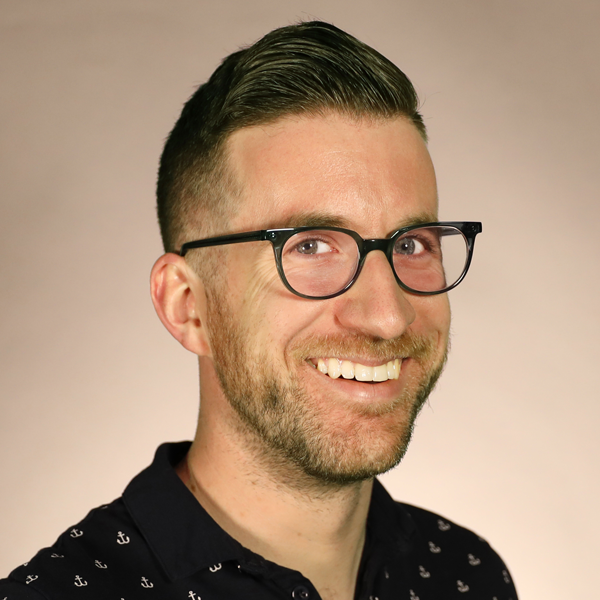
Choice advocates are excited about the federal scholarship tax credit (FSTC) program, created as part of 2025’s “One Big Beautiful Bill.” And understandably so: As the first nationwide federal K–12 choice program, the FSTC could potentially enable hundreds of thousands, if not millions, of students to attend private schools their families could not otherwise afford. The FSTC will be of particular benefit to families in traditionally blue states like New York that would not have offered choice to students on their own but have indicated they will participate in the program.
Savvy public school supporters also see opportunity in the program. Students attending traditional public and public charter schools can tap into the scholarship, and funds can be used for a host of expenses that some districts and charter operators are now paying out of general operating funds or cannot afford to provide at all.
But, as T. S. Eliot famously wrote, between the idea and the reality falls the shadow. Implementation—putting a program into action and making it work as intended—is difficult and complex. Even broadly supported and well-resourced programs have stumbled over the hurdles of implementation before getting to the finish line. The full realization of the FSTC’s potential will require close attention to how it is being implemented, to newly released federal regulations, and to how organizations seeking to take advantage of the funding it generates cope with emerging challenges.
Known and Unknown Knowns
School leaders, parents, taxpayers, and scholarship granting organizations (SGOs) spent the summer eagerly awaiting draft rules from the IRS to help them better understand the ins and outs of the FSTC. U.S. Treasury Department officials released the rules on October 1. These will govern the program for 2027, when it officially begins. Any revisions to those regulations that are completed after the standard notice-and-comment period will apply in subsequent years.
Most notably, the rules clarified the value of the tax credit. The One Big Beautiful Bill stated that the credit was worth $1,700, given dollar-for-dollar for donations to qualifying scholarship granting organizations. But it was unclear if that $1,700 was per person or per household. The new regulations clarified that the credit is per person, so a married couple filing jointly can qualify for a $3,400 tax credit.
The SGOs will pool the funds and grant scholarships to eligible private and public school students, who can apply the money toward tuition or a variety of educational services and products, including books and instructional materials, tutoring, transportation, after-school programs, and technology.
To be eligible, students must come from families earning no more than 300 percent of the median gross income of households in the area in which they live—that is, a metropolitan area, or non-metropolitan county, as determined by the U.S. Department of Housing and Urban Development. This high ceiling puts the program within reach of middle-income families and many wealthy ones: The American Federation for Children estimates that 90 percent of K–12 students nationwide could be eligible. Scholarship granting organizations must have 501(c)(3) nonprofit status, must be included on the state’s list of approved granters, must spend at least 90 percent of donations on scholarships, and must give scholarships to at least 10 different students from at least two different schools. Also, an SGO can award scholarships only to students who live in the state where the SGO is based.
Some advocates hoped that states could place conditions such as making scholarships available only to low-income students, excluding scholarships to students who attend schools that “discriminate,” or requiring standardized testing in schools that partake in the program. Others maintain it would violate both the letter and spirit of the law to place any additional requirements on SGOs beyond what was enumerated in the law.
Vermont even passed a law restricting FSTC scholarships to low-income students attending public schools. But Treasury officials put that to rest in the regulations, writing “A State may not require SGOs to operate in a manner that is more restrictive than the requirements set forth . . . such as by limiting the type of school that scholarship recipients may attend or the types of qualified elementary or secondary education expenses for which scholarship funds may be used.”
There is still some ambiguity as to exactly what public schools will be able to offer their students and when and where they will be able to offer it. Before- and after-school services such as tutoring or enrichment programs seem like clear-cut cases of permissible expenditures. But how will districts account for expenditures within the school day? Will they need to charge students to take an AP class, only to have those funds reimbursed by scholarship dollars? If so, that has implications for students whose family incomes exceed the 300 percent income-eligibility threshold, who might have to pay to take a class their classmates are getting for free. And what about general programming for all students? One-off courses or programs are clear-cut from an accounting perspective, but if districts want to offer general supplemental programming for all students, they might need to charge some kind of fee, at least for eligible students, that is later reimbursed by scholarship dollars.
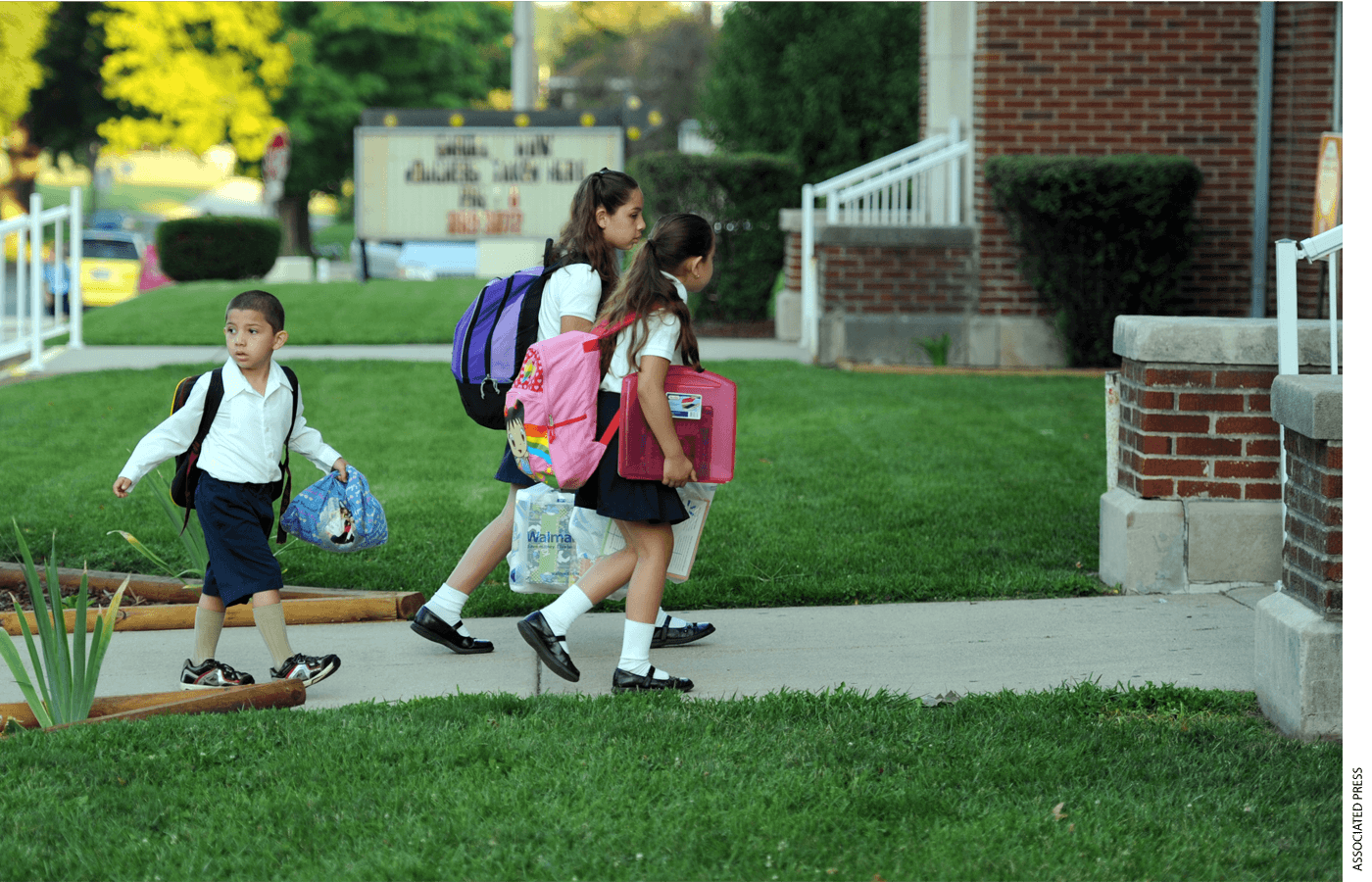
There are also several fraud-prevention steps. Every donor will receive a unique confirmation number from the SGO receiving the funds, which will also send the number to the IRS. The donor will enter that number on their tax return to verify that their donation was legitimate and that their tax credit is justified. There will also be provisions for auditing SGOs and a portal on IRS.gov for submitting forms, lists, and other required documentation.
Treasury also clarified that for the purpose of FSTC scholarships, a qualifying student must be enrolled in a public, private, or religious school as defined by the state in which that child lives. Initial estimates from advocates are that homeschoolers and microschoolers in 22 states should be eligible to participate.
So, You Want to Start an SGO . . .
Some of the SGOs that distribute the federal choice scholarships will be existing organizations that elect to participate in the program; others will be new organizations specifically created to administer the scholarships.
Either way, SGOs will need to follow a series of steps to comply with the law. These five steps delineate what implementation will look like.
Step 1: Get a 501(c)(3) designation. The law requires all SGOs to have 501(c)(3) status. In most states, acquiring this designation requires filing incorporation paperwork with the secretary of state, obtaining a federal employer identification number, applying for federal 501(c)(3) status, applying for state tax exemptions, and registering for charitable solicitation. The organization also needs to establish a board of directors, adopt bylaws and elect officers, open a bank account, and draft key policy documents. This process can take weeks to months.
Step 2: Get state approval to solicit donations and give scholarships. Once an SGO becomes an established 501(c)(3), it needs to become eligible to receive donations and give scholarships. While the state must approve every SGO that meets federal requirements, those requirements are actually more robust than many observers expected. SGOs must provide organizational information like their address and EIN number; evidence of their 501(c)(3) status; governing documents like articles of incorporation and bylaws; a list of policies and procedures, including separate-account procedures that demonstrate that FSTC funds are not co-mingled with other organizational funds; and student eligibility determination and scholarship-selection procedures, as well as financial information and records.
Step 3: Recruit donors. Representatives of many SGOs say they see this as the most challenging step. Donors do not have to reside in the state where the SGO operates. They can even live in states that have not opted into the program. But, because each credit is capped at $1,700, SGOs are going to need a large number of donors. For example, an organization offering scholarships of $5,000 per child would need to recruit at least 30 donors in order to meet the 10-student minimum.
Donors can contribute in three ways. They can give directly to an SGO, they can contribute via monthly withholding from their paycheck, or they can allocate funds when they file their tax return. These three options are not equally easy to access.
Several organizations are trying to crack this nut. Rob Kremer has started up the National Scholarship Organization to work with employers on making FSTC donations easier. He said that when he first heard about the choice program, “my immediate thought was, SGOs are going to have to find a way to scale the fundraising part of this equation.”
If employers were to include FSTC donations in their withholding documentation each year, employees could make a monthly contribution of $141.67 and have their federal tax withholding reduced by the same amount so as not to feel the pinch. Employers could establish their own scholarship funds that donate to employees’ children or to students in aligned schools. Think of a university like Notre Dame encouraging employees to donate to an SGO that grants scholarships to Catholic school students or Eli Lilly working with an SGO to offer scholarships to students at schools with strong STEM programs.
Sean Clifford of the AFC Scholarship Fund says the question to tackle is: “How can we fight the friction?” His organization is taking a three-pronged approach. It is working on the regulatory front to ensure that the government isn’t placing unnecessary burdens on financial entities, with tax preparers and payroll processors to get the FSTC included in their workflows, and on tech platforms to create solutions for donors, families, and schools alike. It will take effort on all three fronts to make participating in the program as frictionless as possible.
Donor education will also be key. Not everyone understands the distinction between a $1,700 tax credit and a tax deduction. Those who confuse the two or think that a dollar-for-dollar credit is too good to be true risk leaving money on the table.
Step 4: Recruit families. Once an SGO has secured enough funding to distribute scholarships, it will need to find recipients. The central administrative concern will be verifying family income to ensure that a student is eligible. The Treasury Department created three ways to verify income: direct verification, categorical eligibility verification, and two safe harbors. Under direct verification, SGOs would use W-2s, pay stubs, tax returns, and reports from crediting agencies. Under categorical verification, SGOs could use award letters for means-tested federal programs like SNAP or TANF as qualification for scholarships, because qualification for those programs indicates an income below the threshold for the FTSC. Finally, the Treasury Department identified specific safe harbor provisions for children in foster care and those who attend schools in low-income areas. Both can be used as streamlined evidence of eligibility to receive an FTSC scholarship.
Step 5: Distribute funds. Two key regulatory elements affect the distribution of funds. First, the SGO must ensure that scholarships are only going to eligible uses. Second, it must be able to prove this.
Most SGOs are looking for financial-technology solutions to help them keep track of spending and compliance. One provider of such services is Odyssey, which currently manages education savings accounts (ESAs) and scholarship tax credit programs in 10 states. Lauren May, head of federal scholarship tax credit and partnerships at Odyssey, said her company’s software solutions can “make sure that we can track every dollar [given] to every kid to an eligible expense.” By streamlining the collection of this information, Odyssey “can ensure that [SGOs] have everything they need for an IRS audit.”
Three Varieties of SGOs
Three general kinds of SGOs are emerging to distribute FSTC scholarships: state-based, national, and those seeking to channel funds to students attending public schools.
The state-based SGO. Nineteen states currently operate scholarship tax credit programs, so there is capacity and experience in these states to administer FSTC scholarships. A group of Iowa’s scholarship tuition organizations (as SGOs are called there) have banded together to create one SGO for the federal program. With each organization facing the prospect of onerous administrative tasks to handle donations under the new program, they have chosen to work together to run a single hub for federal donations and scholarships.
Trish Wilger, executive director of Iowa Advocates for Choice in Education, said, “We’ve been on it since the bill passed” and the organization is working to answer the question, “How do we make this simple and give a seamless experience?” Iowa has a scholarship tax credit program and an ESA program and now will participate in the federal program, so things could get confusing quickly. The upside for families is that they can “stack” their ESA, school tuition organization, and FSTC scholarships, dramatically increasing the level of funding they can receive.
But in states with no pre-existing infrastructure, setting up a new SGO will pose challenges. Before a new SGO can collect a single dollar, it will have to complete much of the work involved in the five steps outlined previously. Organizations cannot accept donations under the FSTC program until January 1, 2027, and they can only devote 10 percent of each $1,700 donation to administrative costs. Even a streamlined organization with a small staff and with the technology to handle much of the administrative work could still accrue several hundred thousand dollars in annual operating costs. For every $100,000 in administrative expenses, an SGO will need to raise $1 million, $1,700 at a time.
The national SGO. National organizations with a broad base of donors and the runway to build processes before donations begin to roll in will have an advantage.
James Elliot of the Association of Christian Schools International sees SGOs as the hub of a wheel that includes the government, schools, families, and donors. He recognizes that “there are complexities to facilitating these things.” Finding donors is toward the top of this list. As he put it, the FSTC “is not like a state program where you can find folks with large income-tax liability.” (Many state programs have much higher caps, if any, on individual donations so they can raise funds in amounts considerably larger than $1,700.) For the FSTC, serious outreach and fundraising work will be required. But big organizations like ACSI have the networks, the staff, and the connected community to undertake that.
But even established organizations are thinking through how best to tap into the FSTC program. Lesley Searcy, vice president at the Children’s Scholarship Fund, recognizes that it is “unprecedented to raise $1,700 at scale in the form of a tax credit.” CSF is working on the infrastructure to link families to schools and providers so they can offer these pre-matched parties to SGOs around the country. As Searcy puts it, “Donors like to give and support at the local level,” so the partnership between national organizations with the know-how and resources and local organizations with connections to and legitimacy in the community could provide the best of both worlds.
EdNext in your inbox
Sign up for the EdNext Weekly newsletter, and stay up to date with the Daily Digest, delivered straight to your inbox.
Public school SGOs. In an early June webinar, Marguerite Roza from the Edunomics Lab at Georgetown argued that since 90 percent of students attend public schools, these schools might become the largest beneficiaries of the program. The webinar spelled out several different scenarios in which public schools could fund programs via tax-credited donations. For instance, they could offer programs for private or home-schooled students, they could provide targeted programs to specific populations of students, or they could offer general programming to all students.
Tutoring, before- and after-school programming, summer school, technology, AP or IB courses, enrichment, and remediation all appear to be allowable uses of FSTC funds within public schools. The question remains whether these funds will be governed by the same “supplement, not supplant” rules that apply to other federal education funding. Those rules stipulate that federal dollars cannot fund services that districts would offer anyway, by paying for them with state and local money. While it appears that scholarship dollars are not strictly bound by the same language as programs like Title I, the general consensus among advocates and observers is that schools cannot use those dollars to pay for services a district was already providing.
Deborah Gist, former superintendent of Tulsa Public Schools, remembered thinking, “Wow, this is huge” after seeing the bill pass last summer. She is now founder and CEO of the Future Schools Fund, an organization dedicated to including public schools in the FSTC program. The opportunity for these schools is tremendous. Consider Tulsa Public Schools as an example. The district has 4,860 full-time equivalent employees, and if every one used payroll deduction to give $1,700 dollars, that would total $8.26 million, or $243 per student for the 34,000 students of the district. (And that is before one parent, grandparent, or community member gives a dime or one area employer includes the FSTC in its open enrollment process.) This calculation assumes that all 4,860 of those district employees would want to contribute and would have at least $1,700 in federal tax liability, which may or may not be true. But doing the math for 4,000 or 3,500 or 3,000 employee donors still yields a substantial sum of money.
Gist allows that this will require “a new way of thinking” for public school administrators, who will have to revise some budgeting procedures, do some work to qualify students for scholarships, and work around students who are financially ineligible to receive them. As she puts it, “Every single part, we are blazing trails that don’t currently exist.” But the potential funding is enormous and could even exceed the federal government’s current spending on K–12 education.
What’s more, to invert the hopeful ending to Churchill’s “We Shall Fight on the Beaches” speech, the Old World may come to the rescue and liberation of the new. At present, the program is widely perceived as being only or primarily about private-school choice, which has led to some political opposition (to wit, every Democratic U.S. senator has signed onto a bill authored by Arizona senator Mark Kelly to repeal the FSTC). But if public school participation turns out to be robust, that could create support across the aisle and across the country. Private-school choice’s recent history teaches us that appeasing public schools with teacher salary increases or promises for more funding is a canny political maneuver to win support for choice, and this program’s inclusion of public schools might represent such a tactic on steroids.
The Future
The public policy scholars Jeffrey Pressman and Aaron Wildavsky described the challenges of turning government intentions into results in their 1973 volume, Implementation.
“People now appear to think that implementation should be easy; they are, therefore, upset when expected events do not occur or turn out badly,” they wrote. “We would consider our effort a success if more people began with the understanding that implementation, under the best of circumstances, is exceedingly difficult. They would, therefore, be pleasantly surprised when a few good things really happened.”
It is hard to predict exactly how implementation of the FSTC will shake out. Public schools, for instance, could play a prominent role in the program, transforming the scenario. With just a few words in the law, Congress has opened the door to tens of billions of dollars potentially flowing into America’s public schools, in turn making advocates of those who would otherwise have opposed the program.
Funding SGOs with 10 percent of donation receipts also shapes the field in ways that folks might not have initially foreseen. With organizations not allowed to collect donations until January 1, and probably not seeing a large number of contributions until later in the year when people’s tax liabilities become clearer to them, the advantage has been tilted to larger and more established organizations.
The implementation picture has yet to come into full focus, but a solid bet is that the FSTC will continue to surprise us.
Michael Q. McShane is director of national research at EdChoice and an adjunct fellow in education policy studies at the American Enterprise Institute.
Suggested citation format:
McShane, M. Q. (2026). “Federal School Choice Is Here. Is the Field Ready?: For choice champions, the new Federal Scholarship Tax Credit brings the happy challenge of implementation.” Education Next, 26(4), 8 October 2026.