


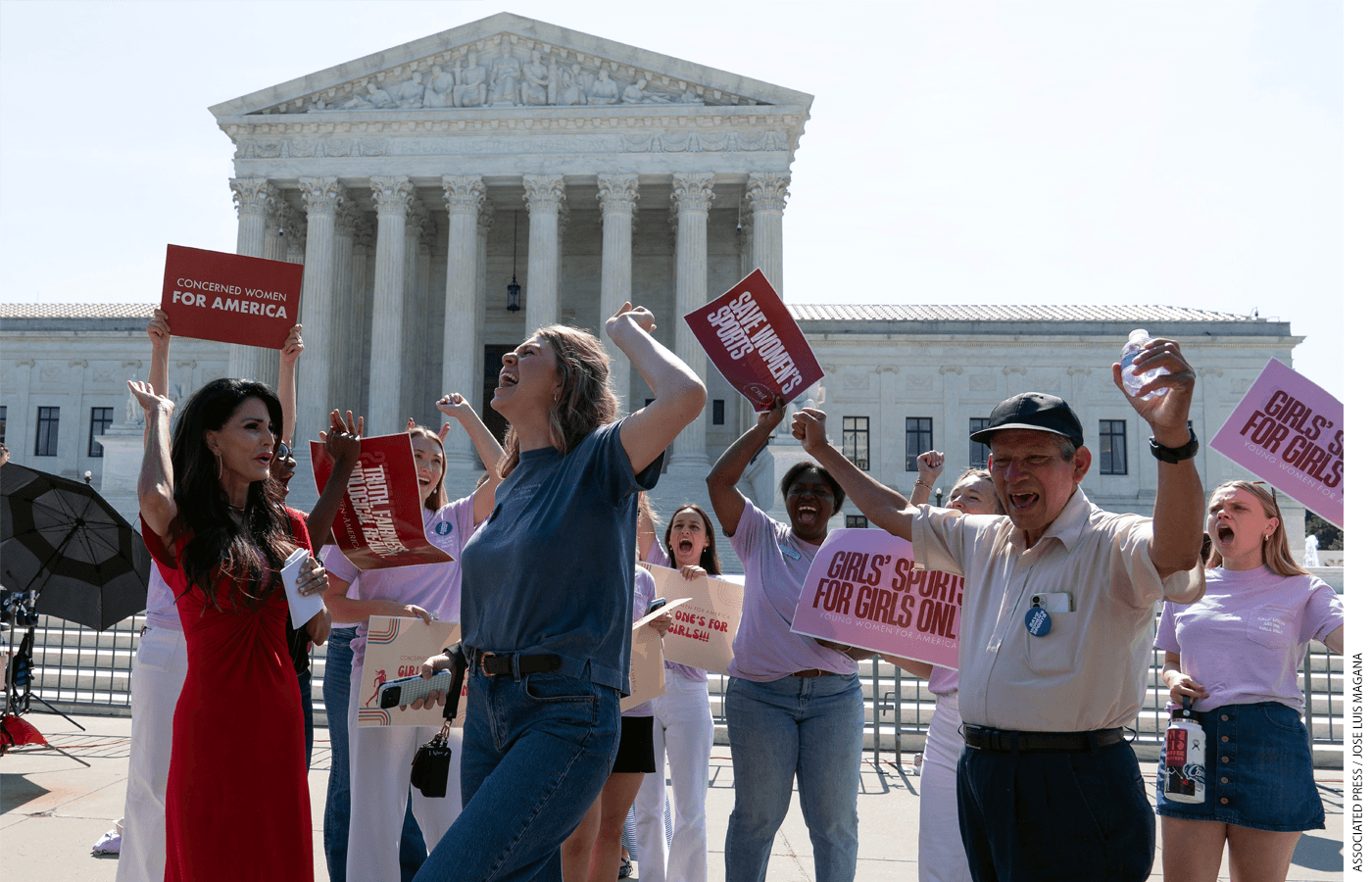
On Tuesday, the Supreme Court decisively answered the core legal question in West Virginia v. B. P. J. and Little v. Hecox: whether states could restrict athletes’ participation in school and collegiate sports based on their biological sex. The answer was a resounding yes.
That conclusion was not surprising since Title IX was created to increase opportunities for females, and subsequent legislation made it clear that sex-segregated teams could be necessary to comply with the law. As everyone could clearly see, teams open to participation by both sexes would be physically dominated by males, leaving females with few meaningful opportunities to contribute. The court’s decision in some ways simply recapitulated what we already knew. But despite the court’s clear answer, more litigation is bound to follow since the court refused to address whether Title IX forbids states from letting biological males participate in female sports.
In his majority opinion, Justice Brett Kavanaugh said that both Title IX and the Fourteenth Amendment’s Equal Protection Clause permit these restrictions. On the Title IX question, which applied only to B. P. J., the court was unanimous that the respondent’s claim failed. But the six conservative justices went further, concluding that “sex” in Title IX’s athletics provisions refers to biological sex and allows states to preserve female athletic opportunities by limiting participation based on biology. The three justices in the liberal bloc, Sotomayor, Kagan, and Jackson, agreed but thought the majority went too far by saying that sex must always mean biological sex under Title IX. They feared that doing so could affect transgender students outside of athletics.
On equal protection, Kavanaugh said the laws were sex-based classifications triggering intermediate scrutiny. Unlike strict scrutiny, the most exacting level of review, intermediate scrutiny gives greater latitude to the government. Most importantly, it does not require that every application of a law be perfectly tailored to an individual’s particular circumstances. States may make categorical judgments related to important governmental interests. In athletics, those interests include safety, fairness, and preserving equal opportunities for females.
That point was central to the court’s rejection of a case-by-case regime. The challengers argued that some transgender girls, particularly those who received puberty blockers or hormone therapy, might not retain the physical advantages associated with male puberty. On that point Sotomayor, Kagan, and Jackson dissented and would have required further fact-finding by lower courts.
Kavanaugh rejected that approach. In addition to not being required by intermediate scrutiny, courts would be wading into a biological and political thicket with no manageable standards. Federal courts are hardly institutionally suited for deciding whether a male’s athletic advantages have been sufficiently mitigated by puberty blockers, hormone therapy, or surgery: “In the sports context,” he wrote, “starting down the road of judicially managed individualized exemptions based on physical capabilities of individual athletes could fundamentally undermine women’s and girls’ sports—especially if the number of biological males who seek to play women’s and girls’ sports increases significantly over time. The questions would be endless (and bitter) and yield few, if any, principled answers. The Equal Protection Clause and this Court’s precedents do not require such a judicial quagmire.”
EdNext in your inbox
Sign up for the EdNext Weekly newsletter, and stay up to date with the Daily Digest, delivered straight to your inbox.
The court’s decision does not end the debate, but rather might just mark the end of its beginning.
While it ruled that states may limit female sports to biological females, the court punted on addressing whether Title IX requires them to do so. “Nothing in this opinion,” Kavanaugh wrote, “is intended to decide that question” and it is that question which will undoubtedly shape the next round of regulation and litigation.
The Trump administration will undoubtedly see the decision as a green light to be even more aggressive with its interpretation and application of Title IX. After Trump took office in 2025, one of the Department of Education’s first Dear Colleague Letters announced that the Office for Civil Rights (OCR) would return to enforcing Title IX on the basis of biological sex. Thus, schools and states that interpret the court’s decision as guidance rather than a mandate and proceed to open female sports to biological males are still likely to invite an investigation by OCR.
Female athletes have already started suing with claims that follow the same roadmap created by transgender athletes. But unlike the latter cohort, which argued that being excluded from female teams violates Title IX, these plaintiffs are arguing that inclusion of biological males in female competition violates Title IX by depriving women and girls of equal opportunities. The court’s decision certainly will not dissuade others from filing similar lawsuits.
That is why Tuesday’s ruling, though definitive, is not final. It answers the question whether states like West Virginia and Idaho may protect female sports through biological-sex classification but leaves for another day whether schools that refuse to do so violate Title IX.
Joshua Dunn is executive director of the Institute of American Civics at the University of Tennessee, Knoxville. The opinions expressed are those of the author and do not represent the views of the Institute of American Civics or the University of Tennessee.
Suggested citation format:
Dunn, J. (2026). “A Definitive—But Not Final—Decision on Transgender Athletes: The Supreme Court’s ruling on biological males participating in female sports is sure to invite more Title IX litigation.” Education Next, 26(3), 1 July 2026.