



During my freshman year at Harvard, I taught civics every Thursday to 5th graders. One morning, I went rogue. Before boarding the subway to Dorchester, I bought a party-size pack of Dum-Dums and brought it with me to class. I opened my lesson on voting rights with a proposal: only the students wearing blue that day could have a say in how lollipops were distributed. After their shrieks subsided, I asked them to reflect. How did they feel? Students who to that point had preferred to put their heads down raised their hands for the first time: “It’s unfair!”
The classroom had briefly become a democracy in crisis. Everyone knew why. They experienced, firsthand, the animating principle behind the history of voting rights: justice. The rest of the lesson, in which we walked through America’s expanding franchise, clicked. They grasped, in a way no textbook could engineer, that restricting the franchise based on an arbitrary characteristic—from race, to sex, to the color of their shirts—violates a principle they already believed.
John Dewey had this in mind when he published Democracy and Education in 1916, a book that turns 110 this year, the same year America turns 250. This coincidence is worth contemplating. Both anniversaries invite the same question: What does it take to sustain a democracy across generations?
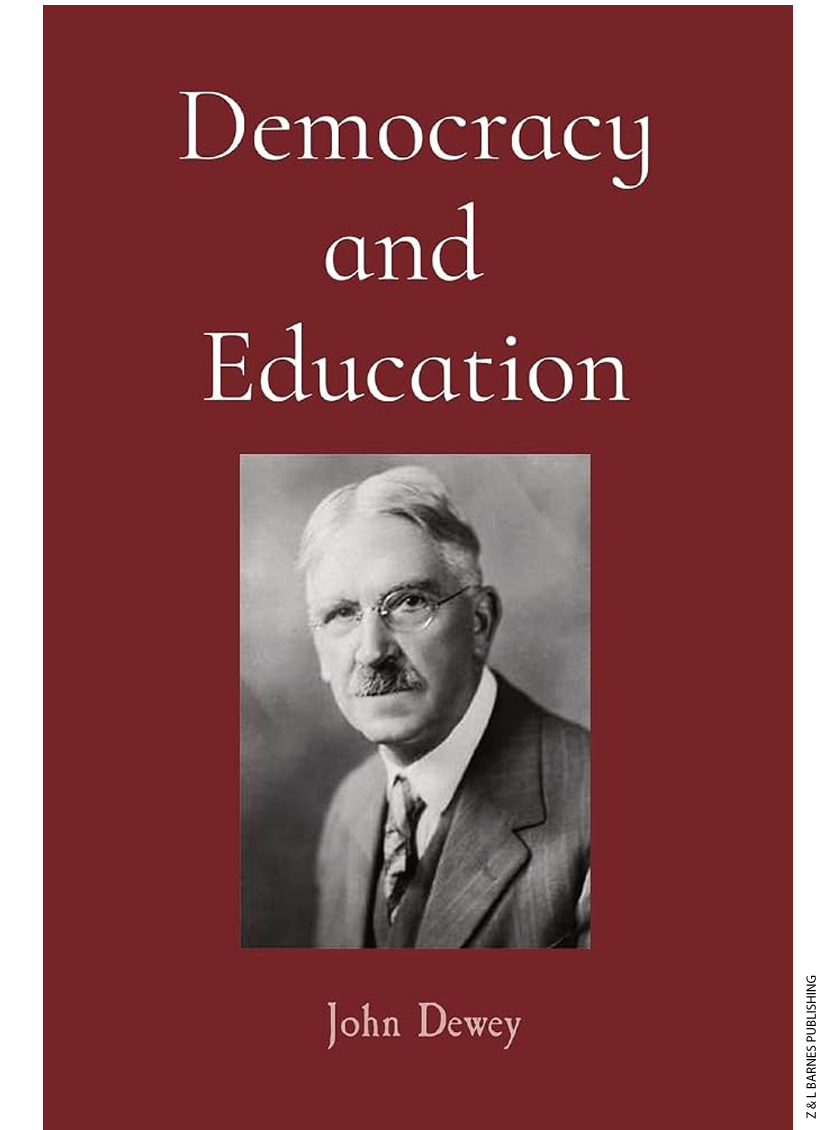
Dewey’s answer was blunt. Democracy, he argued, is “primarily a mode of associated living,” a habit of mind and conduct. Schools, where neophytes of public life can socialize and learn from one another, are where democratic life must begin.
One hundred and ten years later, American public education has yet to heed Dewey’s advice. Teachers are not solely to blame. Civics has been crowded out in recent decades. While many students in the 1960s took as many as three civics courses in high school, most states now require no more than one semester-long course to graduate high school.
It doesn’t help that more American adults seem to think they can do without the nation’s founding ideals; our “democratic faith,” in Dewey’s words, has diminished. In 2006, 73 percent of Americans strongly agreed that democracy is better than any form of government, according to Vanderbilt’s AmericasBarometer project. By 2023, only 32 percent of Americans felt the same way. Unless students feel they have agency in determining the direction of public life, they risk becoming at best spectators to democracy or at worst its most vocal critics.
The underlying problem is that democracy requires more than just knowledge of its mechanics and component parts. To be sure, students cannot deliberate about institutions they neither know nor understand—but knowledge alone is insufficient. Dewey’s ideal of democracy requires us to make civic participation a habit. It requires a disposition to deliberate, to modify a view when the evidence demands it, to work alongside people who see the world differently, and to find common ground in that disagreement. These are not traits that emerge naturally from childhood, much less adolescence. Students must practice them, repeatedly, in conditions not unlike those we hope to find in our legislatures and town halls.
EdNext in your inbox
Sign up for the EdNext Weekly newsletter, and stay up to date with the Daily Digest, delivered straight to your inbox.
But how do we prevent the ideals of 1776 from arriving in the classroom as dusty 250-year-old artifacts? Again, Dewey counsels us to design education “of, by, and for experience,” a phrase that evokes Lincoln’s description of self-government in the Gettysburg Address.
Inside the classroom, we can create experiential opportunities for students to discover democratic ideals. A bag of lollipops and a few extra minutes for discussion helped students experience, firsthand, a miscarriage of justice. Using this experience as a vehicle, they could connect their feelings of discontent to those of their predecessors who demanded expansion of the American franchise.
Furthermore, students already have rich, manifold experiences beyond the schoolhouse gate to bring to bear on lessons about political ideals. They are present in the student who says the city buses don’t run on time, and in the student who feels their coursework isn’t challenging enough—issues my 5th graders raised when they wrote letters to Boston’s mayor, Michelle Wu, at the end of the semester. A teacher’s role—indeed, their civic duty—is to equip students with knowledge of political institutions and the skills to navigate them, enriching their experiences inside and outside of school. This requires extending democratic faith to students’ capacity to collaborate, deliberate, and solve problems with their peers. That is how we can recover democracy for ensuing generations of Americans.
The aspect of democratic education that its critics on both sides tend to overlook is that it is neither indoctrination nor value-neutral teaching. It is something harder: a disciplined initiation into intelligent participation in a shared world.
That is what Dewey meant when he said that education is not preparation for life, but life itself. Democratic living requires us to think critically about how we can improve our communities and work together toward their improvement. That process of collective problem-solving could also illuminate aspects of public life worth celebrating. Formal education is only worth its name if it is genuinely formative—if Americans, long after leaving the schoolhouse, have a grasp on the skills and concepts necessary to be engaged citizens.
As America celebrates its 250th anniversary this weekend, I implore us to ask what kind of education might enable each generation to rediscover the nation’s founding ideals. If 1776 declared a set of venerable democratic truths, then 2026 is as good a year as any to encourage students to see those ideals in their own lives and pursue them.
Ryan Jung is an incoming Fulbright English Teaching Assistant in South Korea and former chair of CIVICS, a volunteer civic education organization at Harvard University.