


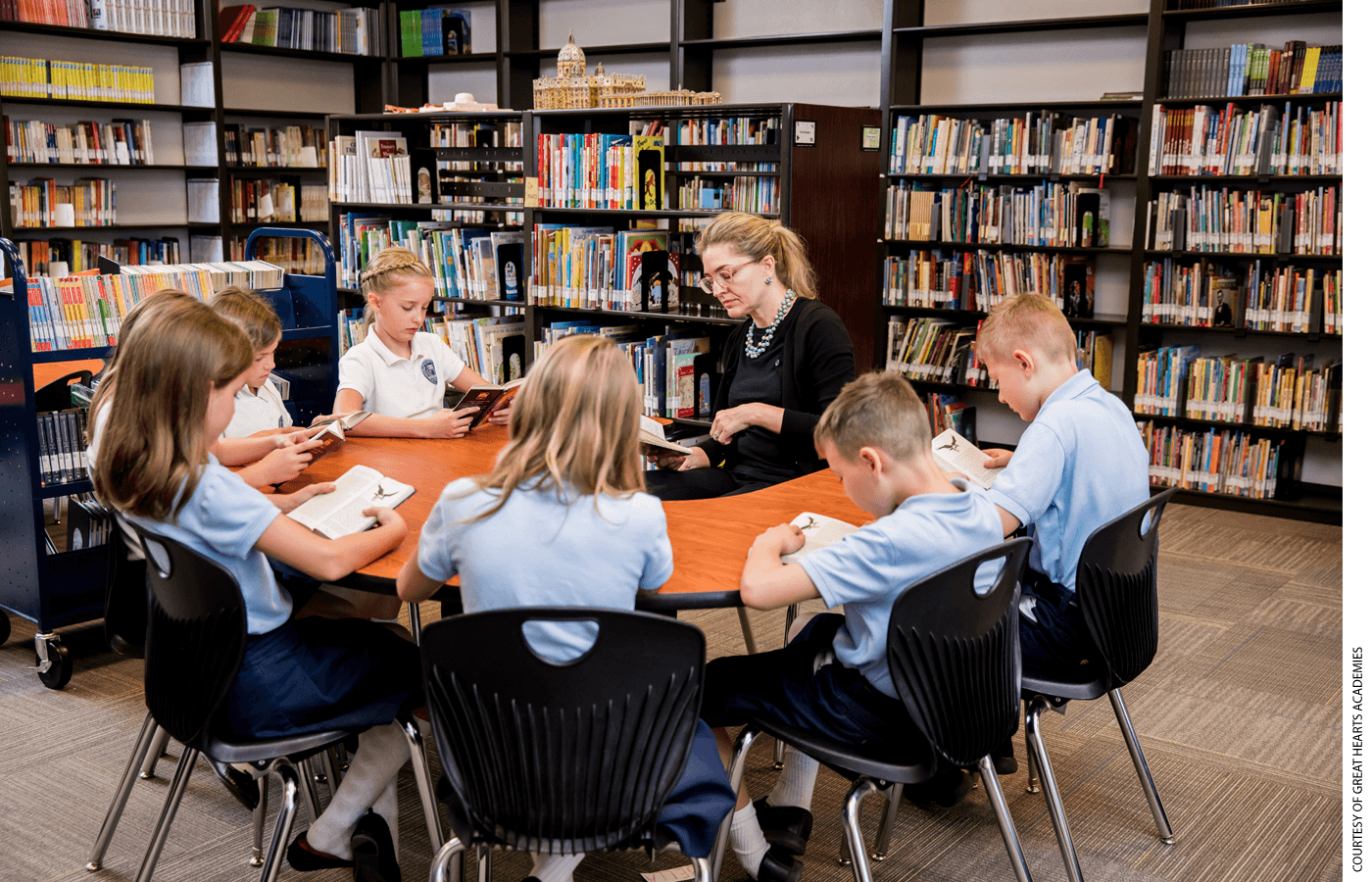
My first job out of college was as a teacher at Great Hearts Academies, the largest classical charter school network in the country. When people asked me what a classical school was, I would usually point to the practices that were most visibly different from your typical district school: the great books curriculum, Latin and Greek classes, school uniforms, seminar discussions, the memorization expected in elementary school (things like state capitols and “Paul Revere’s Ride”), Euclidean geometry, the requirement that all high schoolers perform in a Shakespeare play.
If I wanted to be thorough, I might also mention that it’s one of the fastest growing education models in the nation, with over 1,500 classical schools operating in 2024. About one-third of those schools opened in the last decade.
But my explanations left out an important facet of classical schools: moral education. When you talk to classical education practitioners, this is often the characteristic of their schools they emphasize most passionately. The Great Hearts homepage states it clearly: “We are dedicated to serving families in the moral and intellectual formation of their children” (emphasis added). Indeed, the network’s very name calls to mind “great-hearted Aeneas,” the pious, dutiful hero of Virgil’s Aeneid.
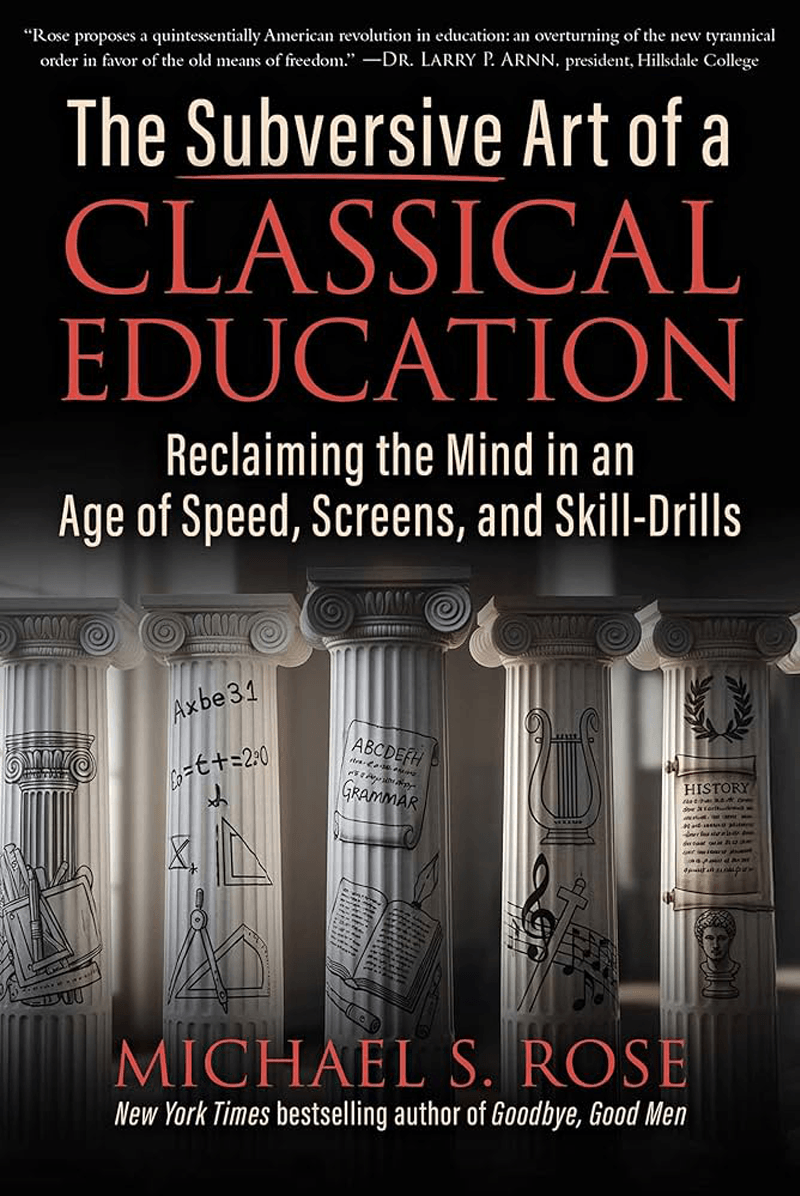
by Michael S. Rose
Regnery, 2026, $32.99, 336 pages
For as much as moral education lies at the center of the classical education model, it may be the most difficult aspect to understand and explain. It’s not enough to say that classical schools care about their students’ character—ask any school in America and they would probably make the same assertion. Indeed, more than 80 percent of public school principals report implementing some version of “social and emotional learning” (SEL), an approach to character building that proponents claim can support academic success but has faced criticism for promoting “therapeutic education,” pathologizing childhood, and potentially harming mental health.
How is the classical approach to moral education distinctive? What sort of morals are classical schools concerned with? Is classical education just SEL from a different point of view?
For answers to those questions, Michael S. Rose’s The Subversive Art of a Classical Education is a terrific resource. Rose, the founding headmaster of Cincinnati Classical Academy, spends over 300 pages making the case for classical education: its subjects, its approach to teaching them, and the philosophy and principles that undergird these practices. At its core, the book is about how classical schools foster virtue in students, and it offers a thoughtful, in-depth exploration of what classical schools mean by moral education.
Subverting What?
Readers will immediately notice the dramatic title. Admittedly, the persistent theme of “subversion” can get a little irksome. Rose’s language is at times overwrought (“the battle for grammar is not merely a skirmish over rules but a campaign for civilization itself”) and even conspiratorial (formal logic has been “deliberately marginalized” to serve “the interests of those who benefit from a populace unable to detect logical fallacies”). Every chapter title follows the same formula: “The Subversive Art of Annotation,” “The Subversive Art of Cursive Handwriting,” and so on. Rose claims he doesn’t wish to “romanticize rebellion,” but the language is certainly there.
Nevertheless, the thesis is compelling: Classical education is “subversive,” Rose argues, because it upends our conventional thinking about the purposes of education. Namely, it challenges the “instrumentalization of learning” and “utilitarian reductionism,” which is “the notion that an activity’s worth can be measured solely by its immediate, practical applications.” In a chapter about poetry, Rose writes:
What is the market value of having Blake’s “Auguries of Innocence” inscribed in memory? What measurable objective is achieved by knowing Frost’s “Stopping by Woods on a Snowy Evening” by heart? These questions miss the point in the same way that asking about the practical utility of love or the market value of friendship misses the point.
In other words, certain practices, like memorizing poetry and studying physics, are good for their own sake. What does that mean? Zena Hitz, a professor at St. John’s College, offers a simple definition: An educational practice is considered good for the effect it has on the learner rather than its external value. The effect Rose has in mind is virtue. When he argues for the importance of learning, say, formal logic or sentence diagramming, he doesn’t claim it’s because they’ll boost scores on reading tests or produce more valuable employees—although both of those outcomes are possible. Instead, he explores how each practice will make students more virtuous people.
Which Virtues?
As Rose explains the practices distinctive to classical schools, he considers how they cultivate an array of intellectual and moral virtues in students. It’s worth examining a few of these virtues in detail to peer inside what he thinks moral formation looks like.
Precision. One way the virtue of precision, closely related to honesty, is fostered at classical schools is through the teaching of grammar, a discipline with precise rules. Rose notes that grammatical structure develops in students “a recognition that words have meanings that cannot be twisted without consequence” and instills “the habit of using language not for manipulation or self-aggrandizement but for the clear expression of truth.” There is a similar precision to formal logic, which teaches students to insist “that arguments be evaluated on their merits rather than their popularity . . . that conclusions follow from premises rather than from preferences.”

Creativity. Rose argues that students become creative artists when they study great works of art, learning their “symbolic vocabulary” and considering “how gesture, drapery, and spatial arrangement communicate meaning.” This engagement with tradition is the key to originality, he says, for “even rebellion needs a thing to rebel against.” He adds, “It is one thing to break the canon and quite another never to have read it.”
Another way to foster creativity is reading and memorizing great works of poetry, oratory, and literature. In Rose’s telling, one’s memory is not just for the storage of information, “as if the mind were merely an inefficient version of a computer.” Rather, a memorized text integrates into “our cognitive and emotional architecture, making it part of the lens through which we perceive and interpret experience.” Hamlet’s Act III soliloquy or King’s Letter from a Birmingham Jail become “thoughts to think with,” gifting students “an invisible company of the wise, the eloquent, the profound.”
Perception. The perceptive student senses the “hidden order” in language, argumentation, and the natural world. Geometry “cultivates perception of proportion, symmetry, and elegance.” Sentence diagramming has the same effect but for language and literature. Quoting the first line of Poe’s “The Fall of the House of Usher,” he points out that:
The diagram of such a sentence becomes a veritable haunted house of grammar, with corridors that twist and turn, rooms that open unexpectedly into other rooms . . . The completed diagram would resemble the House of Usher itself—complex, foreboding, yet possessed of a strange and terrible beauty, where every part connects according to inviolable laws.
Rose suggests that through disciplines like geometry and sentence diagramming, students develop a new sort of vision, “rendering visible aspects of experience that might otherwise remain unnoticed or unarticulated.”
From this survey of virtues, you get a sense of the type of student that classical education is trying to form: one who speaks carefully and listens attentively; whose creativity is thoughtful and deliberate rather than chaotic and self-absorbed; and who senses the order and complexity of the world and marvels at its beauty.
Taking Moral Education Seriously
To return to the initial question, how is classical education different from SEL or other fashionable forms of character education, like “21st century skills”?
First, the classical approach to moral education cultivates virtue through academic content: grammar, geometry, art, and so on. This is distinct from programs that attempt to teach character in isolation, such as in a PowerPoint about integrity or participating in a feelings circle. The practice of using content as a gateway to virtue reflects classical education’s deep respect for teachers, who are considered content experts, not therapists.
EdNext in your inbox
Sign up for the EdNext Weekly newsletter, and stay up to date with the Daily Digest, delivered straight to your inbox.
Classical education also recognizes moral complexity and the nuances of human nature. (As Hamlet put it, “What a piece of work is a man!”) Rose skewers forms of character education that imagine “that goodness can be downloaded like firmware into the juvenile mind . . . as if the human soul were a motherboard awaiting the right update.” He elaborates:
Moral development, in this LED dream, is reduced to a system: measurable, efficient, noninvasive. No need for saints or heroes, no need to watch your father fail nobly or your mother forgive undeservedly. Just tick the rubric and proceed. And somewhere in this machinery of good intentions, the shape of moral reality—its jaggedness, its beauty, its tragic proportions—is flattened into something safe.
On the contrary, Rose argues the best way to cultivate moral understanding in children is through narrative, particularly literature. This does not mean classical schools reduce literature to moralistic fables, telling students to be “brave” like Odysseus or “compassionate” like Alyosha Karamazov. Rather, stories are uniquely suited for depicting “the integration of cognition, emotion, imagination, and will” that shapes moral decision-making. It is the same argument made by Leo Tolstoy—“The aim of an artist is not to solve a problem irrefutably, but to make people love life in all its countless inexhaustible manifestations”—and Flannery O’Connor— “You tell a story because a statement would be inadequate.”
The ultimate goal of classical education—the sum total of the subjects it teaches and the virtues they cultivate—is wisdom, which Rose defines as the capacity “to judge rightly, to discern what is true, good, and beautiful—and to live accordingly.” Through engagement with great ideas, discoveries, and art, students learn to parse complexity, internalize higher standards of thinking, and discern “between the trivial and the profound.” This is what Plato meant when he said that the purpose of education is “to teach us to love what is beautiful”: The recognition of truth and goodness in the arts and sciences eventually becomes the wisdom that governs our daily lives.
Compared with SEL, then, classical education is both more grounded in academic content and more ambitious in moral aims.
Now, Rose’s book has its flaws. Despite his extensive background as a teacher and school leader, I was disappointed to find not a single classroom anecdote. It’s a missed opportunity that deprives readers from learning about Rose’s experience as a classical school founder. Instead, the chapters sometimes get bogged down in abstraction, while his descriptions of classical schools can come across as idealized, such as his claim that classical students “spend hours alone with mathematical proofs, working through logical steps without peer collaboration or instructor intervention.” As a school principal, Rose is undoubtedly aware of the challenges classical schools face, like time constraints and a limited teacher pipeline. A clearer distinction between the ideal vision of classical education and the messy reality of everyday classroom practice would have boosted the credibility of his narrative.
Nevertheless, The Subversive Art of a Classical Education is a worthy primer for those curious about the classical education movement—and what it means to take moral education seriously.
Annika Hernandez is an education policy researcher in Washington, D.C., and a former English teacher at Chandler Preparatory Academy, a Great Hearts charter school.
Suggested citation format:
Hernadez, A. (2026). “Claiming the Moral High Ground for Character Education: New book offers primer on the cultivation of virtue at classical schools.” Education Next, 26(2), 25 June 2026.