


The Free Application for Federal Student Aid, or FAFSA, is the main form that prospective college students use to qualify for federal grants, loans, and work-study assistance, as well as aid from many states and colleges. Roughly 17 million students and family members use the FAFSA system each year, and at least 6 million students use it as the gateway to paying for college. It’s one of the most important pieces of the college-opportunity machinery in the country.
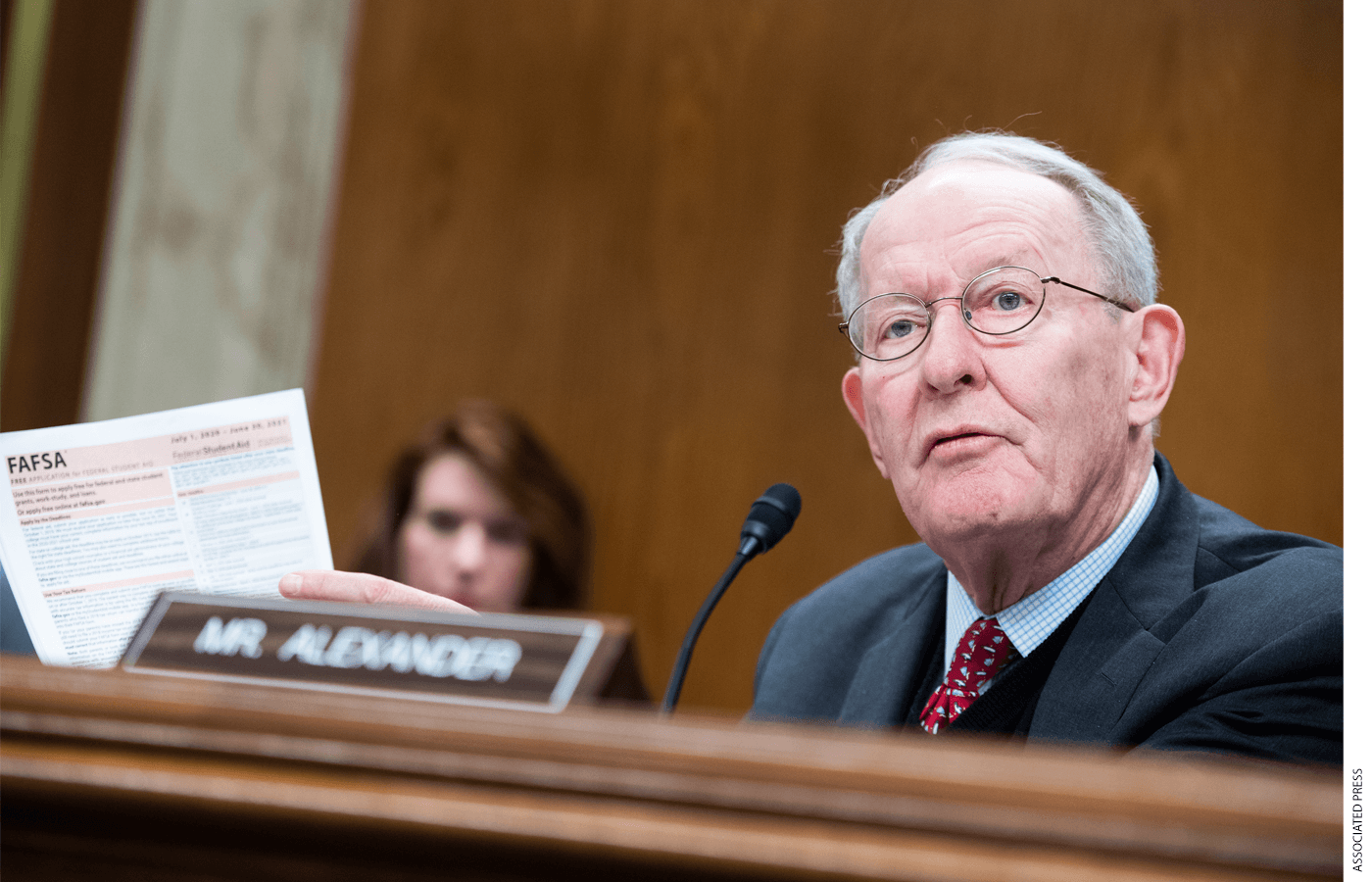
Over the years, however, FAFSA had grown far too complex and confusing, making it challenging for kids and their parents to navigate. Former Republican Senator Lamar Alexander of Tennessee—who also served two terms as governor of Tennessee and was U.S. secretary of education in 1992 when Congress created the form—was keenly aware of the problem and made FAFSA simplification one of his signature causes.
Alexander had a showman’s way of making the point. As chairman of the Senate Health, Education, Labor, and Pensions Committee, he memorably used a giant paper copy of the FAFSA form, about seven feet long connected end-to-end, to dramatize how absurd the application had become. The prop was memorable and the point was obvious. The federal government claimed it wanted to help students get to college but required them to complete a form so long and complex it could intimidate the families most in need of that help.
Why, Alexander asked, should families have to dig through tax forms and manually re-enter information the federal government already had? Why should a student’s path to a Pell Grant and college aid run through a dense, confusing form that discouraged the very students who most often needed financial assistance?
In 2019, Alexander and Democratic Senator Doug Jones of Alabama introduced bipartisan legislation to simplify FAFSA, cut the number of questions from 108 to roughly 18, reduce verification obstacles, and make it easier for students to estimate their aid. Alexander saw the effort as part of his legislative legacy before retiring from the Senate in 2020.
Congress ultimately enacted FAFSA simplification as part of the Consolidated Appropriations Act of 2021, signed by President Donald Trump on December 27, 2020. The reform was rolled out in phases. The biggest changes took effect for students applying to college for the 2024–25 academic year.
Then disaster struck. The Department of Education made a fiasco of implementing the changes.
When its redesigned web form went live, the system crashed. The launch was delayed until December 30, 2023—months later than the usual October opening. Students whose parents lacked Social Security numbers were blocked from submitting the form for months. Colleges didn’t get records when they needed them.
Hundreds of thousands of applications had to be reprocessed due to calculation errors. Roughly 74 percent of calls to the federal student aid call center went unanswered during the first five months of the rollout. The Government Accountability Office later found that the department failed to oversee vendors adequately, follow its own procedures, and communicate clearly with students and colleges. An Education Week headline called the episode a “debacle.” Senator Alexander himself called it “a big mess.”
This was more than a technical glitch. It was a collapse of government assistance with human consequences. Students couldn’t compare aid offers on time. Families delayed enrollment decisions. Colleges lost confidence in the awards calendar. Community-based organizations and school counselors who help students complete the form were left trying to explain a system they didn’t understand because the government itself wasn’t communicating clearly. Simplification of FAFSA was intended to remove the biggest obstacles to college-going, but the rollout of the revamped process created all new ones.
At that point, the goal shifted from defending the redesign in theory to stabilizing it in practice. In June 2024, the department brought in Jeremy Singer, the president of the College Board, as FAFSA executive advisor for the 2025–26 cycle. It also strengthened its leadership team, expanded call-center capacity, and began carefully testing the following year’s form. Between June and August 2024, the department held 46 listening sessions with 293 organizations. While those steps didn’t erase the earlier failure, they were the beginning of a serious recovery effort that included stronger management, better communication, more testing, and more outside feedback.
One of the most useful and colorful accounts of what went wrong came later from Singer himself. He described FAFSA as the biggest software project the department had ever attempted, but one that lacked the kind of technical leadership, vendor management, and operational discipline such a project required. His summative quip was memorable because it was so blunt. “Two moms can’t produce a baby in four and a half months.” Washington had the right idea but not a delivery system that could produce it.
These intense and ultimately successful repair efforts show that the department understood the gravity of the mess it had made. They also show that the underlying reform was sound. The 2026–27 form was released on September 24, 2025, the earliest launch in history, and by the end of October more than 96 percent of users reported being satisfied or highly satisfied with it. The U.S. Department of Education announced in March 2026 that more than 10 million forms had already been completed and processed.
The system is also getting smarter. The department announced in April that FAFSA would begin real-time identity screening to catch suspicious applications as they’re submitted. The new process will use fraud-risk screening to flag or stop suspect applications so that institutions don’t have to sort through them later. The ED has also said it has prevented more than $1 billion in federal student-aid fraud since January 2025. None of this may thrill the average family the way a Pell Grant does. But it’s what competent administration looks like, including forms that move faster for legitimate applicants and trigger more scrutiny for fake ones.
EdNext in your inbox
Sign up for the EdNext Weekly newsletter, and stay up to date with the Daily Digest, delivered straight to your inbox.
Few would have guessed in early 2024 that any of this would happen. The redesigned FAFSA fiasco turned one of the most sensible bipartisan postsecondary education reforms in years into a national failure. But that’s why the story is worth telling. It’s no longer only about how FAFSA reform broke down. It’s about how a disastrous roll-out was answered with competent recovery, and how Alexander’s dream of a shorter, simpler, more effective aid form eventually became a reality.
In other words, Congress got the diagnosis right. Complexity isn’t neutral. A long, confusing aid form doesn’t burden every family equally. It falls hardest on those with the least room for error—low-income parents, first-generation college-going students, families with limited English proficiency, and people who don’t have a college counselor or accountant on call. For them, administrative friction isn’t a minor inconvenience. It’s a reason to give up. That was the heart of Alexander’s argument, and it was correct.
The executive branch, by contrast, got implementation badly wrong at first. It treated execution like an afterthought. But eventually it did something worth noticing: It corrected course. It added leadership, testing, feedback loops, capacity, and a more realistic understanding of what it would take to make the system work. That’s not a glamorous story, and it certainly doesn’t grab headlines the way failure does. But it’s often how government improves—not in one clean triumph, but through scrutiny, adjustment, and a second effort managed better than the first.
The same redesign rollout that once made FAFSA a punchline is beginning to look like an example that some reform dreams aren’t impossible after all—especially when they’re the brainchild of a seasoned education leader and politician like Lamar Alexander. It was simply much harder to execute than imagined.
The lessons are plain.
1. Good reform can be undone by bad execution. Washington often behaves as though passing a bill is the hard part, and implementation is just cleanup. FAFSA reform showed the opposite. For the public, policy is not about Congress’s good intentions. It’s a working website, a deadline that holds, and an aid package that arrives on time.
2. Simplification especially matters for low-income and first-generation college applicants. What is mere paperwork to an agency is like a wall to a family with little room for confusion or delay. Administrative simplification isn’t cosmetic. It’s substantive.
3. The government needs stronger technical capacity, not just good intentions. The FAFSA fiasco wasn’t a fight over goals. It was a failure of software development, project management, communication, and accountability. Modern government can’t do modern work without those capacities.
4. Bipartisan policymaking still matters when it addresses a real barrier. FAFSA simplification was badly botched in rollout, but its central premise was sound. And the evidence suggests it’s helping more students get aid through a shorter, simpler process. In an era when bipartisan achievement is scarce, that’s worth saying plainly.
* * *
In retrospect, the FAFSA saga isn’t a warning against reform. It’s a warning against confusing reform with delivery. Congress got the diagnosis of the problem right, and the executive branch got implementation wrong. The happy ending is that the law now appears able to prove its value—and cement the legacy of a former senator who deserves much of the credit.
Bruno V. Manno is a senior advisor at the Progressive Policy Institute and is a former U.S. Assistant Secretary of Education for Policy.