



It would be fair to say that Will, a recent graduate from a rural high school in the Midwest, has school-to-work to thank for his current employment. However, Will himself describes his experience in the program as “complicated.”
It is an apt description for many high school students who participate in school-to-work (STW), structured learning experiences that incorporate academic education with practical, on-site job training. Although students are given an opportunity to learn specific skills in an industry, earn compensation during typical school hours, establish working relationships with employers, and secure future employment, one critically overlooked and understudied aspect of STW is the degree to which it limits students’ mobility.
That was Will’s experience. At his school, he had difficulty exploring alternative career prospects since the program was designed to bind students to one job for five hours every school day for one academic year.
“I was stuck to one path because, with the way it was set up, they didn’t want me to switch jobs or explore other industries,” he explained. Will thinks it’s possible for STW to give students more flexibility but said it all depends on “how a school goes about [designing] it.”
There is relatively little data currently collected about STW outcomes, and schools are often relied on to manage their own programs. It is worthwhile to look more closely at STW programs for considerations of efficacy, mobility, and returns on investment; evaluate their benefits and limitations; and propose areas of further research and policies to improve its implementation.
Why School-to-Work Programs Matter in Rural Communities
STW is a form of career and technical education (CTE), a broad category of schooling that combines classroom instruction and workplace mentorship in a process known as work-based learning (WBL). Particularly in rural communities, STW programs have become central for preparing students for the labor market.
STW is already quite widespread. In the last national longitudinal data collection, occurring in 1997, around two-fifths of students reported participating in an STW program. Updated metrics are expected in 2027, and there is likely to be even higher participation that coincides with the increase of CTE and STW program credibility.
For rural districts that face limited economic opportunities and shrinking populations, STW helps connect students directly to local jobs in fields with persistent labor shortages—such as healthcare, construction, and legal management—while simultaneously removing barriers related to access and costs of postsecondary education.
Yet, while STW programs strengthen both education and local economies, their rapid expansion presents a predicament in rural areas. When students align their career training too closely with local employers, their long-term mobility pathways may decrease, especially when credentials are not portable beyond a particular region. That makes it essential to evaluate whether the current way STW programs are structured expand opportunities or anchor students to the confines of local economies.
Rural schools often function as economic anchors within their communities. In places where employment options are limited and local economies heavily rely on a small number of industries, schools can prepare and stabilize the future workforce. As schools encourage this narrative of reliance, students may be guided toward specific paths for their futures. One study found that students’ postsecondary residential aspirations were shaped more by the employment opportunities demonstrated in the local economy than by the socioeconomic level of their schools or by the advice they received from educators. So, when schools highlight viable career opportunities within the community, students may feel more confident building a life locally.
This dynamic is particularly relevant in rural regions that face persistent “brain drain,” where talented graduates migrate away from their communities in search of better opportunities. STW programs can therefore contribute to both preparation for employment and identity formation as it relates to place attachment, which in turn invites students to shape their futures around their home communities.
Beyond these broad socioeconomic effects, STW programs provide several educational benefits. Many STW opportunities show evidence for increased student engagement and motivation, while other research suggests high-quality CTE can increase graduation rates by 7 to 10 percent, (with the caveat that certain tracks may decrease graduation rates). More research is needed to understand the exact programs that contribute to each trend and where STW stands among them. But it is clear that STW students who graduate often have a direct path into the workforce, offering them immediate full-time employment.
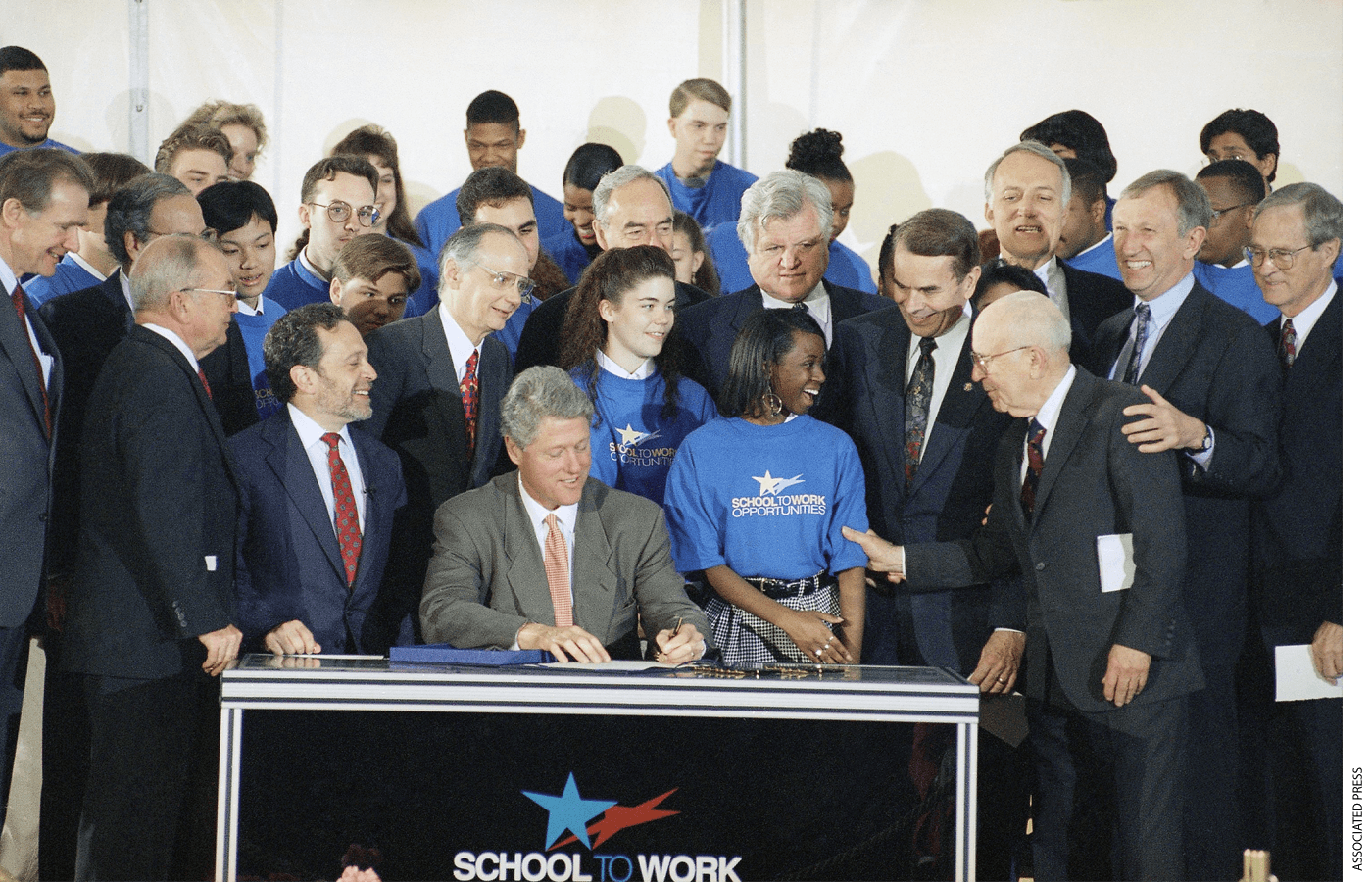
Recognizing these benefits as well as the consistent labor shortages among younger generations, policymakers have increasingly supported STW programs. Beginning with the School-To-Work Opportunities Act of 1994, STW programs have garnered some federal support over the last few decades, but often final policy decisions around funding and design fall back on the state. Since 2023, 34 states and Washington, D.C., have enacted 80 laws dedicated to WBL. As of 2026, federal involvement remains relatively limited, primarily operating through two channels: the Workforce Innovation and Opportunity Act of 2014 Youth Program, which assists youth facing barriers to employment, and Perkins V, which more broadly targets WBL and CTE.
Structural Constraints and Mobility Tradeoff
Despite these advantages, rural STW programs face structural economic constraints that limit how effective they can be in expanding students’ long-term opportunities. Rural labor markets are typically smaller and less diverse than those in urban areas, so communities often have fewer major employers, lower average wages, and limited occupational mobility. In turn, educational pathways involving local employers might mirror the existing structure of the regional economy. And while the STW collaborations may provide valuable training opportunities and the alignment with the economy may help address local labor shortages, the premise may limit exposure to a broader range of careers, making students like Will feel trapped on their path.
After a series of unsuccessful attempts to formally change employers through his STW program, Will secretly quit his original job in the restaurant industry and began a new one working as a heavy machinery operator with an hour-long commute each way. Since his school lacked thorough check-ins, he was able to get by without repercussions—even though proper protocols would typically mean a student would be obligated to finish the term of the program.
But Will’s friend Tim, who participated in STW as a diesel mechanic, wasn’t so lucky. “I don’t think he could ever leave [our town]. He screwed himself over because that experience definitely anchored him to the area. His skills are tied into that one job, and his obligation is forever with that company.”
These dynamics illustrate the mobility tradeoff within some rural STW systems and an important distinction in kind: employer-specific training versus portable credentials.
Employer-specific training prepares students to work with the particular technologies and processes used by a single employer. While this type of training often leads to direct employment following graduation, its value may be limited or even nonexistent outside the immediate region. Portable credentials, on the other hand, are industry-recognized certifications that host constant value regardless of location. Because the credentials are widely recognized, they allow students to explore alternate geographical regions and thus have access to greater long-term career mobility.
EdNext in your inbox
Sign up for the EdNext Weekly newsletter, and stay up to date with the Daily Digest, delivered straight to your inbox.
When rural STW programs focus primarily on employer-specific pathways, they tend to contribute to geographic anchoring effects. Students transitioning directly from high school to local employment often become more economically and socially tied to the region, making relocation or career changes more difficult later on. In fact, twenty percent of students transitioning into the workforce upon graduation plan to continue a job they worked during high school, and seventy-seven percent expect their commute to be less than thirty minutes.
Coupled with the localized skillset is young workers’ sense of commitment to the people and businesses they’ve known for years. Paul, who had experience in a farming STW program, articulates this tension. “My employer really needs me. I don’t know if I should quit or stay around for a few more weeks . . . but I’ve been saying that for months,” he says. “I don’t want to continue this job, but I’m the only employee trained for this specific position.” In rural areas, identity and obligation have a great influence on many recent graduates.
Another risk of highly localized STW pathways is their vulnerability to broader economic shocks. If a major employer in a rural area downsizes or closes, workers who were trained in highly specialized, firm-specific systems may find themselves unemployed and holding skills that do not transfer well to other industries or regions. Even geographic mobility may not provide a clear path forward if comparable job opportunities do not exist elsewhere or require vastly different credentials.
These constraints and tradeoffs show that STW program design would better serve students if it prioritized equipping participants with broadly applicable skills that can prepare them for potential long-term economic instability rather than constrict them only into short-term, immediate employability.
Policy Design and Expanding Opportunity
The challenges of STW programs do not diminish their value. Rather, they highlight the importance of program design and the changes that could benefit high school students.
Policymakers can help ensure that rural career pathways expand opportunities rather than restrict them by placing emphasis on portable, industry-recognized credentials that remain valuable across regions. States and districts might also consider developing state or regional apprenticeship networks to allow students easier mobility among employers and industries rather than relying on a single local partner. Federal efforts have already begun moving in this direction. The U.S. Department of Labor has invested in nationwide apprenticeship initiatives designed to expand access to structured WBL programs to connect employers, schools, students, and training providers across geographical regions.
Finally, STW programs should consider standardizing under one name and a set of defined requirements. With additional versions of STW, such as Youth Apprenticeship and many small programs individualized to each school, accurate data collection and analysis is nearly impossible. STW and WBL systems could be strengthened by prioritizing large-scale, high-quality collection of data and tracking long-term outcomes. This includes, but is not limited to, statistics surrounding wage progression, employment stability, and geographic mobility. This information could offer a better understanding of whether programs are expanding or limiting students’ employment and economic opportunities, if they are simply responding to short-term needs, and the extent to which identity formation contributes to students’ geographic mobility.
Rural students like Will and Paul might benefit from increased transparency, more flexibility, and a changed narrative about geographic anchoring. When they originally signed up for STW programs, they were excited to begin their careers early but soon discovered the challenges, restrictions, and pressures of working in their communities—economic and social. Ultimately, they feel their experiences in STW could lessen the learning curve in future jobs if they eventually decide to leave, as long as future programs commit to prioritizing what students want and need.
Natalie Coon is a junior at Harvard College concentrating in government and psychology.